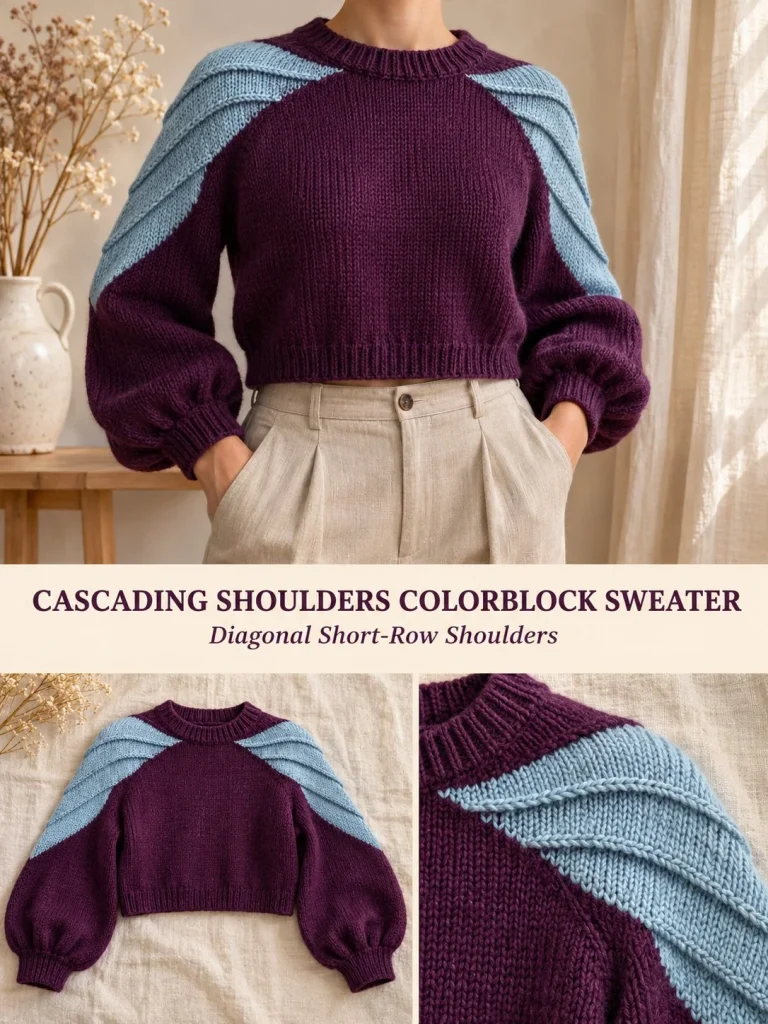
The cropped sweater featured in this pattern brings a modern twist to classic knitwear with its striking diagonal colorblock design. Crafted with smooth, soft yarns in contrasting shades of Eggplant and Robin’s Egg Blue, this piece emphasizes architectural shaping and bold visual lines. The use of short rows to sculpt the cascading shoulder decreases creates a unique silhouette, deviating from traditional drop-shoulder raglan constructions and offering a fresh, dynamic shape around the shoulders and upper arms.
This garment’s design uniquely integrates colorful diagonal bands without simply attaching extra stitches for sleeves, resulting in a bold statement piece combining both form and function. The cropped length and voluminous, puffed sleeves near their ends add charming retro flair, balancing the modern geometric shapes with softness and wearability. Knitting enthusiasts will appreciate the blend of innovative shaping techniques and eye-catching colorwork that make this a rewarding yet approachable project. It’s an excellent choice for those eager to deepen their skills while producing a fashionable garment that stands out in any wardrobe.
Pattern at a Glance
Skill level: Intermediate knitters with experience in short rows and color changing
Terminology: US knitting terminology
Construction: Top-down, starting at the neckline with short-row shoulder shaping; tubular body and sleeves finished by mattress stitch seaming
Finished size: Bust approximately 37–67.5 inches (size XS through 5X), length approximately 18.5–20.5 inches
Yarn weight: DK (Double Knit)
Needles: US 8 / 5 mm circular needles, 16-inch and 24–40-inch lengths
Main stitch: Stockinette stitch with short rows for shaping
Gauge: Determined by yarn and needle; measure to ensure proper fit, particularly important for garment pieces
Color layout: Bold diagonal colorblocking in Eggplant (main) and Robin’s Egg Blue (contrast)
Joining: Mattress stitch underarms and side seams
Finish: Cropped hems with full, puffed sleeve cuffs
Materials
To knit this sweater, you will need:
- Yarn: Kelbourne Woolens Cozy DK, composed of 70% superwash merino and 30% alpaca. These fibers lend softness, warmth, and durability to the finished garment. The project requires:
- Main Color Eggplant: between 3 and 8 skeins depending on size
- Contrast Robin’s Egg Blue: between 1 and 4 skeins depending on size
Each skein contains about 201 yards per 100 grams, ensuring sufficient yarn for the cropped pullover with color blocking.
- Needles: US size 8 (5 mm) circular needles in two lengths: a 16-inch circular for tighter areas like the neckline and a longer 24- to 40-inch circular for working larger sections in the round or flat. Circular needles are preferred as they facilitate working short rows and increase flexibility while knitting.
- Notions: Stitch markers for delineating sections and stitch counts, stitch holders for temporarily placing live stitches, and a tapestry needle for finishing, weaving in ends, and mattress stitch seaming.
The fiber composition of the yarn lends itself well to the defined texture and smooth color transitions essential for the diagonal colorblocking effect. The balance of superwash merino and alpaca provides both easy care and cozy softness.
Yarn and Color Notes
When selecting yarns for this design, the fiber blend plays a crucial role. The superwash merino makes the sweater machine washable and keeps the fabric resilient over multiple wears, while the alpaca adds loft and warmth without weight. Using a DK-weight yarn ensures that the sweater will have enough drape to follow the body’s shape without appearing bulky.
The Eggplant and Robin’s Egg Blue colors form striking complementary blocks. Choosing smooth, plied yarn helps the dramatic color changes pop and enhances the visibility of the sharply defined diagonal lines formed by the cascading shoulder decreases. Avoid fuzzy or high-pile yarns which can obscure stitch definition and complicate short row shaping.
For knitters wishing to explore other color palettes, consider analogous color combinations or pair a neutral tone with a bright contrast. Fading one color gradually into another is not recommended here, as the pattern’s impact depends on crisp, bold color transitions. Suggested color substitutions should maintain a similar tonal contrast to preserve the visual architectural effect.
Finished Measurements
The piece is designed to fit a variety of body sizes with bust measurements approximately ranging from 37 inches to 67.5 inches, accommodating sizes XS through 5X. The cropped length measures about 18.5 to 20.5 inches from shoulder to hem, striking a modern, flattering silhouette.
The sleeves are purposefully shaped to be full or puffed near their lower ends, enhancing the garment’s stylish, contemporary vibe. This puffiness offers comfortable sleeve volume without altering fit at the armholes significantly. The upper arms feature bold diagonal shaping rather than the typical drop-shoulder line, giving the sweater a distinctly modern look.
Because fit and length are integral to this garment’s style, checking measurements as you go is important. You may adjust the finished length within a small margin but extending the body or sleeves too much risks losing the cropped, balanced proportions that define this design.
Gauge
Maintaining gauge is especially important for garments that rely on precise shaping and colorblocking like this one. Use the yarn and needles as specified (Kelbourne Woolens Cozy DK, US 8 / 5 mm needles) and knit swatches to confirm your personal gauge matches the original throughout both colors.
While the exact stitch counts and row numbers are not listed explicitly in the source, consistent gauge ensures that the size fits well and the diagonal colorblocks align cleanly. Check gauge by measuring the swatch over stockinette stitch after blocking, focusing on stitch width and row height.
If your gauge is tighter (smaller stitches), the finished garment will be smaller and possibly shorter. If your gauge is looser, it may be larger but risk distorting the dynamic diagonal shaping. Adjust needle size accordingly to meet the recommended gauge for best results.
Abbreviations
- MC: Main Color (Eggplant)
- CC: Contrast Color (Robin’s Egg Blue)
- K: Knit
- P: Purl
- St(s): Stitch(es)
- RS: Right Side
- WS: Wrong Side
- cyc: Circular needle
- m1: Make one (increase)
- ssk: Slip, slip, knit (left-leaning decrease)
- k2tog: Knit two together (right-leaning decrease)
- yo: Yarn over
- short row: Rows partially knitted before turning, used to shape curves or slopes
Important Pattern Notes
This sweater is designed to be knit from the top down, beginning at the neckline with short rows shaping the right and left shoulders:
- Short rows are critical for creating the cascading shoulder decreases that define the diagonal architectural details. These short rows use partial stitches and wrap-and-turns to sculpt silhouette without adding traditional sleeve stitches.
- Yarn color changes happen strategically to create bold Eggplant and Robin’s Egg Blue diagonal blocks. Maintaining tidy color transitions and managing floats at color changes helps achieve a clean look.
- Stitch markers and holders are used to organize sections such as shoulders and sleeves where stitches are held or pick up later.
- The construction avoids a conventional drop-shoulder raglan style; instead, it sculpts the shoulders and upper arms with cascading decreases that result in visually distinct diagonal patterns.
- Seam finishing employs mattress stitch along the underarms and side body seams for a smooth, almost invisible join.
The pattern demands close attention to both shaping and color placement to capture the striking diagonal colorblock effect.
Special Stitches and Techniques
Short Rows
Short rows are the heart of the shaping technique here, used to build the cascading shoulders by knitting partial rows turning mid-row, creating slopes and reducing stitch counts on one side at a time. Short rows involve:
- Knitting to a designated turning point
- Wrapping the next stitch to prevent holes
- Turning the work before completing the full row
- Later picking up wraps or working around them for smooth shaping
Mattress Stitch Seaming
This classic seaming technique joins live or bound-off edges invisibly, aligning stitch edges neatly. It creates a flat, durable seam perfect for garment side seams and underarms where comfort and aesthetics are essential.
Colorwork Transitions
The pattern relies on crisp and clean color changes between Eggplant and Robin’s Egg Blue. Carry yarn carefully along the wrong side or use bobbins to avoid bulky joins or tangling.
Understanding the Construction
Instead of a typical drop-shoulder raglan where sleeve stitches are picked up along the armhole, this sweater sculpts its sleeves through cascading shoulder decreases:
- The knit starts at the neckline, casting on all body and sleeve stitches simultaneously.
- Short rows shape the right and left shoulders individually, producing an angled slope that forms the diagonal blocks across the upper chest and arms.
- The cascades create a visual “shoulder” that extends in diagonal lines down the arms without adding extra sleeve stitches immediately.
- After shaping the shoulders, the body is worked downward separately, while sleeves are formed and allowed their puffed shape near cuffs.
- Finally, seams under the arms and down the sides are joined with mattress stitch to complete the silhouette.
This design provides bold geometric architecture while maintaining softness and fit, diverging from standard sweater shaping.
Complete Pattern Instructions
Foundation and Neckline
Cast on the total number of stitches encompassing the neckline, shoulders, upper chest, and sleeves in the main color, Eggplant. Begin knitting in the round or back-and-forth on circular needles sized US 8 / 5 mm.
Right and Left Shoulder Short Rows
- Shape the right shoulder first by knitting to a designated stitch count, then work short rows with wrapped turns to decrease the number of active stitches gradually.
- Repeat for the left shoulder symmetrically.
- These short rows form the prominent diagonal decreases that give the sweater its cascading shoulders and diagonal colorblock effect.
Colorblock Changes
Intersperse contrast color Robin’s Egg Blue in strategic blocks during short rows and body knitting to build bold diagonal bands aligned with the shoulder shaping.
Body Formation
After shoulder shaping, continue knitting the torso downward, maintaining the colorblock layout. The body remains cropped with a finished length approximately 18.5 to 20.5 inches.
Sleeve Shaping
Sleeves obtain their full, puffed lower shape by gradually increasing and shaping with the main color and contrast stripes, according to the original instructions. Avoid treating sleeves as traditional drop-shoulder raglan by following short-row shaping cues.
Seaming and Assembly
Once all parts are knit, sew together the underarm and side seams using mattress stitch. This seaming method ensures clean, flat joins that preserve the diagonal architecture visually and structurally.
Checkpoints
- After completing shoulder short rows, the diagonal shaping should be clearly visible across upper arms.
- The sweater body should measure roughly between 18.5 and 20.5 inches in length at this stage.
- Sleeves should exhibit a full, puffed appearance near the wrists once shaping is complete.
- Seams should lay flat after mattress stitch joining and before blocking.
Assembly and Joining
Lay the sweater flat with right sides facing. Using a tapestry needle and matching yarn, carefully mattress stitch the underarm edges of sleeves to the sides of the body:
- Align edges carefully to avoid puckering or stretching.
- Maintain consistent tension so seams are secure but not tight.
- Focus on neatness along the underarm where movement occurs.
- Close side seams from underarm to hem equally on both sides.
This method preserves the crisp, angled lines achieved by the short-row shoulders while maintaining comfort.
Finishing
Weave in all yarn ends securely on the wrong side. Block the sweater gently to relax stitches and even out shapes:
- Use steam blocking or wet blocking based on yarn content and preference.
- Pin the sweater to dimensions matching the finished measurements to preserve the diagonal shaping.
- Avoid over-stretching to maintain the cropped shape and puffed sleeves’ volume.
How to Resize
To resize:
- Refer to the bust size range between approx 37 to 67.5 inches as prescribed; adjusting beyond that requires proportional increases in cast-on stitches and short row shaping points.
- Increasing bust size means using more skeins of yarn and picking the upper end of skein quantity (up to 8 for main color, 4 for contrast).
- Length adjustments should be made cautiously; extending length significantly will modify the cropped, modern silhouette.
- For sleeve volume change, adjust shaping technique proportionally but beware this may alter the visual diagonal architecture.
Precise resizing may require detailed modification of the color blocks’ geometry and short row calculations as dictated by the pattern’s designer.
Useful Variations
- For a subtler look, knit the entire sweater in a single color, preserving the short-row shaping for texture rather than color contrast.
- Substitute analogous or neutral colors to create a less bold diagonal effect while keeping the architectural shoulder shape intact.
- Explore additional ribbing or cuffs on sleeves for a different finish or added warmth.
- Adapt the puffed sleeve shape for a slimmer fitted sleeve by reducing increases near the lower ends.
These variations maintain the core construction while tailoring the visual appeal.
Troubleshooting
Why Are My Short Rows Creating Holes?
Ensure you are properly wrapping the stitches during short rows. Wrap-and-turn technique closes holes by securing the stitch before turning. Missing wraps often cause gaps in fabric.
Why Does the Diagonal Colorblock Look Misaligned?
Check that you switch colors at the pattern-stipulated rows or points. Maintaining accurate stitch and row counts during short-row shaping is essential for proper diagonal lines.
Why Is My Sleeve Not Puffy As Expected?
Review the shaping instructions; puffiness comes from careful increases and color blocking near the cuffs. Make sure you aren’t skipping any increases or shaping rows.
Why Are My Seams Bulky or Noticeable?
Use mattress stitch carefully, aligning stitches precisely and maintaining even tension. Avoid pulling too tightly, which puckers the fabric.
Why Is the Hem Too Long or Short?
Measure frequently against the suggested finished length and adjust rows accordingly during body formation to maintain the cropped effect.
Frequently Asked Questions
Can I use a different yarn weight?
This pattern is designed for DK-weight yarn. Using a heavier or lighter yarn will require adjusting needle size and stitch counts to maintain fit and diagonal shaping.
Can I knit this sweater bottom-up instead of top-down?
The diagonal shoulder shaping depends on starting at the neckline with short rows. Bottom-up construction would require an entirely different pattern and shaping methodology.
Is this suitable for beginners?
Intermediate knitters with experience in short rows and color changes will find this project rewarding. Beginners might need practice with shaping techniques beforehand.
Can I modify the sleeve shape?
Minor adjustments in sleeve volume can be made by altering increases near the lower sleeve, but be cautious as major changes will affect the garment’s distinctive look.
How should I block the finished sweater?
Gentle wet or steam blocking pinned to measurements will allow the fabric to relax and the diagonal lines to set cleanly.
Are the diagonal color blocks symmetrical?
Yes, the design precisely controls color position and shaping to create balanced, mirrored diagonals across both shoulders and upper arms in all sizes.
Can this pattern be knit in the round?
While some sections use circular needles, shaping and color blocks require short rows that are often worked flat. Always follow the pattern’s instructions for shaping.
Optional Related Uses
The short row colorblock technique shown here can inspire related garments and accessories:
- A cowl featuring diagonal colorblocks built with short rows, as seen in this excellent diagonal basket weave cowl knitting pattern.
- Cropped sweaters or cardigans with similar shoulder shaping for a fashionable, modern silhouette.
- Scarves or wraps utilizing bold contrasting diagonal color blocks and textured shaping reminiscent of this sweater’s architecture; explore the related cable sweater scarf knitting pattern for intricate stitch pattern inspiration.
These projects help knitters expand their mastery of shaping and color techniques beyond a single garment.
Final Thoughts
This cropped sweater combines innovative shoulder shaping with bold diagonal colorblocking to create a uniquely modern knitwear piece. By beginning at the neckline and employing short rows, the pattern sculpts cascading shoulders that visually extend into the upper arms without adding typical sleeve stitches. The resultant architectural lines and puffed sleeves deliver both style and comfort.
Following the detailed steps carefully ensures success, while thoughtful selection of yarn and color complements the striking design. Proper seaming and finishing techniques complete the garment to professional standards. This project is a rewarding way to explore advanced shaping and colorwork in knitting, resulting in a distinctive, wearable piece that stands out in any wardrobe.



