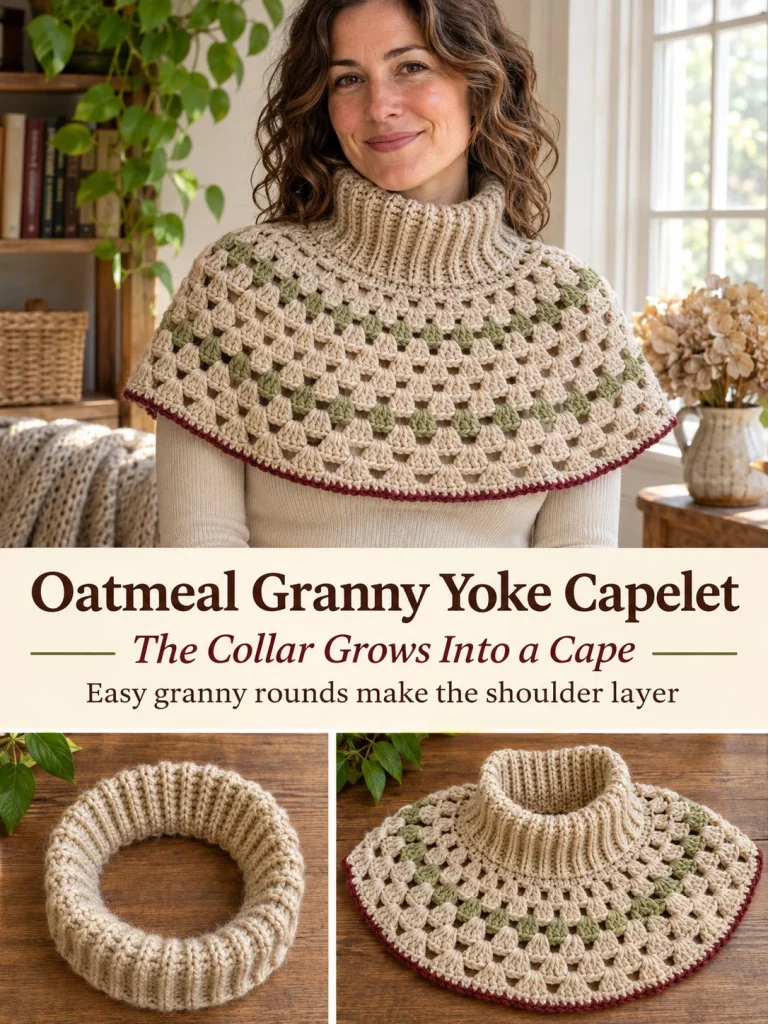
A delicate blend of warmth and classic stitchwork, this crochet capelet features a charming granny stitch yoke with a cozy collar, perfect for layering over casual or dressy outfits. Using a neutral oatmeal base accented with muted sage and burgundy, the design balances subtle colorwork with timeless granny stitch motifs that provide both texture and visual interest. Constructed from the top down, the yoke seamlessly grows outward from a simple collar ring, allowing for easy customization of length and fit.
This project is especially suitable for crocheters looking to combine traditional granny stitch elements with wearable fashion accessories. The finishing details, including color changes every few rounds and a neat burgundy edging, give the capelet a polished look while maintaining a relaxed drape. The use of back loop only (BLO) single crochet for the collar adds subtle texture that contrasts beautifully with the open, airy granny rounds.
The pattern incorporates standard worsted weight yarn and a 6 mm hook, making it accessible for intermediate crocheters familiar with granny motifs and colorwork techniques. For inspiration on integrating granny stitch techniques into wearable items like scarves and blankets, you might enjoy exploring the blue granny stitch head scarf pattern, which complements the style and construction methods here.
Pattern at a Glance
Skill level: Intermediate
Terminology: US crochet terms
Construction: Top-down; collar ring joined with granny stitch yoke worked in rounds
Finished size: Approximately 12-13 inches length below the collar; collar circumference ~22 inches relaxed
Yarn weight: Worsted (#4)
Hook size: 6 mm (US J-10)
Main stitch: Granny stitch clusters of 3 double crochets with chain-1 spaces
Gauge: Not specified; working evenly to achieve given stitch counts and dimensions
Motifs: Granny stitch groups arranged in increasing circular rounds to shape yoke
Layout: Circular yoke expanding from collar ring
Joining: Seamed collar ring and rounds joined with slip stitches and joins
Border: One round of single crochet in burgundy around the lower edge
Seaming: Collar short ends seamed with tapestry needle
Materials
This project calls for worsted weight (#4) yarn in three colors and several essential tools:
- Oatmeal yarn: approximately 650-750 yards for the collar and main body
- Muted sage yarn: approximately 120-150 yards for accent granny rounds (used every fourth round)
- Burgundy yarn: approximately 25-35 yards for the edging round
- 6 mm crochet hook (US J-10) suitable for worsted weight yarn
- Stitch markers to keep track of rounds or increase points
- Tapestry needle for weaving in ends and seaming the collar ring
- Scissors for yarn cutting
Each yarn color plays a specific role, with oatmeal as the base, sage providing soft color breaks that add dimension, and burgundy offering a sharp finishing touch for edging.
Yarn and Color Notes
For this capelet, a smooth worsted weight yarn will showcase the stitch definition of the granny groups and the BLO scalloped collar nicely. Natural fibers like wool or wool blends provide good drape and warmth, though acrylic or cotton blends can be used depending on personal preference and intended seasonality.
The muted oatmeal base color offers a versatile, neutral foundation, while the sage rounds break up the monotony with soft color shifts that prevent the pattern from becoming visually flat. The accent of burgundy on the edge creates a visually striking border that frames the garment elegantly.
When choosing yarns with similar weight but different fiber contents or textures, keep in mind that fuzzy or loosely spun yarns may obscure stitch detail, while very slick yarns could make it harder to see your stitches clearly as you work.
Finished Measurements
The collar strip is worked to approximately 22 inches in length when relaxed, forming a ring that will sit comfortably around the neck. The capelet’s yoke is worked outward with granny stitch rounds until it reaches about 12-13 inches in length below the collar, offering moderate coverage over the shoulders and upper torso.
Due to the flexible nature of crochet fabric and yarn characteristics, blocking will help set these dimensions and ensure the yoke lies flat and shapes well over the rounded shoulder area.
Gauge
Gauge is not explicitly provided, but stitch counts and measurements are critical to achieve fit and shape:
- The collar has 10 single crochet stitches across the chain 11 foundation row.
- Seventy-two single crochet stitches are worked evenly around the 22-inch collar edge, approximately 3.25 stitches per inch, to ensure the yoke lies flat and doesn’t cup or ripple.
- Granny clusters start at 18 groups and increase to 48 groups by round 10, expanding the circumference progressively.
Measuring the stitch gauge in your fabric sample matching these counts will assure proper sizing and fit. If your gauge is looser or tighter, adjust hook size accordingly.
Abbreviations
- ch = chain
- sc = single crochet
- dc = double crochet
- BLO = back loop only
- st = stitch
- sl st = slip stitch
- sp = space
Important Pattern Notes
- Chains do not generally count as stitches except where explicitly stated.
- The collar is worked in rows, back and forth, in single crochet using BLO for texture.
- Short ends of collar strip are seamed to form a ring.
- Granny rounds are worked joined in rounds with slip stitches to join.
- Increases are evenly spaced in six increments per applicable round to maintain shape and avoid puckering.
- The sage color is alternated every 4th granny round, creating a subtle striped effect.
- Final edging is a round of burgundy single crochet worked all around the lower edge for a neat finish.
Special Stitches and Techniques
The pattern uses a few techniques worth understanding thoroughly:
Back Loop Only (BLO) Single Crochet
Working sc in the back loop only creates a subtle ridge and adds texture that helps the collar maintain shape and stretch nicely.
Granny Stitch Cluster
Traditional granny groups of 3 double crochets (dc) worked into the same stitch or space with chain-1 spaces between groups form the classic granny motif used in the yoke rounds.
Evenly Spaced Increases
In increase rounds, six additional granny clusters are added evenly spaced around the yoke, increasing the count by increments of 6 groups — from 18 at Round 1 up to 48 by Round 10 — to shape the capelet and add flare.
Seaming
After the collar strip is worked, short ends are seamed with a tapestry needle to create a neat collar ring before working the yoke rounds outwards.
Understanding the Construction
This capelet is constructed from the top down, beginning with a narrow collar strip worked in single crochet using BLO to add subtle texture. The ends of this strip are seamed together, forming a stable collar ring that fits comfortably around the neck.
Along the lower edge of this collar ring, single crochet stitches are worked evenly to create a foundation edge for the granny rounds. These granny stitch rounds then build outward in concentric circles, growing the garment until it reaches the desired length. The yoke expands with increasing granny clusters in defined rounds following a regular increment pattern to maintain flatness and prevent shaping issues such as cupping or rippling.
Color changes to muted sage yarn are worked every fourth granny round to add visual interest, while the final round is completed in burgundy for a polished edging.
Blocking the finished yoke over a rounded shoulder shape provides professional shaping and drape, ensuring the garment lies flat and comfortable when worn.
Foundation and Collar Strip
Begin by choosing your oatmeal yarn and 6 mm hook.
- Chain 11 stitches.
- Row 1: Starting in the second chain from the hook, work 10 single crochet (sc) across the chain. This sets your foundation row with the right stitch count.
- From Row 2 onward, chain 1 and turn your work. Instead of working into both loops of each stitch, work single crochet into the back loop only (BLO) across the 10 stitches. This technique creates a firm yet flexible fabric with a subtle ridge.
- Continue working BLO single crochet rows until your strip measures about 22 inches when relaxed (unstretched). This length is important to form the proper collar circumference.
Seaming the Collar
After completing the strip, fold it so the short ends meet, creating a ring. Seam these ends together using a tapestry needle and yarn tail in a mattress stitch or whip stitch for an invisible join. The collar should lay flat and neither stretch nor bunch.
Preparing the Collar Edge for Granny Yoke
Along one of the long edges of the collar ring, evenly work 72 single crochet stitches joined with a slip stitch to form a smooth edge. This creates a foundation with about 3.25 stitches per inch around a 22-inch collar circumference and is crucial for the granny stitch yoke rounds to lie flat without cupping or puckering.
Granny Yoke Rounds
Once the foundation edge is complete, begin working the yoke in granny stitch rounds, growing concentrically from the collar outward.
Granny Round 1
- Chain 3 (counts as first double crochet) and make 2 more double crochets into the same stitch to form the first 3-dc group.
- Chain 1, skip 3 single crochets from the collar base.
- Then, work 3 double crochets (dc) into the next single crochet, chain 1, skip 3 sc — repeat around the collar base until you have formed 18 granny groups.
- Join with a slip stitch to the top of the starting chain 3.
Round 2 (Increase Round)
- Slip stitch to the first chain-1 space.
- Work one 3-dc granny group into each chain-1 space around.
- To increase, in 6 evenly spaced chain-1 spaces, work two 3-dc groups separated by a chain 1 instead of one, increasing the number of groups from 18 to 24.
- Join with a slip stitch.
Subsequent Rounds (Rounds 3 to 10)
- Round 3: Work one 3-dc granny group in every chain-1 space (no increases).
- Round 4: Increase by adding 6 new granny groups evenly spaced to reach 30 groups.
- Round 5: Even round (no increases).
- Round 6: Increase by 6 groups to reach 36 groups.
- Round 7: Even round.
- Round 8: Increase by 6 groups to reach 42 groups.
- Round 9: Even round.
- Round 10: Increase by 6 groups to reach 48 groups.
Keep the fabric even and flat by controlling these increases carefully.
Continuing the Yoke
After Round 10, continue working even granny stitch rounds (no increases) until the capelet length measures approximately 12-13 inches below the collar. Monitor the fabric tension as you work:
- If the yoke fabric begins to cup (curl inward), work an extra increase round with 6 evenly spaced increases to widen the garment and flatten the shape.
- If the yoke fabric ripples (waves outward), add an extra even (no-increase) round before the next increase round to restore smoothness.
Color Changes
- Use the muted sage yarn for every 4th granny round to introduce a subtle striped color effect.
- Finish the capelet with a round of burgundy single crochet around the lower edge for a clean, contrasting border.
Blocking
Once complete, block the capelet flat over a rounded shoulder shape to set the stitches evenly and ensure the yoke drapes naturally and lies flat.
Checkpoint: Measuring Your Work
- After forming the collar ring and single crochet foundation, verify that you have 72 evenly spaced single crochets around the collar.
- At each increase round, count granny groups carefully to confirm correct stitch counts (18, 24, 30, 36, 42, 48).
- Periodically measure the yoke length to ensure it approaches 12-13 inches below the collar before finishing.
- Inspect fabric behavior for cupping or rippling and adjust rounds accordingly.
Assembly and Finishing
Since this capelet is worked mostly in continuous rounds from the collar down, assembly requires only seaming the collar strip ends and weaving in yarn tails. Use a tapestry needle for a neat seam that doesn’t distort shape.
Weave in all ends securely, especially color change points and seam joins, to prevent loosening during wear or washing.
Finish by blocking the capelet flat over a rounded shoulder form to ensure the shape is smooth and flattering.
How to Resize This Capelet
This pattern’s top-down, circular construction allows for easy length resizing:
- To lengthen the capelet, continue granny stitch rounds evenly beyond the recommended 12-13 inch length, maintaining stitch counts to preserve shape. Add increases only if cupping begins.
- To shorten, stop earlier, ensuring the yoke ends at your preferred length for comfort or style.
For a larger or smaller neck circumference, adjust the initial collar strip:
- Chain more or fewer stitches initially to reach the desired collar circumference (about 10 stitches for 11 chains gives 22 inches relaxed).
- Adjust the number of single crochets around the collar edge accordingly, maintaining about 3.25 sc per inch to ensure even granny stitch placement.
Maintaining the multiple-of-6 granny group count is crucial for consistent increases and flat shaping.
Useful Variations
- Use a single yarn color throughout for a minimalist look.
- Swap the accent sage rounds with bolder or pastel colors to match different wardrobes or seasons.
- Extend the length for a half-cape or mini poncho style.
- Work the collar in a textured stitch such as front post double crochet for extra visual interest.
- Apply the granny stitch yoke technique to create matching accessories like a shawl or scarf, similar to this heritage granny square blanket using colorblock stripes.
Troubleshooting
Why Is My Yoke Cupping or Curling?
Cupping arises from insufficient increases or fabric tension pulling inward. Add an extra increase round with 6 increases evenly spaced to expand circumference. Ensure stitches are not too tight.
Why Is My Fabric Rippling or Wavy?
Rippling suggests too many increases or loose tension. Work an extra even (no-increase) granny round before the next increase to smooth edges.
How Can I Avoid Uneven Granny Group Spacing?
Count granny groups after each round carefully. Use stitch markers to mark increase points and maintain symmetry. Even spacing of increases every 6 groups prevents distortion.
How Do I Seam the Collar Neatly?
Use mattress stitch or whip stitch with tapestry needle, matching stitch tension to avoid puckers or gaps. Seam on the wrong side for a clean finish.
Why Doesn’t the Collar Fit Right?
Adjust collar chain length or number of rows of BLO sc to get correct circumference. The collar strip should measure approx. 22 inches relaxed to fit comfortably; adjust your foundation chain accordingly.
Frequently Asked Questions
Can I use a different yarn weight?
The pattern is designed for worsted weight yarn. Using lighter or bulkier yarn will affect gauge, fabric drape, and sizing. Adjust hook size and stitch count accordingly.
Can I substitute crochet hook sizes?
Yes, but gauge will change. Use a hook that creates fabric with a drape similar to sample — neither too stiff nor too loose.
Is this pattern suitable for beginners?
Intermediate skills are recommended due to granny stitch shaping, color changes, and seaming. Familiarity with working in rounds and BLO stitches is helpful.
How should I care for this capelet?
Use care instructions for your chosen yarn. Blocking is essential to set shape after washing. Hand wash or gentle machine wash and dry flat if fiber care allows.
Can I make this capelet longer?
Yes, simply add more granny rounds before finishing the edging, monitoring fabric shape to maintain flatness.
How do I block the capelet properly?
Pin the capelet flat over a rounded shoulder form or mannequin. Use steam or wet blocking per fiber guidelines, shaping edges smoothly to prevent curling or puckering.
Final Thoughts
This capelet’s elegant design highlights the charm of classic granny stitch with modern wearable silhouette. The top-down construction offers excellent opportunities for customization, letting you adjust collar size and cape length to suit your preferences.
By carefully working the collar strip, seaming, and increasing granny groups evenly, you’ll create a garment that drapes beautifully and provides just the right amount of cozy coverage. The thoughtful color accents and finishing round add the perfect touch of sophistication to this versatile accessory.
Whether for yourself or as a thoughtful handmade gift, this timeless crochet yoke capelet combines practicality, style, and tradition with just the right technical touches to delight crocheters and wearers alike.



