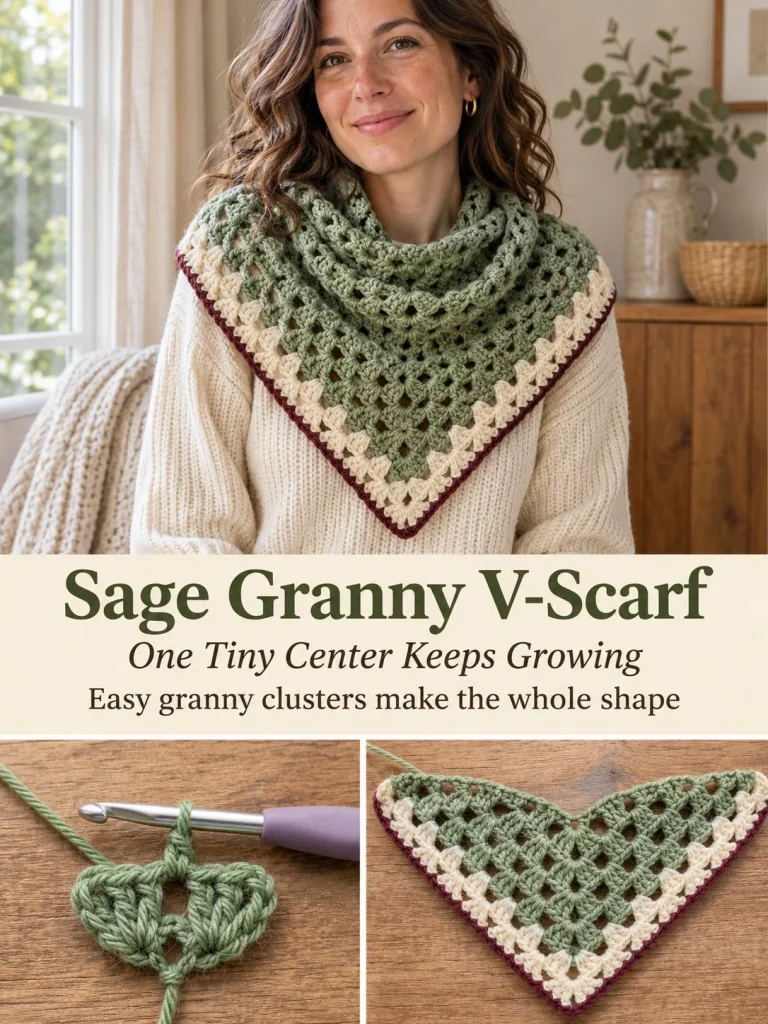
Creating a cozy accessory with timeless appeal, this V-shaped granny stitch scarf embraces classic crochet motifs with a gentle modern twist. Constructed from soft worsted weight yarn in harmonious sage, cream, and burgundy hues, the scarf combines traditional granny stitch clusters arranged in a V-pattern to form an elegant triangular design. This approach not only results in a visually appealing texture but also provides a warm, drapey fabric that wraps comfortably around the neck.
The construction centers on expanding rows of granny clusters, starting from a compact magic ring base and building outward, making it accessible yet gratifying for crocheters familiar with basic stitches like chains and double crochets. The scarf’s shape allows it to sit beautifully on shoulders or to be styled in multiple ways, providing both warmth and style, whether layered over casual outfits or draped for a touch of handcrafted charm.
Alongside its functional benefits, the project offers an excellent opportunity to practice shaping crochet pieces with increase rows and color changes, culminating in a neat single crochet border that enhances durability and finish. Enhancing this classic crafting technique can be enriching for stitchers seeking to expand their repertoire while creating a versatile wardrobe staple.
Pattern at a Glance
Skill level:
Intermediate (comfort with magic ring, double crochet, and color changes recommended)
Terminology:
US crochet terms
Construction:
Crocheted in rows, starting from a ring and worked symmetrically to form a V-shaped triangle
Finished size:
Approximately 36 inches across (wingtip to wingtip) by 18 inches deep
Yarn weight:
Worsted (#4) yarn
Hook:
5.5 mm (I/9) crochet hook
Main stitch:
Classic granny stitch clusters (groups of three double crochets)
Gauge:
Not explicitly stated; fabric drape depends on tension and yarn choice
Motifs:
Granny stitch clusters with chain spaces
Layout:
Triangular, worked from center point outward
Joining:
Single crochet edging along edges
Border:
Relaxed single crochet border in contrasting color
Seaming:
No seaming required; finished flat piece
Materials
To create this inviting crocheted scarf, gather the following materials:
-
Worsted weight (#4) yarn:
- Approximately 300 yards of sage-green yarn for main body
- Approximately 90 yards of cream yarn for accent final rows
- Around 20–30 yards of burgundy yarn for the border
-
Crochet hook: 5.5 mm (I/9) hook recommended for optimal balance between fabric density and softness
-
Tapestry needle: For weaving in ends and neat finishing
-
Scissors: To trim yarn tails cleanly
These materials combine durability and comfort, with the yarn colors thoughtfully selected to accentuate the granny V pattern’s structure and lines.
Yarn and Color Notes
Choosing yarn for this scarf is an opportunity to balance texture, softness, and color harmony. Worsted weight yarn is a versatile category featuring many fiber options such as acrylic, wool blends, cotton blends, or synthetic mixes.
-
Fiber choice:
- A wool or wool-blend yarn provides warmth and slight elasticity, helping maintain the scarf’s shape.
- Acrylic yarns offer easy care and wide color ranges, ideal for frequent use scarves.
- Breathable cotton blends ensure softness but may reduce elasticity and drape.
-
Color impact:
The sage green dominates the design, providing a calm and natural base. The cream rows near the edge add subtle contrast and brighten the overall piece. The burgundy border frames the scarf with a deep, rich tone that enhances the granny stitch pattern’s texture. -
Variegated vs solid:
This pattern benefits from solid colors to highlight granny clusters and V-shape construction clearly. A variegated yarn may obscure stitch definition, making it less ideal unless carefully chosen.
For crocheters wishing to experiment, consider substituting yarns with similar weight and gauge while maintaining contrasting colors for accents and border.
Finished Measurements
Upon completion and blocking, the scarf measures approximately:
- Width (wingtip to wingtip): 36 inches
- Depth (top edge to bottom point): 18 inches
These dimensions provide substantial coverage and visual impact without excess bulk, making the scarf both functional and elegant.
Due to the stitch pattern’s open clusters with chain spaces, measurements may vary slightly depending on individual tension and yarn choice. Blocking will help set the shape and size, smoothing the fabric and enhancing drape.
Gauge
Although exact gauge is not provided, the stitch pattern and recommended hook size offer a balanced fabric consistency typical for worsted weight yarn.
- Where to measure:
- Measure the width and depth after several granny stitch rows sample to estimate size progression.
- Why gauge matters:
- Maintaining consistent tension helps achieve intended finished size and drape.
- If gauge varies:
- Tighter gauge (smaller finished piece) can be countered by using a larger hook size or adding more rows.
- Looser gauge may result in a larger, softer scarf but possibly less structure.
For crocheters interested in precise fit or planning size adjustments, working a small test swatch of granny stitch clusters is advised.
Abbreviations
- ch – chain
- dc – double crochet
- sc – single crochet
- sts – stitches
- sp(s) – space(s)
- rep – repeat
All abbreviations follow standard US crochet terminology.
Important Pattern Notes
- The pattern begins with a magic ring or chaining 4 and joining to form a ring. This forms the starting center for the V-shaped expansion.
- The turning chain for rows is ch 3, and it counts as the first dc stitch for each row.
- Chains between granny stitch clusters (ch 1 between groups in rows beyond row 2) create spacing and the characteristic open texture.
- Color changes occur near the final rows, shifting from the main sage color to cream, then finishing with a burgundy border.
- Edge shaping is symmetrical, working clusters mirrored on each side of the center ch-2 space, which maintains the triangular form.
- The border is a relaxed single crochet row, worked around both diagonal edges and optionally across the top edge for a neat finish.
- Blocking is highly recommended to set the triangular shape and smooth stitch formations.
Special Stitches and Techniques
- Magic ring (or adjustable ring): Provides a tight, neat center to start crocheting in the round or, in this case, the first row of the scarf.
- Granny stitch cluster: Comprised of groups of 3 double crochet stitches worked into specific spaces or stitches.
- Chain spaces (ch-1 and ch-2): Used between clusters to shape gaps and delineate motifs.
- Color changes: Transitioning yarn colors cleanly at row ends.
- Single crochet border: Adds structural stability and clean edge definition.
Mastery of these techniques contributes to the crisp texture and pleasing layout of this piece.
Understanding the Construction
This scarf is crafted from the center point outward in rows, shaping a distinctive V form. The initial foundation is a circular base created by a magic ring or chained ring. The first few rows form a compact V motif using granny stitch clusters and chain spaces to separate groups.
As rows progress, more granny clusters are added strategically with chain spaces between them, and increases occur in the center ch-2 space, widening the base and expanding the dimensions of the triangular scarf. Each row’s shape is mirrored on either side of the center, ensuring symmetry.
The piece is worked predominantly in sage, maintaining a cohesive color theme. In the final stages, two rows of cream granny clusters are incorporated, providing a soft contrast near the edges. The burgundy yarn adds a relaxed single crochet border along the two diagonal outer edges and optionally across the top edge, framing the scarf with a subtle pop of color.
This construction method develops a flat, triangular scarf with an open, airy granny stitch texture, perfectly suited for layering or statement accessory use.
Exploring granny stitch patterns in triangular shapes can provide additional inspiration for similar accessory projects.
Full Pattern Instructions
Foundation
Begin by forming a magic ring with the sage yarn. Alternatively, chain 4 and join with a slip stitch to create a ring.
Row 1
- Chain 3 (counts as first double crochet).
- Work 2 double crochet (dc) stitches into the ring.
- Chain 2 (creates the central turning space).
- Work 3 double crochet stitches into the ring.
- Turn the work.
This row forms the initial V-shaped cluster foundation.
Row 2
- Chain 3 (counts as first dc).
- Work 2 dc in the first stitch of the previous row.
- Chain 1 (spaces between clusters).
- In the central chain-2 space from Row 1, work a set of (3 dc, chain 2, 3 dc). This increases the width at the V’s center.
- Chain 1.
- Work 3 dc in the final stitch of the previous row.
- Turn.
Following Rows
For each following row, proceed as follows:
- Chain 3 (counts as first dc).
- Work 2 dc into the first stitch.
- Chain 1.
- Work a set of 3 dc in every chain-1 space across to the center of the row. Separate each group with a chain 1.
- In the center chain-2 space, work (3 dc, chain 2, 3 dc).
- Mirror the clusters worked so far by working the same 3-dc groups separated by chain 1 on the second half of the row.
- End with a 3 dc group in the last edge stitch.
- Turn.
Continue working these rows in sage until the scarf measures approximately 15 inches deep from top to bottom.
Color Change Rows
Once the main sage portion reaches about 15 inches in depth, switch to cream yarn:
- Work 2 granny stitch rows in cream color, following the same shaping as previous rows.
This accent highlights the natural ending of the scarf’s main body.
Border
Join the burgundy yarn and work one relaxed round of single crochet stitches around the two diagonal outer edges of the scarf. For a more finished look, optionally work the single crochet edging across the top edge as well.
This border provides a subtle frame, enhances durability, and adds a touch of contrasting color.
Blocking
Wet block or steam the finished scarf to approximately 36 inches across (wingtip to wingtip) by 18 inches deep. Blocking smooths stitch definition, sets the shape, and improves drape.
Checkpoints
- After finishing Row 1 and Row 2, the foundation should lie flat and resemble a V-shaped cluster starting to widen.
- Around the midway point (approx. 10 rows in), the scarf should visibly exhibit the developing triangular shape with balanced clustering and chain spaces.
- After working the sage portion to approximately 15 inches depth, confirm the piece maintains the V shape and dimensions before switching colors.
- Observe smooth transitions when changing to cream yarn rows, ensuring even stitch tension and clean joins.
- After adding the burgundy border, ensure the edges lie flat without curling or pulling.
Assembly and Finishing
Since the scarf is worked in a single continuous piece of expanding rows, there is no stitching together of separate parts. Weaving in ends neatly with a tapestry needle will finalize the project. The addition of the single crochet border strengthens the edges and gives a polished look.
Blocking plays an important role in shaping the triangular form and encouraging stitches to relax into their intended positions.
How to Resize
The sizing of this scarf is driven by the number of granny stitch rows worked. To adjust size:
-
To lengthen the scarf (more depth):
Increase the number of granny rows worked in sage before starting the cream color rows. Each added row will widen and deepen the triangle incrementally. -
To shorten the scarf:
Stop sage rows earlier, then start cream rows. Note that very small versions may appear less balanced.
Due to the symmetrical pattern and the shaping of clusters expanding in each row, adding or removing rows changes both the depth and width proportionally.
For a more dramatic size change, ensure you block appropriately to achieve the desired final dimensions.
Useful Variations
- One-color version: Use a single solid yarn color to create a classic granny V-scarf without color changes or borders. This variation simplifies the project but maintains the timeless motif.
- Two-color version: Omit the cream accent and use burgundy or another complementary color for the border to create a bold frame.
- Longer scarf: Add several additional sage granny rows before the cream rows to create a longer wrap or shawl.
- Scrappy yarn: Substitute different yarn colors for each color block to create a patchwork-style scarf, maintaining the same stitch pattern for consistency.
Experimenting with yarn types and weights that match worsted weight standards can also diversify the scarf’s texture.
Troubleshooting
Why Is My Scarf Not Lying Flat?
If the edges ripple or the scarf seems distorted, ensure your tension is even, especially around chain spaces, and that increases are placed symmetrically in the central ch-2 space. Blocking can often resolve slight shape irregularities.
Why Are My Color Changes Noticeable or Messy?
Make smooth transitions by fastening off the old color at row ends and joining the new color with a slip stitch in the first stitch of the next row. Avoid pulling yarn too tight at joins to maintain elasticity.
Why Is My Border Curling or Pulling?
Work the single crochet border loosely to avoid tension pulling edges inward. If edging causes distortion, adjust hook size for the border or skip the top edge border.
Why Does My Scarf Feel Too Stiff or Too Loose?
Using the correct yarn weight and recommended hook size impacts fabric drape. Tighter tension yields stiffer fabric, while loose tension results in a floppy fabric with less warmth.
Frequently Asked Questions
Can I use a smaller or larger hook size?
Yes. A smaller hook will produce a denser, stiffer fabric and a slightly smaller scarf, while a larger hook creates a softer, drapier scarf. Adjust your tension accordingly and block to size.
Can I substitute a different yarn weight?
This pattern is designed for worsted weight yarn. Substituting a lighter or heavier yarn will change finished size and fabric characteristics but can be attempted with corresponding hook size adjustments and gauge considerations.
Is this pattern suitable for beginners?
While the stitches are basic (chains, double crochet), familiarity with the magic ring and working granny stitch clusters with shaping is recommended. Beginners confident with these techniques may find it a rewarding project.
How should I wash this scarf?
Care depends on the fiber content of your yarn. Acrylic and blends generally allow gentle machine washing; wool requires hand washing and air drying to prevent felting.
Can I omit the cream and burgundy colors?
Yes. For a monochrome look, work all rows in sage and finish with no border or a matching sage border.
How do I avoid gaps or holes along edges?
The chain spaces are integral to this granny stitch pattern to create its open texture. If you prefer a tighter fabric, consider substituting some chain spaces with stitches, but note this will alter the visual effect.
What other projects use a similar granny stitch technique?
Granny stitch clusters are versatile and appear in blankets, shawls, and accessories, including the classic granny square blankets, offering ideas for coordinated handmade sets.
Optional Related Uses
The V-shaped granny stitch pattern featured here adapts beautifully to other accessories, such as headscarves or shawls. For instance, a simplified version with fewer rows creates a delicate, triangular headscarf that showcases the granny stitch texture elegantly. Exploring motifs from related scarves can inspire complementary garments and wraps.
Final Thoughts
This project comes down to three main elements: starting from a centered magic ring, expanding granny stitch rows symmetrically to shape the V, and finishing with contrasting color accents and a relaxed border. The combination of classic stitch groupings and careful color placement results in a scarf that is both timeless and current, perfect for adding cozy charm to any ensemble. With straightforward shaping and thoughtful finishing, this scarf is an ideal project to explore granny stitch techniques beyond the traditional square motif, inviting crochet enthusiasts to experiment with form and color in wearable art.



