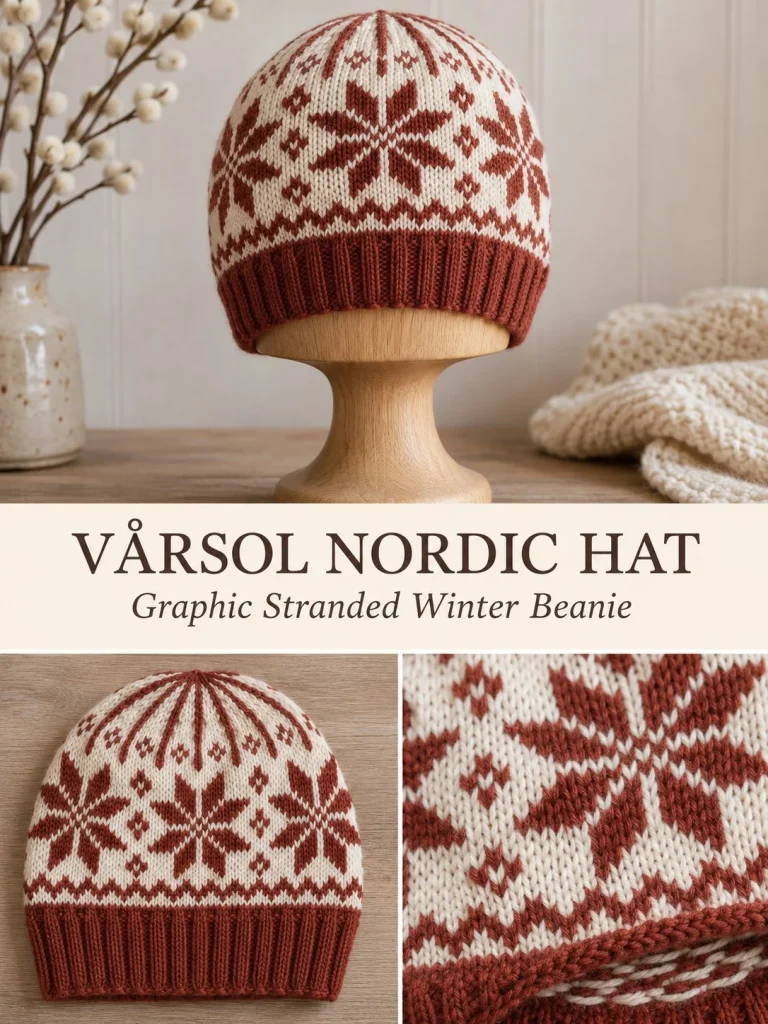
The Varsol Colorwork Hat captures the essence of Nordic winter wear with a bold graphic pattern and impeccable craftsmanship. Designed to be both a stylish accessory and a warm winter staple, this beanie employs intricate stranded colorwork reminiscent of traditional Scandinavian motifs. Its seamless construction and top-down knitting technique contribute to a smooth, comfortable fit that hugs the head’s contours without seams. This project is perfect for knitters seeking to explore stranded knitting methods while creating a functional, eye-catching winter hat.
Stranded colorwork involves carrying two or more colors across each round, creating beautiful motifs without carrying an extra yarn strand unnecessarily. Maintaining tension and ensuring floats are loose enough to preserve elasticity are key aspects of this kind of knitting, especially important for a fitted hat brim and crown shaping. The Varsol colorwork chart, inspired by the iconic Vårsol design, has been carefully scaled and placed to flow seamlessly into the crown decreases, resulting in a professional finish.
This hat bridges traditional Nordic aesthetics with modern knitting techniques. The use of 100% worsted wool yarn contributes to both warmth and structure, highlighting the clean color patterns. Its versatility across child, women’s, and men’s sizes makes it an inclusive pattern for knitters aiming for a customized gift or personal project. Knitters who enjoy patterns like the deer motif beanie will appreciate the complexity and charm of this colorwork winter hat.
Pattern at a Glance
Skill level: Intermediate to advanced (due to stranded colorwork and crown shaping)
Terminology: Standard US knitting terminology
Construction: Seamless, bottom-up knitting in the round, transitioning from ribbed brim to stranded colorwork, finishing with crown decreases
Finished size: Varies — child, women, and men sizes provided
Yarn weight: Worsted (medium)
Needles: US 6 (4.0 mm) for ribbed brim, US 7 (4.5 mm) for colorwork and body; circular or double-pointed needles, magic loop recommended
Main stitch: Stockinette stitch with stranded colorwork motif and ribbed brim
Gauge: 16 stitches and 24 rows = 4 inches in stranded knitting
Motifs: Nordic graphic stranded colorwork designed with the Vårsol chart
Layout: Bottom-up in the round, rib brim to patterned body, crown decreases integrated into motif
Joining: Seamless, worked entirely in the round
Border: Ribbed brim
Seaming: None
Materials
To achieve optimum results with the Varsol hat, it’s best to work with:
- Yarn: Jarbo Svensk Ull 3 tr or any comparable worsted weight 100% wool yarn. The yarn should have a smooth, plied texture to clearly show stranded colorwork patterns. Depending on the size selected, you will need approximately 236 to 276 yards (216 to 252 meters) of yarn in the chosen colors, matching the sample colors closely if possible to retain the original look.
- Needles: US 6 (4.0 mm) circular, double-pointed, or preferred magic-loop needles for the ribbed brim; US 7 (4.5 mm) needles switching to larger size for the stranded colorwork body and crown shaping. Using circular or DPNs is necessary to accommodate working in the round seamlessly.
- Notions: Stitch marker to mark the beginning of rounds, tapestry needle for weaving in ends, and a rounded form for wet-blocking the finished piece.
Using high-quality wool yarn ensures the hat is warm, slightly elastic, and durable. Worsted-weight yarn gives a nice stitch definition essential for graphic colorwork motifs.
Yarn and Color Notes
The choice of yarn fiber and color matters greatly in stranded knitting. Wool is preferred for its elasticity and heat retention, crucial in a snug-fitting winter beanie. The Jarbo Svensk Ull is a robust 100% wool yarn that handles stranded knitting well without excessive fuzziness or halo, allowing the Nordic motifs to stand out crisply.
When selecting colors, pairing light and dark shades with good contrast is vital to emphasize the intricate pattern details. Solid, non-variegated yarns are recommended for each color to avoid visual noise that muddles the clean motifs. Experienced knitters can experiment with subtle tone-on-tone contrasts for a more understated effect but maintaining enough contrast is key for pattern visibility.
For inspiration on complementary beanie styles, you might explore the fluffy ribs eyelets beanie knitting pattern, which uses texture and ribbing in combination with cozy yarn suitable for fall and winter months.
Finished Measurements
The final size of the Varsol hat depends on the chosen size category—child, women’s, or men’s—because the pattern uses different stitch counts and crown shaping charts for each. Since it’s designed to fit securely with stretch, the dimension focuses mostly on head circumference and depth.
- Width (circumference): Adjusted according to the size with exact stitch counts given in the source chart
- Depth: Measured from the brim’s cast-on edge to the crown closure, ensuring coverage over ears and head
- Because gauge is fixed at 16 stitches per 4 inches, sizing is reliably predictable, assuming tension is consistent.
It’s important to knit a gauge swatch before starting to confirm your stitches per inch; slight tension variations can affect fit significantly in a hat.
Gauge
Accurately maintaining the gauge of 16 stitches and 24 rows = 4 inches (10 cm) in stranded knitting is crucial for this project. Measuring gauge should be done over the stranded colorwork section, not just the ribbing.
- To measure gauge, knit a swatch in the stranded pattern on US 7 needles with yarn colors intended for the project. Use both yarns as you would when working the main section to mimic float tension.
- Achieving this gauge ensures the hat fits true to size and the motif scales correctly.
- If your gauge is larger (fewer stitches per inch), the hat will grow in circumference and may be loose. Adjust by going down a needle size.
- If your gauge is smaller (more stitches per inch), expect the hat to be tighter or smaller. Use larger needles or loosen tension.
Accurate gauge aligns the colorwork motif scale, which is a vital part of maintaining the graphic Nordic impression.
Abbreviations
This pattern uses standard knitting abbreviations:
- k: knit
- p: purl
- st(s): stitch(es)
- rnd(s): round(s)
- dpn: double-pointed needles
- yo: yarn over
- sl1: slip 1 stitch
- k2tog: knit two stitches together (decrease)
- ssk: slip, slip, knit (decrease)
- MC: main color
- CC: contrast color(s)
- pm: place marker
Important Pattern Notes
- The hat is worked seamlessly in the round starting from the ribbed brim upwards.
- The ribbed brim uses a smaller needle size to create a firm, fitted edge.
- When starting stranded colorwork, maintain the same tension on both yarns to avoid puckering.
- Floats (stranded yarns carried along the inside) should be kept loose enough to preserve the hat’s stretch.
- Crown decreases are integrated smoothly into the colorwork pattern to avoid interrupting the motif flow.
- Use stitch markers to track the beginning of rounds and decrease points.
- The pattern instructions provide different stitch counts and crown shaping charts for child, women’s, and men’s sizes. Follow charts carefully.
Special Techniques
Stranded Colorwork
Stranded colorwork involves working with two yarn colors across a row or round, carrying the yarn not in use loosely on the back of the work. This pattern requires skill in managing floats and maintaining even tension to avoid puckering or tight fabrics.
Crown Decreases with Colorwork
Decreasing while keeping the stranded motif intact requires careful attention. Decreases happen in specific rounds per the crown chart to preserve the graphic flow, often by knitting two stitches together or performing slip-slip-knit decreases where appropriate within the charted design.
Understanding the Construction
This hat is constructed entirely in the round, starting from the bottom edge:
- Ribbed Brim: Knit first with smaller needles to form a cozy but flexible ribbed edge that comfortably hugs the forehead and ears.
- Body with Colorwork: After ribbing, switch to larger needles and the stranded colorwork chart representing the Vårsol Nordic motif. The stranded colorwork is worked continuously in rounds.
- Crown Shaping: When the hat reaches the prescribed depth for the chosen size, crown decreases are executed following the original pattern’s chart. This step tapers the hat to close neatly at the top without disrupting the motif.
- Finishing: After the crown is decreased, remaining stitches are drawn closed securely with the tapestry needle, ends are woven in, and the hat is blocked over a rounded form to enhance shape and gauge.
This seamless and top-down approach eliminates the need for sewing seams and ensures a neat, professional finish.
Full Pattern Instructions
Foundation (Ribbed Brim)
- Cast on the number of stitches indicated for your size using the smaller needle (US 6 / 4.0 mm). The stitch count corresponds with the ribbing multiple established in the source chart.
- Join to work in the round, being careful not to twist stitches. Place a marker to denote the start of the round.
- Work ribbing in your preferred rib pattern (e.g., k1, p1 or k2, p2) for the length specified in the pattern, which ensures a fitted brim.
Transition to Colorwork Body
- Change to larger needles (US 7 / 4.5 mm) to allow the fabric to relax.
- Begin stranded colorwork according to the source Vårsol chart. Maintain correct color placement and follow the row-round sequence exactly.
- Keep floats loose enough by gently tugging as needed but avoid excessive tightness which can distort stitches.
Patterned Body and Colorwork
Work the stranded pattern in continuous rounds, keeping track of motifs and repeats per size. Follow the published chart for exact stitch counts and motif placements for child, women, or men sizing.
Crown Decreases
Once the hat reaches the specified depth, start decreases exactly as in the crown chart to taper the hat top. This should be done while maintaining stranded colorwork integrity.
Finishing
- Draw remaining stitches closed firmly with the tapestry needle.
- Weave in all yarn ends securely on the wrong side.
- Wet-block the hat over a rounded form to set the fabric and shape, enhancing stitch definition and motif clarity.
Helpful Checkpoints
- After ribbing, the brim should measure the recommended length and stretch comfortably.
- When beginning colorwork, verify the stitch count matches the overlay chart to ensure correct pattern alignment.
- The hat’s depth before shaping the crown must correspond to the size chart—verify periodically.
- Crown decreases should align smoothly with the pattern, and the motif should shrink uniformly without distortion.
Assembly
Since this hat is worked seamlessly in the round, there is no traditional assembly. The main finishing step involves weaving in ends and blocking the piece.
Finishing and Blocking
Wet blocking is essential to relax the stitches, even out the tension of stranded yarns, and shape the hat smoothly. To block:
- Soak the hat in lukewarm water with mild wool wash.
- Gently squeeze out excess water without wringing.
- Place the hat on a rounded form (such as a balloon or hat block) to dry to maintain shape.
- Adjust edges and motif positioning as needed while drying.
Proper blocking enhances both fit and appearance.
How to Resize
This pattern supports resizing by selecting from child, women’s, and men’s stitch counts and charts provided in the source.
- To adjust size beyond these categories, modify the pattern by adding or subtracting pattern repeats in multiples compatible with the stranded motif chart.
- Because gauge and motif repeat are fixed at 16 stitches per 4 inches, adding full motif repeats will maintain design integrity.
- Adjust ribbing length proportionally if desired.
Useful Variations
- One-color ribbing: Knit the brim in a solid color that complements the motif, emphasizing the stranded pattern.
- Color palette: Try different color combinations to reflect your own style or regional Nordic color inspirations.
- Brim styles: Instead of ribbing, an alternate textured brim can be used, but keep consistent needle sizes.
- Different yarns: For a more robust or softer finish, experiment with blends of wool and alpaca while maintaining gauge.
Troubleshooting
Why Are My Floats Too Tight?
Tight floats can cause the fabric to pucker and restrict the hat’s stretch. To fix this, consciously allow the yarn not in use to float loosely across the wrong side with occasional gentle tugging.
Why Does My Motif Look Distorted?
Uneven tension or incorrect stitch counts during stranded knitting can distort motifs. Double-check stitch counts each round and maintain even tension on all yarn colors.
Why Is My Crown Shaping Messy?
Crown decreases performed without matching the colorwork chart will disrupt the motif flow. Follow the source crown-decrease placement carefully and use stitch markers to track decrease points.
Why Is My Brim Too Loose or Tight?
Incorrect needle size or gauge swatch can affect brim fit. Use the smaller needle size and measure gauge before starting. Adjust by switching needle size if necessary.
Frequently Asked Questions
Can I substitute acrylic yarn?
While acrylic can be used, it lacks wool’s elasticity and warmth, which are important for fitted stranded hats. Choose a smooth acrylic blend if substitution is necessary but expect some fit differences.
Is this pattern suitable for beginners?
Intermediate knitters with experience in stranded colorwork and circular knitting will have the best experience. Beginners may find the technique challenging but achievable with practice.
Can I use a fixed circular needle or do I need double-pointed needles?
Either is fine. Magic loop with a long circular needle is often preferred for small-circumference knitting to avoid juggling many DPNs.
How do I maintain even tension in stranded colorwork?
Carry floats loosely, check periodically for puckering, and adjust yarn tension in your hands. Practice swatches improve skill in managing multiple yarns.
Is the pattern reversible?
Because of stranded colorwork floats on the inside, the hat is not reversible.
How long should I block the hat?
Allow the hat to air dry fully on a form, typically 24 hours or more, depending on climate.
Optional Related Uses
The stranded colorwork technique and motifs in this hat can be adapted for:
- Nordic mittens or gloves
- Cozy earmuffs
- Colorwork scarves or cowls
- Winter socks with graphic detail
Each accessory can showcase the same pattern style in different constructions.
Final Thoughts
This hat is a rewarding project that combines traditional Nordic graphic motifs with modern seamless knitting techniques. By working from the ribbed brim upward, knitters create a fitted, visually striking winter accessory that’s both warm and stylish. Paying close attention to tension, gauge, and colorwork integrity throughout ensures professional results. With three sizes and a beautifully charted colorwork motif, this hat pattern has lasting appeal and versatility for gifting or personal use.



