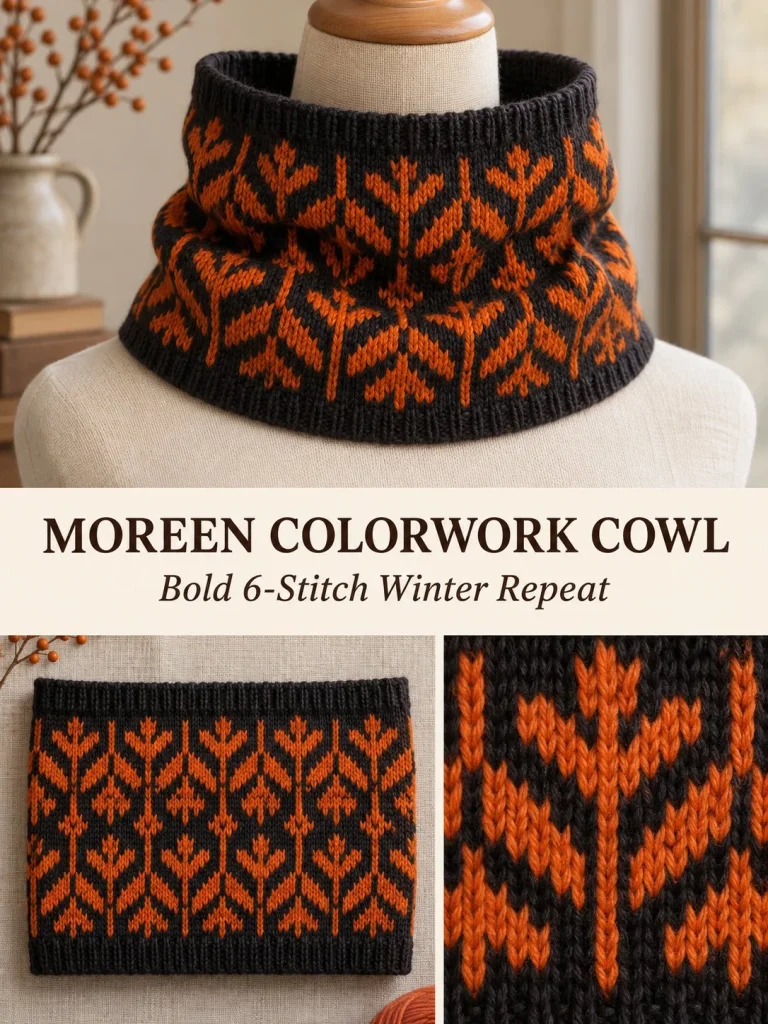
The Moreen stranded colorwork cowl is a cozy, stylish accessory designed for warm winter layering. This project beautifully showcases the art of stranded colorwork knitting, featuring a protected 6-stitch motif that creates an eye-catching pattern. Worked seamlessly in the round, the cowl is not only visually appealing but also practical—providing warmth while maintaining elasticity thanks to careful tension management during color carrying. Crafted with worsted merino yarn, it feels luxuriously soft and comfortable against the skin. The construction begins with a ribbed lower edge to ensure a snug fit around the neck, transitions seamlessly into the stranded colorwork section, and finishes with a matching ribbing at the top for symmetry.
Stranded colorwork can be a rewarding technique to master, combining color contrast and texture, which results in a fabric with intricate detailing. To keep the fabric elastic and prevent tight pulling, the unused yarn color is carried loosely across the back, preserving the stretchiness essential for wearable winter accessories. The seamless tube design not only enhances the fluidity of the pattern but also adds comfort by eliminating side seams that can sometimes cause irritation. For crafters looking to expand their winter wardrobe, this project is an excellent way to learn or practice stranded colorwork while creating a functional, beautiful piece. If you are enjoying this style, you might also appreciate resources on how to knit easy winter ear warmers with cable patterns, which complement the warmth and style of the Moreen cowl.
Pattern at a Glance
Skill level: Intermediate (experience with stranded colorwork recommended)
Terminology: Standard American knitting terms
Construction: Seamless tube worked in the round
Finished size: Approximately 22.75 in (58 cm) circumference and 10.25 in (26 cm) height
Yarn weight: Worsted weight (merino recommended)
Needles: US 5 (3.75 mm) for ribbing, US 7 (4.5 mm) for stranded colorwork, both suitable for working in the round
Main stitch: Stranded colorwork in stockinette stitch with ribbing edges
Gauge: 21 stitches and 22 rows = 4 in (10 cm) in stranded colorwork
Motif: Designer’s protected 6-stitch stranded colorwork repeat
Layout: Ribbing at both edges with colorwork band in between
Seaming: None (worked seamless)
Finishing: Stretchy bind-off and blocking to smooth floats
Materials
For best results, use Malabrigo Rios or a similar worsted merino yarn known for its softness and stitch definition. The adult-size project requires approximately 150 yards (140 meters) of the main color (MC), and about 60 yards (55 meters) of the contrast color (CC). The sample uses a striking combination of Black for MC and Glazed Carrot for CC. Selecting high-quality merino worsted yarn will enhance the warmth and comfort of the cowl without sacrificing breathability.
Knitting needles include US 5 (3.75 mm) for the ribbed sections and US 7 (4.5 mm) for the stranded colorwork portion. Needles must support working in the round, such as circular or double-pointed needles, depending on your style preference and stitch count. A stitch marker is essential to track the beginning of rounds during circular knitting, especially when juggling multiple colors. Finally, a tapestry needle is necessary for weaving in ends and finishing the piece cleanly.
Yarn and Color Notes
Worsted weight merino yarn offers a good balance of warmth and flexibility, making it ideal for a winter accessory like this cowl. Merino’s natural elasticity works well with stranded colorwork, allowing the floats on the back of the fabric to stretch without puckering or restricting movement. Smooth yarns provide excellent stitch definition, which is especially important for intricate stranded colorwork motifs. Avoid fuzzy or highly textured yarns that can obscure the pattern details.
Color combination plays a crucial role in making the stranded motif visible and striking. High contrast between the main and contrast colors is recommended for best pattern visibility. For instance, the sample’s Black and Glazed Carrot combination creates a vivid display of the motif. When selecting your own colors, consider pairing a dark shade with a lighter or bright contrasting tone. Variegated or self-striping yarns are not recommended for stranded colorwork as they can distract from the clean geometric motif.
Finished Measurements
The adult cowl finishes at approximately 22.75 inches (58 cm) in circumference, which comfortably fits most adults around the neck with ease, and a height of about 10.25 inches (26 cm), providing ample coverage for warmth. These dimensions ensure the cowl can be pulled up for added warmth or worn relaxed around the neck for style.
Gauge and yarn elasticity directly influence finished size. If your gauge matches the pattern’s gauge (21 stitches and 22 rows = 4 inches in stranded colorwork), your cowl will have these exact dimensions. Deviations in gauge will affect circumference and height proportionally.
Gauge
Maintaining the correct gauge is critical for a successful finished project. The pattern gauge is 21 stitches and 22 rows over 4 inches (10 cm) in stranded colorwork, measured in the stockinette stitch section with stranded colors carried loosely.
To measure gauge, knit a swatch in the stranded colorwork technique, ensuring to carry the unused yarn loosely across the back for elasticity, as required by the pattern. Measure both stitch and row counts over a 4-inch square area for accuracy after blocking the swatch.
Why gauge matters:
- If your gauge is larger (fewer stitches per inch): The cowl may be too large and loose, leading to less warmth and a baggy fit.
- If your gauge is smaller (more stitches per inch): The cowl might be too tight or small, causing discomfort or reduced elasticity, which can stress the yarn floats.
Adjust your needle size accordingly—larger needles for a looser gauge, smaller for tighter—to match the pattern gauge.
Abbreviations
- MC — Main Color
- CC — Contrast Color
- st(s) — stitch(es)
- rnd(s) — round(s)
- k — knit
- p — purl
- yo — yarn over
- tog — together
- WS — wrong side (inside of the cowl)
- RS — right side (outside of the cowl)
Important Pattern Notes
- The cowl is worked seamlessly in the round, eliminating the need for seaming and ensuring a continuous pattern without breaks.
- Begin with US 5 (3.75 mm) needles for the ribbed edges, switching to US 7 (4.5 mm) needles for the stranded colorwork section. This change allows the stranded fabric to relax, promoting elasticity.
- The stranded colorwork pattern relies on a 6-stitch multiple repeat over the round for the designer’s protected motif—a charted design that must be followed exactly.
- The unused yarn color is carried loosely across the WS to prevent constricting the fabric and maintain elasticity.
- Both ribbing edges use matching stitch patterns to create a uniform finish.
- The bind-off must be done stretchily to avoid tightening the edge, which can interfere with wearability.
- Always use the original chart for the stranded motif provided by the designer; substituting or redesigning the chart can alter the final appearance dramatically.
Special Stitches and Techniques
- Stranded Colorwork (Fair Isle) Knitting: Involves knitting with two colors per row/round, carrying the inactive yarn behind the work as you knit.
- Loose Yarn Carrying: To enhance fabric elasticity, the inactive yarn floats should be carried loosely on the wrong side without pulling tight. This avoids puckering and keeps the cowl stretchy.
- Ribbing (K2, P2 or K1, P1): Used to create elastic edges that hold the cowl snug but comfortable. Ribbing is implemented at both start and finish in this pattern.
- Stretchy Bind-off: A knitting bind-off technique designed to maintain elasticity along the edges, such as a slip-stitch bind-off or a sewn bind-off.
Understanding the Construction
This cowl is constructed as a seamless tube knit entirely in the round, beginning at the lower edge and worked upward to the top edge, eliminating any seams.
- Lower Ribbed Edge: Cast on stitches using smaller needles and knit a short ribbing to provide structure and elasticity at the base.
- Stranded Colorwork Section: Switch to larger needles, then work the stranded colorwork repeat according to the designer’s 6-stitch motif chart, working in continuous rounds.
- Upper Ribbed Edge: Switch back to smaller needles to mirror the ribbing at the base, finishing the cowl with a neat elastic edge.
- Binding Off: Perform a stretchy bind-off to keep the upper edge comfortable.
- Blocking: Finally, block the completed cowl to soften the fabric and smooth the floats on the wrong side, ensuring a polished, even finish.
This approach creates a balanced piece that fits comfortably while showcasing the intricate stranded pattern without seams interrupting the fabric flow.
Complete Pattern Instructions
Foundation and Cast On
- Using US 5 (3.75 mm) needles, cast on the number of stitches required for the adult size. The stitch count should be a multiple of 6 to accommodate the stranded colorwork repeat, matching the gauge and final circumference.
- Join to work in the round, ensuring stitches are not twisted. Place a stitch marker to mark the beginning of the round.
Lower Ribbed Edge
- Work a short ribbing for the first few rounds (e.g., K2, P2 rib) to form a snug, stretchy lower edge approximately 1–2 inches high to prevent curling and provide a comfortable fit.
Transition to Stranded Colorwork
- Switch to US 7 (4.5 mm) needles for looser gauge to accommodate stranded stitches.
- Begin the designer’s 6-stitch stranded colorwork repeat. Follow the provided chart exactly, alternating main and contrast colors as indicated.
- Carry the unused yarn color loosely behind the fabric, ensuring floats are not pulled tightly to keep the fabric elastic.
Stranded Colorwork Body
- Continue the 6-stitch stranded colorwork repeat in the round, working until the body measures approximately 7–8 inches from the lower ribbing or until the source height is reached.
- Maintain consistent tension throughout, periodically checking that the fabric remains elastic and that floats are even.
Upper Ribbed Edge
- Switch back to US 5 (3.75 mm) needles.
- Work the ribbing matching the lower edge ribbing for symmetry, approximately 1–2 inches in height.
Bind-Off and Finishing
- Bind off stretchily to maintain the elasticity of the ribbing edge.
- Weave in all loose ends with a tapestry needle carefully on the wrong side.
- Block the cowl by gently wetting and shaping it to smooth the floats on the wrong side and even out the fabric, allowing the stranded motif to lay flat and the cowl to take its final shape.
Final Size Checkpoint
- The finished cowl should measure approximately 22.75 inches (58 cm) around the neck and 10.25 inches (26 cm) in height.
Helpful Checkpoints
- After casting on and completing the lower ribbing, your cowl circumference should feel snug but not tight around your neck.
- Once the stranded colorwork section is underway, double-check your stitch multiple to ensure the 6-stitch motif aligns correctly around the round.
- Periodically verify that the floats on the back are loose enough to avoid tightening but not so loose they snag.
- After finishing the top ribbing and bind-off, measure the cowl to confirm the finished dimensions align with the pattern.
Finishing Tips
- When weaving in ends, use a tapestry needle and follow the color changes on the inside to hide yarn tails neatly under the floats.
- Blocking is essential after knitting stranded colorwork; use gentle wet blocking to even out stitches and smooth the fabric without stretching.
- Keep the blocking shape consistent with the final intended size.
- Avoid over-blocking, which can distort the motif or stretch the ribbing excessively.
How to Resize This Cowl
This cowl’s sizing depends mainly on the number of stitches cast on, which must be a multiple of 6 to maintain the stranded colorwork motif.
- To increase circumference, add increments of 6 stitches to the cast-on number.
- To decrease circumference, subtract increments of 6 stitches accordingly, but be mindful that going too small will reduce stretch and possibly impact fit.
- Height can be adjusted by knitting more or fewer rounds in the stranded colorwork section or ribbing sections.
- Always knit a gauge swatch before adjusting to ensure yarn choice and needle size yield the proper tension.
- Adjust needle sizes as needed to maintain gauge if using different yarn or desired fabric characteristics.
Useful Variations
- Single Color Version: Knit the cowl entirely in one color using a textured rib or seed stitch pattern for subtle interest.
- Alternate Color Combinations: Swap the main and contrast colors for different style moods, from bold contrasts to muted tones.
- Extended Length: Knit additional rounds in the stranded colorwork section for a taller cowl, which can double as a hood or partial face cover in colder weather.
- Matching Accessories: Create coordinating hats, mittens, or headbands using the same stranded colorwork motif to make a complete set. For example, explore how to winterize your earwarmer knitting pattern to pair perfectly with your cowl.
Troubleshooting
Why Is My Cowl Too Tight or Stiff?
Ensure that you are carrying the unused yarn color loosely across the WS. Too-tight floats restrict fabric stretch and cause stiffness.
Why Are There Gaps in My Colorwork?
Gaps may occur if you pull one color too tight before switching. Keep tension balanced and floats loose.
Why Is My Edging Too Tight After Bind-Off?
Use a stretchy bind-off technique such as a sewn or tubular bind-off. Avoid binding off too tightly.
Why Does My Ribbing Curl?
Ribbing generally lies flat, but if needle size is too large, the ribbing can become floppy. Using smaller needles, as specified, helps.
Why Is My Gauge Not Matching the Pattern?
Check your needle size and yarn choice. Knit a larger swatch and block it before measuring to get an accurate gauge.
Frequently Asked Questions
Can I use a different yarn weight?
You can use other yarn weights, but gauge and needle size will need adjustment. Keep in mind that stitch definition is crucial for stranded colorwork, so choose a yarn with good stitch clarity, preferably similar to worsted weight.
Can a beginner make this?
This project is best for knitters with some experience in stranded colorwork and knitting in the round due to the floating yarns and color changes.
Is the pattern reversible?
Stranded colorwork is reversible but shows floats and can look less neat on the WS. The cowl is designed to be worn with the RS facing outward.
How should I care for this cowl?
Hand wash in cool water and lay flat to dry to maintain its shape and preserve the wool qualities.
Can I make a child’s size?
Yes, simply adjust the stitch count in multiples of 6 for the circumference and reduce height proportionally.
Do I need a special needle?
No special needles are required, but circular or double-pointed needles suitable for working in the round make the project easier.
Related Uses
The stranded colorwork technique and seamless tube construction are versatile and can be adapted for related winter accessories such as headbands, ear warmers, or hats. The cowl pattern motif can also inspire winter scarves with matching colorwork motifs. For additional winter accessory projects using colorwork, check out detailed tutorials on modifying essentials like ear warmers.
Final Thoughts
This cowl is a perfect blend of aesthetic appeal and functional warmth, capitalizing on the beauty of stranded colorwork and clever construction details. Working from the bottom ribbing through the patterned colorwork and finishing with a matching ribbed edge creates a polished final product that’s both cozy and stylish. With careful attention to tension, gauge, and color carrying, the Moreen stranded colorwork cowl is a rewarding knit that adds a handmade touch to your winter wardrobe.



