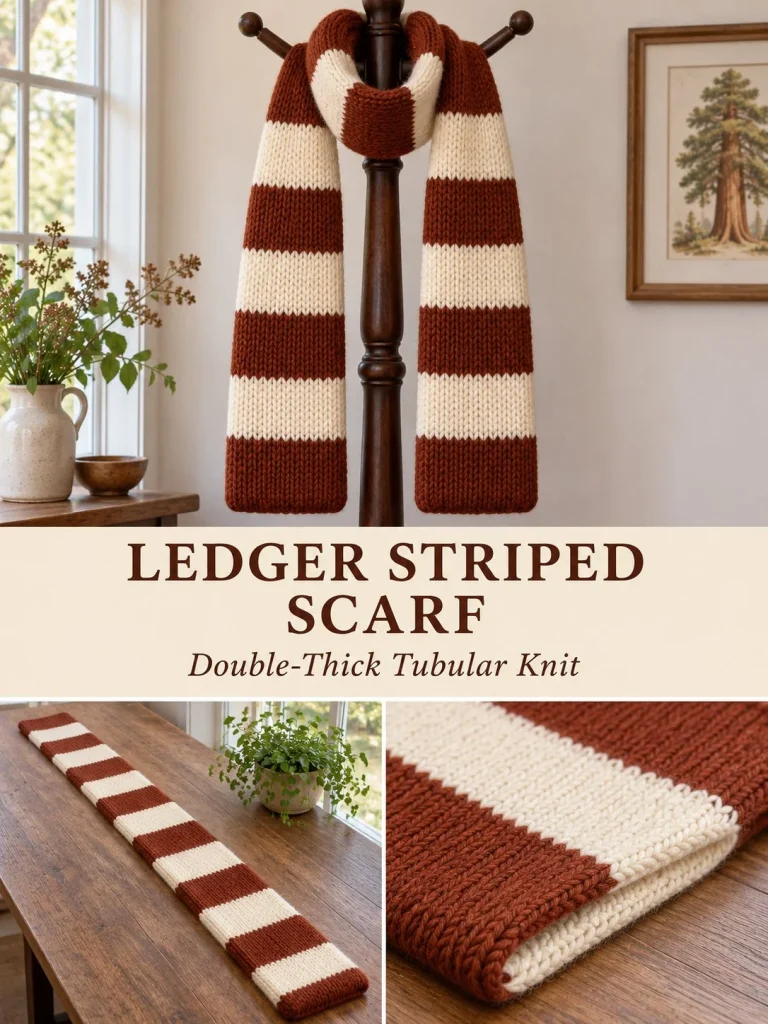
The Ledger Double-Thickness Striped Scarf stands out as a wonderfully versatile accessory, expertly knitted to produce a warm, cozy, and visually striking piece. This scarf’s defining feature is its double-thickness construction achieved through knitting in the round, creating a substantial, cushioned fabric without needing to knit two separate layers. The alternating stripes lend a timeless, classic aesthetic, showcasing how simple color work can elevate a straightforward stockinette stitch project.
Crafted in a continuous tube that folds neatly flat along carefully engineered side creases, this scarf offers both comfort and sophistication. Its construction uses stockinette stitch worked in the round—a method that ensures no visible seams and a smooth, consistent fabric surface on both sides. Beautifully balanced stripes in contrasting hues highlight the careful attention to design, making it a perfect gift or a luxurious addition to any wardrobe.
For knitters interested in exploring colorwork and double-thickness knitting techniques, this pattern offers an accessible yet rewarding project. The method of carrying yarn inside the tube keeps the interior tidy and warm, while adopting a jogless stripe technique ensures the color transitions are crisp and smooth. For those looking for inspiration on similar striped neckwear, you might also appreciate the detailed construction and warm tones found in the Acorn Brown Keyhole Scarf, which offers a uniquely elegant take on scarf design.
Pattern at a Glance
Skill level: Intermediate knitters comfortable with knitting in the round, colorwork, and finishing techniques like Kitchener stitch
Terminology: Standard American knitting terms
Construction: Worked in the round to create a continuous tube with two built-in creases for folding
Finished size: Approximately 19.75 inches in circumference and 87.25 inches long
Yarn weight: Fingering to sport weight, specifically a blend of superwash wool and linen for durability and softness
Needles: US 7/4.5 mm circular needles (16-inch or 32-inch for Magic Loop)
Main stitch: Stockinette stitch knit in the round
Gauge: 21 stitches x 27 rounds = 4 inches in stockinette
Motifs: N/A – continuous tube with stripes
Layout: Tube with two creases to fold flat
Joining: Joined in the round at the beginning, optional seaming at the cast-on end
Border: None specified
Seaming: Optional seam after aligning the tube or Kitchener stitch bind-off for the finish
Materials
This project uses Purl Soho Ochre yarn, which is a refined blend of 90% superwash wool and 10% linen. This composition offers exquisite softness, natural breathability, and durability—a great choice for a scarf worn close to the skin. The superwash finish means that care is simpler: the scarf can be hand-washed or machine washed on gentle securely.
- Color A (main color): Approximately 708 yards
- Color B (contrast color): Approximately 700 yards
- Needles: US 7 (4.5 mm) circular needle, either 16 inches or 32 inches for Magic Loop technique
- Notions: Stitch markers to mark start of round and crease placement; optional spare needle if using a 3-needle bind-off; tapestry needle for weaving in ends and seaming
Using circular needles and knitting in the round eliminates seams and produces a seamless tube. A longer cord or Magic Loop technique is recommended due to the large cast-on of 104 stitches.
Yarn and Color Notes
Selecting a yarn with a smooth texture like the Purl Soho blend helps showcase the clarity of stockinette stitch and the crispness of stripes. The linen content adds a nice drape and slight firmness, which contributes to the scarf holding its shape around the two creases, enhancing the double-thickness effect.
This pattern uses two solid colors for the stripes—one dominant and the other contrast. Solid yarns are preferred to maintain clear color boundaries, especially when using the jogless stripe technique to prevent uneven color shifts.
Consider pairing muted and vibrant shades or complementary tones for a striking visual impact. If you prefer a change in the project’s stitch texture or dimensional interest, exploring other color-blocked scarf patterns like the Autumn Color Block Chunky Scarf could inspire further creative projects with bold color sections.
Finished Measurements
The scarf’s final dimensions measure approximately 19.75 inches around in circumference, creating a comfortable tube thickness that beautifully folds flat along two crease lines without bulkiness. The length extends to about 87.25 inches, allowing multiple wraps or elegant draping.
These measurements depend critically on knitting to the specified gauge. This size balances practical warmth and easy styling, while the generous length embraces classic scarf versatility, adapting to different wear styles.
Gauge
The gauge for this project is 21 stitches by 27 rounds = 4 inches in stockinette stitch.
- Gauge is measured on a flat swatch knitted in stockinette stitch in the round to reflect the stitch density accurately.
- Achieving the exact gauge ensures that your scarf’s circumference and length match the pattern’s intended size.
- If your gauge yields fewer stitches per 4 inches (looser knitting), your scarf will be larger and less dense.
- Conversely, a tighter gauge results in a smaller, thicker scarf.
- Since the double-thickness earns warmth from the fabric density, tension affects both size and texture.
Checking gauge with the intended yarn and needle size before beginning is crucial for success.
Abbreviations
- CO: Cast on
- K: Knit
- St(s): Stitch(es)
- Rnd(s): Round(s)
- PM: Place marker
Important Pattern Notes
- The scarf is knit in the round to form a continuous tube with no side seams.
- A stitch marker divides the round into two halves (52 stitches each), establishing where the fabric creases to fold flat.
- Every alternate round includes slipping a designated stitch to define the crease lines and enhance the tube’s flat foldability.
- The scarf features four-round stripes, alternating between Color B and Color A. Color B is knit for four rounds, then Color A for four rounds, repeating continuously.
- The jogless stripe technique is used to manage color changes neatly, preventing visual "steps" at the start of rounds.
- Ends are finished either by the Kitchener stitch for a smooth join or a 3-needle bind-off for a sturdy edge.
- If using a long-tail cast-on, the cast-on edge is seamed closed after aligning edges, maintaining the tube’s seamless appearance overall.
- The unused yarn is carried up the inside of the tube to keep the interior clean and manageable.
Special Techniques
Slip Stitch for Creases
The two crease lines in the scarf are created by slipping one stitch on alternate rounds. This controlled slip stitch along each side prevents the fabric from curling and allows the tube to fold flat with crisp edges.
Jogless Stripe Technique
To make the color transitions smooth and spiral-free, this pattern employs a jogless stripe method. This advanced technique involves clever management of the first stitch after a color change so the color blocks align perfectly across rounds.
Kitchener Stitch Bind-Off
For a seamless finish, the Kitchener stitch (grafting) closes the final cast-off end. This invisible join blends the last row and the cast-on edge into a continuous round of knitting.
3-Needle Bind-Off (Optional)
Alternatively, the 3-needle bind-off can be used to join the two ends for a sturdier finish. It helps keep the tube’s edges aligned but adds a subtle ridge.
Understanding the Construction
This scarf is knit as a long tube in the round, starting with a cast-on of 104 stitches arranged to split evenly into two 52-stitch halves. These halves form built-in creases allowing the tube to fold flat like a folded ledger or book, lending its name.
Each round is worked in stockinette stitch with a particular stitch slipped every alternate round at crease locations for structural shaping. The double-thickness fabric arises from this cylindrical construction rather than knitting two layers and joining separately.
The stripes alternate every four rounds between two colors, carried seamlessly inside. The fabric is dense yet smooth, ideal for warmth without bulk.
Upon reaching the desired length (~87 inches), the tube is closed neatly with grafting or a 3-needle bind-off. If the scarf was started with a long-tail cast-on, the base of the tube is aligned and seamed, finishing the circle.
Full Pattern Instructions
Foundation
- Cast on 104 stitches using a long-tail cast-on or preferred stretchy cast-on suitable for knitting in the round.
- Join to knit in the round carefully, ensuring the cast-on edge is not twisted.
- Place a stitch marker precisely after 52 stitches to mark the halfway point; this marker divides the tube into two equal halves for crease creation.
Stockinette and Crease Slip Stitch
- Begin knitting stockinette stitch continuously in the round.
- To form the creases, slip the stitch immediately after each marker (the crease stitch) every alternate round, slipping it purlwise without knitting. This technique creates the structural fold lines that allow the tube to lie flat.
Stripe Pattern
- Work stripes in an 8-round repeat block:
- Rounds 1–4: Knit with Color B.
- Rounds 5–8: Knit with Color A.
- Carry the unused yarn along the inside of the tube neatly to avoid bulk.
- Use the jogless stripe technique to prevent a visible step where the rounds change color. This involves slipping or knitting the first stitch in a particular way when switching colors (tutorials for jogless stripes may be helpful).
Repeat
- Repeat the 8-round stripe block 72 more times, or until the scarf measures approximately 87 inches long from cast-on to end.
Finishing the Tube End
- When your scarf reaches the desired length, finish the open end:
- For the neatest appearance, use the Kitchener stitch to graft the last round to the first row, creating an invisible join.
- Alternatively, use a 3-needle bind-off if you prefer a sturdier edge and have an extra needle.
- If a long-tail cast-on was used, align the starting cast-on edge and seam it closed to form the complete tube.
Weaving and Blocking
- Weave in all yarn ends securely on the inside of the scarf.
- Wet block the scarf flat, allowing the natural drape and crisper creases to set.
Checkpoints
- After placing the halfway marker, ensure you have 52 stitches between markers, confirming accurate crease placement.
- When slipping crease stitches on alternating rounds, confirm the tube starts to fold naturally as the knitting progresses.
- Measure the length periodically; the scarf should reach about 87 inches before finishing.
- Maintain consistent tension to preserve gauge and ensure the fabric lies flat.
Assembly and Joining
The primary construction is continuous; however, closing the tube ends requires finishing steps:
- The top closing edge is seamlessly bound off with grafting or a 3-needle bind-off.
- The base cast-on edge may require seaming after aligning edges if long-tail cast-on was applied.
- Use matching yarn and a tapestry needle for seaming to make the join as invisible as possible.
- Align creases during seaming to preserve the flat fold structure.
Finishing and Blocking
To achieve the desired look and hand:
- Wet block by soaking the scarf gently in lukewarm water with mild wool wash.
- Remove excess water by rolling in a towel to avoid stretching.
- Pin the scarf flat on a blocking surface, gently shaping the creases and aligning edges.
- Take care to maintain the tube circumference and crease definition.
- Allow to dry completely before wearing or storing.
Correct blocking enhances the fabric’s smoothness, stripe visibility, and the structural folding effect.
How to Resize This Scarf
Resizing involves adjusting the total cast-on number and/or the striping length:
- Circumference: Multiples of the stitch count corresponding to 104 stitches maintain the construction balance since creases depend on half the total stitches (52 stitches). For a narrower scarf, reduce cast on in multiples of 8 (reflecting gauge), keeping halves equal.
- Length: Add or subtract repeats of the 8-round stripe block to adjust length in increments of about 1.2 inches (27 rounds ≈ 4 inches, so each round ≈ 0.15 inches).
- Remember to adjust yarn quantities accordingly.
- Gauge swatching is crucial if changing needle size or yarn weight, as this affects final size heavily.
Useful Variations
- Single-Color Version: Knit the entire scarf in one color for a minimalist and cozy look without stripes.
- Two-Color Choice: Experiment with contrasting or more subtle color pairings to complement wardrobes or seasons.
- Chunky Yarn Option: Use a bulkier weight yarn combined with larger needles for a quicker knit and chunkier scarf. Adjust gauge and stitch count as needed.
- Length Adjustable: Shorten or lengthen the scarf by changing the number of stripe repeats for a personalized fit.
- Add Fringe: Attach fringe to the ends for a traditional scarf finishing touch.
- For additional inspiration, explore similar projects like the Autumn Color Block Chunky Scarf, which plays with block stripes and textures yet also offers warmth and style.
Troubleshooting
Why Is My Scarf Not Folding Flat?
Check that crease stitches are slipped every other round consistently. Missing slips can cause the tube to curl or pucker unevenly.
Why Are My Stripes Jogging?
Ensure you use the jogless stripe technique accurately when switching colors. Dropping or misplacing the first stitch treatment in the new color round can cause visible jogs.
Why Is My Tension Uneven When Carrying Yarn Inside?
Carry yarn loosely along the inside without pulling tight to prevent puckering or distortion. Use a yarn guide or bobbin to manage yarn tension.
My Scarf Is Too Tight or Too Loose
Adjust needle size and/or yarn tension. Check gauge on a swatch and adjust accordingly before beginning the full scarf.
How Do I Seam the Cast-On Edge Neatly?
Align edges carefully and use a mattress stitch or the same bind-off method on the other edge for congruence.
Frequently Asked Questions
Can I Use a Different Yarn?
Yes, but choose a yarn with similar weight (fingering to sport) and fiber content for the best results. Natural fibers with some resilience are ideal.
Can a Beginner Knit This Scarf?
This project suits determined beginners with experience in knitting in the round and changing colors. The jogless stripe technique and slipping crease stitches might require practice.
Is This Scarf Reversible?
Yes, since stockinette is worked in the round and the joins are invisible, both sides are smooth and attractive.
Can I Make It Shorter?
Absolutely. Decrease the number of stripe repeats to shorten length. Keep stripe repeats intact for best aesthetics.
Do I Need Special Needles?
Circular needles are needed (16-inch or 32-inch). Magic Loop technique is perfect if preferred.
How Should I Wash This Scarf?
Hand wash in cool water or gentle machine wash on wool setting because of the superwash wool content. Lay flat to dry.
Optional Related Uses
The stitch technique and double-thickness tube construction used here could inspire other knitted projects such as:
- Warm cowls or infinity scarves
- Sleeves or cuffs with reinforced edges
- Cozy tube cushions by adjusting size and stuffing
- Double-layered leg warmers or mittens
The strong yet flexible construction ensures warmth and durability across various cozy knitted accessories.
Final Thoughts
This scarf is a classic example of how expert construction and careful detail — such as built-in creases and jogless stripes — elevate a simple stitch into a sophisticated accessory. Knitting a continuous tube with alternating stripes produces a lush, double-thick fabric perfect for chilly days. The blend of fibers ensures durability and comfort, while meticulous finishing makes the scarf a joy to wear and gift. Its adaptable length and understated striped design offer timeless appeal, rewarding knitters with both the process of creation and the final cozy result.



