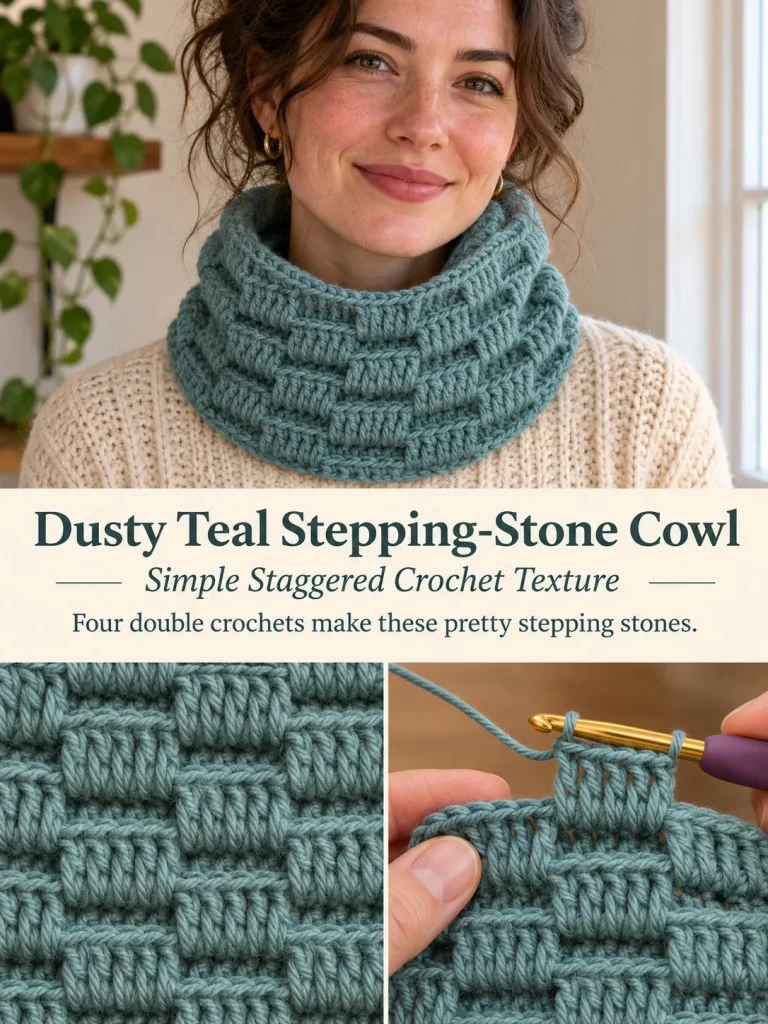
This cozy and textured cowl embraces both style and warmth through its carefully crafted stepped pattern and color combination. Featuring a delicate play of dusty teal as the dominant shade accented with warm cream and deep burgundy, this cowl showcases a subtle colorwork that complements the intricate crochet stitches. Constructed entirely in the round, it forms a seamless loop perfect for layering over outerwear during cooler months. The textured stepping-stone motif is not only eye-catching but also adds a three-dimensional quality to the fabric, making the accessory a statement piece in any wardrobe.
The project employs a thoughtful combination of front post and back post double crochet stitches to provide a ribbed texture in the lower section before transitioning into the main pattern block. This method of alternating post stitches creates a flexible and sturdy fabric that comfortably hugs the neck without constriction. The cowl’s construction highlights the use of joined rounds with a color change strategy that maintains clean joins and color clarity. If you appreciate projects that integrate both visual texture and color interplay without complicated shaping, this stepping-stone design is a perfect choice. For crocheters interested in extending this style, exploring coordinating pieces like the dusty teal granny bib cowl could provide cohesive accessory options.
Pattern at a Glance
Skill level: Intermediate — requires familiarity with post stitches and working in joined rounds
Terminology: US crochet terms
Construction: Worked in continuous joined rounds, forming a seamless tubular shape
Finished size: Approximately 4–5 inches in height, circumference sized to neck with initial foundation chain
Yarn weight: Worsted weight (#4)
Hook: 5 mm crochet hook
Main stitch: Combination of double crochet, front post double crochet (fpdc), and back post double crochet (bpdc), with chain spaces
Gauge: Not explicitly specified, but stitch consistency affects height and texture
Motifs: Stepping-stone blocks formed by staggered 4-dc groups separated by chain spaces
Layout: Circular pattern repeating rounds throughout
Joining: Joined rounds at the end of each round with slip stitches
Border: Ribbing rounds with alternating fpdc and bpdc at start and finish for neat edges
Seaming: None; continuous tube
Materials
To bring this cowl to life, you will need:
- Approximately 130 yards of dusty teal worsted weight (#4) yarn as the main color, which provides the primary hue and texture emphasis throughout most rounds.
- Approximately 70 yards of warm cream worsted weight yarn to add subtle contrast in occasional rounds.
- Approximately 50 yards of deep burgundy worsted weight yarn used sparingly to add richness and depth in accent rounds.
- A 5 mm (H/8) crochet hook, suitable for worsted weight yarn to achieve proper stitch definition and fabric flexibility.
- A tapestry needle for weaving in yarn ends neatly after color changes and completing the project.
- Scissors for cutting yarn securely.
The combination of three colors in these proportions ensures a balanced color dominance with dusty teal while allowing elegant pops of cream and burgundy that enhance the stepping-stone pattern. Using a worsted weight yarn makes the cowl warm yet breathable, perfect for transitional seasons.
Yarn and Color Notes
Choosing the right yarn fiber is essential for comfort and fabric behavior. Smooth, plied worsted yarns highlight the stitch definition of the front post and back post double crochet, allowing the stepping-stone texture to stand out clearly. A yarn with good stitch memory—such as wool blends, acrylic blends, or cotton blends—will help the cowl retain its shape after blocking.
The dusty teal as a main color works well due to its muted vibrancy, which balances nicely with the warm cream’s softness and the burgundy’s depth. When substituting colors, consider choosing shades that create a similar tonal contrast to maintain the visual impact of the staggered stepping-stone blocks. Solid colors, rather than variegated or heavily textured yarns, are recommended to prevent visual disruption of the intricate pattern.
Finished Measurements
This cowl finishes approximately 4 to 5 inches in height, forming a comfortable collar that is easy to layer. The circumference corresponds roughly to the starting chain length of 88 stitches joined in a round without twisting. This length comfortably fits an average adult neck, providing a snug but not tight fit.
Since the fabric is worked in rounds without shaping, the circumference is fixed by the initial chain count. The height can be adjusted depending on how many repeating blocks you make, giving some control over the cowl’s width when worn or allowing you to make it taller for added warmth.
Gauge
While a specific gauge is not provided, maintaining consistent tension is crucial for this cowl, especially since stitch height and texture define the pattern’s overall look. To check gauge:
- Measure the height of the textured stepping-stone section as you work to ensure the cowl reaches the intended 4–5 inches.
- Gauge alterations may affect fit and texture sharpness: a looser gauge may create a stretchier, less defined block pattern, while a tighter gauge gives a denser, stiffer fabric.
Because the cowl is a wearable accessory rather than fitted garment, gauge variations are forgiving but should be monitored for desired texture and sizing.
Abbreviations
- ch: chain
- dc: double crochet
- fpdc: front post double crochet
- bpdc: back post double crochet
- sl st: slip stitch
- st(s): stitch(es)
- sp: space
- rnd: round
These are used throughout the pattern following standard US crochet terminology.
Important Pattern Notes
- The pattern is worked in continuous joined rounds; each round ends with a slip stitch to the starting chain or stitch to maintain a uniform tube shape.
- For turning chains: the first ch3 counts as the first dc of the round.
- Color changes occur only at round joins to ensure clean edges between colors.
- The initial foundation chain of 88 stitches must be joined carefully without twisting to maintain circular continuity.
- Alternating front post and back post double crochet rounds create a slight ribbing texture framing the main pattern.
- Stepping-stone blocks are created by alternating rounds with chain spaces that offset each group of 4 dc stitches, producing a staggered, textured effect.
- Blocks of color change should retain dominant dusty teal, with occasional rounds in warm cream and deep burgundy for contrast.
Special Stitches and Techniques
Front Post Double Crochet (fpdc) and Back Post Double Crochet (bpdc)
These stitches involve working around the post (vertical portion) of the stitch from the previous round rather than through the top loops:
- fpdc: Yarn over, insert the hook from front to back around the post of the indicated stitch, yarn over and pull through, complete the double crochet as usual. This creates a raised stitch on the front of the fabric.
- bpdc: Yarn over, insert the hook from back to front around the post of the indicated stitch, yarn over and pull through, complete the double crochet as usual. This creates a raised stitch behind the fabric, producing recessed texture.
Alternating fpdc and bpdc rounds create vertical ribs that contrast with the main stepping-stone blocks and add fabric elasticity and structure.
Understanding the Construction
The cowl begins as a circular foundation chain joined without twists to ensure a perfect loop. It starts with a round of standard double crochet stitches to build a solid base.
Subsequently, a textured ribbing section consisting of three rounds alternates front post and back post double crochet stitches, creating a firm lower edge that gently hugs the neck.
The main body features a repeating pattern of two block rounds (A and B) that form the stepping-stone motif:
- Block Round A: Builds groups of 4 double crochets separated by chain-4 spaces, creating solid rectangular blocks separated by open spaces.
- Block Round B: Works clusters of 4 double crochets into the previously established chain-4 spaces, with chain-4 spaces thrown over the prior solid blocks.
Repeating these two block rounds alternately creates staggered groups of solid stepping stones that visually shift round to round, producing a textured three-dimensional appearance.
The cowl finishes with three rounds of alternating fpdc and bpdc in dusty teal, mirroring the lower ribbed edge for symmetry and neatness.
Complete Pattern Instructions
Foundation
Chain 88 stitches. Be careful to join without twisting this foundation chain into a round for a uniform tubular shape.
Round 1
Work 1 double crochet (dc) in each chain stitch around. Join with a slip stitch (sl st) to the top of the starting chain-3 (which counts as the first dc) to close the round.
You should have 88 dc stitches forming the base.
Rounds 2 to 4 (Lower Ribbing)
These rounds establish a ribbed texture by alternating front post and back post double crochet stitches:
- Round 2: Starting with the first stitch, work 1 front post double crochet (fpdc), 1 back post double crochet (bpdc) around alternating each stitch until the round ends. Join with a sl st to the beginning of this round.
- Round 3: Repeat the fpdc, bpdc alternating pattern as in Round 2.
- Round 4: Repeat once more like the previous two rounds.
This ribbing adds stretch and texture to the cowl’s base and top edges.
Block Round A (Start of Stepping-Stone Pattern)
- Chain 3 (counts as first dc).
- Work 1 dc in each of the next 3 stitches.
- Chain 4, skip 4 stitches, work 1 dc in each of the next 4 stitches.
- Repeat from * around until the end of the round.
- Join with a slip stitch to the top of the starting chain-3.
This round creates solid groups of 4 dc separated by chain-4 spaces around the cowl.
Block Round B
- Slip stitch to the first chain-4 space from the previous round.
- Chain 3 (counts as first dc), work 3 more dc into that same chain-4 space (total of 4 dc within that space).
- *Chain 4 over the previous solid 4-dc block.
- Work 4 dc into the next chain-4 space.*
- Repeat from * around until you reach the beginning of the round.
- Join with a slip stitch to the top of the starting chain-3.
This round fills in the previous chain-4 gaps with groups of 4 dc, creating the staggered stepping-stone blocks.
Repeat Block Rounds A and B
Alternate these two rounds repeatedly so that the solid 4-dc groups alternate their positions, creating the characteristic staggered stepping-stone design.
Change colors only at round joins, primarily using dusty teal as the dominant color while introducing warm cream and deep burgundy in occasional rounds for accents.
Continue this repeating pattern until your textured area reaches approximately 4 to 5 inches in height.
Finishing Rounds
Complete the cowl by working 3 rounds of alternating fpdc and bpdc in dusty teal to echo the lower ribbing and provide a polished finish.
After the final round, fasten off and weave in all ends using a tapestry needle.
Helpful Checkpoints
- After the initial foundation and Round 1, your piece should form a neat circle of 88 sts.
- The ribbing rounds (2–4) create a stretchy band approximately 0.5–1 inch tall.
- Each pair of block rounds (A and B) adds roughly 1 inch in height as the stepping stones build up vertically.
- Upon reaching 4–5 inches of textured height, confirm the circumference remains consistent and the fabric lies flat without curling.
- Final ribbing rounds ensure edges are uniform and stretchy before binding off.
Assembly and Joining
There is no assembly or seaming required, as the entire cowl is worked in continuous joined rounds. The initial foundation chain must be joined carefully to avoid twisting and to maintain the cylindrical shape. Weave in yarn ends from color changes neatly on the wrong side of the fabric with a tapestry needle for a clean finish.
Border / Finishing
The cowl’s finishing rounds mirror the lower ribbing edge: alternating front post and back post double crochet stitches form a soft but stable border that prevents curling and maintains shape. Blocking is recommended to smooth stitches and align edges:
- Lightly dampen the finished piece.
- Pin flat on a blocking mat to desired dimensions.
- Allow to dry completely to set the shape and enhance stitch definition.
This finishing technique ensures the stepping-stone pattern’s bold blocks and chain spaces hold their form beautifully.
How to Resize
To adjust the circumference:
- Change the initial foundation chain length by multiples of 8 stitches (since the pattern repeat involves 4 dc blocks separated by chain spaces).
- Ensure the total chain count is a multiple that accommodates the staggered stepping-stone block pattern.
- When resizing in circumference, maintain the ribbing and block round repeats accordingly.
To adjust the height:
- Simply add or remove repetitions of the alternating Block Rounds A and B until the desired height is reached.
- Each pair of block rounds adds approximately 1 inch to the height of the cowl.
Useful Variations
Consider these variations that complement the basic pattern:
- One-color version — work the entire cowl in dusty teal for a monochromatic textured look.
- Two-color version — alternate only dusty teal and warm cream rounds for a softer palette.
- Longer version — continue the block repetitions until the piece reaches 6 to 8 inches height to create a wider neck warmer.
- Matching accessory set — pair this cowl with other crochet pieces in the same color scheme, such as the dusty teal granny wrap, to complete a coordinated outfit.
- Scrap yarn use — swap the accent colors with leftover yarn bits for a scrappy multicolor effect.
Troubleshooting
Why Is My Cowl Getting Wider?
This can happen if your initial foundation chain has excess stitches. Ensure the chain count is exactly 88 stitches and that it is joined without twisting. Also, maintain consistent tension in post stitches to avoid stretching.
Why Is My Edge Curling?
Curling usually results from uneven tension or omitting the alternating ribbing rounds at the edges. The 3 rounds of alternating fpdc and bpdc at both the start and end help balance fabric tension. Blocking will also help flatten the edges.
Why Are the Color Changes Messy?
Change colors only at round joins by completing the last stitch of a round with the new color yarn. Avoid switching mid-round to keep color transitions clean.
Why Is the Pattern Not Aligning?
Check that you are repeating Block Rounds A and B in exact alternation without skipping rounds. Misalignment occurs if the staggered blocks are skipped or worked out of order.
Why Does My Fabric Feel Too Stiff?
Tight tension or using heavier yarn than specified can cause stiffness. Use the recommended worsted weight yarn and relax your gauge for a softer, more flexible fabric.
Frequently Asked Questions
Can I use a different yarn weight?
Using a heavier or lighter yarn will change the size and texture significantly. If substituting, adjust the hook size accordingly and be prepared for differences in drape and cowl dimensions.
Can this pattern be worked as a wrap or scarf?
Yes, by extending the foundation chain significantly and adjusting height repeats, you can adapt the stepping-stone blocks into a wrap or small neck warmer.
Is this pattern suitable for beginners?
This pattern requires intermediate skills, especially familiarity with front and back post stitches and working in rounds with color changes. Beginners may want to practice these techniques first.
Can I make the cowl taller?
Certainly. Simply repeat the Block Rounds A and B until reaching your desired height beyond the recommended 4–5 inches.
How do I carry yarn during color changes?
Since color changes happen only at round joins, end the round with the new color yarn and carry the unused yarn loosely along the wrong side if desired, making sure not to tighten or snag.
Is the cowl reversible?
Yes, the texture created by front and back post stitches looks attractive on both sides, making it a reversible accessory.
Optional Related Uses
The stepping-stone block pattern lends itself beautifully to other accessories and garments. Consider adapting the motif to:
- A coordinating wrap or shawl for broader coverage.
- A matching headband or earwarmer using narrower chains.
- Textured blankets or throws using the same alternating block pattern for a sophisticated geometric motif.
These related projects can make the stepping-stone stitch technique a versatile addition to your crochet repertoire.
Final Thoughts
This stepping-stone cowl embodies a harmonious blend of texture, color, and thoughtful construction. Its seamless circular build, alternating ribbed edges, and distinctive staggered block pattern create a versatile accessory that is both visually engaging and comfortably wearable. By mastering the front and back post double crochet stitches and careful color transitions, crocheters can create a polished and stylish piece. Whether worn alone or paired with complementary pieces like the dusty teal granny wrap, this cowl elevates simple yarn and stitch into a standout wardrobe essential.



