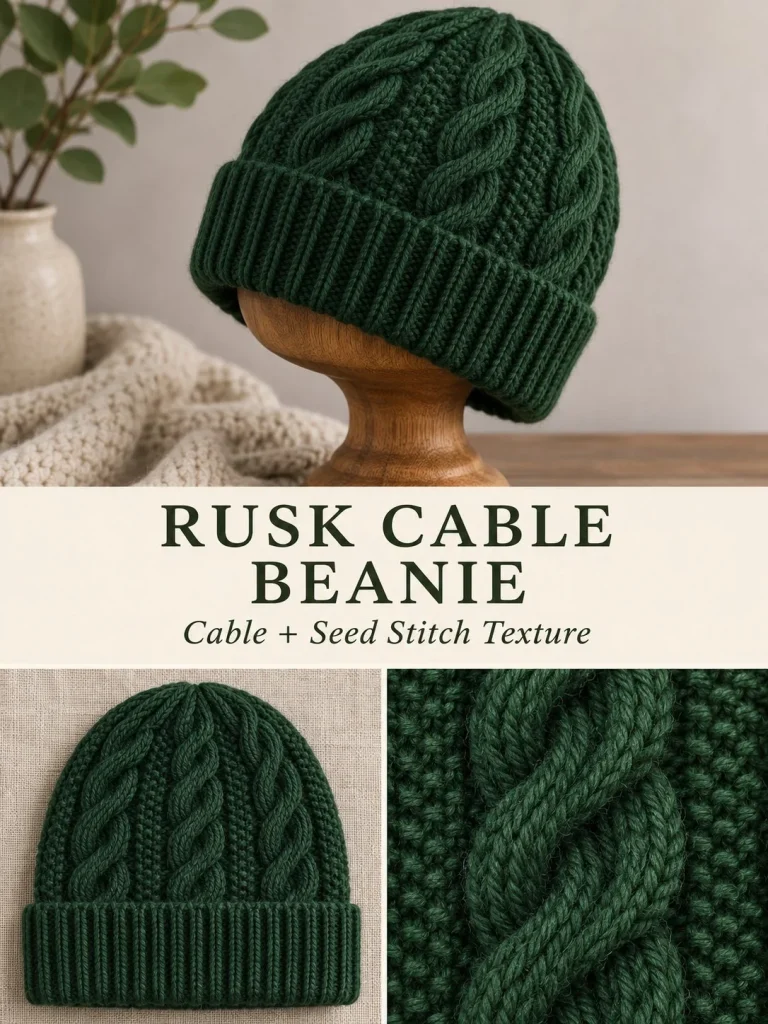
Creating a warm, stylish beanie that elegantly combines texture and classic stitch work makes for a satisfying knitting project, especially for the cooler months. This beanie features a captivating interplay of cables and seed stitch, both of which add visual interest and a cozy feel. Crafted with aran-weight yarn, it strikes a perfect balance between warmth and breathability.
The construction of this adult-sized beanie uses a straightforward round knitting technique, beginning with a snug K1/P1 rib brim, ideal for retaining heat and comfortably fitting various head sizes. The body transitions smoothly into an intricate cable and seed stitch pattern, showcasing skilled knitting that remains approachable for knitters with a bit of experience. As the hat tapers towards the crown, the decreases maintain the pattern’s integrity while shaping a comfortable, rounded top.
This design’s clever use of stitch combinations to create texture enhances not only its aesthetic appeal but also its functionality. Whether worn folded or unfolded, the brim adds customizable warmth and style. Such textured craftsmanship echoes the allure of classic knitting motifs found in accessories like the cable headband patterns, which similarly blend warmth with sophisticated stitch work.
Pattern at a Glance
Skill level: Intermediate – requires familiarity with cable knitting and basic increases/decreases
Terminology: Standard UK/English knitting terms (K = knit, P = purl, etc.)
Construction: Circular knitting from brim upward, worked in joined rounds
Finished size: Adult small and medium/large options included
Yarn weight: Aran-weight yarn (~150–182 m / 164–199 yd)
Needles: 3.5 mm for brim, 4.0 mm for body, double-pointed needles (DPNs) for crown shaping
Main stitch pattern: Combination of cables and seed stitch variations
Gauge: Not explicitly specified, but maintaining stitch counts ensures fit
Motifs: Cables with seed stitch background
Layout: Continuous round knitting with ribbed brim and patterned body
Joining: Knit in the round, no seams until weaving in ends
Border: Ribbed brim serves as functional border
Seaming: None required
Materials
To successfully complete this beanie, you will need the following materials:
- Aran-weight yarn: Approximately 150–182 meters (164–199 yards). A wool or wool-blend yarn is recommended for warmth and stitch definition.
- 3.5 mm circular knitting needles: Used primarily for the K1/P1 rib brim to achieve a tighter, elastic edge.
- 4.0 mm circular knitting needles: Used for knitting the main body, allowing the fabric to have a softer drape.
- Cable needle: Essential for holding stitches to create front and back cable crosses.
- Stitch marker: To mark the beginning of rounds and help track pattern repeats.
- Double Pointed Needles (DPNs): For working the decreases that shape the crown when the number of stitches becomes too few for circular needles.
- Tapestry needle: For weaving in yarn ends and final finishing touches.
Each of these tools plays an important role in the smooth progression of the project and the quality of the finished beanie.
Yarn and Color Notes
Choosing the right yarn is crucial for texture and warmth in this pattern. Aran-weight yarn offers a medium thickness, providing enough heft for cozy insulation without becoming overly bulky. Wool blends with a bit of elasticity hold cables nicely, helping them stand out against the seed stitch background.
Variegated yarns may obscure the clarity of the cables, so solid or semi-solid shades are preferred to highlight the pattern’s detail. If you prefer a simpler style or want to experiment, consider how a subtle color gradient or speckling could add depth without losing stitch definition.
When selecting yarn, also consider fiber characteristics:
- Smooth fibers (like merino wool): Showcase cable detail sharply and feel soft on the skin.
- Fuzzy yarns (like alpaca blends): Add halo and warmth but may blur stitch textures.
- Cotton or synthetic blends: Can be used, but these may affect warmth and elasticity.
The combination of cable and seed stitch lends itself well to winter accessories like the cranberry moss stitch headband, where yarn choice similarly affects texture visibility and comfort.
Finished Measurements
This beanie is designed with two adult size options:
- Small: Accommodates smaller adult head circumferences comfortably.
- Medium/Large: Slightly larger to fit broader head sizes.
The brim is knitted to measure approximately 6 cm for small and 7 cm for medium/large before folding, contributing to adjustable height and warmth. The height of the body continues from the brim upward, customizable by repeating the pattern rounds to desired length before beginning crown shaping.
Accurate finished size depends on gauge and personal knitting tension, so it’s recommended to try on the beanie during knitting or measure against an existing hat.
Gauge
Though a specific gauge is not supplied, maintaining the stitch counts precisely is crucial for proper fit. Because the beanie is knit in the round with specific stitch multiples, swatching is recommended to match needle size and yarn tension to the pattern.
- Why Gauge Matters: A larger gauge (looser knitting) produces a bigger, possibly slouchier beanie; too small gauge yields a tighter, smaller hat.
- Where to Measure: Measure over the ribbed brim and cable/seed stitch body to ensure the correct stitch density.
- Adjustments: If your gauge differs significantly, adjust needle sizes accordingly, remembering that brim and body needles differ in size for texture contrast.
Maintaining gauge ensures the intricate cabling sits correctly and the final slouch or fit is intended.
Abbreviations
- CO: Cast On
- K: Knit
- P: Purl
- P1: Purl one stitch
- K1: Knit one stitch
- K2tog: Knit two stitches together (decrease)
- SSK: Slip, slip, knit (left-leaning decrease)
- M1: Make one stitch (increase)
- C4F: Cable 4 front – hold 2 stitches to front, knit 2, then knit the held stitches
- C4B: Cable 4 back – hold 2 stitches to back, knit 2, then knit the held stitches
- CDD: Central double decrease – slip 2 stitches together knitwise, knit 1, pass slipped stitches over
- DPNs: Double Point Needles
Important Pattern Notes
- This pattern is worked entirely in the round, joined rounds for seamless construction.
- The brim uses a tighter needle size (3.5 mm) and a K1/P1 rib stitch for elasticity.
- Increases for the body after the brim are evenly spaced to increase stitch count and accommodate the cable pattern.
- Cables are worked with a cable needle; front and back variations create visual texture.
- Decreases for crown shaping preserve the pattern’s symmetry.
- Marker placement helps track round beginnings and pattern repeats.
- The brim can be worn folded or unfolded for different styling and warmth.
- Blocking is recommended to soften stitch definition and improve the beanie’s shape.
Special Stitches and Techniques
Cable Stitches (C4F and C4B)
- C4F (Cable 4 Front): Slip next 2 stitches to cable needle and hold in front of work; knit the next 2 stitches; then knit the 2 stitches from cable needle.
- C4B (Cable 4 Back): Slip next 2 stitches to cable needle and hold in back of work; knit the next 2 stitches; then knit the 2 stitches from cable needle.
These stitches create the characteristic twisted rope look.
Central Double Decrease (CDD)
- Slip 2 stitches together knitwise as if to knit.
- Knit the next stitch.
- Pass the 2 slipped stitches over the knit stitch.
This technique decreases two stitches at once symmetrically, maintaining the cable direction in decreases.
K2tog and SSK
- Common decreases to shape the crown and maintain pattern alignment.
- K2tog leans right; SSK leans left.
Maintaining directional decreases is key for even shaping.
Cable techniques in similar winter accessories can expand your skills in twist stitches and texture management.
Understanding the Construction
This beanie is crafted entirely in the round, starting from the brim upward:
- Ribbed Brim: Created on smaller needles for a firm yet stretchable edge, using a K1/P1 rib that fits snugly.
- Body: After increasing stitches uniformly, the main pattern combines cables and seed stitch for a textured surface. The repeat consists of four rounds, establishing the distinct cable waves interspersed with purl stitches.
- Length: The body pattern repeats multiple times to desired height, often allowing the brim to be folded for double warmth or worn unfolded.
- Crown shaping: Uses a series of carefully arranged decreases to taper the beanie’s top without disrupting the overall texture.
This top-down construction eliminates seams for comfort and aesthetic finish.
Complete Pattern Instructions
Foundation
- Using 3.5 mm needles, Cast On (CO) 96 stitches for Small or 108 stitches for Medium/Large, join carefully in the round making sure not to twist stitches.
- Place marker for round start.
Brim
- Work in K1, P1 ribbing for 6 cm (Small) or 7 cm (Medium/Large). This provides elasticity and warmth at the base.
Transition Round (Increase)
-
On 3.5 mm needles, increase evenly around:
Repeat (K1, P1) six times, then make one stitch (M1) until the end of the round.
This increases your stitch count to 104 (Small) or 117 (Medium/Large) stitches. -
Switch to 4.0 mm needles for the body to achieve a softer drape.
Body Pattern Repeat
Repeat the following 4 rounds nine times for Small or ten times for Medium/Large or until the hat body reaches the desired length (consider the brim folded for warmth).
- Round 1: K9, P1, K1, P1, K1 around.
- Round 2: K8, P1, K1, P1, K1, P1 around.
- Round 3: Cable 4 front (C4F), Cable 4 back (C4B), K1, P1, K1, P1, K1 around.
- Round 4: Repeat Round 2.
Crown Shaping
Begin crown decreases with DPNs or smaller circular needles as the stitch count drops:
- Round 1: K8, P2tog, K1, P2tog — reduces count to 88 (Small) / 99 (Medium/Large) stitches.
- Round 2: K9, P1, K1 around.
- Round 3: C4F, C4B, Central double decrease (CDD) — reduces to 72 (Small) / 81 (Medium/Large) stitches.
- Round 4: K8, P1 around.
- Round 5: K2, K2tog, SSK, K3 — reduces to 56 (Small) / 63 (Medium/Large) stitches.
- Round 6: K6, P1 around.
- Round 7: C3F decrease (Cable 3 front decrease), C3B decrease (Cable 3 back decrease), K1 — reduces to 40 (Small) / 45 (Medium/Large) stitches.
- Round 8: K2, K2tog, P1 — reduces to 32 (Small) / 36 (Medium/Large) stitches.
- Round 9: Knit 2 together (K2tog) around — reduces to 16 (Small) / 18 (Medium/Large) stitches.
- Round 10: K2tog around — reduces to 8 (Small) / 9 (Medium/Large) stitches.
- Round 11: K2tog around, knit last odd stitch if any — final 4 (Small) / 5 (Medium/Large) stitches remain.
Cut yarn, thread through remaining stitches, draw tight to close top, secure yarn firmly.
Finishing
- Weave in all ends securely with a tapestry needle.
- Block gently to set the shape and smooth stitches.
- Fold brim if desired before wearing.
Helpful Checkpoints
- After ribbing, your brim should measure 6-7 cm and have 96 or 108 stitches.
- After the increase round, confirm you have 104 (Small) or 117 (Medium/Large) stitches.
- After completing the body pattern repeats, the hat should be the length you want for coverage.
- Each decrease round’s stitch count matches the pattern exactly; count stitches to avoid mistakes.
- Crown shaping rounds progressively reduce stitches while maintaining pattern flow.
How to Resize
To adjust the size beyond Small and Medium/Large:
- The pattern’s stitch multiple centers around the brim’s initial cast-on; add or subtract stitches in multiples that preserve the ribbing and cable pattern alignment. For example, multiples of 12 stitches plus an adjustment for rib repeats.
- For longer or shorter beanies, add or subtract repeats of the 4-round body pattern.
- Adjust brim height by knitting more or fewer rib rounds.
The stitch count increases after the brim round depend on the 6 K1/P1 sequences and 1 M1 per repeat. Plan carefully to maintain pattern integrity.
Useful Variations
- One-color or two-color yarn: Use a solid yarn for traditional texture, or contrast yarns for highlighted cables.
- Longer cuff brim: Knit extra rounds of ribbing for more warmth.
- Slouchy version: Add several more body pattern repeats for relaxed style.
- Ear warmer/headband adaptation: Use the cable and seed stitch pattern for a cozy, narrow ear warmer, similar in feeling to this cable headband knitting pattern.
Troubleshooting
Why Is My Beanie Too Tight or Too Loose?
Check your gauge carefully. Gauge variations affect width and fit considerably, especially with cables that can pull fabric in. Adjust needle sizes accordingly.
Why Are My Cable Crosses Twisted or Off-Pattern?
Ensure you use your cable needle correctly—hold stitches in front or back as specified. Count stitches carefully to maintain alignment.
My Crown Decreases Distort the Pattern
Follow decrease instructions carefully, favoring directional decreases (SSK vs K2tog) to maintain symmetry. Use markers to track repeats.
Why Is the Ribbed Brim Not Stretching Enough?
Using 3.5 mm needles for the brim is deliberate for elasticity. If too tight, try slightly larger needles but note this may affect fit.
Why Does the Cap Feel Short or Long?
Measure the body length after repetitions before starting the crown. The brim can be folded or left unfolded to adjust height.
Frequently Asked Questions
Can I use a different yarn weight?
This pattern is designed for aran-weight yarn. Using thinner yarn will require adjusting needle size and stitch counts, which may complicate the cable texture and fit.
Can beginners knit this beanie?
Intermediate knitters comfortable with cable stitches and knitting in the round will find this pattern approachable. Beginners might consider starting with simpler rib or stockinette projects first.
Do I need a cable needle?
Yes, a cable needle is recommended for managing front and back cable crosses cleanly.
How do I block this beanie?
Wet block gently by soaking, then shape and lay flat to dry, paying special attention to cables to encourage evenness without stretching out ribbing.
Is the pattern reversible?
The ribbed brim can be worn inside out for a cleaner fold, but the cable and seed stitch body showcases texture best on the right side.
Can I make a child’s size?
Adjust stitch counts proportionally, reducing cast-on stitches and repeats while preserving the stitch pattern sequence.
Optional Related Uses
The cable and seed stitch texture works beautifully beyond hats:
- Scarves with the same cable and seed stitch motif provide warmth and style.
- Headbands that highlight cables create great accessories similar to the cranberry moss stitch headband pattern.
- Cowls employing this cable mix offer neck warmth without bulk.
- Mittens could incorporate the cable panels as decorative elements.
Final Thoughts
This beanie pattern combines classic cable knitting with textural seed stitch in a seamless, circular construction that perfectly balances visual interest with practical warmth. Starting with a firm ribbed brim, increasing carefully to fit, and shaping the crown with symmetrical decreases, the hat fits various adult head sizes and styles. The clear pattern repeats, combined with progressive crown shaping rounds, create a sophisticated yet cozy accessory for winter wear.
Its adaptability encourages knitters to explore different yarns or sizes while preserving the integrity of the cable and seed stitch design. Proper attention to gauge, cable technique, and crown shaping ensures a beautifully finished project that will be cherished for years.



