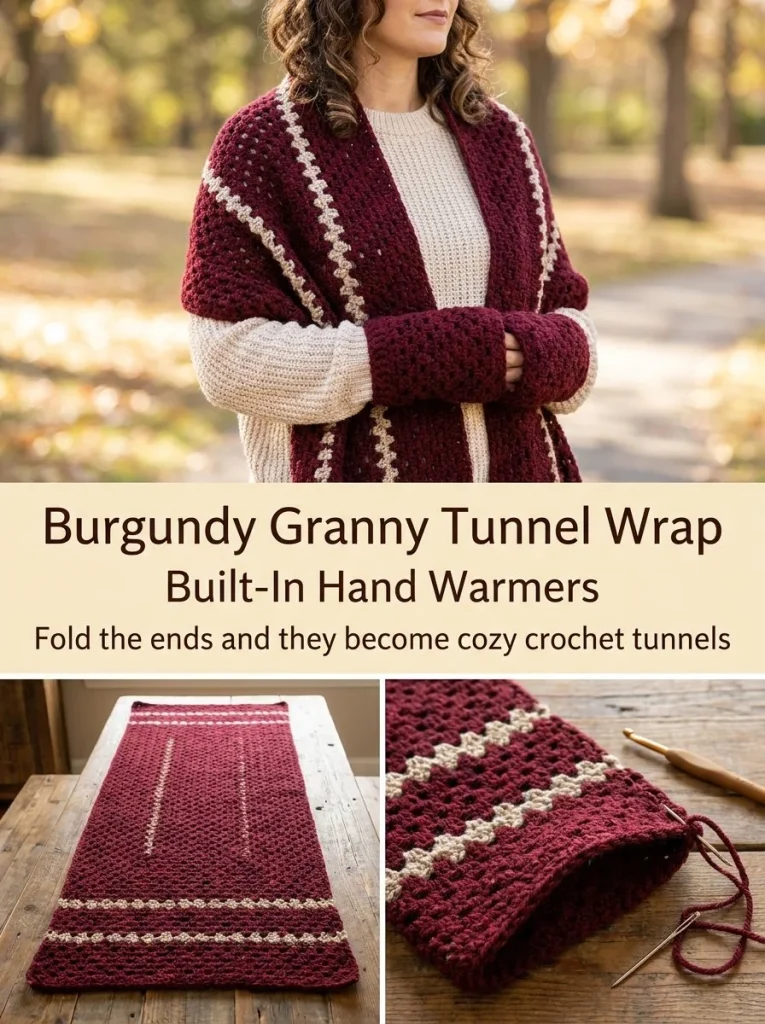
This richly textured wrap incorporates classic granny stitchwork in a novel tunnel design that blends warmth and style. Crafted from bulky yarn, this piece offers dense, cozy fabric with a distinctive pattern of offset clusters, accented by subtle oatmeal bands that add visual interest without compromising the overall color harmony. The tunnel construction at each end creates functional openings that can accommodate layering or slipping the wrap onto jacket sleeves, making it both practical and fashionable.
The foundation of the design is a long rectangular panel crocheted with a series of alternating granny rows. This corridor-like shape measures approximately 72 inches long and 16 inches wide, allowing it to drape comfortably around the shoulders. The alternating stitch pattern produces a balanced open texture ideal for autumn and winter wear. Utilizing bulky yarn and a large 7 mm hook speeds up the process while ensuring a soft yet structured finished fabric that holds its shape nicely.
The repetition of granny clusters offset every other row introduces a classic stitch variation that appeals to crocheters who enjoy traditional motifs with a fresh twist. To add a touch of contrast, occasional rows in oatmeal provide a subtle banding effect that breaks the uniformity of the solid burgundy hue. This color interplay enhances the visual texture, making it a versatile accessory to pair with a variety of outerwear. If you appreciate cozy accessories like this, you might also enjoy exploring the autumn flower granny blanket, which uses similar color themes and timeless stitch combinations.
Pattern at a Glance
Skill level: Intermediate due to stitch pattern and shaping
Terminology: US crochet terms
Construction: Worked flat in rows, then folded and seamed to form tunnel ends
Finished size: Approximately 72" long by 16" wide, with 10" tunnel tubes at ends and 52" flat center section
Yarn weight: Bulky (#5)
Hook size: 7 mm (US K-10.5)
Main stitch: Granny clusters alternating with double crochet spaces
Gauge: Not specifically provided, but bulky yarn and 7 mm hook yield substantial thickness
Motifs: Cluster groups in alternating rows
Layout: One long rectangular panel
Joining: Seaming of folded ends to create tunnels
Border: None required; edges finished with stitch patterns
Seaming: Tapestry needle used for sewing folded edges
Materials
- Approximately 1000 yards of bulky (#5) burgundy yarn: main body color ensures warmth and richness of hue. Bulky yarns offer quick coverage with great stitch definition, ideal for this chunky granny stitch pattern.
- Approximately 180 yards of bulky (#5) oatmeal yarn: used for accent bands, adding a soft, neutral contrast to burgundy.
- 7 mm crochet hook (US K-10.5): this larger hook complements bulky yarn to create a fabric with good drape and texture.
- Tapestry needle: essential for seaming the tunnel sections with yarn ends securely woven in.
Optional but useful tools:
- Stitch markers to highlight tunnel seam placement along edges
- Measuring tape for accurate length marking
- Scissors for clean yarn cutting
Yarn and Color Notes
Selecting a bulky yarn lends the wrap a plush hand and warm fabric density, which is specially suited for this elongated crocheted panel intended to be wrapped around the shoulders or worn with layers. Bulky yarns tend to hold their stitches well without stretching excessively, which supports the structural tunnel ends. Choose a yarn with some elasticity such as a wool blend or acrylic-wool mix for softness and durability.
The two-color scheme uses a dominant deep burgundy with occasional oatmeal rows. The oatmeal stripes can be worked every so often for visual breaks, lending harmony without overpowering the rich burgundy. Yarn with a smooth finish will best showcase the granny cluster pattern, as overly fuzzy yarns may obscure stitch definition.
For those who prefer a single color effect or more vibrant contrast, substituting accents or solid yarn can be done, but keep yarn weight consistent to maintain gauge and texture. Subtler hues in the same color family can also yield a beautifully nuanced look.
Finished Measurements
- Total length of flat rectangle: approximately 72 inches
- Width of flat piece: approximately 16 inches
- Tunnel sections at each end: approximately 10 inches long each, folded inward along the length
- Middle flat section between tunnel ends: approximately 52 inches
These dimensions create a versatile wrap size that suits most adults comfortably, providing ample coverage across the back and front without excess bulk.
Gauge
No exact gauge is specified, but given the yarn weight and hook size, expect the stitch gauge to produce a firm but moderately flexible fabric. It is important to maintain consistent tension so that the granny clusters align correctly and the piece measures accurately.
For accessory pieces such as this wrap, gauge is less critical than for fitted garments; however, significant deviation may alter the tunnel sizes or the overall drape. If your fabric is too stiff or tight, consider loosening your tension or switching to a slightly larger hook, noting that this will also affect length and width measurements.
Abbreviations
- ch = chain
- sc = single crochet
- dc = double crochet
- st(s) = stitch(es)
- skip = omit the following stitch(es) without working in them
- cluster = group of stitches worked into the same stitch or space
- tog = together
All stitches are worked using standard US terminology.
Important Pattern Notes
- The initial chain stitches establish the foundation row side length.
- The turning chain in granny rows counts as the first double crochet (dc).
- Row repeats alternate between clusters worked into stitches and clusters worked into spaces between previous clusters, creating the offset granny pattern.
- Oatmeal accent bands are worked as two consecutive rows, standing out subtly against the burgundy.
- Tunnel seams are placed carefully so that openings remain unobstructed at both ends of the tube.
- Each tunnel section is formed by folding only the 10-inch segment on each end inward, not the entire wrap length.
- The center section remains completely flat for comfortable wear and ease of movement.
Special Stitches and Techniques
Granny Cluster Stitch
The primary stitch is a triple double crochet cluster worked into a single stitch or space, characteristic of granny stitch work:
- Ch 3 (counts as first dc), skip next two stitches, work 3 dc into the following stitch (or gap between clusters).
- This forms a cluster of four dc (including the ch 3 acting as a dc) separated by skipped stitches, creating the well-known granny square texture extended in rows.
Alternating Rows with Offset Clusters
The pattern alternates between two granny row types (A and B) to offset the clusters for stability and visual interest:
- Row A: Clusters worked directly into stitches.
- Row B: Clusters worked into spaces between the clusters of Row A.
This interplay ensures that clusters are offset row by row, enhancing fabric elasticity and preventing stiff ridges.
Seaming Tunnel Sections
Use the tapestry needle to whip stitch or mattress stitch the folded edges of the tunnel sections along markers placed 10 inches inward from short ends. Leave openings at both ends of the tunnels for functional layering.
Understanding the Construction
The wrap is essentially one long rectangular panel crocheted back and forth. The foundation chain is 39 stitches, establishing a width of 16 inches when worked with bulky yarn and a 7 mm hook.
You begin with a single crochet foundation row to provide sturdy base, creating 38 stitches across (starting single crochet in 2nd chain).
The main body of the wrap consists of alternating granny row patterns (Row A and Row B), which you alternate continuously until the piece measures approximately 72 inches long. Integrate occasional two-row oatmeal accent bands as color breaks within this length.
Once the rectangle is complete, the tunnel ends are created by folding the outer 10-inch segments inward lengthwise and seaming the two long edges together from the short edge to the 10-inch mark, leaving the tunnel open and accessible. The middle part of the panel remains flat at approximately 52 inches long.
This clever fold-and-seam technique produces two tunnels at either end through which the wearer can slip their arms or secure the wrap—an elegant functional detail.
Complete Pattern Instructions
Foundation
- Using the burgundy bulky yarn, chain 39.
- This chain creates the foundation width of 38 stitches across.
Row 1
- Starting in the second chain from the hook, work a single crochet (sc) in each chain across.
- You should have 38 single crochet stitches total.
Granny Row A
- Chain 3 to count as the first edge double crochet (dc).
- Skip the next 2 stitches, then work 3 dc into the next stitch.
- Repeat the skip 2 stitches and 3 dc cluster across the row so that the final cluster sits in stitch 37.
- Finish the row with a double crochet in the final stitch (st 38).
- This row forms the classic granny clusters spaced apart by skipped stitches.
Granny Row B
- Chain 3, counts as edge dc.
- Work 3 dc into each open gap between the previous clusters across.
- End with a double crochet in the top of the turning chain of the previous row.
- This creates clusters offset into the spaces between the clusters of the prior row.
Alternating Rows
- Alternate Rows A and B, carefully working the clusters into either the stitches or the open spaces created by the opposite row.
- This alternating pattern maintains the offset granny cluster effect through the length of the wrap.
Oatmeal Accent Bands
- Occasionally switch to the oatmeal bulky yarn and work two consecutive rows using the same granny rows stitch pattern for contrast bands.
- After two rows, switch back to burgundy yarn.
- The oatmeal bands add subtle color and texture variation.
Continue Pattern
- Repeat Rows A and B, introducing oatmeal two-row bands occasionally, until the rectangle measures approximately 72 inches long and 16 inches wide.
Tunnel Construction
- Measure 10 inches inward from each short end of the rectangle along both long edges and place stitch markers.
- At the first short end, fold only that 10-inch section lengthwise so the two long edges meet, creating a tunnel section.
- Seam these matching long edges together from the short end up to the 10-inch marker using the tapestry needle and yarn.
- Do not sew across the ends of the tunnel, leaving the tube open at both the outer end and where it meets the flat wrap.
- Repeat the same folding and seaming process on the other short end.
- The middle section of about 52 inches remains completely flat and unsewn.
Checkpoints
- After completing Row 1, confirm you have 38 stitches across.
- At regular intervals, measure the length of the panel; it should approach 72 inches before tunnel folding.
- Ensure granny clusters remain offset smoothly without gaps or stitch confusion.
- When folding for tunnels, verify markers align precisely 10 inches from each short edge along long edges to maintain symmetry.
Assembly and Joining
The assembly consists of folding the ends and seaming the tunnel sections:
- Fold each 10-inch segment inward lengthwise, aligning the long edges together.
- Seam the edges securely from the short end to the 10-inch marker.
- Use yarn tails and tapestry needle to whip stitch or mattress stitch seams for neatness and strength.
- Ensure seam tension is firm but not tight to preserve the tube shape and avoid puckering.
- Leave tunnel openings unsewn so they function as sleeves or for layering.
- The middle portion remains unfolded and unsewn, providing flat wrap functionality.
Finishing
- Weave in all yarn ends securely using the tapestry needle.
- Block lightly if desired to even out stitches and enhance drape, using steam or wet blocking suited for bulky yarn.
- The wrap needs no additional border due to the neat finish of the granny stitch rows.
- Check seams for stability and reinforce if needed before wearing.
How to Resize
To adjust the wrap size:
- Width: Change the starting chain count in multiples of 3 plus 3 (to maintain granny cluster groups and turning chains). This preserves stitch multiples for granny patterns.
- Length: Add or reduce the total number of granny row repeats, maintaining alternating rows A and B, and adjusting tunnel placement markers accordingly to keep the 10-inch tunnel section.
- For smaller or larger wraps, maintain the tunnel length at 10 inches for functional integrity.
- Remember yarn amounts and hook size will affect overall size—consistent tension is key.
Useful Variations
- Single color version: Omit oatmeal accent bands for a solid monochromatic look focused on textured stitches.
- Color swap: Use a lighter main color with darker accent bands for a different contrast effect.
- Shorter wrap: Reduce total length to approximately 60 inches for a snugger fit or children’s size.
- Longer wrap: Extend the rectangle to 84 inches or longer for more coverage and wrap-around styles.
- Changing yarn: Substitute with worsted weight yarn and adjust hook to 5.5 – 6 mm for a lighter fabric.
- Combine this wrap style with other projects like the buttoned shoulder wrap demonstrated in the buttoned crochet shoulder wrap pattern for versatile accessories.
Troubleshooting
Why Are My Granny Clusters Not Aligning?
Ensure you alternate Rows A and B without skipping or adding stitches. Follow the pattern of working clusters into stitches on Row A and into spaces on Row B. Using stitch markers at row starts helps maintain alignment.
Why Is My Edge Curling?
Bulky yarn and open stitch patterns can curl if tension is uneven or edges are not finished carefully. Adding single crochet edging on the first row stabilizes the base chain. Blocking the finished piece can help relax curls.
Why Does My Wrap Feel Too Tight or Small?
Check your tension and needle size. Consider using a slightly larger hook if fabric feels dense. Alternatively, adjust starting chains for more width and increase row repeats for length.
How Do I Seam Tunnel Sections Neatly?
Use a tapestry needle and yarn tail to mattress stitch or whip stitch along the folded edges, keeping stitches even and not too tight. Test seaming loosely first to check fit and tube shape.
Why Is My Oatmeal Accent Band Make the Wrap Too Stiff?
Keep stitch tension consistent across color changes. Ensure color transitions are smooth. Using the same type and weight of yarn helps maintain fabric uniformity.
Frequently Asked Questions
Can I use a different yarn weight?
You can substitute yarn weights but must adjust hook size and gauge accordingly to maintain the proper size and drape.
Can I use cotton yarn?
Cotton is possible but will create a denser, less stretchy fabric and the wrap may have less drape and warmth.
Can I crochet this in one color?
Yes, simply continue working all rows in the main burgundy yarn for a classic monochrome granny pattern.
Is this project suitable for beginners?
Intermediate beginner crocheters with some experience in granny stitch patterns and seaming should manage this project well.
How do I care for this wrap?
Follow your yarn care instructions. Usually, bulky acrylic blends are machine washable on gentle cycle and can be dried flat.
Can I make this wrap longer or wider?
Yes, modify the starting chain and row repeats while maintaining the stitch multiples and tunnel sections as described.
Optional Related Uses
The offset granny stitch panel concept can be adapted to other accessories such as scarves, cowls, or rectangular shawls. Folding and seaming techniques translate well to shoulder wraps or even a cozy lap blanket with pockets. For a larger home accessory, growing the rectangle and skipping the tunnel ends would create a rich-textured blanket similar to the granny square blanket.
Final Thoughts
This tunnel wrap project combines familiar granny stitchwork with a practical yet innovative folded tube construction, resulting in a stylish accessory perfect for layering in cooler seasons. Its use of bulky yarn and generous dimensions make it a quick, fulfilling crochet project, while the alternating stitch rows and oatmeal accent stripes inject classic design elements for enduring appeal. By following the detailed instructions and tips provided, you can create a beautiful hand-made wrap that complements your autumn and winter wardrobe effortlessly.



