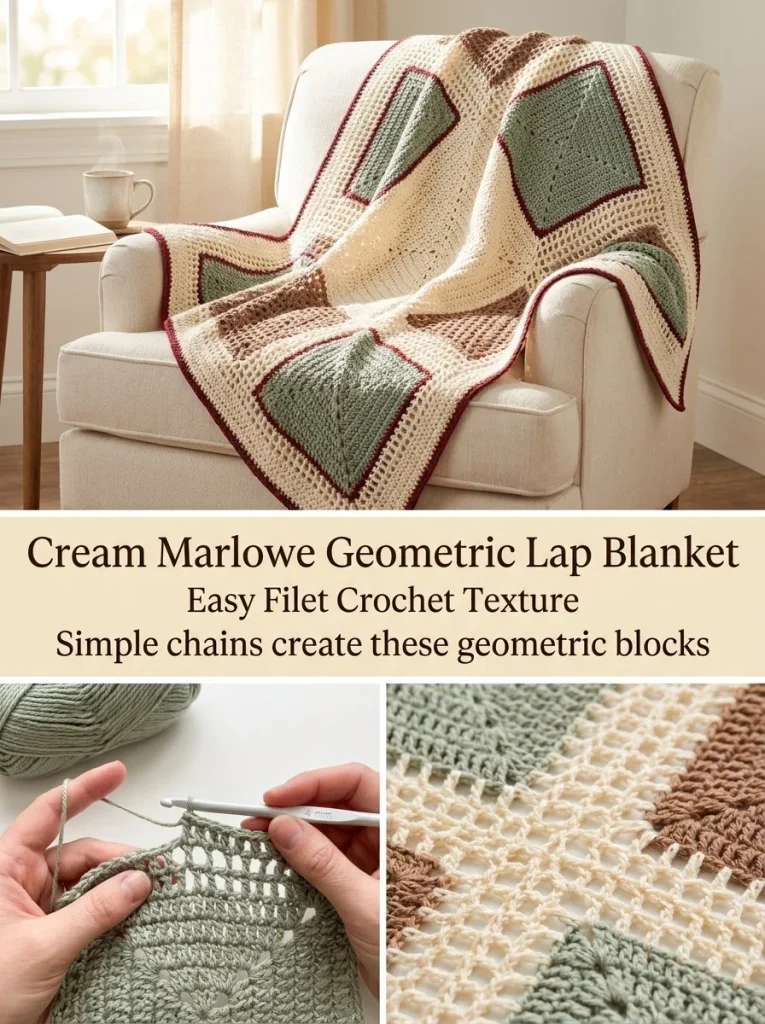
This elegant lap blanket showcases a refined geometric design created with classic crochet techniques. The interplay of solid double crochet sections with airy filet windows forms a stepped pattern that creates visual depth and texture. The construction effectively balances warmth and breathability, making it a versatile accessory for cozying up on chilly evenings or adding a touch of handmade charm to your living space.
The blanket’s color palette has been carefully chosen to highlight the design’s architectural feel. A warm cream forms the dominant backdrop, while muted sage and rich cocoa provide subtle contrast in the geometric blocks and mesh accents. A narrow burgundy stripe adds a deep, unexpected pop amidst the calmed neutrals, enhancing the overall sophistication of the piece. This combination of soothing hues and structured stitchwork results in a project that is both inviting and stylish—a perfect blend of form and function.
Crocheted using DK weight yarn and a moderate 4 mm hook, the pattern progresses in rows, creating a rectangular blanket sized approximately 36 inches wide by 54 inches long. The stitch pattern is based around multiples of eleven to accommodate the repeating geometric blocks, which slide inward or outward row by row to produce a stepped filet effect. Between these blocks, mesh separators composed of alternating double crochet and chain stitches provide elegant spacing and lightness.
The design’s solid and openwork interplay is a beautiful example of filet crochet, a technique where chains are strategically skipped to create open “windows” reminiscent of lace. This method combines structure with airiness and provides excellent scope for color switching and visual interest. Its manageable difficulty level and rhythmic stitch repetition make the blanket an enjoyable project for intermediate crocheters looking to expand their skills and create a stunning finished object. If you appreciate balanced texture and subtle geometric motifs, this pattern offers a wonderful way to explore filet crochet artistry.
For additional ideas on comfortable, practical lap blankets using a similarly cozy stitch base, see the textured warmth of the Moonbeam Star Lap Blanket, which showcases complementary design sensibilities.
Pattern at a Glance
Skill level: Intermediate
Terminology: US crochet terms
Construction: Worked flat in rows, integrating solid and filet sections with mesh separators
Finished size: Approximately 36" wide x 54" long
Yarn weight: DK #3
Hook: 4 mm (G/6) crochet hook
Main stitch: Double crochet (dc) with filet-style chain spaces
Gauge: Approximately 18 sts x 9 rows = 4 in (10 cm) in pattern
Motifs: Repeating geometric blocks made of solid and open filet stitches
Layout: Rectangular panel with stepped filet windows across width
Joining: Not applicable (single-piece construction)
Border: None specified; edging can be added optionally
Seaming: None required
Materials
- Yarn: DK #3 yarn totaling approximately:
- 650 yards of warm cream (dominant background)
- 400 yards of muted sage (used in selected geometric sections)
- 300 yards of cocoa (used for occasional mesh groups)
- 80 yards of burgundy (narrow accent rows every several repeats)
- Hook: 4 mm (G/6) crochet hook, suitable for DK yarn tension and drape
- Notions:
- Tapestry needle for weaving in ends
- Scissors
- Stitch markers (optional for marking pattern repeats)
Each yarn color is used purposefully to define different sections of the blanket, so having all four colors on hand before starting will ensure smooth transitions and consistent colorwork.
Yarn and Color Notes
Selecting yarn with good stitch definition enhances the clarity of the geometric pattern. Smooth, plied DK yarns in matte or softly lustrous fibers work well by showcasing the interplay of solid and open stitches without visual muddiness. For this blanket, natural fiber blends or acrylics with moderate halo are ideal for maintaining structure.
The warm cream creates a neutral and soothing base, while muted sage introduces a calm, natural tone that complements rather than competes. Cocoa adds warmth and depth without overpowering, and the subtle use of burgundy injects color interest without overwhelming the overall palette.
For those interested in adapting the design, this pattern also lends itself well to different colorways, such as monochromatic palettes emphasizing texture, or more vibrant collections for a bolder modern look.
Finished Measurements
The blanket measures approximately 36 inches (91 cm) wide and 54 inches (137 cm) long, suitable for a lap or throw blanket size. Width is determined by the foundation chain multiple (multiples of 11 stitches until width is about 36 inches), while length is controlled by working repeated rows and color sequence to approximately 54 inches.
These dimensions are approximate and may vary slightly based on individual tension and yarn characteristics. The finished size offers a comfortable lap coverage while remaining manageable for on-the-go use.
Gauge
The gauge target is approximately 18 stitches x 9 rows = 4 inches (10 cm) in the pattern using a 4 mm hook with DK weight yarn.
To measure gauge: crochet a swatch in the filet/dc pattern specified, block gently to measurement, then count stitches and rows within a 4-inch square. Accurate gauge helps ensure the final blanket dimensions align with the stated measurements.
If your gauge is larger (more stitches/rows per 4 inches), your blanket will be slightly smaller and fabric denser. A smaller gauge (fewer stitches/rows) results in a looser, larger blanket. Gauge for blankets is flexible; adjust hook size accordingly if you prefer a significantly different finish.
Abbreviations
- ch – chain
- dc – double crochet
- sk – skip
- st(s) – stitch(es)
- rep – repeat
- tog – together
- RS – right side
- WS – wrong side
Use standard US crochet terminology for all stitch abbreviations.
Important Pattern Notes
- The foundation chain must be a multiple of 11 stitches, as this repeat governs the geometric block width. Adjust multiples for custom width if desired (see resizing notes).
- Each row maintains the same stitch count; the filet openings move by one stitch position each following row to create stepped geometry.
- Turning chains count as first dc unless otherwise specified for gauge consistency.
- Edges maintain solid dc stitches to provide a neat border throughout.
- Color changes occur between rows, transitioning between cream (primary), sage, cocoa, and burgundy accent rows.
- The filet windows are worked using chains replacing skipped double crochets, opening spaces for the stepped pattern.
- Mesh separator rows use alternating dc and ch1/skip1 stitches for a breathable effect separating geometric blocks.
- The finishing row should be a solid block section rather than an open mesh row for a tidy edge.
Special Stitches and Techniques
- Double Crochet (dc): Standard US double crochet stitch used throughout; insert hook, yarn over, pull up a loop, yarn over, pull through two loops twice.
- Filet Crochet Window: Achieved by making chain spaces and skipping stitches, forming open “windows” against solid block of double crochets.
- Mesh Separator Row: Alternates dc and chain 1/skip 1 stitches to create an airy mesh effect while maintaining solid edge stitches for structure.
- Color Changing: Change colors at the end of rows by completing the last yarn over with the new color for clean transitions.
Understanding how to shift the filet openings inward or outward by one stitch in subsequent rows will allow the geometric stepped motif to emerge clearly.
Understanding the Construction
This lap blanket is worked as a single rectangular panel from the foundation chain upwards, progressing row by row. The foundation chain stitches a width of about 36 inches, composed of multiples of 11 stitches to accommodate the repeating geometric block pattern.
The blanket’s pattern is composed of alternating sections of solid double crochet blocks and filet “windows,” arranged in horizontal bands. Each geometric block section includes two solid blocks of 5 dc stitches each, separated by a filet opening created from skipped stitches and chains. These blocks repeat across the blanket width.
As you work row after row, these filet openings shift position by one stitch, creating a stepped, zigzag appearance horizontally. This stepping repeats in groups of five rows forming a complete geometric block sequence.
Between these geometric block repeats are mesh separator rows that alternate dc and chain stitches, adding lightness and contrast while maintaining sturdy edges.
The color placement follows a planned sequence: cream remains the dominant background color, sage highlights selected geometric blocks, cocoa is used occasionally for mesh areas, and a narrow burgundy stripe appears every few repeats to accent the design.
The blanket is worked until it reaches roughly 54 inches in length, finishing with a solid block section for a neat edge. The entire piece is then carefully woven and blocked to square the filet openings, balancing the fabric for an even finished look.
Foundation
Begin by chaining a foundation in multiples of 11 stitches until it measures approximately 36 inches across, ensuring your chain count lands on an exact multiple of 11 to maintain pattern integrity.
This foundation determines the width of your blanket and affects the number of geometric repeats across.
Row 1 — Setup Row
Work one full row of double crochet (dc) stitches across the foundation chain. This setup solidifies the base and prepares the fabric for the interplay of solid and open filet sections.
- Ch 3 (counts as first dc), turn.
- Dc in each chain across the row without skipping, maintaining a stitch count equal to your foundation chain.
Geometric Block Section: Row Sequence
This section forms the core visual interest by combining blocks of solid double crochet stitches with open filet windows.
Each 11-stitch repeat across the row follows this pattern:
- 5 solid dc stitches
- Filet window created by chain spaces and skipping stitches
- 5 solid dc stitches
Repeat this 11-stitch geometry across the entire width of the blanket.
Following Rows
In subsequent rows, the filet window shifts outward or inward by one stitch position to create a stepped effect. This means that where the filet was located in row 1, in row 2 it moves one stitch to the right or left, progressing rhythmically over rows.
Maintain the overall stitch count by balancing each shifted filet opening with adjacent solid dc blocks.
Repeat this shifting stepped pattern for five complete row repeats, composing one full geometric block sequence.
Mesh Separator Row
After completing a geometric block sequence (five rows), work a mesh separator row as follows:
- Maintain solid edge stitches (dc) at the beginning and end of the row for tidy edges.
- Across the row, alternate between dc stitches and chain 1/skip 1 to create a breathable mesh stretch.
This separator row adds pattern variety and lightness between the denser geometric sections, enhancing the overall texture of the blanket.
Repeat Pattern Throughout
Continue alternating the five-row geometric block sequence with mesh separator rows, repeating the full sequence to build the blanket lengthwise.
Follow the prescribed color scheme closely during these repeats:
- Use warm cream as the main background color.
- Switch to muted sage for select geometric block sections to differentiate pattern areas.
- Incorporate cocoa occasionally in mesh rows to add subtle contrast.
- Add a narrow burgundy row every several repeats for a striking accent.
Continue until the blanket measures approximately 54 inches long, making sure to finish after a solid block section rather than an open mesh row for a polished edge.
Final Touches
Weave in all yarn ends carefully using a tapestry needle, securing them to prevent unraveling.
Block the finished blanket lightly. Use gentle pinning and steam or wet blocking to encourage the filet windows to square out evenly and the fabric to relax into its intended shape. Proper blocking ensures the geometric pattern’s clarity and a professional finish.
Checkpoints
- After foundation and setup row, blanket width should measure approximately 36 inches.
- After completing the initial geometric block sequence (five rows), check that the filet openings have shifted correctly by one stitch each row, creating sharp stepped blocks.
- Mesh separator rows should maintain open, airy texture with solid edges.
- Color changes should be clean and consistent, contributing to pattern clarity.
- Upon finishing, the blanket length should be about 54 inches and end on a solid block row.
How to Resize
This pattern’s width depends on the foundation chain, which must be a multiple of 11 stitches to accommodate the repeating geometric blocks. To adjust the width:
- Multiply 11 stitches by the desired number of repeats to match your preferred width.
- Chain accordingly to achieve your chosen width, ensuring the stitch multiple is exact.
For length adjustments:
- Repeat the pattern sequences (five-row geometric blocks plus mesh separator rows) additional times until the desired length is reached.
- Remember to end on a solid block section for a neat finish.
Be mindful that changing size will affect yarn requirements proportionally.
Useful Variations
- Single-color version: Use one color for the entire blanket to highlight texture and stepped pattern without color distractions.
- Monochromatic gradient: Use shades of a single color for a subtle gradient effect within geometric blocks.
- Scrap yarn version: Use leftover DK yarns in varying colors for a patchwork feel, maintaining stitch pattern.
- Smaller throw size: Reduce foundation chain multiples and row repeats for a compact lapghan suitable for infants or as a decorative throw pillow cover.
Troubleshooting
Why Is My Filet Window Not Clear?
Ensure proper stitch counts when creating filet windows. Skipping and chaining should be balanced to avoid accidental stitch increases/decreases. Use stitch markers to track filet boundaries.
Why Are My Edges Uneven?
Maintain solid edge stitches as a border on every row. Uneven edges often come from accidentally skipping or adding stitches. Count stitches regularly.
Why Does My Pattern Lose Its Stepped Look?
Check that on each row the filet openings shift exactly one stitch inward or outward. Skipping the step or shifting by more than one stitch disrupts the geometric effect.
Why Are My Color Changes Messy?
Complete color changes at the end of rows by finishing the last yarn over with the new color. Carry yarn loosely along the edge or cut and weave in ends between color changes to keep edges tidy.
Why Is My Gauge Different Than Expected?
Adjust hook size to achieve a gauge of approximately 18 sts x 9 rows = 4 inches in pattern. Swatch before starting to avoid sizing issues.
Frequently Asked Questions
Can I use a different yarn weight?
Using yarn weights other than DK will alter the blanket size and drape. If using heavier yarn, choose a larger hook and adjust foundation chains accordingly, but the stitch multiple of 11 must still be respected.
Can I substitute colors?
Yes, but aim for solid or semi-solid yarns with good stitch definition to preserve pattern clarity. Avoid highly variegated yarns which can obscure the stepped pattern.
Is this pattern suitable for beginners?
This pattern is ideal for advanced beginners or intermediate crocheters comfortable with double crochet, chain spaces, and color changes.
How should I block this blanket?
Light steam or wet blocking is recommended. Pin edges gently to square the filet windows without stretching excessively.
Can I add a border?
While the pattern does not include a border, simple single crochet or double crochet edges can be added evenly around the blanket after finishing.
How do I carry yarn with multiple color changes?
You may carry yarn loosely along the edges or cut and weave in ends after each color change for best results.
How long does this project take?
Time depends on individual speed, but expect several hours due to complexity and color work.
Related Projects
The same stitch interplay of solid blocks and mesh can be adapted for cozy home accessories like pillows or lightweight throws. For example, the openwork filet technique features elegantly in designs such as the Oatmeal Chunky Lap Throw, which offers a simpler two-stitch texture in a similarly comforting size.
Final Thoughts
This geometric lap blanket project masterfully combines solid and open crochet stitches to create a visually striking, textured fabric perfect for year-round comfort. Through layering filet windows within blocks and alternating mesh rows, the pattern achieves a delicate balance of warmth, breathability, and modern aesthetics. By carefully managing stitch multiples, color placement, and finishing techniques like blocking, you can craft a polished, professional-looking accessory that adds handmade charm to any space. The project’s repetition and manageable stitch complexity offer a satisfying challenge, making it both fulfilling to create and delightful to use.



