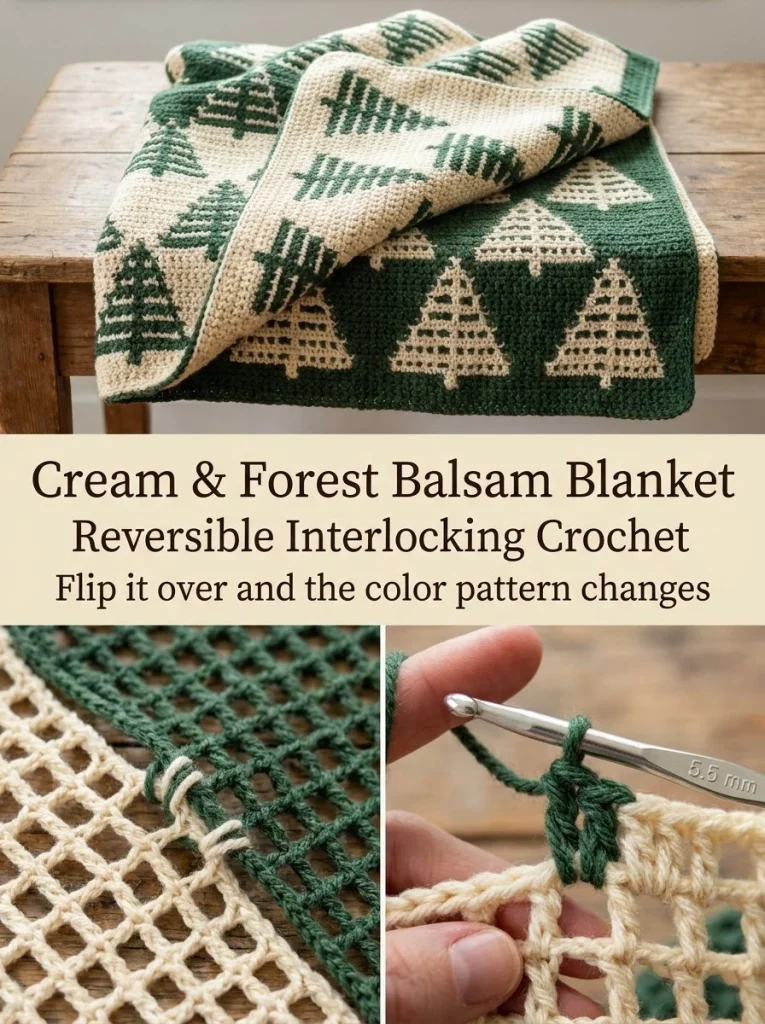
Exploring the rich interplay between nature-inspired colors and innovative crochet technique, this blanket pairs warm cream and deep forest hues in a captivating geometric design. Its distinctive construction uses an interlocking double-filet mesh technique, where two separate crochet layers coexist within the same fabric plane without being physically sewn together. This method produces a sophisticated overlay effect reminiscent of frost-covered forest canopies, perfectly suited for cozy throws or decorative lapghans.
The heart of the project lies in making two offset filet meshes—one in cream and another in forest green—working simultaneously to create a balanced composition of solid and open spaces. Each color alternates rows of double crochets separated by chain-1 windows, but the way these stitches interconnect by passing through openings in the opposite color’s mesh gives the illusion of a single intricate layer woven from tree-like geometric motifs. This elegant visual and structural design can elevate any crochet repertoire to an advanced skillset.
If you appreciate detailed textural blankets knit or crocheted with unique stitch methods, this project complements similar pieces like the sage cream Tunisian chevron blanket, which also features a sophisticated interplay of texture and color but in a Tunisian crochet style. Both projects highlight ways to use two-tone work for an engaging, elegant finish.
Pattern at a Glance
- Skill level: Intermediate to Advanced
- Terminology: US crochet terms
- Construction: Interlocking double-filet mesh worked in two separate color layers
- Finished size: Approximately 42 inches wide by 35 inches long (lapghan)
- Yarn weight: DK #3
- Hook: 5.5 mm crochet hook
- Main stitch: Double crochet (dc) and chain-1 (ch1) windows (filet crochet)
- Gauge: Determined by yarn and hook; mesh openness controls size
- Motifs: Tree-like repeating geometric sequence formed by offset meshes
- Layout: Two color layers, cream and forest, offset by two stitches
- Joining: There is no joining; layers are linked by passing stitches through each other’s mesh windows
- Border: Finished separately on each color layer
- Seaming: None; layers remain distinct and linked only by stitch interaction
Materials
Creating this elegantly textured blanket calls for the following supplies:
- Yarn: DK weight (category 3) yarn in two colors: approximately 1500 yards of warm cream and 1200 yards of deep forest green for the lapghan size. Using a smooth yarn with good stitch definition will help the mesh windows and overlays stand out beautifully.
- Crochet hook: Size 5.5 mm, suitable for DK yarn to yield a balanced fabric that’s not too tight or too loose, allowing clear window openings and flexible drape.
- Stitch markers: Two stitch markers to keep track of pattern repeats or section transitions.
- Tapestry needle: For weaving in ends seamlessly into the respective color layers at the finishing stage.
Having quality materials appropriate for the interlocking filet technique is essential to maintain the structural integrity and maximize the visual impact of the geometric overlays.
Yarn and Color Notes
The choice of yarn fiber can influence the drape and durability of this blanket. A smooth, plied wool or wool-blend DK yarn will provide elasticity and crisp stitch definition, which is critical for the clean window openings that form the characteristic filet mesh. A slightly fuzzy or highly textured yarn might obscure the geometric patterns.
Color selection is equally important. The contrasting warm cream and deep forest colors in this design show off the layered tree-like motifs strikingly, giving the blanket a winter-forest ambiance. Solid colors are recommended to preserve the clarity of the interlocking pattern, whereas variegated yarns could blur the distinct meshes.
For those looking for color inspiration or a similarly textured effect in a different medium, the alpine tweed boucle blanket knitting pattern offers a tweed-inspired alternative that is approachable for beginners and showcases texture and color contrast in a knit fabric.
Finished Measurements
The lapghan-size blanket measures approximately 42 inches wide and 35 inches long upon completion. The width corresponds to the number of stitches in the cream Foundation A mesh, while the length results from repeating cream and forest rows in an alternating sequence.
Because this is an interlocking filet mesh with open windows, exact measurements can vary slightly depending on individual tension and yarn elasticity. The gauge is therefore a guideline rather than a strict requirement but testing swatches is beneficial to ensure satisfied dimensions.
Gauge
While no explicit stitch gauge is given, the fabric’s key characteristics depend on maintaining the proper openness of the filet mesh rows:
- Measure the width across the Foundation A cream mesh after completing a row to check that the stitch count and mesh size fit about 42 inches.
- If your gauge is too tight, the blanket may become smaller and the windows may close up, reducing the delicate overlay effect.
- If your tension is too loose, the mesh could distort, making the top edge uneven and the pattern less defined.
For blankets, exact gauge is somewhat flexible, but balancing mesh openness for aesthetic consistency is crucial for this project’s visual motifs.
Abbreviations
- ch: chain
- dc: double crochet
- st(s): stitch(es)
- rep: repeat
- FP: front post (used conceptually as stitches inserted in front face)
- BP: back post (conceptual for stitches inserted behind or through the back mesh)
Important Pattern Notes
- This blanket uses interlocking double-filet construction, meaning two independent filet meshes interlace physically but are never sewn or crocheted together.
- Each mesh is created in a specific sequence and offset so that stitch windows align properly for the forest images on the cream background and vice versa.
- The cream Foundation A mesh is made with the full stitch count (~42 inches wide), while the forest Foundation B mesh uses two stitches fewer to achieve proper offset.
- Inactive yarn color is always carried behind the working fabric to avoid tangles and maintain visual cleanliness.
- Stitches are placed either on the front or back of the opposing mesh’s chain-1 windows to create the layered appearance.
- Do not crochet the two layers together at stitch tops; linkage happens only by passing the hook through the opposing mesh windows during pattern rows.
- The repeating pattern resembles a tree-like geometric sequence, which must be followed precisely for correct motif placement.
- Both color layers are finished separately along the final edge to preserve fabric structure and aesthetic.
Special Techniques
Interlocking Double-Filet Mesh
This technique involves creating two filet crochet mesh layers that physically occupy the same fabric space but are independent in construction. Stitches from one mesh pass through the windows of the opposite mesh for visual overlay without joining stitch tops.
Filet Row
A filet row consists of double crochet stitches separated uniformly by chain-1 spaces, forming a grid of solid blocks and open “windows” which help create geometric patterns.
Working Stitches on Opposite Fabric Faces
- For stitches appearing on the front face, insert the hook through the chain-1 window of the opposite mesh, catch the working yarn of that color behind, and complete the double crochet in front.
- For stitches on the back face, pass the hook through the opposing mesh window to the fabric’s reverse side before finishing the double crochet.
- Alternating front and back placements along the row builds the complex overlapping pattern that forms the visual motif.
This nuanced insertion requires careful attention to stitch positioning and yarn placement.
Understanding the Construction
The blanket is constructed flat in rows combining two distinct but spatially interlocked layers:
- Foundation: Start by creating two separate chain foundations. The cream Foundation A is the full width; the forest Foundation B is two stitches shorter to offset the meshes.
- Filet Mesh Rows: Each color works a mesh row of double crochets separated by chain-1 windows.
- Interlocking Pattern Rows: Work the pattern rows alternating cream and forest meshes. In these rows, forest double crochets may appear on the cream face by bridging through cream’s chain spaces, and vice versa.
- Layer Separation: Never join the layers by stitching across their tops; they are linked solely by stitches passing through windows of the opposing mesh.
- Continuity: Repeat this alternating sequence until the blanket reaches about 35 inches in length.
- Finishing: Finish edges on both color layers separately, ensuring clean weaving of all yarn ends into the corresponding layers.
This method produces a fabric with the stability of two layers and an aesthetically intricate overlay reminiscent of intertwined branches.
Complete Pattern Instructions
Foundation
- Cream Foundation A: Chain the number of stitches required to achieve approximately 42 inches width based on your gauge and yarn choice. This foundation sets the baseline for the cream filet mesh.
- Forest Foundation B: Chain two stitches fewer than Foundation A to create the forest mesh foundation, allowing the proper horizontal offset of the two layers.
Ensure both foundations are neat and consistent, as they form the structural basis for the interlock.
Filet Rows
For each color starting with their respective foundation:
- Work a row of double crochet stitches separated by chain-1, creating the open mesh windows vital for the overlay effect.
- The inactive color should be kept behind the work to maintain clean fabric fronts and allow smooth stitch insertion.
Because each mesh is a grid, keep track of stitch counts carefully to maintain alignment.
Pattern Rows
- Alternate between cream and forest rows to form the repeating pattern.
- When a forest double crochet needs to appear overlaying the cream mesh, insert the hook through the corresponding cream chain-1 window. Catch the forest working stitch behind this window, then complete the double crochet stitch on the cream side (front face).
- If the stitch is assigned to show on the back, pass the hook to the reverse side through the matching window before completing the double crochet.
- Follow the tree-like geometric sequence to decide which stitches appear on front or back at each point.
- Complete one entire cream row, then one entire forest row, before moving on.
Key Reminder
Never crochet the two layers together by joining stitch tops; allow them to remain linked only by passing stitches through windows in the opposing mesh. This unique linkage maintains fabric flexibility and distinct visual layering.
Repeat Pattern Rows
Continue repeating alternating cream and forest rows following the geometric tree motif sequence. Stop once the blanket reaches approximately 35 inches in length, or your desired length if resizing.
Finishing
Finish both color layers separately along the final edge:
- Bind off each mesh securely but without tightening which may distort the fabric edge.
- Weave all yarn ends into their matching color layer using a tapestry needle to produce an invisible, durable finish.
- Avoid joining layers on the edge; keep them separate to preserve the interlocking structure.
Checkpoint: After completing foundations and a few filet rows, confirm your fabric measures close to 42 inches in width and gauge is consistent. The mesh windows should be even and the offset between layers apparent.
Assembly
No assembly or seaming is needed because both layers coexist within the same fabric:
- The cream and forest layers remain separate structures interlocked through stitch placement.
- Final edges are finished individually, so no joining stitches or seaming methods are applied after completion.
This unique interlocking construction eliminates traditional blanket assembly steps and lends lightness with structural integrity.
Finishing and Blocking
- After weaving in ends, gently block the blanket if desired to even out mesh spacing and smooth edges.
- Use a damp cloth or spray, pin the blanket flat on a blocking surface, ensuring the windows are uniform, and allow to dry.
- Blocking helps sets the shape and accentuates the clean geometry of the pattern.
Avoid aggressive stretching that could distort the two-layer interlock.
How to Resize
To resize the blanket, adjust the stitch count and row number according to the filet mesh repeat multiple:
- Width: Change the starting chain in cream Foundation A by adding or subtracting increments corresponding to the filet repeat unit, keeping in mind that the forest Foundation B foundation always needs to be two stitches shorter to maintain offset.
- Length: Add or reduce pattern rows (pairs of one cream row and one forest row) to increase or decrease length while preserving the geometric tree motif repetitions.
Be sure to maintain the two-stitch offset difference between cream and forest foundations to ensure correct mesh alignment.
Because the technique is mesh-based, each added repeat increases size in multiples of the established filet stitch and row units.
Useful Variations
- One-color version: Create the entire blanket in either cream or forest for subtle texture play rather than color contrast.
- Seasonal palettes: Substitute the forest green for rich autumn oranges or icy blues for a seasonal twist.
- Lapghan or throw sizes: Extend width or length by adding mesh repeats as described above.
- Scrap yarn version: Use several cream and forest tone shades to create gradients or stripe effects within the interlocking mesh, adding visual interest while maintaining pattern integrity.
Experimenting with color shifts in the two layers can yield spectacular effects without altering construction.
Troubleshooting
Why Is My Mesh Not Aligning Properly?
Ensure the foundation chains have the correct stitch counts: cream Foundation A must be the full count, and forest Foundation B two stitches fewer to properly offset meshes. Miscounts cause mismatched windows.
Why Does My Fabric Feel Too Tight or Stiff?
Using a smaller hook or tighter tension closes mesh windows, making it hard to insert stitches through opposing mesh openings. Switch to the recommended 5.5 mm hook and loosen tension.
How Do I Keep Yarns from Tangling?
Always keep the inactive color behind your work, carrying it loosely and using stitch markers if needed to maintain separation during color changes.
Are My Overlay Stitches Hard to Work?
Use a comfortable crochet hook and insert it carefully through the chain-1 windows of the opposite mesh. Practicing this interlocking maneuver before starting the full pattern helps build confidence.
What If I Accidentally Crochet Layers Together?
If you accidentally join the stitch tops of the two meshes, it creates tension and stiffness and loses the layered effect. Use a tapestry needle to carefully undo those stitches and work the stitches through windows only.
Frequently Asked Questions
Can I use a different yarn weight?
This pattern is designed for DK #3 yarn for balanced drape and clear mesh openings. Using heavier yarns will create a denser fabric, possibly obscuring the mesh windows, while lighter yarns may yield a flimsy fabric.
Can a beginner make this?
This project is best suited for intermediate to advanced crocheters comfortable with filet crochet, color changes, and working stitches through opposite fabric layers.
Do I need a special hook?
A standard 5.5 mm crochet hook works well. Avoid hooks that are too small or too large for DK yarn to maintain the right stitch size.
Is the blanket reversible?
Yes, the design creates an attractive overlay effect visible on both sides, though the visual contrast will vary slightly.
Can I make this blanket larger or smaller?
Yes, by adjusting the stitch counts in multiples of the filet repeat and the row repeats, maintaining the two-stitch offset between cream and forest, you can customize dimensions.
How should I block this blanket?
Gently wet-block to even out the mesh, pinning the edges straight without overstretching, preserving the open window design.
Optional Related Uses
The interlocking filet technique demonstrated here could adapt beautifully for:
- Decorative pillow covers emphasizing layered mesh motifs.
- Lightweight scarves with contrasting layered patterns.
- Table runners showcasing geometric overlays.
- Baby blankets sized smaller by adjusting repeat units.
This versatile double-layer mesh can inspire numerous textured projects beyond the lapghan.
Final Thoughts
This unique interlocking double-filet blanket brings home an innovative way to combine color and technique in crochet. By working two offset filet meshes side by side—never sewn together but linked through shared stitch windows—the pattern creates tree-inspired geometric overlays that delight both visually and texturally.
Embracing precise stitch counts, maintaining offset foundations, and mastering the technique of working stitches through opposing mesh layers unlocks the full beauty of this blanket. The result is a two-layered fabric that merges gently into a harmonious textured whole, making this an exceptional project for crocheters seeking both challenge and artistry.



