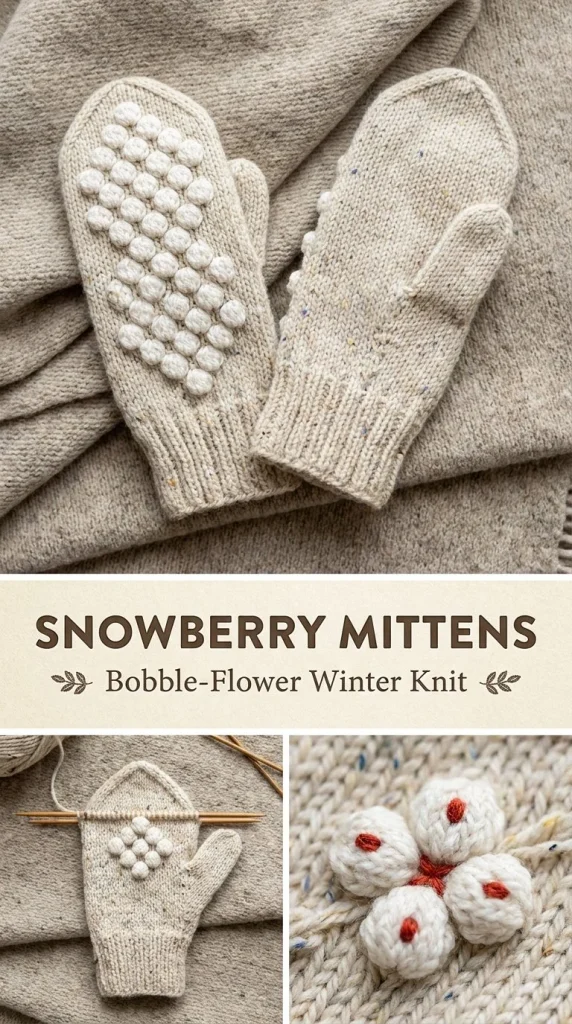
The Snowberry Mittens project offers a delightful combination of cozy warmth and charming vintage-inspired detailing. These adult-sized mittens showcase a beautifully textured fabric created with smooth stockinette stitch, highlighted by unique bobble flower clusters on the back of the hand. Their rolled cuffs provide a naturally elegant edge that enhances comfort while adding style. Worked seamlessly in the round, the mittens shape snugly to the hand with a thumb gusset that ensures fit and mobility. Completing these mittens with delicate embroidered stitches in contrasting color imparts a refined heirloom quality that stands out in handmade winter accessories.
Knitters who appreciate subtle decorative elements will enjoy mastering the bobble flower motifs, which add dimensional charm to an otherwise simple stockinette fabric. By focusing decorative details exclusively on the back of the hand while keeping the palm plain, these mittens maintain functionality without bulk. The rolled cuff is not only attractive but also practical: knitting the cuff on smaller needles encourages it to roll naturally without added finishing. This style creates a classic look reminiscent of vintage knitwear, perfect for gifting or personal use. To explore similar textured stitch patterns, consider reviewing the cranberry moss stitch headband knitting pattern, which complements the takedown of bobble detail in these mittens with a tactile surface.
Pattern at a Glance
Skill level: Intermediate — requires bobble stitch technique and thumb gusset shaping
Terminology: American knitting terms
Construction: Knitted in the round from cuff to fingertip with an afterthought thumb gusset
Finished size: Adult Small/Medium, palm circumference approximately 7.5 in / 19 cm, length about 10.5 in / 27 cm
Yarn weight: Worsted/Aran weight
Needle sizes: US 4 (3.5 mm) for cuff, US 6 (4 mm) for hand
Main stitch: Stockinette stitch with bobble flower clusters on back of hand
Gauge: 20 stitches x 32 rounds = 4 in / 10 cm (stockinette on larger needles)
Motifs: Bobble flowers consisting of 4 bobbles and embroidery detail
Layout: Continuous rounds, with decorative stitches on the back-of-hand half only
Joining: Seamless join in the round, afterthought thumb gusset with bridging stitch
Border: Rolled cuff edge
Materials
To complete the Snowberry Mittens, gather the following materials:
- Yarn: Approximately 180 yards (165 meters) of worsted or aran weight yarn in a main color. The suggested look is a tweedy heirloom white shade to create a timeless, soft base. Additionally, set aside about 5 yards (4.5 meters) of a contrasting color, such as persimmon red, for the embroidered stitch accents on the bobble clusters.
- Needles: A set of double-pointed or circular knitting needles depending on your preference and style. Use US 4 (3.5 mm) needles to knit the cuff portion, which facilitates the rolled effect, then switch to US 6 (4 mm) needles for the hand to create a looser, more comfortable fabric.
- Notions:
- Stitch markers to designate thumb gusset placement
- Waste yarn or a stitch holder to hold thumb stitches while working the hand
- A tapestry needle for weaving in ends and embroidering the finishing stitches
- Additional: A measuring tape or ruler to check gauge and length progress.
These materials ensure you achieve the intended fabric density, fit, and detailed embellishments characteristic of the pattern.
Yarn and Color Notes
When selecting yarn, choose fibers that offer warmth and some elasticity to accommodate a human hand’s shape and movement. Wool or wool blends are ideal for this style. Smooth yarns will define the bobbles and embroidered details crisply, whereas very fuzzy or haloed yarn might obscure these decorations.
For the contrast color stitching, pick a hue that pops against the main body. The pattern’s suggested persimmon red on a tweedy white base imbues a soft vintage feel with a touch of modern vibrancy. While variegated yarns can introduce pleasing visual texture, they may reduce the visibility of the bobble flower shapes and embroidered accent stitches.
Experimenting with color combinations can also make these mittens suitable for personal tastes or seasonal palettes. For a delicate twist, a pastel contrast yarn for embroidery echoes the subtle sophistication of soft knitwear, akin to techniques addressed in the soft pink bobble vest knitting pattern, where bobble textures and color accents unite gracefully.
Finished Measurements
The finished mittens measure approximately:
- Palm circumference: 7.5 inches (19 cm) at the widest part around the hand
- Total length: Approximately 10.5 inches (27 cm) from the cuff fold to the tip of the mitten
These dimensions fit an adult Small/Medium hand. The cuff length is 3 inches (7.5 cm) before switching needle sizes. Ensure your knitting gauge matches the provided guideline to maintain these dimensions and achieve comfortable fit — alterations without gauge adjustment could affect sizing.
If you have larger or smaller hands, consider the resizing section later in this article for guidance on modifying stitch counts accordingly.
Gauge
Achieving the correct gauge is critical for fit, especially in garments and accessories involving shaping such as thumb gussets and fitted tops. The recommended gauge for this pattern is:
- 20 stitches x 32 rounds = 4 inches / 10 cm in stockinette stitch on US 6 (4 mm) needles.
Measure your gauge over a swatch knitted in stockinette stitch using the specified needles and yarn. Use a ruler or gauge tool to count stitches and rounds accurately. If your gauge is too tight (more stitches per inch), the mittens will be smaller and tighter than intended. Choose larger needles to loosen gauge in that case.
Conversely, a loose gauge (fewer stitches per inch) will produce mittens that are longer or wider. Smaller needles will help tighten gauge to the correct measurement.
Regularly measuring your progress against these parameters assures proper fit and comfortable wear.
Abbreviations
- CO: Cast On
- sts: Stitches
- rnd(s): Round(s)
- k: Knit
- yo: Yarn Over
- dec: Decrease
- CO: Cast On
Note: The pattern involves a unique bobble technique expanding one stitch into four, then compressing back.
Important Pattern Notes
- The mittens are worked in continuous rounds, joined without turning rows. This seamless construction improves both comfort and aesthetics.
- The cuff is worked on smaller needles to create a naturally rolling edge that requires no finishing treatment.
- The bobble flower cluster decoration is confined exclusively to the back-of-hand half of the mitten, leaving the palm plain for grip and wearability.
- The thumb gusset is formed using strategically placed stitch markers and increases every third round, producing a comfortable thumb shaping without interrupting the round’s continuity.
- The thumb itself is knitted after the main hand, employing an afterthought gusset technique involving holding stitches on waste yarn.
- Embroidery is added last onto each bobble cluster to enhance the flower motif with subtle horizontal stitches.
- Use of a bridge stitch between thumb opening stitches allows for smooth continuation of the round and easier thumb pick-up later.
Special Stitches and Techniques
Bobble Stitch Method
Bobbles are key decorative elements in this pattern, appearing as small clustered flower motifs on the back of the hand.
The bobble technique here involves:
- Increasing one stitch into four total stitches.
- Working these four stitches back and forth for two short passes without turning the mitten as a whole, producing a little raised bump.
- Passing three of these stitches over the first stitch to consolidate back into one stitch.
This creates a firm but rounded bump that stands out on the fabric.
Rolled Cuff
Knitting the cuff on smaller needles and in stockinette naturally causes the edge to roll inward, acting as a simple decorative border that does not require picking up stitches or binding off differently.
Afterthought Thumb Gusset
The thumb increase stitches are placed on markers around the palm’s center stitch. After completing increases to reach 13 thumb gusset stitches, these are moved to waste yarn to hold while the hand continues knitting. A bridge stitch is cast on to connect the thumb gap, enabling knitting in the round to proceed uninterrupted. Later, the thumb stitches are returned to needles and knitted separately.
Understanding the Construction
These mittens begin at the cuff, working upward to the fingertips, knitted seamlessly in the round. The smaller US 4 needles produce a snug, rolled edge cuff that naturally folds without finishing.
After the cuff, the needle size increases to US 6 for the hand section, producing a softer, more flexible fabric ideal for comfortable wear. The hand is worked plain stockinette except for the back side, where the bobble flower clusters are incorporated for decoration.
A thumb gusset is created mid-round with increases at markers, shaping a widened area around the thumb’s base. Once the gusset stitch count is reached, those stitches are removed and held for the thumb, and a bridging stitch is cast on so the main hand continues in the round without interruption.
Once the hand reaches near complete length, the top shaping begins through controlled decreases forming the rounded fingertip closure.
Finally, the thumb is knitted on separately, decreasing after knitting about 2 inches (5 cm) to taper the tip, before closing. Embroidery accents finish the floral bobbles.
Foundation: Casting On and Cuff Preparation
Begin by casting on 38 stitches using US 4 (3.5 mm) needles. Join your stitches carefully to work in the round, ensuring they are not twisted around the needle.
Knit every round continuously for 3 inches (7.5 cm) on these smaller needles. This deliberate length allows the cuff edge to roll naturally inward, creating a soft, fabric border without additional finishing. The rolled cuff both frames the design and helps secure the mitten snugly to the wrist.
Hand Body: Transition and Plain Rounds
Switch to US 6 (4 mm) needles after completing the cuff. This change permits the fabric to loosen slightly for flexible, warm coverage.
Work 6 plain stockinette stitch rounds on these larger needles with knit stitches all around. This plain section is the foundation below the decorative bobble flowers.
Bobble Flower Embellishments
Focus bobble placement on the back-of-hand half only:
- Knit a small flower cluster made of 4 bobbles centered on the back of the hand.
- Add a second, smaller bobble cluster positioned above the first.
- Keep the palm side plain for functionality.
To work a bobble:
- Increase a single stitch into 4 stitches.
- Without turning the mitten around, work the four stitches back and forth for two short passes.
- Pass the last three stitches over the first stitch to return to 1 stitch, thus completing the bobble.
This approach produces rounded, dimensional bobbles that look like tiny flowers.
Thumb Gusset: Marking and Increasing
Locate the center stitch of the palm area and place stitch markers around it to identify the thumb gusset placement.
Increase 1 stitch just inside each marker every 3rd round until there are 13 thumb gusset stitches total. This increment opens up space for thumb shaping while maintaining the round structure on the hand.
Once the gusset stitch count is reached:
- Transfer the gusset stitches to waste yarn or a stitch holder.
- Cast on 1 bridge stitch between the thumb gap stitches.
- Continue knitting the hand in the round seamlessly with the bridging stitch connecting the gap.
Working the Hand Length and Top Shaping
Knit in the round until the hand measures approximately:
- 7.75 inches (19.5 cm) from the cuff fold, or
- Stops 1.75 inches (4.5 cm) short of your desired finished length to allow for shaping and finishing.
To shape the mitten’s top:
- Divide the total stitches into two equal sections representing the palm and back of the hand.
- Begin decreasing stitches at both edges of each section every other round initially.
- As you proceed near the tip, switch to decreasing every round.
- Continue decreasing until 10 stitches remain.
- Draw yarn through these remaining stitches to close the mitten tip securely.
Thumb Knitting and Closure
Return the held thumb gusset stitches from waste yarn back to the needles. Pick up 1 or 2 stitches across the gap over the bridge stitch to close the thumb opening seamlessly.
Knit the thumb straight until it measures about 2 inches (5 cm) in length.
Then decrease evenly over 2 rounds to taper the thumb tip.
Finally, draw yarn tightly through the remaining stitches to close the thumb tip cleanly.
Embroidery and Finishing Touches
Use the contrasting yarn to embroider 3 short horizontal stitches centered within each 4-bobble flower cluster. This subtle touch brings a dash of color and defines the flower shapes with delicate contrast.
Weave in all yarn ends thoroughly using a tapestry needle to keep the interior smooth and avoid discomfort.
Complete the finishing by wet blocking your mittens to shape and soften the fabric, encouraging the rolled cuff to lie evenly and the bobbles to stand nicely.
Helpful Checkpoints
- After casting on and working the cuff, your piece should measure roughly 3 inches (7.5 cm).
- The bobble clusters’ placement should be centered on the back of the hand, not crossing over to the palm side.
- The thumb gusset increases should produce a total of 13 stitches before being set aside.
- Hand length should be measured from cuff fold for accuracy before beginning top shaping.
- Ensure embroidery threads are firmly secured and not too tight to avoid puckering.
Assembly
Since the mittens are knit in the round, there is no seaming or joining apart from weaving in ends.
The thumb is knitted separately after the main hand, then closed and embroidered. No additional assembly is required.
Finishing and Blocking
Wet blocking is essential for a polished final look:
- Gently soak the mittens in lukewarm water.
- Squeeze out excess water without wringing.
- Lay flat on a towel, shaping the rolled cuff, bobble clusters, and thumb tip for uniformity.
- Allow to dry fully.
Blocking opens the fabric slightly and evens out stitches, enhancing comfort and longevity.
How to Resize
To resize these mittens:
- Adjust the initial cast-on stitch count in multiples that maintain the stitch pattern integrity (ideally multiple of the pattern’s base gauge).
- Increase the number of stitch increases in the thumb gusset proportionally, maintaining the same ratio to total stitches.
- Adjust hand length by knitting more or fewer rounds after the gusset as needed.
- Remember to re-check gauge with your chosen yarn and needles to ensure fit.
This approach will scale the mittens up or down while preserving design elements like the bobble clusters’ placement and cuff roll.
Useful Variations
- One-color mittens: Skip embroidery and use a single yarn for a minimalist look.
- Color-block mittens: Use contrasting colors for cuff and hand sections.
- Longer cuffs: Add length by knitting more rounds on smaller needles before switching.
- Seasonal palettes: Choose yarn shades celebrating holidays for gift giving.
- Coordinated accessories: Pair these mittens with matching items like hats or vests to complete a set, similar in texture and decoration to patterns such as the soft pink bobble vest knitting pattern.
Troubleshooting
Why Is My Cuff Not Rolling?
The rolled cuff is achieved by knitting on smaller needles to tighten stitches. Using needles that are too large or working purl stitches can prevent rolling. Ensure you use US 4 (3.5 mm) needles and knit every round without switching stitch types.
Why Do My Bobbles Look Flat or Uneven?
Make sure to increase one stitch into four, and work the four stitches back and forth twice without turning the mitten fully. When passing three stitches over the first, do so gently to form a neat, rounded bobble.
I’m Losing Track of Thumb Gusset Increases
Place stitch markers clearly before starting increases and count stitches every round to confirm you have the correct number. Increasing every third round, just inside the markers, helps keep increments consistent.
My Thumb Opening Has a Gap or Is Too Tight
Casting on the single bridging stitch between thumb gusset stitches creates a stable bridge allowing for smooth knitting around the thumb. If the bridging stitch is missing or too tight, pick up 1–2 stitches across the gap when returning the thumb to needles to close the gap neatly.
Embroidery Looks Crooked or Too Tight
Loosen embroidery stitches slightly and ensure they are centered on each bobble cluster. Embroidery added after full blocking helps the fabric settle beneath the stitches.
Frequently Asked Questions
Can I use a yarn other than wool?
Yes, but wool’s elasticity and warmth make it ideal. Blends with acrylic or alpaca are suitable. Avoid purely cotton yarns as they lack stretch and may not retain shape well.
Is this pattern suitable for beginners?
Intermediate knitters will find the bobble and thumb gusset techniques challenging but rewarding. Beginners with basic knitting in the round skills can try it with practice on bobbles separately.
Do I have to embroider the mittens?
Embroidery adds charming detail but can be omitted for a simpler look.
Can I make these mittens larger or smaller?
Follow the resizing guidance above, adjusting cast-on stitches and thumb increases proportionally.
What if my gauge is different?
Choose needle size accordingly to match gauge; adjust stitch counts carefully if gauge varies significantly.
How should I care for these mittens?
Hand wash gently in cool water and lay flat to dry to preserve shape and softness.
Optional Related Uses
The bobble stitch technique and afterthought gusset method used in these mittens suit projects like fingerless gloves, hats with bobble motifs, or cozy vests. The rolled edge cuff concept translates well to wristwarmers or headbands, providing a similar natural edge without complex finishing.
Final Thoughts
This pattern combines classic construction with delicate decorative details. From the rolled cuff that frames the piece to the charming bobble flower motifs and careful thumb gusset shaping, each element is designed for both aesthetics and comfort. Working seamlessly in the round offers a graceful knit fabric that fits well and wears beautifully. The final embroidery brings the flower clusters to life with a subtle contrast that elevates this pair to heirloom quality.
By following detailed instructions and leveraging the rich explanation provided here alongside the central technical pattern, you’ll create a pair of mittens tailored for warmth, elegance, and lasting enjoyment.



