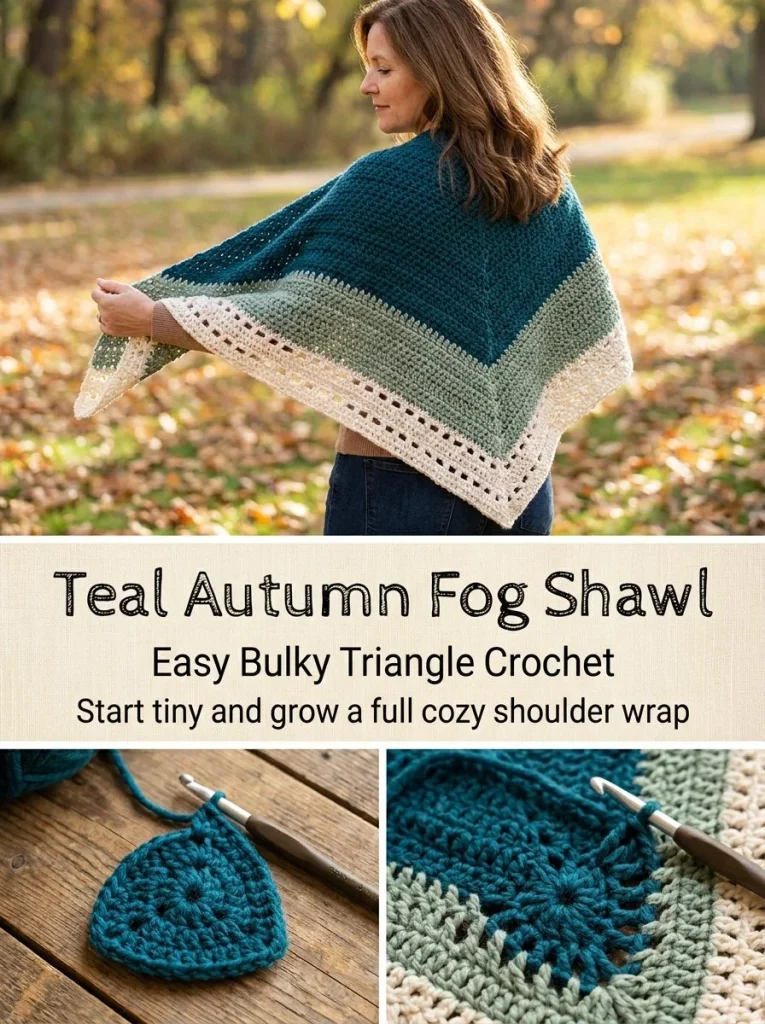
Creating a cozy, visually captivating shawl that embodies the rich hues of autumn requires a blend of thoughtful design and straightforward construction. This project explores an elegant triangular shawl worked in bulky yarn, combining deep teal with subtle sage and cream transitions to evoke a misty, atmospheric feeling perfect for chilly days. The design uses a repeating pattern sequence with alternating textured stitches to create an inviting layered fabric that is both warm and lightweight.
Crocheted from the top center outward, the shawl grows symmetrically with increases along both edges and the central spine, ensuring balanced shaping without complex stitch counts. The color transitions provide a soft gradient effect, enhancing the shawl’s dimensionality and visual interest. Whether wrapped around the shoulders for added warmth or styled as an accessory, it delivers both practicality and understated beauty. For those looking to explore similar cozy autumn projects, this pattern pairs well with designs like the entertaining autumn color block scarf to complement your seasonal wardrobe.
Pattern at a Glance
Skill level: Intermediate (due to shaping and stitch pattern variations)
Terminology: US crochet terms
Construction: Top-down, triangular shawl worked in rows with increases at edges and center
Finished size: Approximately 68 inches wingspan by 30 inches deep
Yarn weight: Bulky (#5)
Hook size: 6.5 mm
Main stitches: Double crochet (dc), single crochet (sc), chain (ch)
Gauge: Not explicitly provided but adjustable for size and drape
Motifs: No separate motifs; pattern stitch repeats create fabric texture
Layout: Single triangular panel
Joining: None (single piece construction)
Border: None specified, finished by weaving ends
Seaming: None
Materials
To achieve the rich color palette and warming texture this shawl needs, gather the following materials:
- Bulky #5 yarn: Approximately 630 to 700 yards, featuring a gradient from deep teal through muted sage to cream. This choice adds both softness and structure, allowing the pattern’s texture to stand out clearly.
- 6.5 mm crochet hook: Matches the bulky yarn to give a comfortable fabric weight that is neither too tight nor overly loose.
- 3 stitch markers: Used for marking key stitches such as the first stitch, center, and last stitch to help with symmetrical increases and shaping.
- Tapestry needle: For weaving in ends smoothly once the piece is finished.
Each tool and material complements the overall feel of the project, creating a finished item that is warm but not heavy, comfortable yet visually striking.
Yarn and Color Notes
Bulky yarn is an ideal choice to provide warmth and a plush texture without requiring an overly dense fabric. Look for fibers that feel soft against the skin, such as blends of wool and acrylic, or pure wool depending on preference and care requirements. Avoid overly fuzzy or novelty yarns that may obscure stitch definition.
The color transitions in this pattern—from a deep teal base to subtle muted sage and finally cream—simulate the gentle fade of autumn fog and changing leaves. Using a skein or gradient yarn that provides these shifts naturally can add visual interest without complicated color changes. Alternatively, you may manually switch skeins if your chosen yarn does not come in gradient form.
For a harmonious look, pair the visual effect of this shawl with other autumn-inspired projects such as an autumn knit scrunchie trio to complete coordinating accessories.
Finished Measurements
The finished shawl spans approximately 68 inches across the wingspan (the longest edge which rests across the shoulders) and measures about 30 inches deep from top center to bottom point. This generous size offers ample coverage and can be styled in several ways: draped loosely, wrapped around the neck, or fastened with a shawl pin.
Because of the triangular shape, the depth measurement determines how far down the shawl will fall on the body, making it cozy enough for crisp outdoor wear while maintaining elegant drape.
Gauge
No specific gauge is provided for this project, but since the shawl’s dimensions are based on working a particular set of rows with incremental increases, achieving exact gauge is less critical than with fitted garments.
However, keep in mind:
- A tighter gauge will result in a smaller, denser shawl, which might feel more structured but less flowy.
- A looser gauge will produce a larger, drapier shawl with more openness in the stitch pattern.
If you alter your hook size or yarn brand, check by working a swatch of the core stitches until you are satisfied with the fabric feel and size.
Abbreviations
- ch: chain
- dc: double crochet
- sc: single crochet
- st(s): stitch(es)
- ch-space: chain space
All instructions follow standard US crochet terminology.
Important Pattern Notes
- The shawl is shaped by increasing stitches at both edges and the center stitch to maintain a balanced triangular shape.
- Turning chains are worked according to the established height of each row’s stitch type (for dc rows, ch4; for sc rows, ch1; etc.).
- Chains created for turning do not count as stitches in this pattern.
- Stitch markers are essential to mark the first stitch, the center stitch for increases, and the last stitch for ease of increases.
- Color transitions should be introduced according to the instructions for a subtle gradient effect.
Special Stitches and Techniques
- Double Crochet (dc): A fundamental stitch creating the solid solid portions of the shawl.
- Single Crochet (sc): Used in certain rows to add texture and contrast.
- Chain 3/Dc groups: These form open spaces and textured loops, alternating with solid stitches to enhance the lacy feel.
- Increases: Applied at both edges and center by working multiple stitches into a single stitch or chain space.
Understanding how these stitches alternate to create fabric texture helps in maintaining an even gauge and symmetrical growth.
Understanding the Construction
This shawl begins with a small center base—a foundation chain with multiple double crochets worked into a single chain to form the triangle’s tip. The piece grows outward symmetrically through carefully placed increases at the beginning and end of each row and centrally.
The pattern repeats a sequence of four rows that alternate between solid double crochet lines, open chain spaces, and decorative loops using single crochet and chain combinations. This sequence extends the shawl gradually, keeping the fabric light but warm.
Color changes progress naturally from the predominant teal through sage and finally creamy off-white in the last textured rows, enhancing the design’s organic, foggy palette.
Complete Pattern Instructions
Foundation
Start with a chain of 4.
Row 1
Work 6 double crochets (dc) into the 4th chain from the hook. This creates a small cluster of stitches forming the tip of the triangle.
Place stitch markers on the first stitch, the center stitch, and the last stitch to help with pattern shaping across future rows.
Row 2
Chain 4 (counts as first dc plus turning chain), turn your work.
Make 1 dc in the same first stitch to create an edge increase.
Then, chain 1, dc in the next stitch repeat across the row.
Finish with a chain 1 and 1 dc in the last stitch to increase the opposite edge.
Row 3
Chain 1 and turn.
Work 1 single crochet (sc) in the first stitch.
Then, chain 3, skip the next chain space, sc in the next dc across the row.
End with an sc in the final stitch.
Row 4
Chain 3, turn.
Work 1 dc in the same first stitch.
Then work repeating groups of chain 3 followed by a dc across the row.
Place an extra dc group around the center marker to maintain the triangular center expansion.
Finish the row with 2 dc in the last stitch to increase the edge.
Continuing the Pattern
Repeat this four-row sequence:
- Solid dc row with increases at edges and center.
- Row with chain spaces and dc stitches.
- Row alternating sc and chain loops.
- Row with dc groups expanding the center using extra increases.
Consistency in marking edges and center stitches with stitch markers ensures symmetrical shaping.
Maintain the color scheme by working with the deep teal for most of the shawl’s body. Introduce muted sage yarn during the final third of the stitches. For the last few rows featuring textured loops, switch to cream yarn to create a soft, elegant finish.
Completion
Continue repeating the pattern until the wingspan measures approximately 68 inches. The depth should be about 30 inches.
Finally, weave in all ends carefully using a tapestry needle to secure and tidy the piece.
Helpful Checkpoints
- After completing Row 1, your piece should form a small cluster simulating the triangle’s tip.
- When you finish multiple repeats, check that your increases at the edges and center maintain symmetrical triangular shaping.
- Ensure the wingspan and depth measurements match the target sizes to achieve the right fit.
- Keep your stitch markers in place throughout for accuracy.
Finishing Techniques
Weaving in ends neatly avoids loose yarn tails that might snag during wear.
While the pattern does not specify blocking, gently blocking the finished shawl can open up the lace-like sections and smooth the edges. Use blocking pins suitable for your fiber and allow the piece to dry flat in the desired shape.
How to Resize
To make the shawl larger or smaller while preserving the pattern:
- Increase or decrease the number of 4-row repeats. Each repeat expands the wingspan and depth proportionally.
- To alter width beyond repeating rows, consider adjusting hook size or yarn weight slightly.
Because shaping depends on increases at the edges and center, avoid skipping increases to keep the triangle symmetrical.
Useful Variations
- Solid Color: Make the entire shawl in one color for a classic, versatile look.
- Color Blocking: Introduce different color blocks earlier or more frequently to create stripes or sudden color changes.
- Smaller Size: Stop the pattern earlier for a petite shawl or scarf-sized accessory.
- Textured Border: Add an optional border with complementary stitches for extra detail.
Troubleshooting
Why Is My Shawl Not Laying Flat?
Ensure increases are correct at both edges and the center to maintain even shaping. Missing or misplaced increases create uneven fabric prone to curling or ruffling.
Why Are My Edges Uneven?
Double-check that you place stitch markers on the first stitch, center stitch, and last stitch at the start of each row and increase outward equally.
How Can I Avoid Holes in the Fabric?
Stick to the pattern’s stitch counts and chaining instructions. Holes may arise if stitches are skipped accidentally or chains are worked incorrectly.
My Color Transitions Are Harsh. How Can I Improve This?
Use a gradient yarn or blend colors gradually by alternating a few rows of each color before switching fully.
Frequently Asked Questions
Can I use a different yarn weight?
Yes, but you should adjust the hook size and expected size accordingly. Thinner yarns require smaller hooks and more repeats; thicker yarns create heavier fabric.
Can a beginner make this shawl?
Intermediate crochet skills are recommended because of shaping and stitch pattern changes. Familiarity with dc, sc, and working with stitch markers is necessary.
How should I care for this shawl?
Follow the yarn manufacturer’s instructions. Hand washing and flat drying are safest with bulky wool blends.
Is the pattern reversible?
The pattern has texture variation, so the right side has more defined stitch patterns. It is mostly meant to be worn with the right side outward.
Can I substitute colors?
Absolutely. Choose colors that blend well and inspire the soft, foggy feeling for best aesthetic results.
How do stitch markers help in this pattern?
Markers track the edges and center stitch, guiding where to place increases for symmetrical growth without counting every stitch each row.
Optional Related Uses
The stitch combination and shaping could be adapted for:
- Lightweight scarves with fewer repeats.
- Larger wraps by adding more rows.
- Textured cowls using circle shaping with similar stitch sequences.
Final Thoughts
This shawl merges rhythmic stitch patterns with thoughtful shaping to create a cozy, drapey accessory inspired by the misty colors of autumn. The consistent increases at edges and center maintain an elegant triangular symmetry, while textured rows add visual depth. Working from a bulky yarn with soft, gradient hues, this piece fits naturally into cooler weather wardrobes as a versatile wrap or statement layer.
The project unfolds in clear stages: establish the foundational stitches, maintain symmetrical growth by carefully marking edges and center, and transition colors gently toward the end. With only basic stitch knowledge and an attention to detail, this shawl pattern makes for a satisfying, practical project full of seasonal charm.



