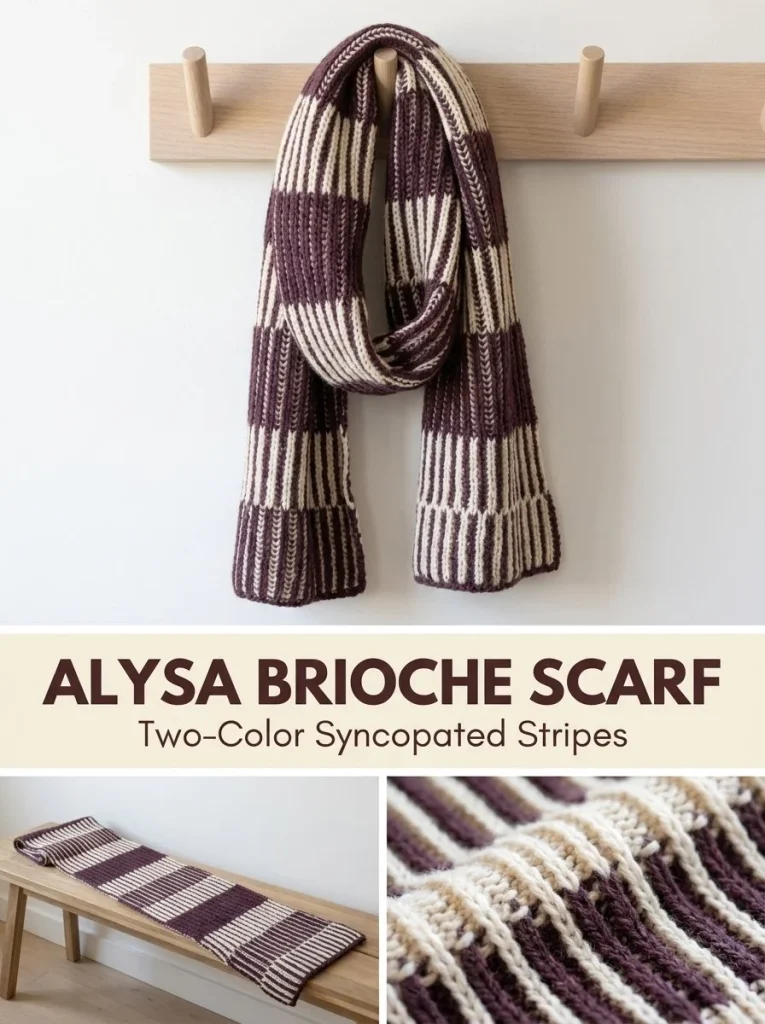
Creating a scarf using two-color brioche knitting offers a luxurious and reversible fabric with complex texture and vibrant color interplay. This scarf showcases not only the classic elegance of brioche stitch but also adds a modern twist with syncopated stripes that reverse the knit-and-purl columns, giving the piece dynamic visual interest. Crafted from worsted-weight smooth wool in a striking high-contrast pair of colors, the Y-shaped fabric pulls double duty—its rounded ridges define a sumptuous hand feel, while the contrasting stripes provide a rhythmic pattern that is both bold and harmonious.
The design is worked using an odd stitch count, perfect for the brioche stitch, which is known for its stretchy, lofty fabric structure. The use of a circular needle simplifies the two-pass row construction inherent in two-color brioche, facilitating smooth transitions between colors while maintaining an easy workflow. This project is a striking way to deepen your knowledge of brioche knitting while creating an accessory that is perfect for chilly days, wrapping comfortably around the neck. For knitters interested in scarves with unique textures and patterns, the alternation of conventional brioche and syncopated stripes offers a fresh take on a classic stitch method. Those intrigued by colorwork in knitting might also appreciate designs like the Acorn Brown Keyhole Scarf Knitting Pattern, which similarly explores intriguing yarn combinations and texture.
Pattern at a Glance
Skill level: Intermediate to Advanced (due to brioche two-color technique)
Terminology: Standard US Knitting Terms
Construction: One continuous piece worked in two-color brioche on circular needles
Finished size: Approximately 7 inches wide by 68 inches long (18 x 173 cm)
Yarn weight: Worsted weight
Needles: US 7 / 4.5 mm circular needle, length 16-20 in / 40-50 cm
Main stitch: Two-color brioche with syncopated stripes
Gauge: About 15 stitches x 17 rows = 4 in / 10 cm in two-color brioche
Motifs or repeats: Stripes of alternating brioche knit/purl columns in 6-row blocks
Layout: Rectangular scarf with symmetrical ends
Joining: Not applicable (worked in one piece)
Border: No separate border; edges formed by firm but loose edge stitches
Seaming: None required
Materials
This project requires two complementary high-contrast yarn colors in worsted-weight smooth wool to highlight the brioche texture and striped pattern. The yarn suggested is Rowan Pure Wool Superwash Worsted, with one 100 g / 219 yd ball in “Raisin” as the main color (MC) and one 100 g / 219 yd ball in “Soft Cream” as the contrast color (CC).
You will also need:
- A US 7 / 4.5 mm circular knitting needle, preferably 16-20 inches (40-50 cm) long, to accommodate the two-pass rows.
- A removable stitch marker to keep track of rows or pattern changes if desired.
- A tapestry needle for weaving in ends and final finishing.
Gauge swatching before beginning is essential to achieve the scarf’s correct finished size and ensure smooth brioche stitches. The gauge is around 15 stitches and 17 rows per 4 inches (10 cm) in two-color brioche, so matching this gauge helps ensure the scarf stretches and drapes appropriately.
Yarn and Color Notes
Choosing the right yarn fiber and colors can significantly impact both the process and result. Worsted weight wool is ideal for this brioche scarf, providing warmth, elasticity, and good stitch definition. Pure wool tends to hold its shape well during blocking, preventing unwanted sagging while maintaining softness.
Smooth yarns showcase brioche stitches elegantly because the stitch structure has a lot of depth and texture. Avoid overly fuzzy or highly textured yarns, as they can obscure the stitch details and make it harder to see the distinct knit and purl columns created by the two-color brioche process.
For color selection, using two solid, contrasting colors maximizes the visibility of the syncopated stripe design. While this pattern uses deep raisin and soft cream, you could experiment with other pairs, as long as they contrast sufficiently to highlight the stitch texture. Solid yarns work best here, rather than variegated or tonal, which can distract from the stripe effect. For further inspiration on color blocking in scarves, consider exploring the Autumn Color Block Chunky Scarf Knitting Pattern, which similarly plays with bold color contrasts and textural knitting.
Finished Measurements
The scarf finishes at approximately 7 inches (18 cm) wide and 68 inches (173 cm) long, a generous length suitable for multiple wraps or comfortable draping. The width is governed mainly by the cast-on stitch count of 27 stitches and the yarn weight. Length is controlled by the number of brioche rows worked as described in the pattern.
Because the stitch pattern used—the two-color brioche—is fairly stretchy and lofty, these dimensions offer a nice balance of warmth and sleekness without excessive bulk.
Gauge
This pattern’s gauge is calculated as roughly 15 stitches by 17 rows = 4 inches (10 cm) in two-color brioche. Always check your gauge before beginning by knitting a well-sized swatch.
- To measure gauge, lay your swatch flat without stretching and count 15 stitches across and 17 rows vertically to match 4 inches by 4 inches.
- If your gauge is larger (more stitches per inch), the scarf will come out narrower and possibly shorter, so consider using larger needles or adjusting your tension.
- Conversely, if your gauge is smaller, the scarf may be wider and longer, which might be desirable but will affect yarn use estimates.
Correct gauge ensures the scarf’s patterning and fabric structure behave as intended and that the final measurements correspond to the pattern design.
Abbreviations
- MC: Main Color (Raisin)
- CC: Contrast Color (Soft Cream)
- BRK1: Brioche Knit 1 — knit stitch together with its yarn-over wrap
- BRP1: Brioche Purl 1 — purl stitch together with its yarn-over wrap
- SL1YO: Slip 1 with yarn over — part of brioche stitch technique
- sts: stitches
- rep: repeat
Important Pattern Notes
- The scarf is worked using two-color brioche, which requires knitting in two colors simultaneously across the fabric. Each "row" is actually two passes (rows) — one using the MC and one using the CC.
- This necessitates using circular needles so that after completing the first color pass of each row, you can slide the stitches back to the start without turning the work. This approach allows for continuous knitting in the round, simplifying handling of two-color brioche.
- Maintain an odd number of stitches (27) for the stitch pattern balance.
- Edge stitches on both passes are worked firmly but not tight to ensure neat, stable edges without puckering.
- Syncopated stripes are created by reversing which brioche columns are knitted and purled for blocks of 6 completed rows each, imparting visual rhythm to the colorwork.
Special Stitches and Techniques
The key technique here is the two-color brioche stitch, which creates a raised, ribbed, and reversible fabric involving paired knitting passes.
- BRK1 (Brioche Knit 1): On the MC pass, you knit one stitch together with its yarn-over wrap from the previous CC pass. This creates elongated stitches characteristic of brioche.
- SL1YO (Slip 1 with Yarn Over): A slipped stitch with a yarn over to prepare for the complementary brioche knit or purl on the next pass.
- BRP1 (Brioche Purl 1): On the CC pass, you purl the stitch together with its YO wrap.
These techniques alternate to form a lush, bicolor fabric. The special brioche knitting method requires some practice but greatly enhances the scarf’s texture and color depth.
Understanding the Construction
The scarf is knit flat but on circular needles to facilitate the two-color brioche technique. The pattern begins with a stretchy long-tail cast-on of 27 stitches in the MC color. The two-color brioche stitch is then established and worked over multiple rows following a sequence that alternates active colors each pass.
The construction includes three main sections:
- An initial 32 rows of regular two-color brioche, establishing the base fabric and edge stability.
- A central section of syncopated stripes, where brioche knit and purl columns reverse every 6 completed rows to create an engaging striped effect over 16 blocks plus one final syncopated block.
- A finishing section mirroring the beginning with another 32 rows of regular two-color brioche so both scarf ends match visually.
This structure creates a balanced scarf with a thoughtful play of color and texture, symmetrical in design and pleasing in hand feel.
Complete Pattern Instructions
Foundation
Begin by casting on 27 stitches with the Main Color (MC) using a stretchy long-tail cast-on method. This provides elasticity for comfortable scarf edges.
Working the Two-Color Brioche Stitch
Because two-color brioche requires two passes to complete each row, work on circular needles and after completing the first color pass, slide the stitches back to the starting needle tip instead of turning, maintaining your working position.
Stitch count remains constant at 27 throughout.
MC Pass (Main Color Pass)
- Work the edge stitch firm but not too tight to create a clean edge.
- Then alternate between BRK1 (knitting the stitch together with its YO wrap) and SL1YO (slipping one stitch with its yarn over). This produces the raised brioche knit columns.
- End with the last edge stitch worked firmly as well.
CC Pass (Contrast Color Pass)
- Work the edge stitch firmly.
- Work the alternating complementary sequence of SL1YO and BRP1 (purl together with its YO wrap) across the row. This balances the MC pass to create the full brioche pattern.
- End with the last edge stitch firmly worked.
Regular Two-Color Brioche Section
Work this regular two-color brioche pattern for 32 completed rows (64 passes; 32 MC passes and 32 CC passes). This establishes a consistent base texture.
Syncopated Stripes Section
Now begin the distinctive syncopated stripes by reversing which columns are knitted and purled in the brioche pattern.
- Work 6 completed rows in this reverse orientation.
- Then return to the original brioche pattern for 6 completed rows.
Alternate these two 6-row blocks—the reversed and original brioche—for a total of 16 stripe blocks, ending with one final syncopated (reversed) block.
Finishing Brioche Section
After completing the stripes, return to the regular two-color brioche pattern and work another 32 two-color brioche rows to mirror the scarf’s beginning, ensuring both ends match perfectly.
Bind Off and Finishing
- Cut the CC yarn and work one final securing row with the MC.
- Bind off loosely in pattern to maintain scarf elasticity.
Washing and Blocking
- Wash the scarf gently by hand in lukewarm water to relax the fibers without stretching.
- Lay flat to dry, shaping to approximately 7 inches by 68 inches.
- Avoid stretching during drying to maintain fabric proportions.
This finishing ensures the scarf’s brioche stitches bloom to their full textured beauty while preserving the scarf’s crisp edges.
Helpful Checkpoints
- After the first 32 brioche rows, your work should feel evenly textured, with about 7 inches in width.
- After each 6-row syncopated stripe block, examine that the knit and purl columns are visibly reversed and aligned.
- After finishing all stripe blocks and the final 32 brioche rows, the scarf’s ends should mirror each other in pattern and length.
How to Resize
To adjust the width of the scarf, modify the cast-on stitch count by adding or subtracting multiples of 2 stitches, maintaining an odd total stitch count to preserve the brioche pattern integrity.
Length can be altered by working more or fewer rows in the key sections: the initial 32-row brioche section, syncopated stripe blocks (each set of 12 rows per full stripe pair), and ending 32-row brioche section.
Note that changing stitch count or row count will affect yarn requirements and finished size; always swatch to maintain the gauge of 15 stitches x 17 rows per 4 inches / 10 cm.
Useful Variations
- Use different high-contrast color pairs to customize your scarf’s look, e.g., jewel tones, pastels, or monochrome grey-scale.
- For a warmer, chunkier version, substitute the yarn with a bulky weight and correspondingly larger needles, adjusting stitch and row counts proportionally.
- Explore a single-color version of the brioche technique, simplifying the process but retaining the lofty texture.
- For a wider scarf, cast on additional stitches while respecting the odd stitch count required by brioche.
Exploring similar projects such as the Autumn Color Block Chunky Scarf may inspire new color and texture combinations that complement this brioche scarf beautifully.
Troubleshooting
Why is My Brioche Edge Tight or Puckered?
Edges should be worked firmly but not tight. If they curl or pucker, try loosening your tension or experimenting with slightly larger needles for edge stitches.
Why Can’t I See the Contrast Color Clearly?
Make sure you use high-contrast and solid-color yarns. Smooth yarns showcase brioche textures better than fuzzy or variegated yarns.
Why is My Stitch Count Changing?
Ensure you are consistently performing brioche knit and purl stitches correctly, slipping the yarn over stitches (SL1YO) as directed to maintain stitch count.
How to Avoid Tangling Two Colors?
Keep each yarn on separate sides and bring them gently around before knitting to maintain tension and prevent tugging.
What If My Fabric is Too Tight or Stiff?
Using the recommended needle size and yarn weight helps, but blocking is essential to relax the fabric and improve drape.
Frequently Asked Questions
Can I use a different yarn weight?
Yes, but be prepared to adjust needle size and stitch/row counts accordingly. This pattern is designed for worsted weight yarn.
Is this scarf reversible?
Yes, the two-color brioche technique makes the fabric fully reversible, with contrasting color patterning visible on both sides.
Can beginners knit this scarf?
Two-color brioche has a learning curve, so some knitting experience is recommended. Familiarity with brioche basics helps tremendously.
Do I need circular needles?
Yes, circular needles facilitate the “sliding” technique needed for two passes per row without turning your work.
How do I block the scarf?
Gently wash and lay flat to dry without stretching. Blocking relaxes the brioche fabric and enhances its texture.
Can I substitute yarn?
Yes, but choose yarn with similar weight and smoothness to preserve gauge and fabric quality.
Optional Related Uses
The two-color brioche stitch technique used here is ideal for other projects such as cowls, hats, and mittens, where the plush reversible fabric can be shown off to its fullest. It can also be adapted for home décor accessories like cushions or blankets to add warmth and flair.
Final Thoughts
This scarf’s construction revolves around mastering the two-color brioche stitch on circular needles, working in alternating passes of two yarn colors. Its syncopated stripe section flips the knit and purl columns periodically, creating a lively interplay of texture and shadow. The result is a beautifully finished scarf with soft elasticity, dynamic stripes, and neat edges—a versatile project that grows your brioche knitting skills while producing a timeless winter accessory.



