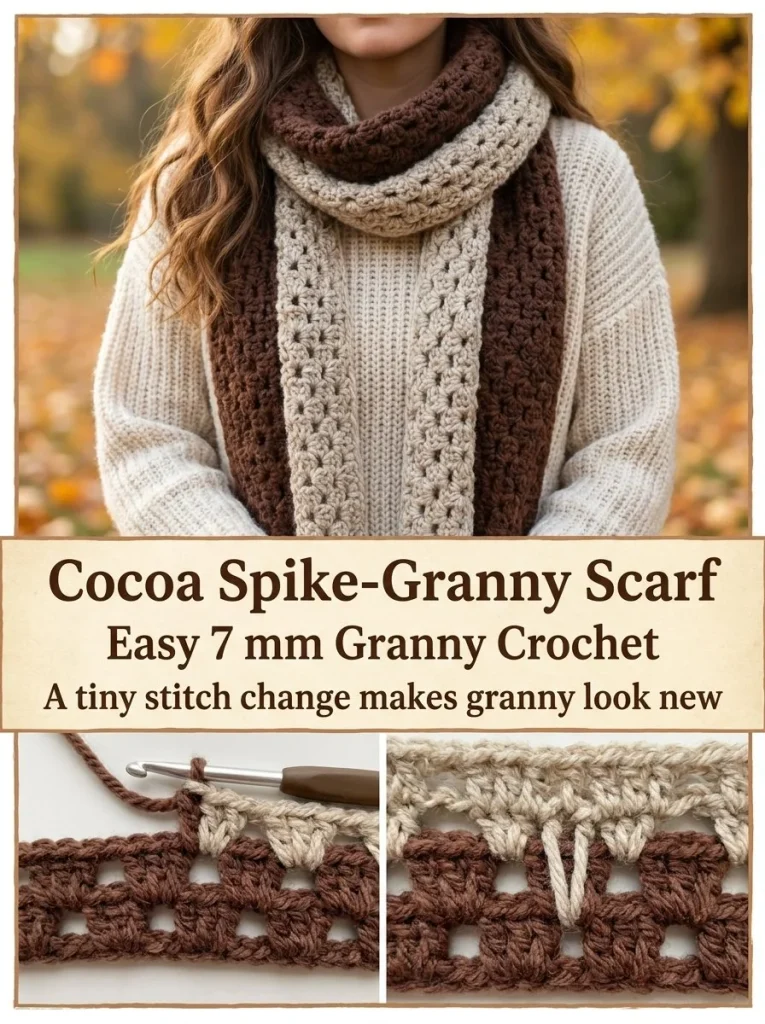
The richly textured scarf you’ll create with this pattern combines the classic appeal of granny stitches with a distinctive spike element, forming an elegant yet cozy accessory. Featuring a harmonious blend of cocoa and oatmeal hues worked in bulky yarn, this design showcases a rhythmic interplay of color and texture that makes the scarf not only visually engaging but also warm and substantial enough for colder days. The main technique revolves around alternating granny motifs with spike-granny stitches, creating a dynamic fabric with depth and interest.
Crocheted in rows using a bulky #5 yarn and a 7 mm hook, the scarf grows in length through a repeated 8-row color and stitch cycle that balances two tones and varied stitch placement. This striking construction lends itself well to wearability, offering plenty of warmth and an appealing flexibility. In addition to the main pattern, it’s worth exploring other textured scarf designs that utilize chunky yarn and color blocking, which can be found in patterns such as the autumn-inspired color block scarf, perfect for those who enjoy experimenting with seasonal palettes.
Pattern at a Glance
Skill level: Intermediate – requires familiarity with double crochet, treble crochet, and working spike stitches in multi-row patterns
Terminology: US crochet terms
Construction: Worked flat in rows with color changes, alternating stitch patterns
Finished size: Approximately 72.5 inches long; width defined by 23 foundation chains and stitch gauge
Yarn weight: Bulky (#5)
Hook: 7 mm crochet hook
Main stitch: Spike-granny stitch combining double crochet and treble crochet spikes within granny groups
Gauge: About 11 stitches = 4 inches; 8 rows = 5 inches in pattern
Motifs: Rows of granny clusters and spike-granny repeats
Layout: Linear repeated stitch rows with color changes every 8 rows
Joining: Not applicable (single piece)
Border: Final rows of double crochet to close pattern
Seaming: None required
Materials
- Bulky #5 yarn: Approximately 210 yards of cocoa color and 185 yards of oatmeal color. Bulky yarn gives the scarf a squishy and insulating texture, ideal for outerwear accessories. The two colors alternate throughout the pattern, which will create a warm contrast and highlight the stitch pattern.
- Crochet hook size 7 mm (K-10.5): This size is optimal for bulky yarn to achieve the stitch gauge specified while maintaining a flexible fabric that is not too stiff or overly loose.
- Tapestry needle: Used for weaving in yarn ends at the end of the project to ensure a clean finish.
Each material is chosen to fit the design goals of a lush, textured scarf with good drape and cozy warmth.
Yarn and Color Notes
Bulky yarns with a smooth and plied texture are recommended to showcase the stitch definition of both granny clusters and spike stitches. Avoid heavily fuzzy or novelty yarns, as the intricacies of the spike-granny will be less visible. The contrasting cocoa and oatmeal colors not only provide visual interest but also help the stitch pattern pop.
Selecting a soft wool blend or acrylic with good stitch recovery will ensure the scarf holds up well to daily wear. Consider solid colors rather than variegated yarns to preserve the clarity of the stitch design.
A related project with complementary colorwork and chunky textures is the acorn brown keyhole scarf knitting pattern, which offers insight into layering textures and tones in cozy scarves.
Finished Measurements
The completed scarf measures approximately 72.5 inches in length, making it versatile for various wrapping styles around the neck or layering with outerwear. The width is defined by the initial foundation chain and stitch gauge, resulting in a comfortable scarf width that balances coverage and weight.
Because the scarf is worked in rows and the gauge is controlled, the final width is consistent and does not require special finishing adjustments. The finished length depends on completing about 114 rows plus finishing rows, giving ample length for both styling and warmth.
Gauge
The stitch gauge to achieve correct dimensions is:
- 11 stitches = 4 inches
- 8 rows = 5 inches
Measured in the stitch pattern, this gauge ensures the fabric is neither too tight nor too loose, maintaining good drape and stitch definition.
To check gauge, work a swatch in the spike-granny pattern with the recommended yarn and hook, measuring across stitches and rows. Adjust hook size if necessary:
- Using a smaller hook may result in a narrower or shorter scarf and a denser fabric.
- Using a larger hook may create a wider, looser fabric lacking stitch clarity.
Gauge accuracy is important for this project to ensure the scarf’s repeating stitch pattern and color changes align properly across the length.
Abbreviations
- ch – chain
- dc – double crochet
- tr – treble crochet
- sp – space
All stitch terms follow US crochet terminology.
Important Pattern Notes
- Turning chains: Ch3 at the start of rows generally counts as a dc unless otherwise specified.
- Spike-granny stitch definition: The stitch sequence involves a double crochet in the current row’s ch-1 space, one treble crochet worked two rows below into the center of the granny group directly beneath, then another double crochet in the current ch-1 space, forming an elongated “spike” texture.
- Color changes: Alternate between cocoa and oatmeal yarn according to the 8-row repeat cycle prescribed. Make color changes at the end of rows to maintain clean transitions.
- Row repeats: The scarf pattern repeats an 8-row sequence comprising spike-granny and standard granny groups, alternating colors between cocoa and oatmeal.
- Edge stitches: Maintain consistent stitch counts on edges throughout to prevent skewing or ruffling.
Maintaining tension and stitch placement is crucial to preserve the overall pattern integrity.
Special Stitches and Techniques
Spike-Granny Stitch
This stitch is central to the pattern’s textured appeal. It combines:
- A dc worked into the current row’s ch-1 space,
- A treble crochet worked one row beneath into the center stitch of the granny group directly below (thus “spiking” down),
- Followed by another dc into the current ch-1 space.
This creates elongated vertical stitch elements that overlay the granny clusters in a visually striking manner.
Granny Groups
The classic granny cluster consists of three dc worked into single spaces, separated by chain spaces (ch1). This forms the traditional openwork motif, providing a latticed effect.
Mastery of these stitches guarantees smooth pattern execution.
Understanding the Construction
This scarf is created in one continuous rectangular piece worked back and forth in rows. The width is established by the initial foundation chain of 23 stitches in cocoa color, which determines stitch counts and final width.
The fabric is formed by alternating two-row stitch sequences — spike-granny rows and granny group rows — combined with an 8-row color-changing cycle between cocoa and oatmeal. This cyclical alternation creates a balanced color and texture pattern, extending the scarf to about 114 rows for a total length near 72.5 inches.
No assembly or seaming is required, making this project straightforward once the repeating pattern and color changes are mastered.
Pattern Instructions
Foundation
With cocoa yarn, chain 23.
This sets up the base width of your scarf.
Row 1
- Dc in 4th ch from hook and in each chain across, for a total of 21 dc.
- This first row creates a stable base of double crochet stitches.
Row 2
- Ch 3 (counts as first dc), turn.
- Skip next stitch.
- Work 3 dc into the next stitch.
- Repeat the sequence: [ch 1, skip next stitch, 3 dc in next stitch] until you reach the last two stitches.
- Skip next stitch and dc in the last stitch.
At the end, you will have formed 5 granny groups, each consisting of 3 dc, separated by chain-1 spaces.
Row 3
-
Ch 3, turn.
-
Dc in first stitch.
-
Ch 1, skip the next 3 stitches.
-
Work the spike-granny stitch in each chain-1 space separated by ch-1 across the row:
- Dc in the indicated ch-1 space,
- One treble down into the center stitch of the granny group two rows below,
- Dc again in the current ch-1 space.
-
Finish row with 2 dc in the final stitch.
This creates the distinctive elongated spikes overlaying granny clusters.
Row 4
- Return to the standard granny groups as Row 2.
- Work in oatmeal color, changing yarn at the end of this row.
Rows 5 to 8
- Alternate Rows 3 and 4 in oatmeal color.
- At the end of Row 8, change back to cocoa color.
Rows 9 to 10
- Repeat the same two-row sequence (Rows 3 and 4) in cocoa.
Repeat Cycle
- Repeat this 8-row color and stitch cycle (Rows 3–10) until approximately Row 114 and the scarf measures around 72.5 inches in length.
Finishing Rows
- Work one row that closes the spike spaces using double crochet and spike-granny placement.
- Follow with one full row of double crochet to close and even out the fabric.
Final Steps
- Fasten off the yarn securely.
- Weave in all ends neatly with a tapestry needle.
- Block the scarf gently to relax stitches and even out the fabric.
Checkpoints
- After completing Row 4, your fabric should clearly show alternating granny clusters in oatmeal.
- By Row 8, the transition back to cocoa should be smooth without gaps.
- After about 50 rows, the scarf will feel substantial but flexible; check length regularly for personal preference.
- Spike-granny stitches should create noticeable vertical texture overlaying the granny pattern.
Finishing and Blocking
Blocking is important to achieve a smooth and even finish. Lightly steam or wet block the scarf, pinning it to shape while damp. This will help the texture and stitches settle, making the fabric drape beautifully.
Weaving in ends should be done securely with a tapestry needle, burying tails within the fabric to prevent unraveling. Take care not to pull ends too tight, which could distort the motive.
How to Resize
To adjust the width of the scarf, change the foundation chain in multiples consistent with the granny groups. Each granny group consists essentially of 4 stitches plus chains (3 dc + ch1 space), so increasing by 4 or 5 stitches while maintaining the overall pattern balance will widen the scarf.
Length adjustment is straightforward: repeat the 8-row color/stitch cycle fewer or more times until desired length is reached. Always measure against gauge swatches to maintain proportionality.
Useful Variations
- Single-color version: Use only cocoa or oatmeal yarn for a more subtle, monochrome accessory.
- Color swap: Reverse the color assignments or use other complementary colors such as deep burgundy and cream.
- Chunky wool or super bulky yarn: For a warmer, puffier scarf, substitute with a thicker yarn and larger hook, then adjust foundation chain and rows for gauge.
- Addition of a border: A simple single crochet or shell stitch border in one contrast color can frame the scarf elegantly.
For more layered textures and color ideas, the acorn brown keyhole scarf knitting pattern may inspire additional creative directions.
Troubleshooting
Why Is My Scarf Getting Wider on One Edge?
This often happens from inconsistent tension, especially when switching colors or forming spike stitches. Maintain steady tension around color changes and be sure to chain the correct amount at edges.
Why Are Spike-Granny Stitches Hard to Identify?
Ensure you are working the treble crochet spike into the center stitch of the granny group two rows below, not the chain spaces. This spike penetration is crucial for the characteristic look.
How Can I Avoid Gaps in Color Changes?
Always complete your stitch for the row before changing color. Carry yarn neatly or fasten off to prevent loose loops.
Why Does the Edge Ripple?
Rippleing is generally caused by uneven stitch tension or inconsistent turning chain usage. Make sure turning chains match stitch height and that stitches are evenly spaced.
Frequently Asked Questions
Can I use a different yarn weight for this scarf?
You can substitute with a yarn of a different weight, but you should adjust the hook size and foundation chain length to maintain gauge and the integrity of the stitch pattern.
Is this pattern suitable for beginners?
Intermediate crochet skills are recommended because of the spike-granny stitch and color changes. Familiarity with double crochet, treble crochet, and working into previous rows helps.
How should I block the finished scarf?
Light steam or wet blocking pinned flat will help even the texture and relax stitches. Avoid stretching to maintain shape.
Can I make this scarf longer or shorter?
Yes, simply repeat or reduce the 8-row color/stitch cycle until you reach your preferred length.
Are the color changes carried along the sides?
No, the yarn is changed at the end of each row, and ends are woven in; yarn is not carried along the edges to keep the scarf neat.
Does the turning chain count as a stitch?
Yes, in this pattern the chain-3 turning chain counts as the first double crochet of the row.
Related Uses
The spike-granny stitch technique is versatile and can be applied to other accessories such as cowls, blankets, or pillow covers. Its mix of texture and openwork lends a rustic yet refined look to any project, similar to the color-blocking found in the chunky scarf pattern known for its bold seasonal palette.
Final Thoughts
This project combines the timeless charm of granny clusters with the distinctive spike stitch to produce a textured, color-contrasted scarf perfect for chilly seasons. The methodical 8-row and two-color cycling allows for rhythmic patterning that keeps crocheters engaged while achieving a warm and substantial garment. The construction is straightforward with no assembly, making it a rewarding piece that balances complexity with approachable techniques. With careful attention to gauge, tension, and color changes, you’ll create a versatile scarf that’s both cozy and visually striking.



