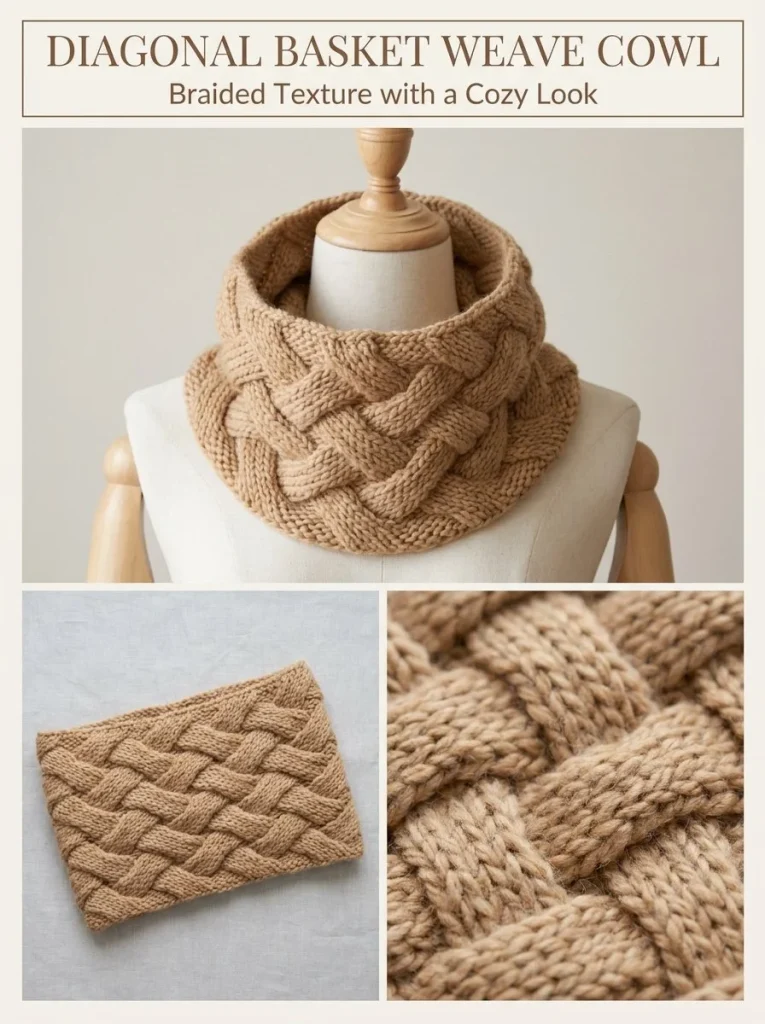
The textured Diagonal Basket Weave Cowl offers a visually intriguing combination of depth and movement through its distinctive cable pattern. This knitting project showcases diagonal cables that interlace to mimic the structure of a woven basket, creating a rich tactile fabric that is both warm and stylish. Made in the round using circular needles, the cowl forms a seamless tube that comfortably wraps around the neck, making it a versatile accessory suitable for cooler seasons.
Crafted using two basic 2-over-2 cable crossings, this cowl’s stitch pattern incorporates a balanced play between right-cross and left-cross cables, creating the diagonal basket weave effect. The use of circular needles and a cable needle enables knitters to maintain consistent tension while working a tight cable fabric, ensuring the pattern emerges crisply. The stitch is worked in multiples of four, which means planning your cast-on is an important step to achieve the perfect circumference.
For those who appreciate not only the aesthetic but also the technical aspects of cable knitting, this project reflects the inspiration drawn from Studio Knit’s Diagonal Basket Weave Cable Stitch tutorial. It harnesses both traditional cable techniques and the efficiency of circular knitting to deliver a finished piece that is elegant and structurally sound. The texture lends itself well to a variety of yarns, though smooth, plied yarns tend to highlight the woven detail best. By wet-blocking, the final fabric relaxes and flattens slightly, which enhances the intricate cable design while reducing any natural curling tendencies of the knitted fabric.
Pattern at a Glance
Skill level: Intermediate (comfortable with cable knitting and circular needles)
Terminology: Standard knitting terminology, US terms
Construction: Seamless circular knitting in the round
Finished size: Determined by chosen cast-on multiple and gauge; circumference is customizable
Yarn weight: Any desired weight, choose accordingly for drape and warmth
Needles: Circular needles larger than the label recommendation for the chosen yarn weight
Notions: Cable needle, stitch marker, tapestry needle, scissors
Main stitch: 4-round repeat of Diagonal Basket Weave Cable pattern using 2-over-2 cable crossings
Gauge: Depends on yarn and needle size; swatch required to calculate circumference
Motifs: Repetitive multiple-of-4 stitch pattern
Joining: Joined carefully in the round at cast-on
Border: None specified; bind off without tightening to keep edge flexible
Seaming: None required
Materials
To complete this project, gather the following materials based on the authoritative source:
- Smooth yarn in the desired weight — This project benefits from yarns with good stitch definition to accent the cable pattern’s woven texture.
- Circular knitting needles larger than the yarn manufacturer’s recommended size — A slightly larger needle size helps loosen the tightness typical of cable knitting and provides the fabric with better drape.
- Cable needle — Used to hold stitches for the 2-over-2 cable crossings essential to the texture.
- Stitch marker — Helpful to mark the beginning of the round after joining in the round.
- Tapestry needle — For weaving in ends neatly upon completion.
- Scissors — To cut yarn securely after finishing.
This selection of materials is critical to achieving the correct fabric tension and enhancing the overall appearance of the diagonal basket weave pattern.
Yarn and Color Notes
Selecting the right yarn can elevate the texture and wearability of the cowl. Smooth yarns, such as plied wool, wool blends, or acrylics with sheen, are ideal because they showcase the intricate cables sharply without fuzziness obscuring the pattern. Avoid highly textured or novelty yarns (like boucle or highly fuzzy mohair) as these can hide the diagonal crossings that define the basket weave look.
When considering color, solid or semi-solid shades work best to highlight the stitch definition. Variegated or self-striping yarns might distract from the linear cable flow, though subtle tonal variations can add a pleasant depth if chosen thoughtfully.
For inspiration on using the diagonal basket weave technique in varied projects, check out how this cable stitch is adapted in different forms, such as the original diagonal basket weave cable stitch tutorial which provides additional context to the fabric’s unique texture.
Finished Measurements
Because the cowl is knit in the round with a customizable cast-on, its measurements depend on the knitter’s gauge and chosen needle size. The circumference should be determined by casting on a multiple of 4 stitches that, once blocked, yield a comfortable neck circumference—typically between 20 to 24 inches for adults.
Height is similarly flexible: continue knitting the pattern repeat until the cowl reaches the desired height, generally around 8 to 12 inches to allow comfortable coverage over the neck and lower face if desired.
Swatching is essential to ascertain both the gauge and resulting dimensions before beginning.
Gauge
Precise gauge is important for this project, especially because cable stitches create a denser fabric than stockinette or garter stitch. To measure gauge:
- Knit a swatch using the specified multiple-of-4 stitches in the 4-round repeat pattern.
- Wet block the swatch and measure the stitch count and row height over 4 inches (10 cm).
- Adjust needle size if necessary to meet desired gauge.
If your gauge is too tight (smaller than intended), the cowl will be smaller and less flexible. Conversely, a looser gauge results in larger circumference and a softer drape but risks losing cable definition.
Abbreviations
- CO – Cast On
- K – Knit
- CN – Cable Needle
- St(s) – Stitch(es)
- Rnd(s) – Round(s)
- Right-cross cable – 2-over-2 cable crossing where the right-hand side stitches cross over the left
- Left-cross cable – 2-over-2 cable crossing where the left-hand side stitches cross over the right
Important Pattern Notes
- This cowl is worked seamlessly in the round, so there is no wrong side.
- The stitch pattern is based on multiples of 4 stitches.
- The cable pattern consists of two basic 2-over-2 cable crossings, alternating right-cross and left-cross directions on different rounds.
- The fabric is a tight cable knit, so larger needles than normally recommended for your yarn weight are suggested for flexibility.
- Bind off loosely to avoid tight edges.
- Wet-block to relax the fabric and reduce curling.
- A stitch marker is helpful to track the beginning of each round.
Special Stitches and Techniques
Two key cable techniques form the visual foundation:
- 2-over-2 Right-Cross Cable: Slip two stitches onto the cable needle and hold at back, knit next two stitches from the left needle, then knit the two stitches from the cable needle.
- 2-over-2 Left-Cross Cable: Slip two stitches onto the cable needle and hold at front, knit next two stitches from the left needle, then knit the two stitches from the cable needle.
These crossings alternate to create the diagonal woven basket effect.
Using a cable needle can be tricky at first but ensures clean, well-defined stitches. Practice the cable crossing on a swatch before starting the main project if you are new to cables.
Understanding the Construction
The project is knit in the round as a continuous loop with no seams. This construction means the diagonal basket weave pattern seamlessly spirals around the cowl, maintaining an uninterrupted texture flow and eliminating the need for joining.
Begin by casting on the number of stitches suited to your desired circumference, making sure it is a multiple of 4 to preserve the stitch pattern integrity. The cowl is built by repeating a four-round cable stitch sequence that incorporates alternating right- and left-cross cables and plain knit rounds that balance the texture and spacing.
Because the cowl is knit in the round, the edges naturally curl less than flat-knit cables but still benefit greatly from a good blocking session.
Foundation
To start, cast on a multiple of 4 stitches using a stretchy cast-on method to allow comfortable wear.
Place a stitch marker to denote the beginning of the round and join carefully in the round, ensuring stitches are not twisted.
Your cast-on count determines the final circumference. For example, if your gauge after blocking is 6 stitches per inch and you want a 22-inch circumference, cast on 88 stitches (22 x 4).
Round 1
Work a 2-over-2 right-cross cable across the round. This means:
- For each sequence of 4 stitches: slip two stitches to cable needle and hold at the back, knit next two from left needle, then knit the two from the cable needle.
Repeat this across the entire round.
Round 2
Knit all stitches plain (no cabling) around the round to create balance and texture contrast.
Round 3
Work a 2-over-2 left-cross cable across the round. For every 4 stitches:
- Slip two stitches to cable needle and hold at front, knit next two stitches, then knit the two stitches from cable needle.
Repeat this across the round.
Round 4
Repeat knitting all stitches plain in this round.
Pattern Repeat
Repeat rounds 1-4 continuously, alternating right-cross and left-cross cables interspersed with two rounds of plain knitting, until the cowl reaches the desired height.
Bind Off
When the cowl is tall enough to your preference, bind off loosely in pattern (knit the knit stitches) without pulling tight to keep the edge flexible.
Checkpoint
At various stages, lay the piece flat or measure around your neck to check circumference and height. Ensure your cables look balanced and that fabric is not overly stretched or tight.
Assembly
No assembly is required as the cowl is knit in the round. Weave in all ends securely using the tapestry needle.
Finishing
Wet-block the cowl by soaking it in lukewarm water, gently squeezing out excess water without wringing, and laying flat to dry. Pin slightly to shape if necessary. Blocking is vital to relax the stitches, reduce curling at the edges, and enhance the basket weave texture.
How to Resize
Since the stitch pattern is based on multiples of 4 stitches and a 4-round repeat, resizing is straightforward:
- To change circumference: Adjust the cast-on stitches in multiples of 4 stitches.
- To change height: Knit more or fewer repeats of the 4-round sequence.
Swatching is essential before starting to ensure your gauge matches expectations and the size will be comfortable.
Useful Variations
- Colorwork: Incorporate contrasting yarn colors to outline diagonal cables subtly.
- Longer cowl: Add extra repeats to create a doubled or snood style.
- Matching accessories: Use the diagonal basket weave cable stitch in coordinating hats or mittens; for inspiration, see a knit tote adaptation of the same stitch pattern.
- Chunky yarn: Using thicker yarn can transform this into a warmer, more textured winter piece.
Troubleshooting
Why Is My Fabric Too Tight?
Cable stitches naturally tighten the fabric. Using the recommended larger needles helps. If fabric is still tight, try a needle size up or a softer yarn.
Why Is My Pattern Losing the Basket Weave Texture?
Ensure that you are alternating right-cross and left-cross cables correctly every other cable round. Follow the exact cable placement for all four rounds as in the original source.
Why Are My Edges Curling?
Even when working in the round, cable fabrics can curl due to stitch tension. Proper wet-blocking and a loose bind-off will help flatten the edges.
How Can I Make the Cable Crossings Easier?
Practice with a cable needle and make sure to maintain even tension when slipping stitches. Using a cable needle with grips or a flexible cable needle can help manage stitches more comfortably.
What If My Cast-On Count Is Not a Multiple of 4?
The stitch pattern will not align properly, and cables may be misaligned or disrupted. Always adjust to a multiple of 4.
Frequently Asked Questions
Can I use a different yarn weight?
Yes, but adjust needle size accordingly and swatch to check gauge and fabric drape. Thicker yarn will give a chunkier cowl; thinner yarn will create a finer texture.
Can beginners make this cowl?
Intermediate knitters with some experience in cabling should find this manageable. Familiarity with using a cable needle and knitting in the round is important.
Is this pattern reversible?
Because the cowl is knit in the round, both sides are technically right side, but the cables are more prominent on one side. The texture displays well on both faces.
How should I block the finished cowl?
Wet-block by soaking and drying flat, shaping gently to avoid distortion. Avoid stretching cables too much.
Can I add a border?
While not part of this pattern, adding a ribbed or garter stitch edge before blocking might help edges lie flat but would require knitting flat and seaming or modifying the construction.
Do I need special needles?
Circular needles longer than usual for your yarn weight help to accommodate the stitch count comfortably. A cable needle is necessary.
Optional Related Uses
The diagonal basket weave cable stitch is versatile and can be adapted for other projects such as scarves, blankets, or stylish knit totes. The stitch’s woven look adds visual interest and texture wherever used.
Explore more about adapting this stitch for various projects and detailed stitch work techniques in the diagonal basket weave cable knit stitch tutorial.
Final Thoughts
This cowl project combines a structured yet flowing cable texture achieved by alternating simple 2-over-2 cable crossings in a thoughtful way using circular needles. The seamless, tubular construction adds comfort and practicality without compromising on style. A careful choice in yarn and needle sizing, combined with attention to gauge and blocking, ensures a wearable piece that highlights the classic woven basket pattern beautifully. Whether dressing for function or fashion, the diagonal basket weave cowl offers an elegant statement wrapped around your neck.



