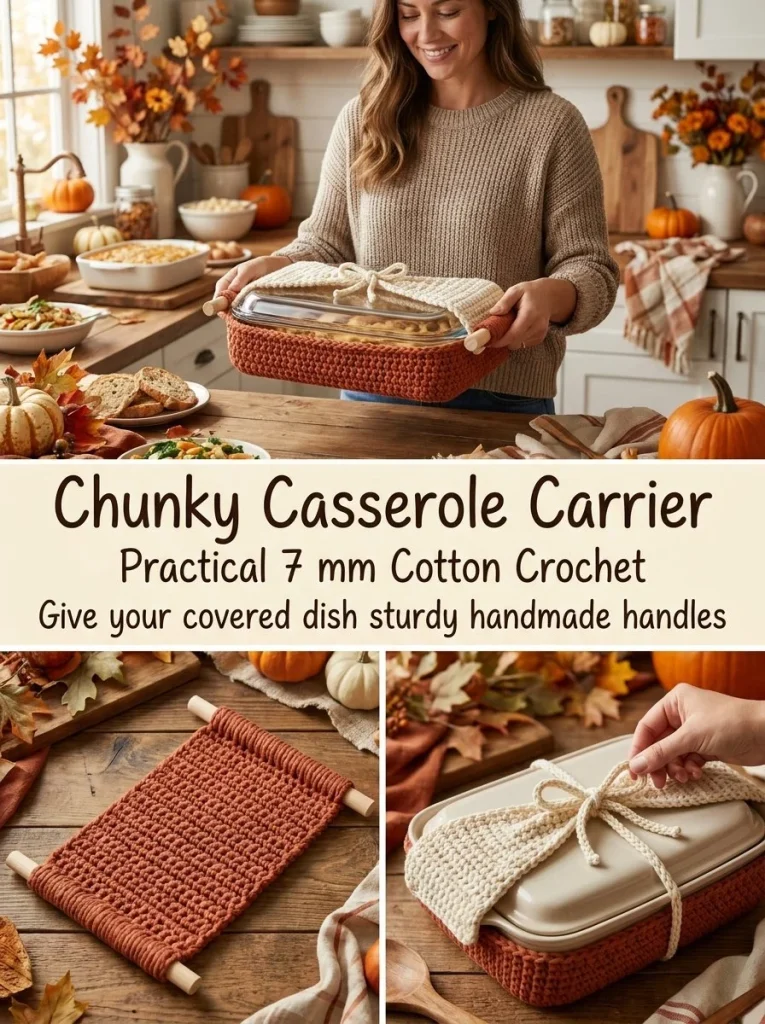
Crochet offers endless possibilities for creating practical and stylish items, and one such project is a sturdy, chunky casserole carrier designed for transporting covered dishes safely and hands-free. This eye-catching carrier combines the warm, earthy terracotta color with creamy accents to create a cozy aesthetic that complements autumn and rustic kitchen styles. Constructed mainly with single crochet, the piece features a long sling that cradles the casserole dish, accented by flaps that fold over the lid and secure with ties for extra protection.
The simplicity of the main stitch—a dense single crochet fabric made with doubled worsted cotton yarn—ensures durability and ample strength to support a closed casserole dish once it has cooled to a safe handling temperature. Uniquely, the design incorporates wooden dowels enclosed within the crocheted edges as functional handles, merging natural materials with handcrafted fiber art for a charming and useful kitchen accessory. This project emphasizes functionality, offering a hands-free solution for transporting heavy or bulky dishes while adding handcrafted charm to your culinary gatherings or potlucks.
Crocheters familiar with basic stitches will appreciate the straightforward construction, but the project also introduces assembly techniques involving sewing fabric edges around dowels and attaching flaps with fixed ties, elevating its practical appeal. The use of 100% cotton yarn ensures heat resistance and easy washing, key for kitchen textiles. For those looking to expand their kitchen crochet collection, the concept of pairing cotton fiber projects with natural wooden elements creates a harmonious, tactile appeal reminiscent of other fall-themed accessories, like an other casserole carrier patterns with cozy textures and earthy colors.
Pattern at a Glance
Skill level: Easy – Suitable for beginners comfortable working in rows and sewing components together
Terminology: US crochet terms
Construction: Worked flat in rows; main body and side flaps crocheted separately; handles made by enclosing wooden dowels within folded fabric edges; flaps sewn and tied for closure
Finished size: Main sling approx. 12 in wide by 36 in long; side flaps approx. 9 x 10 in each
Yarn weight: Worsted weight (#4) cotton yarn held double
Hook size: 7 mm (approx. US K/10.5)
Main stitch: Single crochet (sc)
Gauge: 9 sc x 8 rows = 4 inches (measured with two strands held together)
Motifs: None; single large piece plus two flaps
Layout: Rectangular sling with folded edges for dowels; two rectangular flaps sewn onto long sides
Joining: Sewing flaps to sling edges; securing dowels inside folded edges
Border: None specified
Seaming: Sewn using tapestry needle
Materials
Achieving the sturdy yet comfortable texture of this carrier requires these specific materials:
- 100% cotton worsted weight (#4) yarn, held double for a thick, durable fabric. You will need approximately 1000 to 1200 yards total, split between terracotta (main sling color) and cream (flaps and ties).
- A 7 mm crochet hook (about US K/10.5) is ideal to balance stitch definition and overall fabric density with doubled yarn.
- Two smooth 12-inch wooden dowels, about ½ inch in diameter, serve as the carrier’s handles. The dowels must be smooth to avoid catching the yarn.
- A tapestry needle for sewing the fabric edges securely around the dowels and attaching the flaps and ties.
Using 100% cotton yarn ensures that your carrier remains washable, breathable, and moderately heat-resistant—qualities essential for kitchen and serving accessories. Avoid yarns with synthetic fibers here, as they may not handle light heat safely or feel comfortable to grip.
Yarn and Color Notes
Holding two strands of worsted cotton yarn together creates a substantial, chunky fabric perfect for a carrier needing firmness without rigidity. Cotton’s natural absorbency also helps if minor spills occur. The choice of terracotta and cream lends a warm, earthy palette reminiscent of fall tones, which pairs nicely with rustic kitchen decor.
Keep in mind:
- Cotton lacks elasticity, so gauge swatches are crucial to avoid a carrier that is too stretchy or loose-fitting around your casserole dish.
- Variegated yarn could work but may distract from the clean lines of this project’s simple construction. Solid colors highlight structure better.
- The cream color provides a nice contrast for the functional flaps and ties, making them visually distinct while complementing the terracotta body.
If you’d like to explore color blocking techniques to further enhance the texture and interest of chunky yarn projects, consider patterns like the autumn color block chunky scarf pattern.
Finished Measurements
- Main sling: Approximately 12 inches wide by 36 inches long. This rectangular panel forms the main body cradle for the casserole dish.
- Side flaps (make 2): Approximately 9 x 10 inches each. These rectangular panels attach mid-length along opposite long edges of the sling and fold inward over the dish lid.
- The fit is designed to accommodate typical 9 x 13 inch casserole dishes.
Because the carrier depends heavily on accurate gauge, particularly to fit dishes snugly and ensure the dowels fit correctly within folded edges, maintaining recommended tension is important.
Gauge
This project’s gauge is measured with two strands of yarn held together to increase thickness and strength. The target is:
- 9 single crochet stitches x 8 rows = 4 inches square
How to measure gauge: work a swatch holding two yarn strands together, crocheting rows of single crochet. Measure across 9 stitches and 8 rows; adjust tension or hook size if your swatch is too large or small.
Gauge affects:
- The overall size of the sling and side flaps
- How snugly the flaps fit over the casserole lid
- Whether the dowels fit smoothly in the folded fabric edges
If your gauge is too loose, your project may stretch excessively and handle less weight firmly. Too tight, and the fabric may be stiff, with dowels hard to insert.
Because this is a utilitarian kitchen accessory, exact gauge is helpful but not critical—small variations will only alter the finished size slightly.
Abbreviations
- ch: chain
- sc: single crochet
- sl st: slip stitch
- st(s): stitch(es)
Important Pattern Notes
- The project is worked entirely in flat rows, back and forth.
- Each row begins with ch 1 which does not count as a stitch, consistent with standard single crochet working in rows.
- Stitch counts remain constant; no increases or decreases are worked, resulting in a rectangular shape.
- The yarn is held double throughout to create a thicker fabric.
- Side flaps include ties created by chaining and slip stitching back to secure the chords, providing adjustability.
- Assembly involves folding ends and sewing fabric around dowels to form handles.
- The carrier is intended for carrying closed and cooled casserole dishes; it is not a heat protector or oven mitt. Use caution.
Special Stitches and Techniques
This pattern is straightforward and uses only the following:
- Single crochet: A dense, durable stitch that creates a firm fabric perfect for carrying weight.
- Slip stitch: Used for securing ties at flap corners.
- Sewing/folding: Folding crochet fabric over dowels and using a tapestry needle to securely sew creates wooden dowel handles.
No complex stitches or advanced techniques are required, making this an accessible project.
Understanding the Construction
The carrier is composed of three separate crochet pieces plus hardware:
-
Main sling: A long rectangular panel worked in terracotta yarn to cradle the casserole dish’s base. The short ends are folded over wooden dowels, which are sewn securely inside. These dowels become the handles for carrying.
-
Side flaps: Two rectangular panels in cream yarn sewn onto the long sides of the sling, positioned centrally. Each flap folds inward over the dish’s lid.
-
Ties: Four short cords attached at flap corners secure the flaps together by tying over the lid, keeping the dish covered and stable during transport.
This design allows the carrier to carry a casserole dish safely, distributing the weight across the dowels and fabric sling, while the flaps and ties ensure the dish remains covered.
Complete Pattern Instructions
Foundation and Main Sling
- With two strands of terracotta yarn held together, make a foundation chain of 28 chains.
Row 1
- Starting in the second chain from the hook, work one single crochet (sc) in each chain across the row.
- You should have 27 sc stitches.
Rows 2 to 72
- Chain 1, turn your work.
- Work single crochet across all stitches in each row, maintaining 27 stitches per row.
- Continue this for a total of 72 rows (counting Row 1 as the first row).
At the end of 72 rows, your main sling should be approximately 12 inches wide by 36 inches long.
Attaching the Wooden Dowels
- Lay your sling flat with the short ends horizontal.
- Place a 12-inch wooden dowel across each of the short ends, aligning it with the fabric edge.
- Fold approximately 2.5 inches of the crochet fabric over each dowel, creating a thick fold.
- Using a tapestry needle and yarn (terracotta), sew the folded edge securely to the sling edge all the way along, enclosing the dowel completely inside the fabric fold.
- Ensure the dowel handle remains exposed and free above the folded fabric for carrying.
Side Flaps (Make 2)
- Using two strands of cream yarn held together, chain 21 chains.
- Row 1: Starting from the second chain from the hook, sc across (20 stitches).
- Row 2 to 20: Chain 1, turn, sc across all 20 stitches each row.
- After 20 rows, the flap measures approximately 9 inches wide by 10 inches long.
Attaching Side Flaps
- Sew one edge (the 9-inch edge) of each side flap to the center of opposite long sides of the sling so that each flap folds toward the center when lifted.
- This overlapping fold will cover a casserole dish approximately 9 x 13 inches in size.
Making and Attaching Ties
- At each free flap corner, join the cream yarn and chain 25 chains.
- Slip stitch back along the chain to the flap to secure the tie.
- Make a total of 4 ties, one at each flap corner.
Using the Carrier
- Place a closed casserole dish in the center of the sling.
- Lift the ends of each wooden dowel to carry.
- Fold the side flaps over the casserole lid.
- Tie opposite flap ties around the lid to secure the dish.
Important Usage Note
- Use only with covered dishes that have cooled to a safe handling temperature.
- This carrier is not designed as an oven mitt, trivet, or heat protector.
Checkpoints
- After completing the main sling, verify the piece measures approximately 12 x 36 inches.
- The folded fabric over dowels should be snug, securely sewn, and the dowels must sit firmly without slipping.
- Side flaps should measure about 9 x 10 inches and lie flat when sewn.
- The ties at the flap corners should be long enough to comfortably knot over the lid.
Assembly
Attention to neat, tight sewing improves durability:
- Sew flaps exactly centered along the opposite long edges of the sling for balanced coverage.
- Secure the dowels by folding fabric firmly; seams must cover the entire dowel length to prevent any falling out during carrying.
- Ties should be knotted securely but remain easy to untie.
Finishing
- Weave in any loose yarn ends securely for longevity and aesthetics.
- Lightly block the pieces by dampening and pinning flat to enhance stitch regularity, though blocking is optional.
- The natural cotton yarn may soften with use and washing, which can add comfort.
How to Resize
To adjust size for a larger or smaller carrier:
- Width: Change the starting chain count for the main sling by multiples of 1 (since 27 stitches fits approximately 12 inches width). Ensure stitch count matches your new width intentions.
- Length: Adjust the number of rows worked (currently 72 rows for ~36 inches). Add or subtract rows in multiples as needed for length changes.
- Side Flaps: Adjust the chains and rows proportionally (currently 21 ch x 20 rows for ~9 x 10 inches flaps). Be sure to maintain flap size sufficient to cover your dish.
- Remember: maintaining gauge by checking tension and stitches per inch is essential for proper fit.
Useful Variations
- One-color version: Use terracotta or cream yarn for the entire project for a more minimalistic look.
- Striped or color-blocked flaps: Add stripes in the cream flaps for subtle variation.
- Use variegated cotton yarn: For more texture and color interest without altering the pattern.
- Open handles: Instead of fully enclosing dowels, leave part exposed for easier carrying.
Troubleshooting
Why Is My Carrier Too Big or Too Small?
- Gauge variations seriously affect size here; always swatch with doubled yarn and check gauge.
- Adjust chain or row count gently to compensate.
Why Is My Fabric Too Loose or Stretchy?
- Using a larger hook or holding yarn loosely reduces fabric density, causing sagging under weight.
- Hold tension firm and check that the fabric feels dense but flexible.
How Do I Sew the Dowels Securely?
- Use matching yarn threaded on a tapestry needle; sew multiple passes through the folded fabric edge without piercing the dowel itself to avoid splintering.
- Tension should be firm but not so tight as to pucker fabric.
What If My Flaps Do Not Cover the Lid Properly?
- Check flap dimensions and placement on sling edges. Adjust flap size if necessary, making larger flaps or centering placement more accurately.
Frequently Asked Questions
Can I use a different yarn weight?
This pattern is specifically written for worsted weight (#4) cotton yarn held double. Using lighter or heavier yarn will affect gauge and finished size. If substituting, swatch carefully and adjust chain and row counts as needed.
Can I use acrylic yarn instead of cotton?
Cotton is preferred for its natural heat resistance and washability. Acrylic yarn might melt or deform if exposed to heat and may not feel as comfortable for kitchen use.
How should I wash the finished carrier?
Hand wash or gentle machine wash cold with like colors. Lay flat to dry to maintain shape. Avoid high heat drying.
Is this pattern suitable for beginners?
Yes, the simple single crochet stitches and straightforward construction make it accessible for beginners comfortable with basic crochet and sewing.
Can I make this carrier larger for pot-sized dishes?
Yes, increase chain and row counts proportionally to enlarge the sling and flaps, maintaining gauge for proper fit.
Are the wooden dowels necessary?
They provide sturdy handles and distribute weight, making carrying easier. You can try using sturdy wooden or plastic rods but dowels are recommended.
Optional Related Uses
The sturdy single crochet fabric and dowel handle construction can inspire other projects, such as:
- Picnic or market bag with similar dowel handles
- Kitchen utensil holder sling
- Hand towel rack combining crochet and wood elements
For additional inspiration on autumn and chunky textures, projects like the chunky color block scarf complement the seasonal aesthetic of this casserole carrier.
Final Thoughts
This crochet casserole carrier leverages the strength and cozy texture of doubled worsted cotton yarn and the rustic charm of wooden dowels, creating a functional and attractive kitchen accessory. The simple single crochet stitch results in a dense fabric that safely cradles your casserole dishes while the side flaps and ties secure the lid during transport. Thoughtful assembly with enclosed dowels transforms ordinary crochet fabric into ergonomic handles, making carrying heavy or bulky dishes easier and safer. The project’s straightforward construction is practical for stitchers at all skill levels and makes an excellent gift or personal kitchen upgrade with lasting utility and style.



