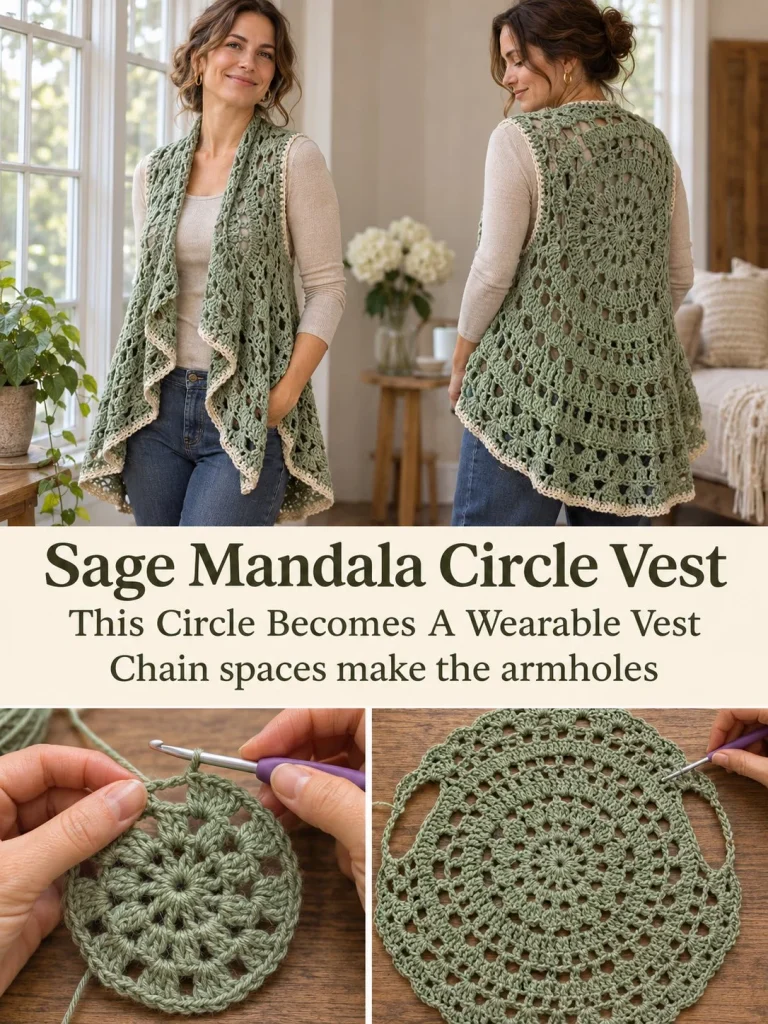
Creating a beautifully draped, circular crochet vest with intricate radial lace detail is a satisfying challenge that blends foundational crochet techniques with thoughtful shaping. This vest centers on a single large mandala that rests on the wearer’s back, framed by armhole openings that maintain the circular form while allowing comfortable movement. The design offers both visual appeal and versatility, making it an eye-catching layering piece for transitional weather or a statement accessory to any outfit.
The construction is based on crocheting one expansive radial lace circle featuring an airy shell-and-chain stitch pattern. Unlike ponchos or sewn garments, this vest is crafted entirely in the round as a continuous piece, with carefully planned armhole openings created by bridging unworked spaces. The circular fabric expands outward gracefully, ensuring it lies flat through thoughtful increase placement. A final narrow cream border rounds the piece off with a subtle color accent.
Working this vest requires attention to gauge and shaping since the mandala and armholes are gauge-dependent for proper fit and lay. To get a practical sense of shaping and measurements, sampling your stitch tension and blocking test swatches is essential. This project offers a sophisticated look using primarily double crochet shells and chain spaces, easily accessible to those comfortable with basic crochet stitches, but it asks for precision in increasing and shaping rounds.
For crocheters who enjoy a blend of technical challenge and wearable artistry, this radial lace vest makes a distinctive, modern bohemian design. It also presents an excellent opportunity to deepen understanding of circular shawl-type construction adapted for wearable armholes.
Pattern at a Glance
Skill level: Intermediate – requires confident stitch execution and shaping in the round
Terminology: US crochet terms (dc, ch, sl st, etc.)
Construction: Single large radial circular mandala with two integrated armhole openings
Finished size: Diameter approximately 38-40 inches after completing the full circular piece
Yarn weight: DK (Double Knitting) weight #3 yarn
Hook: 5.5 mm crochet hook
Main stitch: Radial shell and chain lace repeats
Gauge: Swatch required for flat lace circle, gauge affects size and flatness
Motifs: One continuous mandala circle
Layout: Circular garment worn with mandala resting on the back, armholes on upper sides
Joining: Not applicable, worked in rounds without seaming
Border: Narrow cream single crochet or chain space round
Seaming: None
Materials
- Approximately 750-1000 yards of muted sage DK weight yarn (main color) — this soft, medium-light yarn creates a delicate drape while providing stitch definition.
- Approximately 30-50 yards of cream DK yarn for the final narrow border round to add a subtle contrasting edge.
- 5.5 mm crochet hook, suitable for the DK yarn to achieve a balance between openness and fabric integrity.
- At least eight stitch markers to mark the radial sectors and the armhole positions clearly during shaping.
- Tapestry needle for weaving in ends and finishing touches.
Each material contributes to the final look and function: the DK yarn weight combined with the open lace shell stitch ensures light warmth and breathability while maintaining an elegant drape.
Yarn and Color Notes
Choosing the right DK yarn fiber content can influence the wearability and appearance. Smooth yarns such as mercerized cotton, cotton blends, or fine wool blends help accentuate the radial shell pattern and provide crisp stitch definition, enhancing the mandala’s visual structure. A fuzzy or heavily textured yarn may obscure the lace pattern, so keep that in mind.
Muted sage delivers a subtle earthy tone that aligns well with boho and cottagecore aesthetics. The narrow cream border round offers just enough contrast to frame the entire piece gracefully without overpowering the delicate sage lace. For color variations, you could experiment with monochromatic shades or subtle gradients, but keep the contrast subtle to preserve the mandala’s harmonious look.
Finished Measurements
- The initial circular lace disc measures about 22 inches in diameter before creating the armhole gaps.
- After establishing two armhole openings and expanding outward, the finished diameter reaches approximately 38-40 inches.
- The armhole gaps themselves should be about 8-9 inches vertically, designed to comfortably fit arms through while allowing the mandala to rest centered on the back.
These measurements are approximate and are heavily influenced by the gauge and individual tailoring during construction.
Gauge
Since the vest is a circular lace garment that relies on precise shaping to lie flat, making a washed and dried gauge swatch in the actual stitch and yarn combination is essential before starting. The key reason is that radial increases depend on your exact stitch measurements to maintain flatness without ripples or ruffles.
If your gauge results in larger stitches, your disc may become too large too quickly, risking distortion or excessive slumping. Conversely, a smaller gauge could yield a stiffer fabric that fights shaping, leading to curling edges. Adjust your hook size accordingly to polish the balance between openness and structure.
Abbreviations
- ch = chain
- sl st = slip stitch
- sc = single crochet
- hdc = half double crochet
- dc = double crochet
- sp = space
- st = stitch
- sk = skip
- rnd = round
- RS = right side
- BLO = back loop only
- rep = repeat
All abbreviations follow US crochet terms standard for accessibility and clarity.
Important Pattern Notes
- Chains generally count as stitches according to the pattern’s stitch count and shell placements.
- All rounds are joined rounds: you will join each round with a slip stitch without twisting the circular piece.
- Armholes are formed by skipping stitches under bridge chains, creating real unworked spaces rather than cutting or sewing the circle.
- Use stitch markers liberally to mark the eight radial sectors and the positions of the armholes precisely to maintain symmetry.
- The pattern assumes you will check for flatness frequently by laying the work on a flat surface, crucial for achieving the perfect circular drape.
Special Stitches and Techniques
This pattern primarily uses:
- Double crochet shell groups: clusters of dc stitches worked into defined spaces to create scallops.
- Chain spaces: strategic gaps between shells to create lace openness.
- Joined rounds: rounds closed by slip stitches to avoid twisting, crucial for maintaining circular shape.
- Radial increases in shells to maintain flatness of the circular mandala.
- Armhole bridge chains and skips to form comfortable, unworked slits in the circle.
No complex or novel stitches are required; focus is on precision and consistency.
Understanding the Construction
The vest is created entirely in one piece—a large circular mandala worked outward from a small center ring. Initially, you crochet 8 evenly spaced radial sectors, establishing the shell-and-chain lace pattern and forming a balanced circle. The circle grows smoothly with systematic increases in each sector to keep the fabric flat.
When the disc reaches approximately 22 inches, you mark and later create two armhole openings by bridging and skipping stitches on one round. Subsequent rounds maintain the shell-and-chain lace over these bridges while preserving the underlying gaps, achieving functional armholes without interrupting the circular lace.
You continue expanding the circle until it reaches about 38-40 inches in diameter, add a narrow cream border round, and finally try the vest on by slipping arms through the openings so the mandala sits centered on the back and the front hangs open.
This vest is not a poncho or sewn garment but a single, continuous circular fabric with shaped armholes.
Complete Pattern Instructions
Swatch and Preparation
Before starting, crochet a test swatch of the radial shell-and-chain lace repeat using your chosen DK yarn and 5.5 mm hook. This will inform whether the mandala will lie flat with your tension and stitch size. Blocking your swatch and measuring its diameter helps adjust hook size or tension before you commit to the vest.
Round 1: Small Center Ring
- Using the muted sage yarn, create a small ring by chaining 4 stitches and joining with a slip stitch to form a loop (ch 4, sl st).
- Inside this ring, work a balanced first round comprising 8 groups of double crochet posts, separated by modest chain spaces to establish the eight radial sectors evenly.
- Place stitch markers at each sector division for guidance.
- Join the round with a slip stitch, ensuring no twisting occurs.
Rounds 2 to ~N: Expanding the Mandala
- Begin expanding the circle by placing evenly spaced increases in each radial sector to maintain a flat round shape.
- Follow a consistent decorative sequence where double crochet shell groups alternate with chain spaces, only working new shells into planned chain openings. Avoid stacking shells onto unrelated posts to keep the pattern harmonious.
- Use stitch markers to monitor the eight radial sectors and maintain symmetry throughout.
- Periodically lay the work flat on a table to check for rippling or buckling, adjusting increases as needed.
- Continue until the blocked disc measures roughly 22 inches in diameter.
Armhole Placement and Marking
- Position two mirror-symmetric sets of stitch markers on the upper outer section of the disc at points corresponding to planned armhole locations.
- Ensure these armholes lie such that when worn, the mandala remains on the back.
- Confirm armhole placement and clearance by holding the disc against the wearer, verifying that each armhole gap achieves the recommended 8-9 inch vertical clearance.
Round with Armhole Gaps
- On the round where armholes will be formed, work shells and chains normally until reaching the first armhole opening.
- Chain a bridge long enough to span the armhole width, then skip the corresponding marked stitches beneath the chain bridge.
- Anchor the working yarn to the first stitch after the skipped gap.
- Repeat the same procedure symmetrically for the second armhole on the same round.
- This creates two real, unworked spaces (“holes”) beneath the chain bridges; do not alter the circle by cutting or sewing at these points.
Continuing the Circular Expansion
- Work following rounds by crocheting shell and chain repeats across the chain bridges, maintaining the full shell sequence while accommodating the two distinct armhole gaps underneath.
- Match the shell spacing on each side of both armholes to preserve symmetry and verify the gaps do not shrink.
- Continue spiraling outward with sage yarn until the mandala disc measures approximately 38-40 inches in diameter.
Final Border Round
- Work a single narrow outer round in cream yarn using either single crochet stitches or light chain-space patterning.
- Incorporate enough ease to prevent tightening the circumference and avoid puckering at the edge.
Final Fitting
- Try on the vest with both arms through the armholes, ensuring the circular center remains on the back and the front panels drape open as intended.
- If necessary, adjust the bridge lengths on your sample for optimal armhole fit and comfort.
Because this garment involves shaping dependent on stitch gauge and shell increases, it is critically important to physically test fit before releasing any formal numbered-round PDF instructions.
Helpful Checkpoints
- After round 1, you should see a neat ring with 8 radial sectors marked.
- After about 8-10 rounds, the disk will begin to flatten; no rippling or buckling should be apparent.
- Before creating armholes, the disc should measure around 22 inches in diameter when blocked.
- After incorporating armholes, confirm that gap sizes remain consistent at 8-9 inches vertical clearance during the outward expansion.
- Final diameter after completion should be about 38-40 inches.
Assembly and Joining
This vest requires no assembly or seaming. It is worked as a single continuous circular piece with integrated armholes.
Finishing and Blocking
- Carefully weave in all yarn ends using the tapestry needle to avoid snagging or loose threads.
- Block the finished garment by laying it flat, gently stretching to circular shape and armhole clearance dimensions. Blocking helps flatten the lace mandala and set the final shape.
- Avoid harsh stretching or pinching at the armholes; maintain their natural open space during drying.
How to Resize
Resizing will rely heavily on gauge and careful adjustments to shell increases:
- To make a smaller or larger vest, adjust the number of radial sectors or the number of shells in each sector proportionally. Note that the current pattern uses 8 sectors evenly spaced.
- Change the diameter target for the mandala before and after armhole placement to suit individual body proportions.
- Armhole size can be modified by altering the number of stitches skipped and chain bridge length, maintaining a vertical clearance close to 8-9 inches for comfort.
- Since the construction depends on increasing shells in each sector and maintaining flatness, always swatch and test fit before committing to large size adjustments.
Useful Variations
- Use a single solid color for the entire vest for a monochromatic look.
- Swap the final round’s cream color for a contrasting bright accent or variegated yarn for visual interest.
- Employ a different lace shell motif maintaining radial symmetry for a custom texture.
- Work with different DK yarn blends (cotton, wool, blends) for seasonal adaptation.
- Create a cropped or extended version by adjusting final diameter and armhole placement accordingly.
Troubleshooting
Why is my mandala curling or rippling?
Your gauge may be off, causing stitches to form too tightly or too loosely. Try reworking the tension with a larger or smaller hook and confirm flatness on a table frequently. Uneven increases in the eight radial sectors can also cause distortion; make sure increases are evenly placed.
Why do my armhole gaps shrink after finishing?
Check that you skipped enough stitches under the bridge chains during armhole formation. If the shell spacing is inconsistent around armholes in later rounds, adjust your stitches to maintain symmetry and avoid closure.
Why isn’t the circular piece laying flat?
Check your stitch counts carefully and confirm consistent increase placement in all radial sectors. Blocking will help, but significant rippling indicates a structural shaping issue during increases.
How do I keep the final edge from tightening?
Add easing stitches in the last cream outer round by incorporating chain spaces or single crochets loosely to avoid pulling the circumference inward.
Frequently Asked Questions
Can I use cotton instead of the recommended yarn?
Yes, but cotton yarn tends to be less elastic, so the vest might have less drape. Swatching and possibly adjusting hook size for tension is recommended.
Is this pattern suitable for beginners?
Intermediate skill is recommended due to shaping, working in rounds, and precision needed for armhole placement.
Can I make it in one color?
Absolutely. Using a single color throughout will simplify the process and emphasize the lace texture.
How should I block the finished vest?
Wet block it by pinning gently on a flat surface to circular shape with armholes open to correct measurements, allowing to dry fully.
Can I make the armholes larger or smaller?
Adjust the number of stitches skipped and the chain bridge length on the armhole-forming round. Aim for about 8-9 inches vertical clearance but adjust for personal comfort.
What if my mandala doesn’t lie flat?
Try adjusting your gauge or hook size and confirm increases are placed evenly in each radial sector. Flatness is key for the garment’s silhouette.
Optional Related Uses
The radial shell-and-chain lace motif used for this vest can inspire designs such as:
- Circular shawls or wraps
- Mandala-style table runners or decorative doilies
- Circular scarves or cowls with armholes for layering
- Open disc ponchos or capelets with varied armhole shaping
These related projects share the construction principles of working in expansive lace rounds with radial increases.
Final Thoughts
This crochet vest transforms a traditional circular mandala lace into a wearable piece by thoughtfully integrating armhole openings with bridge chains and skipped stitches. The construction is streamlined yet sophisticated: starting from a small center ring, growing evenly in eight radial sectors to maintain flatness, cutting into the outer rounds to establish armholes, and finishing with a delicate border. The vest’s striking circular back and open drape front combine form and function, making it a perfect project to enhance your technique and wardrobe simultaneously.
Exploring this project offers practical lessons in circular crochet increase strategies, radial symmetry, and creative shaping — valuable skills transferable to many garment and accessory projects. For those eager to try a meditative, elegant garment, this mandala circle vest invites you to stitch a statement piece that is as wearable as it is beautiful.
For another inspired layering vest project in a different construction style, explore the sage four square granny vest pattern, a textured alternate that complements the circular lace allure with boxy granny square designs.



