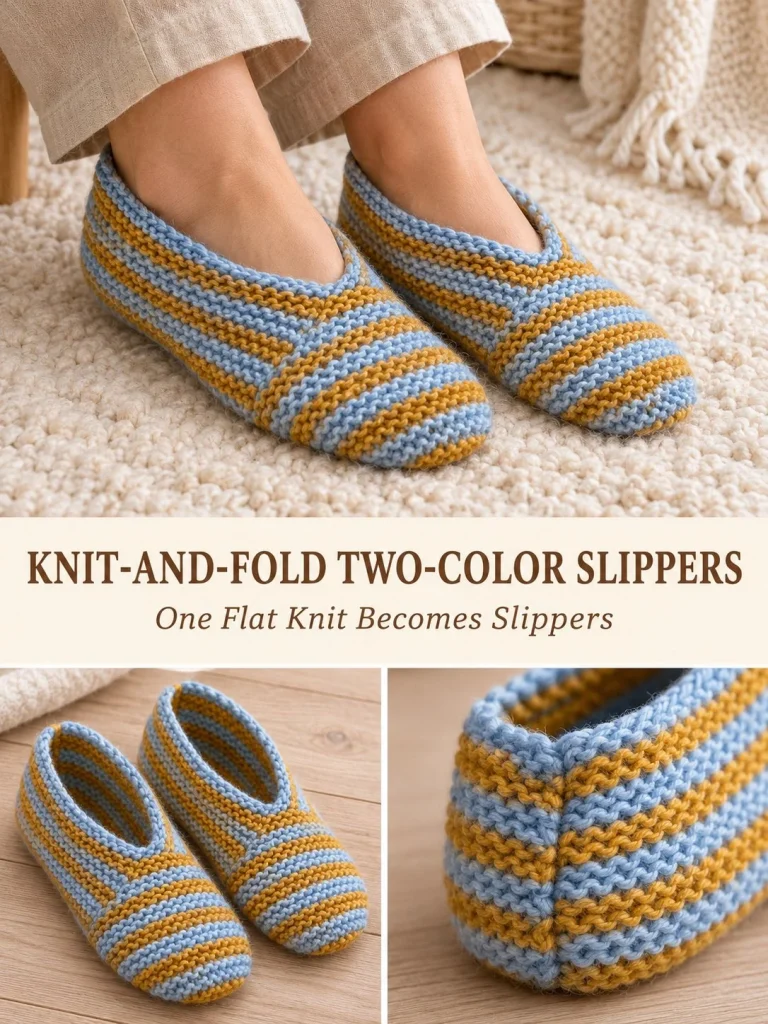
Creating cozy, wearable slippers with a charming two-color garter stitch gives this project both visual appeal and practical warmth. Unlike traditional socks or simple slippers, these slippers are constructed from flat knitted panels that fold and seam into three-dimensional shapes perfectly fitting the contours of your feet. Featuring a carefully considered asymmetrical shaping and an inventive fold-and-seam construction technique, the slippers blend style with structure, offering a unique approach to footwear knitting that invites both intermediate and advanced knitters.
The slipper’s design utilizes an alternating two-color stripe pattern in garter stitch—an extremely textured, stretchy, and cushy stitch that enhances comfort and durability. Carrying the inactive color along the edges keeps long floats tidy and lends a polished look to the color transitions. The finished slippers measure approximately 9.5 inches in length and 4.75 inches in width for the adult medium size, accommodating typical foot dimensions with a snug but flexible fit.
The project draws from premium materials, namely DK weight 100% merino wool, achieving a soft yet sturdy fabric. Because the slippers are knit flat, careful attention to shaping via decreases and bind-offs forms foot-specific left and right pieces, which are then folded and seamed to create depth and dimension. This method not only eliminates the need for cutting or complex sock construction but also yields a visually striking, scroll-stopping finished object. For an inspiring complement, knitters might also explore cozy, felted footwear patterns like the Magical Felted Slippers Garter Stitch to build a winter-ready shoe collection.
Pattern at a Glance
Skill level: Intermediate
Terminology: US knitting terms
Construction: Two coordinated flat pieces knitted in garter stitch, folded and seamed into slippers
Finished size (Adult Medium): Length approx. 9.5 in; width approx. 4.75 in
Yarn weight: DK (Double Knit)
Needles: US 3 / 3.25 mm 20-inch circular needles
Main stitch: Garter stitch with alternating two-color stripes
Gauge: 24 stitches x 48 rows = 4 inches in garter stitch
Motifs: None (solid garter stitch fabric)
Layout: Flat, asymmetrical left/right panels shaped by decreases and bind-offs
Joining: Hand-seamed after folding along designated lines
Border: None specified beyond garter stitch edges
Seaming: Hand-sewn using a tapestry needle to join folded edges
Materials
- Yarn: Purl Soho Knitting Yarn DK 100% merino wool
- Color A (sample): Spring Sky (approx. 115 yards for Adult Medium)
- Color B (sample): Golden Raisin (approx. 145 yards for Adult Medium)
- Needles: US 3 / 3.25 mm 20-inch circular knitting needles – circular needles facilitate even knitting and allow managing the stitch count easily; though the project is knit flat, circular needles offer flexibility and space for markers and stitches.
- Notions:
- Five removable stitch markers to track sections and shaping
- Tapestry needle for weaving in ends and seaming the pieces together
These materials ensure the slippers are soft, warm, and hold their shape while being lightweight enough for indoor wear. The choice of merino wool offers natural breathability, moisture management, and a soft hand feel against the skin — ideal for footwear.
Yarn and Color Notes
Choosing yarn for slippers means balancing durability with softness. Merino wool is excellent because it is naturally elastic and resilient, which helps the slippers retain their shape despite foot movement. A DK weight yarn provides a fabric dense enough to keep feet warm but light enough to wear comfortably indoors.
The two-color stripe arrangement enhances the visual interest by alternating bold hues like Spring Sky and Golden Raisin, creating a vibrant contrast. This alternating stripe pattern in garter stitch also highlights the fabric’s texture. When selecting colors, consider the contrast level; high contrast emphasizes stripes and edges, while subtler combinations produce a muted, blended effect.
For knitters seeking to explore further similar textures or colorwork, projects like the Foldy Chunky Garter Tote feature garter stitch at a chunkier gauge and can inform your understanding of color carrying and edge finishing, enriching your approach to this slipper pattern.
Finished Measurements
This pattern offers sizes from baby to adult XL. The sample adult medium slippers measure approximately:
- Length: 9.5 inches
- Width: 4.75 inches
These dimensions describe the slipper’s final shape after folding, seaming, and blocking. Because of the pliability of garter stitch and wool, expect a little stretch and give for comfort during wear. Precise fit is crucial for slippers to ensure they stay on securely while walking and prevent fabric bunching.
Gauge
Gauge plays a significant role in achieving the correct slipper size and fit. The specified gauge is:
- 24 stitches and 48 rows = 4 inches in garter stitch using US 3 (3.25 mm) needles.
Measuring gauge:
- Use a ruler or gauge swatch checker after knitting a 4-inch square in garter stitch with the specified yarn and needle size.
- Be sure to measure both stitch and row counts for accuracy.
Why gauge is important:
- If your gauge is looser (fewer stitches per 4 inches), your slippers will be larger and possibly looser fitting.
- If your gauge is tighter (more stitches per 4 inches), your slippers will be smaller and may fit snugly or feel tight.
Because slippers are worn on the feet, maintaining gauge is important but also allows for personal stretch preferences — a slightly larger slipper may improve comfort for some. Swatching is highly recommended before starting the project.
Abbreviations
This pattern uses standard US knitting abbreviations relevant to garter stitch construction:
- k: knit
- sts: stitches
- CO: cast on
- BO: bind off
- dec: decrease
- RS: right side
- WS: wrong side
The alternating two-color stripes suggest changing colors every few rows, carrying the inactive color along the edge, which involves basic colorwork techniques.
Important Pattern Notes
- Both slippers consist of two flat, asymmetrical pieces shaped by decreases and bind-offs, one for each foot (left and right). Use stitch markers to track shaping points.
- The pattern carries the inactive color vertically along one edge to tidy the floats, enhancing the appearance and preventing loose strands.
- The asymmetrical shape avoids the complexity of knitting socks by folding flat panels into the correct foot shape.
- No cutting or additional shaping beyond knit decreases is necessary.
- Be sure to follow specified fold lines exactly to ensure the foot curves correctly when seamed.
- Light blocking after seaming helps set the dense garter texture and smooths the slips.
Special Techniques
- Two-Color Stripe Carrying: The inactive color is carried neatly up one edge of the fabric, creating a tidy finished edge without long floats inside the slipper. This technique requires careful tension control to avoid puckering.
- Asymmetrical Decreases and Bind-Offs: These shape the flat piece to wrap the three-dimensional curves of the foot. Each side differs slightly, so follow the left/right instructions carefully.
- Hand-Seaming: Matching edges after folding requires uniform, precise seams to maintain slipper shape and durability. Mattress stitch or similar invisible seam techniques are recommended for a clean finish.
- Light Blocking: Helps preserve the dense garter texture and even out stitches after assembly.
Understanding the Construction
At the heart of the slipper’s design are two flat panels, one for the left foot and one for the right, knitted identically in garter stitch but mirrored in shaping. These pieces are knit flat using an alternating color stripe sequence that generates a vibrant two-tone striped fabric. The inactive yarn is carried along one vertical edge in each panel, creating neat color transitions and enhancing durability.
Shaping occurs through prescribed decreases and bind-offs that sculpt each panel’s unique, asymmetrical shape to conform to each foot’s contours. This method eliminates the need for complex sock toe shaping or fabric cutting, offering an innovative take on slipper construction.
Once the panels are complete, they are folded along exact fold lines, a crucial step to transform the two-dimensional fabric into three-dimensional slippers. The folded edges are then hand-seamed carefully to secure the shape permanently. This folding and seaming approach creates a slipper that is both functional and visually captivating, embodying structural design and textile architecture.
Full Pattern Instructions
Materials and Setup
Before beginning, gather all materials:
- DK weight 100% merino yarn in two colors
- US 3 (3.25 mm) 20-inch circular needles to accommodate the stitch count
- Five removable stitch markers to mark shaping and color changes
- Tapestry needle for finishing
Casting On and Starting
Cast on the specified number of stitches for your slipper size (refer to original size chart). Markers will be placed for shaping points and color carrying.
Begin knitting flat in garter stitch, alternating colors according to the two-color stripe arrangement designed by the source. Carry the inactive color neatly along the edge as instructed, picking it up every other row to maintain tension and appearance.
Stripe Arrangement and Color Carrying
- Work stripes by alternating colors A and B every few rows as specified.
- Carry the yarn not in use up the left or right edge of the panel, depending on left or right slipper, keeping floats short and tidy by twisting yarns when changing colors at edge stitches.
- This technique yields a clean, professional edge without excess bulk inside the slipper.
Shaping: Decreases and Bind-Offs
- Follow the pattern’s decrease instructions carefully to shape the slipper asymmetrically.
- Decreases occur at specified rows and stitch locations to carve the contour of the slipper’s toe and instep.
- Some rows will require binding off stitches at specific edges to taper the shape.
- Refer closely to pattern markings and stitch counts to ensure correct shaping for each foot.
Completing Each Panel
- Continue knitting row by row until the panel height reaches the required dimension (approximate length guided by size).
- The finished flat piece should be an asymmetrical shape with correct placement for folding lines.
Folding and Seaming
- Fold the flat piece along the pattern’s designated fold lines. These correspond to anatomical features of the foot to create the slipper’s volume.
- Align edges precisely; the matching edges will be joined by hand.
- Use the tapestry needle and matching yarn to seam the folded edges with an invisible seam technique like mattress stitch.
Repeat for Opposite Foot
- Knit the second panel as the mirror image of the first, applying identical stripe and shaping instructions but reversed for left/right orientation.
- Fold and seam as done for the first slipper.
Weaving in Ends and Blocking
- After seaming both slippers, weave in all yarn ends carefully.
- Lightly block the slippers on a flat surface shaped with slight curves to preserve the garter texture and final shape. Use minimal moisture and avoid stretching.
Useful Checkpoints
- After casting on and initial rows: Confirm stitch count matches size requirements, and color carrying is neat.
- Midway through shaping: Check slipper piece against measurements or pattern sketches to ensure shaping aligns correctly.
- Before folding: Lay flat and verify the asymmetrical shape matches the pattern and is appropriate for the intended foot.
- After folding and seaming: Confirm slipper fits foot lengthwise and widthwise comfortably.
Assembly and Joining
The construction is a clever twist on traditional slipper making. Instead of knitting in the round or cutting fabric, the flat panels form the foundation. Correctly folding along the specified fold lines translates these 2D pieces into fitted 3D slippers.
Seaming requires patience and precision:
- Position the folded edges together so that all points and sides align perfectly.
- Use a tapestry needle with the leftover yarn or a matching yarn for a nearly invisible seam.
- Mattress stitch is ideal for joining garter stitch fabrics because it creates a flat and elastic seam, avoiding bulky joins.
- Avoid pulling seams too tight, as some elasticity is needed to accommodate foot movement.
- Once sewn, the slippers are stable and hold their shape well thanks to this construction.
Finishing and Blocking
- Weave all loose ends securely inside the slippers to avoid unraveling.
- Lightly block slippers to even out the fabric and enhance texture density. Merino wool responds well to gentle blocking with steam or damp cloth, but avoid soaking.
- Allow slippers to dry completely on a shaped form or flat surface with slight curves mimicking foot shape.
How to Resize
This pattern offers a wide size range from baby to adult XL. To resize:
- Refer to the source size chart for stitch counts and row numbers for each size.
- Gauge swatches are crucial; a different gauge will alter size significantly.
- Adjust stitch counts according to the stitch multiple of 1, preserving the stripe and shaping pattern.
- Ensure decreases and bind-offs correspond proportionally to the size.
- When scaling for children or small adults, consider reducing the needle size or using lighter weight yarn equivalents, while maintaining the pattern’s gauge.
Useful Variations
- Single-Color Version: Omit the two-color stripes and knit slippers in one solid color for an elegant, minimalist look.
- Chunkier Yarn: Substitute a bulky yarn for a warmer, cushier slipper but adjust needle size and gauge (see warnings in resizing).
- Color Placement: Reverse color dominance or swap colors to personalize the stripe arrangement.
- Embellishments: Add embroidered motifs or knit-on embellishments after assembly for added flair.
- Matching Accessories: Use similar yarn to knit matching slippers or complementary projects such as scarves or bags, exploring the same garter stitch texture.
Troubleshooting
Why Are My Slippers Too Tight or Too Loose?
The most common cause is gauge variation. Verify your gauge and adjust needle size accordingly. A tighter gauge produces smaller, snugger slippers; a looser gauge produces larger ones. Also, double-check your stitch counts.
Why Is My Color Carrying Uneven?
Carrying inactive yarn too tightly can pucker edges. Maintain even tension and twist yarns neatly at color changes to prevent loops or slack.
How Can I Prevent Seams from Being Bulky?
Use mattress stitch for seaming and be gentle when pulling the seam yarn. Avoid catching multiple garter ridges at once and place seams on inside folds.
Why Do My Fold Lines Not Match?
Measure often during knitting to confirm stitches and rows; precise folding requires matching pattern dimensions exactly. Mistakes in shaping will distort folding geometry.
What If I Don’t Have Circular Needles?
Although recommended, straight needles can be used, but managing large stitch counts may be cumbersome.
Frequently Asked Questions
Can I use a different yarn weight?
This pattern is designed for DK weight yarn at the specified gauge. Using thicker or thinner yarn requires adjustments to needle size and stitch count to preserve fit.
Can I make slippers for children?
Yes, the pattern includes sizes from baby through adult XL. Choose appropriate yarn amounts and gauge for smaller sizes.
Is this pattern suitable for beginners?
Intermediate experience with knitting and color carrying techniques is recommended due to shaping and seam construction.
How do I carry yarn neatly on edges?
Carry the inactive yarn vertically along one edge, twisting colors at stripe changes to secure the float.
Can the slippers be washed?
Merino wool slippers can be hand washed gently; avoid machine washing to prevent felting unless intentionally felting.
Are there other projects to practice garter stitch with stripes?
Absolutely. The Foldy Chunky Garter Tote offers a larger canvas to practice color carrying and garter texture.
Optional Related Uses
This versatile two-color garter stitch technique and fold-and-seam construction can inspire other cozy accessories:
- Slipper socks with ankle cuffs
- Slouchy knitted bags or pouches utilizing the stripe and folding method
- Cushions with geometric folds replicating slipper shapes
- Matching wristwarmers or fingerless gloves using same yarn and stripe pattern
Final Thoughts
The unique approach of knitting flat garter stitch panels with precise shaping, folding, and seaming elevates these slippers from simple footwear to a textile design statement. The interplay of two colors in stripes adds vibrant visual interest while the dense garter fabric ensures warmth and comfort. Through a combination of careful gauge control, neat color carrying, and meticulous seaming, these slippers offer a rewarding knitted project that blends function and artistry, inviting crafters to explore innovative footwear beyond traditional sock knitting.



