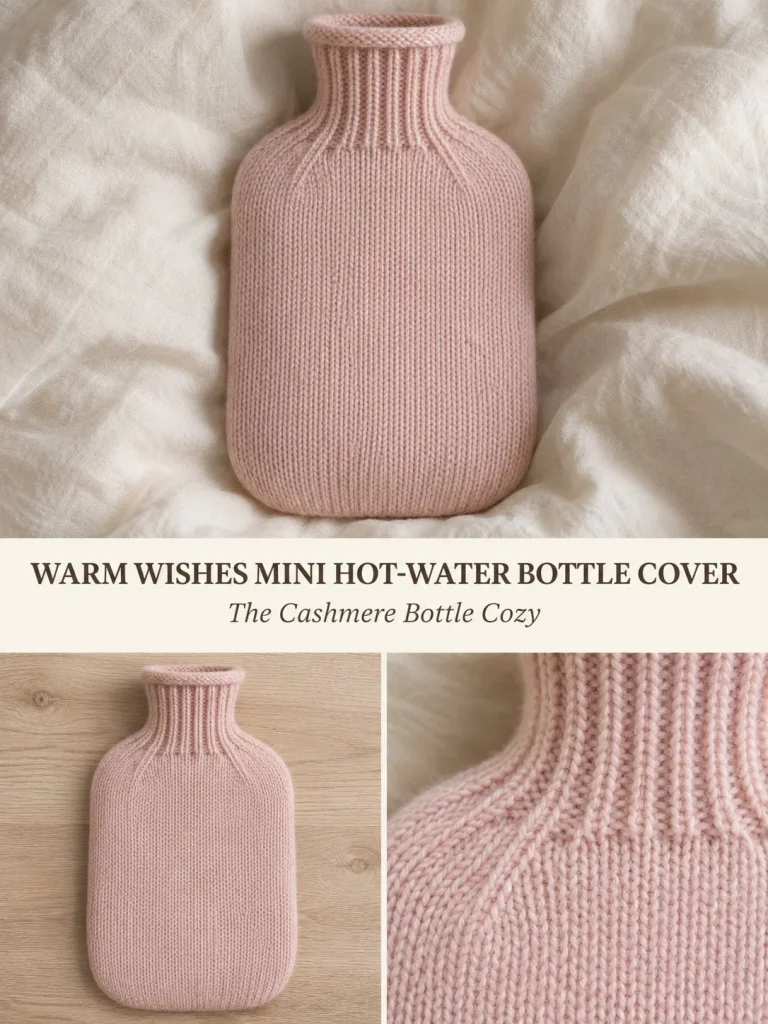
Creating a luxurious and snug mini hot water bottle cover offers both comfort and style during chilly seasons. This knitting project crafts a refined, cozy cover carefully designed to fit a standard 1-liter hot water bottle. The delicate use of cashmere yarn gives it a soft, warm texture that feels gentle against the skin while providing excellent insulation. Constructed entirely in the round, the cover has a sleek silhouette with a clean rolled edge and a snug ribbed neck that ensures the hot water bottle slides in securely and retains heat effectively.
This cover’s elegant design melds practicality and refined aesthetics, making it a perfect handmade gift or a cherished addition to your home comfort essentials. The top-down knitting technique simplifies the shaping process while maintaining a seamless finish, showcasing a smooth stockinette fabric that highlights the natural beauty of the cashmere fiber. This technique also allows for precise fitting with increases and decreases strategically placed to contour around the bottle’s shoulder and base.
The project utilizes circular needles and the Magic Loop method, which is well suited to knitting in the round on relatively small circumferences. The pattern combines technical precision with a soothing rhythmic knitting experience, suitable for intermediate knitters comfortable with ribbing, increases, decreases, and grafting stitches together using the Kitchener stitch. For those interested, you can explore similar warm cozy patterns like the mini hot water bottle cover knitting pattern to expand your collection of handmade comforts.
Pattern at a Glance
Skill level: Intermediate
Terminology: US knitting terms
Construction: Worked in the round, top-down
Finished size: Approximately 12 inches circumference x 11.5 inches height from cast-on edge when unrolled
Yarn weight: DK (Double Knitting)
Needles: US 6 (4 mm), 32-inch circular needles for Magic Loop method
Main stitch: Stockinette with 2×2 ribbing for neck
Gauge: 20 stitches x 32 rounds = 4 inches in stockinette stitch
Motifs: None (solid fabric)
Layout: Knit as one continuous tube, shaped with increases and decreases
Joining: None (seamless in the round)
Border: Narrow rolled stockinette lip, followed by ribbed neck
Seaming: Kitchener stitch to close bottom edge
Materials
For this cozy knit cover, gather the following supplies:
-
Yarn: 1 skein of Purl Soho Nigh DK, 100% cashmere, approximately 105 yards in the color Pink Pearl. This luxurious fiber ensures warmth and softness, ideal for direct skin contact.
-
Needles: A pair of US size 6 (4 mm) 32-inch circular knitting needles suitable for the Magic Loop technique. This length allows knitting small circumferences seamlessly in the round without switching to double-pointed needles.
-
Notions: Stitch markers to denote increase points and track rounds, a tapestry needle to weave in ends and complete the Kitchener stitch grafting, and a 1-liter hot water bottle for sizing accuracy and final fit check.
This precise combination of materials helps achieve the exact fit and fabric behavior envisioned in the pattern.
Yarn and Color Notes
Selecting cashmere for this project is a luxurious choice—you’ll want a yarn that is soft, warm, and slightly elastic to comfortably fit the contours of the bottle. DK-weight yarn strikes a perfect balance between warmth and drape without being overly bulky.
Smooth yarns like cashmere render the stockinette stitch clean and elegant, with clearly defined stitches that create a polished surface. Light or solid colors such as Pink Pearl enhance the subtle texture and rolled lips’ sophistication. Avoid heavily variegated or fuzzy yarns here, as they may obscure the stitch definition and distract from the sleek shape.
If you wish to experiment with yarn substitutions, opt for fibers with comparable softness and elasticity to maintain close gauge and stretch—for example, a soft merino or silk blend DK yarn could offer appealing alternatives.
Finished Measurements
The completed cozy measures approximately 12 inches in circumference and 11.5 inches in height from the cast-on edge when laid out flat and unrolled. The circumference ensures a snug but flexible fit around a standard 1-liter hot water bottle, while the height fully covers the bottle to improve heat retention and comfort while in use.
Because the cover is knit in the round with some stretch, the actual fit will gently hug and hold the bottle without slipping off. Precise dimensions rely on maintaining gauge and using the recommended yarn and needles.
Gauge
The pattern is based on the exact gauge of 20 stitches by 32 rounds equal 4 inches in stockinette stitch. Gauge refers to the number of stitches and rows per unit area and is crucial to achieving the correct size and fit, particularly for fitted projects like this hot water bottle cover.
-
Where to measure: Knit a swatch at least 4 inches square in stockinette stitch, blocking it as you will the finished piece.
-
Why it matters: Running tighter than gauge will yield a smaller, denser fabric that might not stretch sufficiently to fit the bottle; looser knitting will cause a baggy cover that doesn’t snugly insulate.
-
Adjusting gauge: If your gauge differs, adjust needle size accordingly and recalculate stitch counts only if experienced, as the pattern’s shaping depends on exact stitch placement.
Maintaining the specified gauge ensures your knit cover fits like a tailored garment for your hot water bottle.
Abbreviations
- K: knit
- P: purl
- St(s): stitch(es)
- Rnd: round
- 2×2 rib: knit 2 stitches, purl 2 stitches, repeated around
- Kitchener stitch: grafting technique to seamlessly join live stitches
These are standard US knitting abbreviations aligned with this pattern’s instructions.
Important Pattern Notes
-
The entire piece is worked in the round using the Magic Loop method on long circular needles to accommodate small circumference knitting without seaming.
-
The cover is constructed top-down, starting at the opening with a narrow rolled lip in stockinette followed by a stretchy 2×2 ribbed neck to ensure a snug fit around the bottle mouth.
-
Increases are strategically placed at four regularly spaced points to shape smooth rounded shoulders that comfortably fit a 1-liter bottle.
-
The main body is knit in stockinette stitch for a sleek look.
-
Decreases are placed correspondingly in four locations around the lower body to shape the base tapering for ease of fit.
-
The bottom edge is grafted closed using the Kitchener stitch, producing a smooth, seamless finish without buttons or closures.
-
The final step involves blocking the knitted piece to shape it properly before slipping the cooled bottle into the stretchy neck opening.
Special Stitches and Techniques
-
2×2 Ribbing: Alternating knit and purl stitches in groups of two creates a stretchable and elastic fabric ideal for the bottle neck.
-
Magic Loop Method: Using a long circular needle to efficiently knit small circumferences in the round without double-pointed needles.
-
Increases: Regularly spaced increases widen the fabric evenly to form rounded shoulders.
-
Decreases: Corresponding decreases reduce width at the base, fitting the bottle taper.
-
Kitchener Stitch: A grafting method that joins live stitches invisibly, used to close the bottom of the cover for a seamless finish.
These techniques combine to create a professional-looking, comfortable, and form-fitting cover.
Understanding the Construction
This cozy hot water bottle cover is knit as a single seamless tube from the top down. The process begins with a narrow stockinette stockinette lip that naturally rolls for an elegant edge at the bottle opening. Immediately following is a snug 2×2 ribbed section which forms the neck, offering the necessary elasticity to easily slip the bottle in and hold it snugly.
After the ribbed neck, increases are introduced at four symmetrical points around the work. These evenly spaced increases shape the fabric outward to produce smooth, rounded shoulders that comfortably accommodate the shoulder of the bottle, ensuring neither too tight nor baggy a fit.
After shaping the shoulders, the bulk of the body is knit in plain stockinette stitch, offering a clean, smooth surface with excellent stretch and warmth due to the cashmere fiber.
Near the bottom, the fabric is gradually decreased at four points to taper the cover smoothly toward the bottle base for a neat fit.
Once all shaping and length have been finished, live stitches from two needles are grafted together using the Kitchener stitch to close the bottom edge seamlessly. This results in a cozy homemade fabric sleeve, not a knitted bottle or a buttoned separate cover.
Finally, the piece is carefully blocked to settle the stitches and shape the cover into its final dimensions before inserting the cooled bottle.
Full Pattern Instructions
Foundation
Cast on the required number of stitches (follow the exact stitch count per gauge) using the Magic Loop method on your 32-inch circular needles with DK cashmere yarn. Arrange stitches evenly on the needle to begin knitting in the round.
Rolled Lip Edge
Work a narrow band in stockinette stitch (knit every round) for several rounds to create a rolled edge at the opening of the cover. This rolling effect forms a neat, natural lip that softens the edge of the neck opening.
Ribbed Bottle Neck
Switch to 2×2 ribbing—knit 2 stitches, purl 2 stitches around—for the neck section. This ribbing is worked snugly to provide elasticity and stretch needed for the bottle to slide through securely while hugging the neck firmly.
Shaping the Shoulders
At four regularly spaced points, begin increasing stitches evenly around the round. These increases gradually broaden the fabric, shaping gentle rounded shoulders to contour the bottle’s shoulder curve. This shaping is critical for the proper fit of the cover.
Body
Once the shoulder shaping is complete, continue knitting the body in smooth stockinette stitch (knit every round) to the desired length, ensuring a uniform surface and comfortable fit around the bottle’s midsection.
Shaping the Bottom
Approach the lower end of the cover by placing decreases at the same four points where increases were done earlier. These decreases taper the fabric, shaping the cover to closely fit the bottom of the hot water bottle.
Closing the Bottom
When the correct length and shaping are achieved, place all remaining live stitches onto two needles. Use the Kitchener stitch to graft these stitches together seamlessly, creating a smooth, closed end without bulk or uneven seams.
Blocking and Finishing
Block the knitted fabric by gently wetting and shaping it to the finished size dimensions. Let it dry flat to set the stitches and smooth out any unevenness. Once dry, slide the cooled empty bottle through the elastic ribbed neck opening to complete.
Your cover is now ready to keep your hot water bottle cozy and warm.
Helpful Checkpoints
-
The rolled lip section should measure about 0.5 inches in height and be visibly curling inward.
-
The 2×2 ribbed neck must feel elastic and snug; if it’s too loose or tight, adjust needle size slightly.
-
After increases for shoulders, confirmed stitch count should have expanded according to the pattern’s specified increments.
-
The body section should be smooth with no unintended increases or decreases.
-
Decreases at the bottom must result in a tapered shape; your stitch count here should match the decreased total.
-
When placing live stitches for the Kitchener stitch, count carefully to ensure matching on both needles.
Assembly
This project is one seamless piece worked entirely in the round except for the final grafting at the bottom edge. There are no additional assembly steps or seams after blocking. Simply slide the cooled bottle inside via the ribbed neck.
Finishing
Weaving in ends should be done carefully with the tapestry needle, securing all yarn tails inside the fabric and hiding them along knit rows. The Kitchener stitch graft must be neat and invisible, ensuring the bottom edge is smooth and comfortable.
Blocking is essential—a proper wet block will help shape the cover perfectly, relaxing the cashmere fibers and setting the final dimensions.
How to Resize
The pattern relies on fixed stitch counts determined by the gauge to fit a standard 1-liter hot water bottle. To resize:
-
Adjust yarn weight and needles to knit a larger or smaller gauge fabric.
-
For a larger bottle, using a bulkier yarn and larger needles will increase circumference and height by changing gauge naturally.
-
To maintain proportions, increase or decrease the number of stitches in multiples of four to preserve symmetrical shaping at the four increase and decrease points.
-
Adjust the height by knitting more or fewer rounds in the body and ribbed neck sections.
Careful swatching and gauge measurement are critical to successful resizing.
Useful Variations
-
Colorwork: Incorporate stripes or simple color blocking into the body for a modern look without altering stitch counts.
-
Textured ribbing: Substitute 2×2 rib with 1×1 rib or seed stitch rib to change the neck’s elasticity and texture.
-
Longer cover: Knit additional rounds to lengthen the body, covering more of the hot water bottle for extra warmth.
-
Different yarn: Use soft merino wool or alpaca blends for alternative textures or warmth characteristics.
-
Crochet Alternative: For those interested in a similar handmade cozy in crochet, explore the terracotta hot water bottle cover crochet cozy, which provides a charming variant crafted with a related approach.
Troubleshooting
Why Is My Cover Too Tight at the Neck?
Make sure you knit the 2×2 ribbing snugly but with enough looseness to allow the bottle opening. If the neck is too tight, try going up one needle size or loosening your tension slightly.
Why Is My Cover Too Loose and Sloppy?
Gauge likely differs from the pattern. Check your swatch and adjust to meet the specified 20 sts x 32 rounds in 4 inches. Avoid knitting loosely or using a larger needle than recommended.
Why Does the Rolled Lip Not Roll?
Ensure you are knitting stockinette without ribbing or garter in that first section. Too tight tension or alternate stitch patterns can affect rolling behavior.
Why Is the Shoulder Shaping Uneven?
Verify your increase placements are evenly spaced in four points throughout the round. Use stitch markers for precision.
Why Are My Decreases Causing Rippled Fabric?
Make sure decreases mirror your increases’ locations and use consistent decrease methods like knit two together (k2tog) or slip-slip-knit (ssk) for even shaping.
How Do I Seam Using Kitchener Stitch?
Work slowly, matching the live stitches on two needles stitch by stitch to create an invisible seam. Use tutorials or videos if unfamiliar with grafting.
Frequently Asked Questions
Can I use a different yarn weight?
Using a yarn significantly heavier or lighter than DK will affect gauge and fit. If swapping yarns, knit a gauge swatch first and adjust needle size and stitch counts as needed.
Can beginners knit this cover?
Intermediate knitting skills are advised due to working in the round with Magic Loop, increases, decreases, ribbing, and grafting. Beginners should familiarize themselves with these techniques before attempting.
Is the pattern suitable for other bottle sizes?
This specific pattern fits a standard 1-liter hot water bottle. Adjustments for different sizes require careful gauge and stitch count recalculations.
How should I block the finished cover?
Wet the cover gently, shape it flat to the exact finished measurements on a blocking mat, pin carefully, and allow it to dry completely to set the stitches.
Can I add buttons or a zipper?
This design does not include closures; the ribbed neck provides sufficient elasticity to insert and hold the bottle securely.
Are there care instructions for the cashmere cover?
Hand wash gently in cool water with mild detergent and lay flat to dry to preserve the softness and shape.
Optional Related Uses
The smooth stockinette and ribbed neck construction work well for other small cozy projects:
- Slippers or slipper socks with ribbed cuffs
- Bottle cozies for different sizes or shapes
- Cozy pouches for handheld gadgets
- Small decorative wrap covers for vases or cups
This versatile construction lends itself to other cozy heartfelt gifts or home accessories.
Final Thoughts
Knitting this cashmere mini hot water bottle cover is a rewarding project that produces a beautifully fitted, soft, and warm accessory. The seamless top-down construction ensures no bulky seams or finishing hassles, while the carefully placed increases and decreases provide a smooth, contoured shape embracing the bottle snugly. The rolled lip and stretchy ribbing add both charm and function, ensuring the bottle stays secure and snug without discomfort.
By following the exact gauge and stitch counts, and patiently working the subtle shaping, you create a luxurious, heirloom-quality miniature cozy that elevates the humble hot water bottle into an object of comfort and style. Consider exploring other cozy knit projects or crochet alternatives to expand your handmade comfort collection and enjoy the therapeutic rhythm of yarn crafting.



