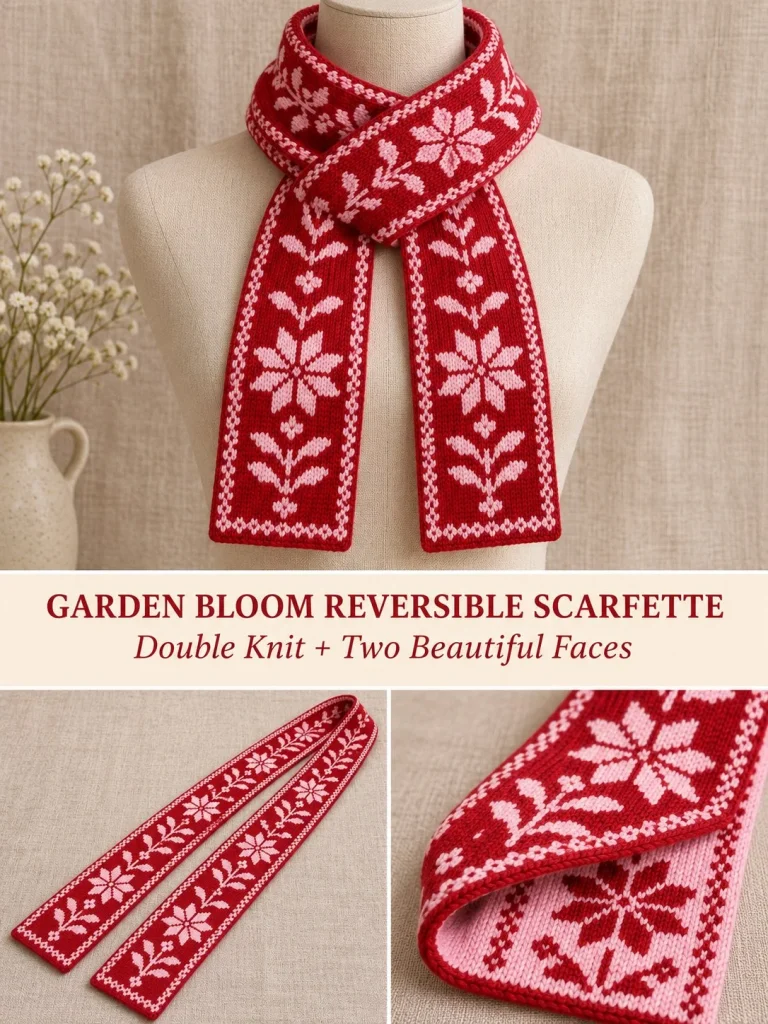
The Garden Bloom double-knit scarfette is a charming accessory that combines artistry and advanced knitting techniques. Crafted as a narrow scarf approximately 4.25 inches wide and 32 inches long, it features a distinctive reversible double-knit fabric showcasing a two-color Nordic-style floral motif. This scarfette is designed to present the same beautiful floral pattern on both sides, but with inverted colors, offering a versatile and elegant look. The interplay of the Red Heart Super Saver DK yarn in red and baby pink creates a harmonious color contrast that enhances the intricate double-knit design.
This piece is constructed using the double-knitting technique with fingering-weight yarn and size US 6 / 4.0 mm straight needles, resulting in a medium-weight, warm yet lightweight fabric suitable for transitional seasons or layering. Unlike stranded Fair Isle knitting, this pattern demands careful management of two yarn strands simultaneously to create two layers of fabric at once—one on the front and the other on the back. The challenge and beauty lie in handling the knit and purl stitches in tandem to maintain design alignment and avoid twisting carried yarns, ensuring both faces of the scarfette display the flower motif crisply and consistently.
For knitters familiar with intermediate skills seeking a rewarding project that beautifully demonstrates reversible colorwork, this scarfette balances technical challenge with wearable art. The delicate Nordic floral design paired with the reversible nature elevates what might otherwise be a simple scarf into a striking statement piece. To explore projects with similar reversible and layered features, you might also appreciate the versatility found in the Tied With A Bow scarf knitting pattern that creatively employs reversible ribbing.
Pattern at a Glance
Skill level: Intermediate
Terminology: Knitting (American)
Construction: Flat, two-color double knitting with paired knit/purl stitches
Finished size: Approximately 4.25 inches wide x 32 inches long (11 x 81.5 cm)
Yarn weight: DK (double knitting) weight yarn
Needle size: US 6 / 4.0 mm straight knitting needles
Main stitch: Double-knit with knit/purl stitch pairing to form two-layer fabric
Gauge and chart details: Provided in the free official downloadable PDF from Yarnspirations
Motifs: Nordic-style flower motif, reversible with color inversion
Layout: Single narrow rectangular scarfette
Joining: None (single piece)
Border: Charted border treatment included in the PDF
Seaming: Not applicable
Materials
To complete this scarfette, you will need:
- Yarn: 1 ball Red Heart Super Saver DK in Red and 1 ball in Baby Pink. These two colors are used in combination to achieve the reversible, two-color floral effect. The yarn’s acrylic fibers offer durability and ease of care, making this an ideal everyday accessory.
- Needles: US 6 / 4.0 mm straight knitting needles suitable for DK weight yarn, providing the appropriate tension and fabric density.
- Notions: A tapestry needle is essential for weaving in ends neatly once the knitting is complete, especially important for reversible projects to maintain clean edges.
- Additional resources: The complete chart, cast-on number, row directions, border instructions, and bind-off methods are contained within the free official Yarnspirations PDF download, which is critical for following the pattern accurately.
Using these tools and materials faithfully will result in a high-quality, durable scarfette that beautifully showcases the double-knit floral design.
Yarn and Color Notes
When selecting yarn, it’s important to consider fiber content and texture. Red Heart Super Saver DK is an acrylic yarn known for its vibrant color saturation and durability. Acrylic yarn’s smooth texture helps with the double-knit technique by reducing friction as strands are woven together, aiding in preventing tangling and twist.
For a project featuring two-color reversible florals, the choice of contrasting solid colors such as red and baby pink enhances the visual impact by clearly defining the pattern on both sides without muddling the design. Variegated or fuzzy yarns are not recommended here because they may obscure the fine details of the florals and complicate stitch definition.
You can experiment with other two-color combinations, such as complementary or analogous color pairs, but maintain solid color choices to preserve clarity in the pattern. The yarns should ideally have similar thickness and fiber characteristics to optimize stitch consistency and fabric stability.
Finished Measurements
The scarfette finished size is approximately 4.25 inches (11 cm) wide by 32 inches (81.5 cm) long. These dimensions are measured flat and unstretched. The width reflects the predetermined cast-on stitch count and the use of the double-knit technique, while the length corresponds to the total number of rows including the border sections.
Because the pattern uses double knitting, the fabric has inherent thickness and drape that affects the perception of size. This length is ideal for a lightweight neck accessory to wear draped or folded, rather than a long wrap. If you prefer a longer scarfette, additional repeats of the pattern rows can be added thoughtfully.
Gauge
Gauge is pivotal in this project to achieve the correct finished size and proper motif alignment. While the exact stitch and row gauge are documented in the downloadable PDF, the key is to maintain consistent tension, especially since two yarn strands are worked in tandem to create the double-knit fabric.
Measure gauge by counting stitches and rows over a few inches of the double-knit fabric. It is best to measure after you have established a rhythm with paired knit and purl stitches in both colors.
Why gauge matters:
- If your gauge is larger (looser knitting), your scarfette will come out wider and longer, but the fabric might be less stable and pattern details less crisp.
- If your gauge is smaller (tighter knitting), your scarfette will be narrower and shorter, with potentially denser and less flexible fabric.
Due to the double-knit construction, slight variations in gauge will more noticeably affect the finished width than length.
Abbreviations
This pattern uses standard knitting abbreviations:
- K – Knit stitch
- P – Purl stitch
- CO – Cast on
- BO – Bind off
- RS – Right side
- WS – Wrong side
Since this is a double-knit piece, knit and purl stitches are paired to form the two fabric layers simultaneously.
Important Pattern Notes
- This is a two-color double knitting project—each stitch worked consists of a knit stitch and a corresponding purl stitch in paired yarn strands, producing two fabrics connected back to back.
- Do not treat this as stranded Fair Isle knitting, which involves floats across the back; instead, manage two separate yarn strands carefully without twisting them.
- Maintain careful strand untwisting during knitting to avoid tangles and distortions.
- Follow the exact flower chart and cast-on number from the official PDF without inventing alternate repeats or altering the pattern flow.
- Consistent color management and stitch tension are key to ensuring the two faces mirror each other with clean color inversion.
- The scarfette is worked flat, with an included border treatment to frame the motifs.
- Use the tapestry needle to weave in ends invisibly for a professional finish.
Special Stitches and Techniques
The core technique here is two-color double knitting:
- This involves knitting the fabric with two yarns simultaneously, using paired knit and purl stitches.
- Each stitch consists of two interconnected loops—one forms the front fabric with one color, the other forms the back fabric with the opposite color.
- The colors invert on the opposite side, so red on the front corresponds to baby pink on the back, and vice versa.
- This technique allows reversible motifs without the bulk or carry strands typical of stranded knitting.
Mastering this technique requires familiarity with managing two yarns concurrently and executing knit and purl stitches accurately across the row. Maintaining yarn separation and preventing strand twisting ensures a smooth, even fabric on both sides.
Understanding the Construction
The scarfette is worked as a single flat panel from cast-on to bind-off. The entire piece forms one continuous rectangle, with the flower pattern repeated along the width and length according to the chart.
Two strands—one red and one baby pink—are used together from the start. As you work each paired stitch, you knit with one strand on the front fabric and purl with the other on the back fabric simultaneously, producing the reversible double-knit effect.
The border treatment frames and stabilizes the floral motifs on both edges of the scarfette, providing a polished and cohesive look.
Throughout the work, yarn strands are carried carefully parallel without twisting to maintain clarity in the design and consistent width.
Complete Pattern Instructions
Foundation
Cast on the exact number of stitches specified in the official Yarnspirations downloadable PDF, using one strand of the Red yarn and one strand of Baby Pink simultaneously, so that each stitch forms a pair of loops—one knit, one purl.
The cast-on produces a double-knit foundation with stitch pairs ready for the first patterned row.
Rows 1 and onwards
Follow the flower chart in the free PDF exactly, carefully executing each paired stitch as indicated:
- For each stitch pair, knit with the Red yarn on the front fabric side while purling with Baby Pink yarn on the back fabric, or vice versa, depending on the chart.
- This paired knit/purl action produces two layers simultaneously, with color inversions creating the reversible floral pattern.
- Maintain yarn tension to avoid bowing or puckering.
- Keep the carried yarn strands parallel and untwisted throughout each row.
- Work the border stitches as per chart instructions to maintain clean edges.
- Continue working rows in pattern until you reach the indicated length (approximately 32 inches).
Bind-off
Once the final row is complete, bind off in pattern using the same paired knit/purl technique to preserve the double-knit structure at the edges.
Finishing
- Weave in all yarn ends carefully with a tapestry needle, ensuring ends are secured between the two fabric layers to maintain the reversibility and neatness.
- Gently block the scarfette if desired, to shape and even out the stitches without stretching.
- Demonstrate the reversible nature by flipping the scarfette gently to showcase the two visible faces with the inverted color flowers.
Your finished scarfette will reveal the charming flower motif on both sides, with red and baby pink exchanging places beautifully.
Checkpoints During Knitting
- After cast-on: Ensure cast-on stitches are tidy and consistent, checking that the two yarn strands run parallel without twisting.
- Midway through length: Measure the scarfette’s length; it should be approximately half the intended 32 inches.
- Motif alignment: Verify the flower motifs line up perfectly across the width; any misalignment often indicates an off-pattern stitch.
- Before bind-off: Confirm edge stitches are neat and border treatments are uniform.
How to Resize
Since this scarfette is a double-knit project based on a fixed stitch count and chart:
- To increase width, add repeats of the chart horizontally by casting on multiples of the stitch count indicated for each flower motif plus border stitches. Be mindful that each repeat adds approximately the width of one flower motif (consult the chart for exact stitch multiples).
- To lengthen, add entire repeats of the row pattern vertically, maintaining the border treatment.
- When resizing, maintain yarn tension and yarn strand management for consistency.
- Gauge swatches are recommended to confirm adjustments before starting.
Useful Variations
- Monochrome version: Use a single-color yarn to knit both strands for a subtle textured double-knit fabric.
- Different color combos: Switch red and baby pink to other contrasting solid colors like navy and cream for seasonal variations.
- Wider scarf: Add additional chart motif repeats across the width for a more substantial scarf.
- Matching accessories: Use similar double-knit techniques to create reversible hats or mittens, such as the reversible double-layer beanie available in the City reversible double-layer beanie knitting pattern.
Troubleshooting
Why Is My Pattern Not Reversible?
Ensure you are pairing each knit stitch on the front with a corresponding purl stitch on the back, managing both yarns simultaneously without swapping or dropping stitches.
Why Are My Yarn Strands Twisting?
Periodically stop and untwist the yarns in your hands to prevent tension buildup. Maintaining parallel yarn strands is critical.
Why Are My Motifs Misaligned?
Check stitch counts regularly. Missing or added stitches can shift the floral pattern. Use stitch markers if necessary to track motif repeats.
Why Is The Fabric Curling at Edges?
Double-knit fabric generally lies flat; curling may indicate uneven tension. Relax your knitting and use the charted border stitches carefully to stabilize edges.
Why Is The Scarfette Too Narrow or Short?
Verify gauge and yarn tension against the original pattern. If necessary, resize by adding repeats as detailed above.
Frequently Asked Questions
Can I use a different yarn weight?
It is recommended to stick with DK weight to maintain the design’s proportions and gauge. Using heavier or lighter yarn may distort size and motif clarity.
Can beginners attempt this pattern?
This is an intermediate-level project due to the double-knit technique and two-color management. Beginners may find it challenging but possible with practice.
Is the pattern truly reversible?
Yes, the double-knit technique ensures the floral motifs appear on both sides with colors exactly reversed.
How do I carry the two yarns without twisting?
Hold each yarn strand in separate hands or arrange them side by side on the same hand, and untwist frequently during knitting.
Can I block the scarfette?
Yes, gentle blocking after finishing helps even stitches and relax tension, but avoid stretching.
Do I need special needles?
Standard straight US 6 / 4.0 mm needles are used. Circular needles are not necessary, but can be used if preferred.
Related Uses for This Technique
Using the reversible double-knit method demonstrated here, you can also create:
- Reversible scarves with different motifs or simpler geometric patterns.
- Small reversible bags or pouches with the floral pattern.
- Coordinated accessories such as hats, like the referenced reversible beanie.
- Home décor accents like pillow covers with double-knit florals.
This technique elevates any two-color knit project by offering both warmth and two beautiful faces.
Final Thoughts
This scarfette project combines skillful two-color double knitting with a striking Nordic floral design to produce a reversible, elegant accessory. By mastering the paired knit and purl stitch technique and careful yarn handling, knitters create a striking reversible fabric that showcases the same motif with contrasting colors on each side. The use of durable DK acrylic yarn ensures this scarfette is both practical and visually appealing.
The project involves key steps: casting on precise stitches, working the floral motif following the chart with paired knit/purl stitches while managing yarn tension, applying a neat border, and finishing with careful weaving of ends. The result is a charming neck accessory that balances texture and color, inviting repeated wear and admiration.
This scarfette not only introduces the intermediate knitter to rewarding double-knit color techniques but also pairs well with companion accessories in reversible double-knit styles, perfect for expanding your knitting repertoire.



