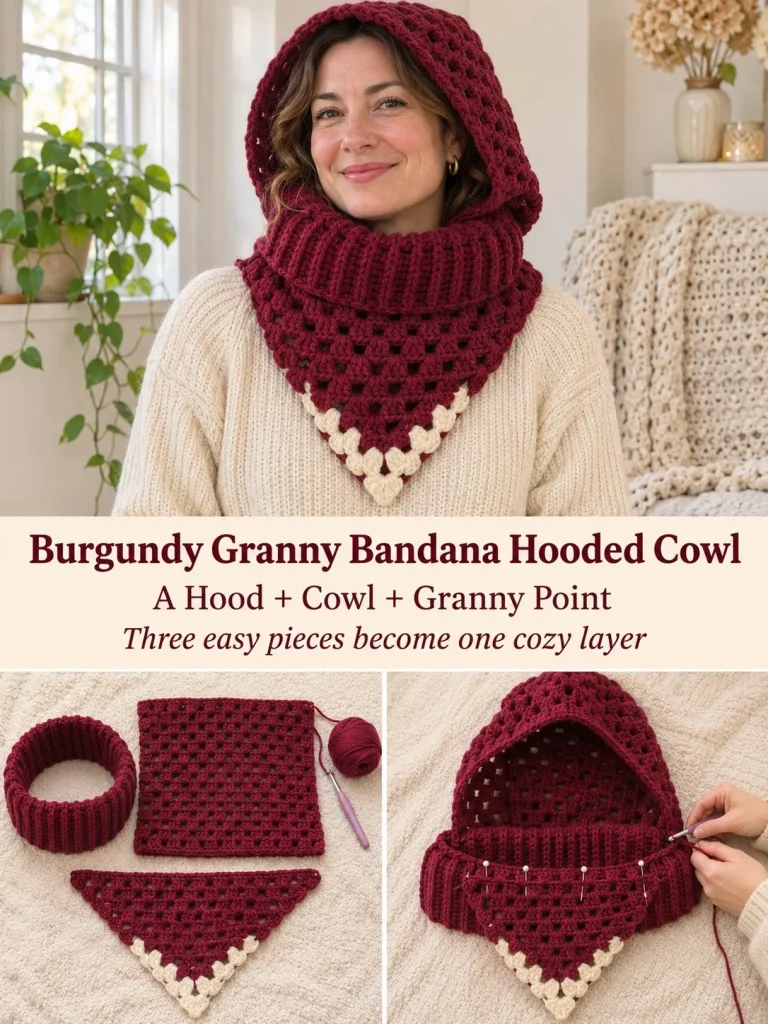
Crafted with a blend of classic motifs and functional style, this crochet project combines a warm hood, cozy cowl, and an elegant bandana front piece. Using textured ribbing and traditional granny mesh lace, it offers a versatile accessory that envelops the wearer in softness while displaying intricate stitch work. The design’s foundation lies in simple yet effective stitch combinations, making it accessible to confident beginners and experienced crocheters who appreciate timeless textures and airy grannies.
The construction involves three main components: a ribbed cowl band for neck warmth, a mesh hood shaped for comfortable coverage, and a distinctive center-out granny triangle bandana that frames the face. Together, these elements create a harmonious piece that balances snug fitting with breathable openwork. This blend of structure and lace brings an artistic flair to practical outerwear, ensuring that the accessory is both functional and fashion-forward.
The project primarily uses worsted weight yarn in a rich burgundy shade accented by muted cream, enhancing the visual contrast and detail in the granny bandana edging. The combination of back-loop half double crochet ribbing for the cowl and a classic granny mesh for the hood provides both stretch and decorative appeal. The bandana’s final rounds in cream offer a delicate highlight that complements the overall warmth of the ensemble.
The skills honed and stitches practiced in this pattern include working short rows for shaping, back loop stitches for ribbing texture, and mastering cluster stitches in granny mesh motifs. Additionally, shaping the hood through folding and seaming transforms a flat panel into a three-dimensional garment piece, showcasing crochet garment construction techniques beyond flat panels and squares. For a related project exploring similar granny stitch techniques with a different style, the burgundy granny square blanket is a great resource.
Pattern at a Glance
Skill level: Intermediate beginner to intermediate
Terminology: US crochet terms
Construction: Three separate pieces — ribbed cowl tube, granny mesh hood, center-out granny triangle bandana — sewn together
Finished size:
- Cowl band approx. 26 inches circumference × 6 inches height
- Hood rectangle 24 × 13 inches folded to 12 × 13 inches
- Bandana triangle approx. 18 inches width at top × 12 inches point depth
Yarn weight: Worsted #4
Hook size: 5.5 mm (I-9)
Main stitch: Back-loop half double crochet for cowl; granny mesh pattern for hood; granny triangle for bandana
Gauge: Not explicitly stated; focus on matching specified measurements
Motifs: Traditional granny groups of 3 double crochet clusters and chain spaces
Layout: Separate pieces joined in assembly
Joining: Seaming short ends of cowl; seaming hood back fold; sewing bandana along cowl front rim
Border: Cream rounds on final bandana edges
Seaming: Mattress stitch or whip stitch with tapestry needle for neat joins
Materials
To complete this project, gather the following supplies:
- Worsted weight (#4) yarn: Approximately 600–750 yards in a rich burgundy color for the main sections and around 70–100 yards in a muted cream for accent rounds on the bandana. Using a quality worsted yarn helps maintain stitch definition and durability, ideal for both the ribbed texture and open granny mesh.
- Crochet hook: 5.5 mm (I-9), providing a balanced gauge that yields a soft yet structured fabric. Adjust hook size slightly if needed to meet gauge and ensure measurements.
- Tapestry needle: For weaving in yarn ends and seaming the cowl, hood, and bandana pieces securely. A blunt needle facilitates smooth finishing without snagging the yarn fibers.
- Stitch markers: Useful for marking pattern repeats, counting rows, or indicating corner stitches during granny triangle increases and any seaming alignment points.
Each tool complements the yarn choices and stitch complexity, offering control and precision throughout construction.
Yarn and Color Notes
Choosing worsted weight yarn brings a cozy warmth and reliable stitch definition, especially important when combining textured ribbing and intricate granny clusters. Fibers such as wool blends or acrylic offer elasticity along with soft drape, suitable for wearable accessories.
The burgundy shade gives a deep, autumnal richness that makes the piece versatile for fall and winter wear. Contrasting the cream for the bandana’s final two rounds creates a refined color break, enhancing the triangular shape and framing the face elegantly. This subtle two-color approach allows the granny stitch details to stand out without overwhelming the design.
Avoid highly variegated or fuzzy yarns for this project as they may obscure stitch definition, particularly in the open granny mesh of the hood and bandana. Smooth, plied worsted yarns best showcase the stitch textures.
Finished Measurements
The finished accessory has carefully chosen dimensions to combine comfort with style:
- Cowl: Measures approximately 26 inches around, comfortably fitting most adult neck sizes, with a height of about 6 inches to cover the lower neck and collarbone area. This circumference ensures it sits snug but not tight.
- Hood: The single rectangle measures 24 inches wide × 13 inches high before folding. After folding widthwise, the hood backend seam is 13 inches with a 12 × 13 inch profile, creating a well-fitted hood opening measuring 13 inches across. The hood’s lower edge aligns with about 24 inches of the cowl’s top circumference, leaving a slight ease for shaping around the face front.
- Bandana: The center-out granny triangle grows to about 18 inches wide at the top edge with a 12 inch point depth, perfectly framing the front cowl rim.
Since gauge can vary, blocking the hood to exact dimensions ensures the proper fit and ease required for comfortable wearing.
Gauge
While no specific gauge number is given, measuring and matching the following dimensions is critical to ensure a proper fit and alignment of parts:
- Cowl band length: approx. 26 inches long
- Cowl height: about 6 inches
- Hood rectangle: 24 × 13 inches before folding
- Bandana triangle: 18 inches wide by 12 inches deep
It is recommended to crochet a small swatch in the back-loop half double crochet to check tension and fabric flexibility for the cowl, and similarly a gauge swatch in granny mesh for the hood and bandana triangles. Adjust hook size slightly if needed to match these measurements rather than focusing on a strict stitch count.
Maintaining consistent row height and stitch width gives the project the desired drape and fit. Too tight a gauge will make the cowl and hood small and less comfortable, while too loose may cause sagging and distorted shapes.
Abbreviations
- ch: chain
- hdc: half double crochet
- dc: double crochet
- BLO: back loop only
- st(s): stitch(es)
- sl st: slip stitch
All terms follow US crochet terminology conventions.
Important Pattern Notes
- The cowl is worked in short rows using back loop only half double crochet for a stretchy ribbed texture. Short rows mean you crochet partial rows back and forth to build height gradually.
- When chaining for the hood foundation, make a multiple of 3 plus an additional chain for the turning chain, maintaining the stitch multiple required for granny groups of three double crochets.
- The granny mesh pattern in the hood uses groups of 3 double crochets separated by chain 1 spaces allowing airiness and stretch.
- Folding the hood rectangle widthwise and seaming along one short edge creates a 3D hood shape with a back seam.
- The bandana is constructed from the center out, increasing at both sides and especially at the center point with (3 dc, ch 2, 3 dc) cluster increases, typical of granny triangles.
- The final two rounds of the bandana are worked in the cream color to create a soft border contrast.
- All pieces are seamed together carefully, with the bandana top edge sewn along the front upper rim of the cowl, permitting some overlap at corners for secure connection.
- It is strongly suggested to make a sample for fitting before final assembly, ensuring the hood opening and cowl circumference fit comfortably.
- Marker use is helpful to track corners and increases, especially around the bandana triangle’s center and edges.
Special Stitches and Techniques
Back Loop Only Half Double Crochet (BLO HDC)
This technique creates a subtle ribbed fabric by inserting the hook only through the back loop of each stitch. It results in a texture that is elastic and visually distinct from regular hdc worked through both loops.
Short Rows
Short rows involve working partial rows that turn before reaching the end, building fabric height in segments and adding shaping without increasing width.
Granny Mesh Pattern
This classic pattern consists of clusters of 3 double crochets separated by chain one spaces, generating an open and lacy texture. It’s ideal for warm weather and delicate coverage.
Center-Out Granny Triangle
Starting at a central point chain, increases happen simultaneously at each side and the center to form a growing triangle, using combinations of (3 dc, ch 2, 3 dc) for the point and increases of 3 dc groups on the sides.
Blocking
Shaping and stretching the hood rectangle to the exact 24 × 13 inches before folding sets proper dimensions and helps ease assembly.
Understanding the Construction
The project creates three interconnected pieces:
-
The Cowl Band: A ribbed tube circling the neck, worked flat in short rows to a height of 6 inches and a length roughly equal to a 26-inch circumference. The ends are seamed together to form a stretchy band with texture and structure.
-
The Hood: A large rectangular granny mesh panel (24 by 13 inches) folded widthwise (forming 12-inch width and 13-inch height) to create a hood shape. Seaming one 13-inch side forms the back seam of the hood, while the opposite side is the face opening. The lower edge of the hood attaches to the cowl’s upper circumference, covering the back and sides with slight front easing for comfort.
-
The Bandana: A triangular granny motif expanding from a center outwards with strategic increases. It finishes approximately 18 inches wide and 12 inches deep. The bandana’s top edge is sewn along the front upper edge of the cowl, overlapping slightly at the corners for stability and aesthetic transition. Its final two rounds highlight the muted cream color for contrast.
This modular construction allows for precise shaping and customization through gauge and blocking, giving a balanced mixture of warmth, breathability, and elegant traditional stitch detail.
Pattern Instructions
Cowl Band
Foundation
Chain a length appropriate to reach approximately 26 inches long (this chain length forms the width of the band, which will later be seamed to form a circle). For reference, begin with a chain sufficient to yield this length when measured flat.
Row 1
Work half double crochet (hdc) stitches in the back loop only (BLO) across the chain. This means inserting your hook under the back loop of each chain stitch only, creating horizontal ribbing. Turn your work.
Short Rows
Continue working back loop only hdc in short rows, meaning that you will crochet a partial row and then turn before reaching the end, typically to build up 6 inches in height. This creates a stretchy, ribbed fabric with a refined texture. Use stitch markers if helpful to mark turning points.
Seaming
Once your ribbed band measures about 26 inches in length along the foundation chain and 6 inches tall, seam the short ends together securely to create a tube with a circumference of approximately 26 inches.
Hood Mesh
Foundation Chain
Chain a foundation with a multiple of 3 plus an additional chain for the turning chain. This foundation should measure roughly 24 inches in width. The multiple of 3 ensures correct stitch repeats for the granny mesh.
Row 1
Work granny mesh clusters: each cluster consists of 3 double crochet (dc) stitches worked into designated spaces, separated by chain 1 (ch 1) spaces. For the foundation row, groups of 3 dc are worked into the chain stitches.
Subsequent Rows
Continue repeating granny mesh rows: groups of 3 double crochets separated by chain 1 worked into the established chain spaces from previous rows, maintaining the mesh pattern.
Blocking
Once the hood rectangle measures approximately 24 × 13 inches, block it to these exact dimensions by gently wetting and pinning the fabric flat to dry. This stabilizes the shape for subsequent folding and assembly.
Folding and Seaming
Fold the rectangle widthwise so it measures 12 × 13 inches. Seam along one 13-inch side; this seam forms the BACK of the hood. The opposite 13-inch side becomes the face opening.
Attaching to Cowl
Align the lower 24-inch edge of the hood with about 24 inches of the cowl’s top circumference covering the back and sides. Gently ease the remaining 2 inches at the front for a comfortable, curved fit.
Bandana Triangle
Foundation
Begin with a small foundation ring or chain center point from which the triangle will grow outwards.
Initial Rounds
Crochet a center-out granny triangle by adding 3 double crochet groups along both sides of the triangle, and at the center point, add an increase cluster of (3 dc, chain 2, 3 dc). This helps the triangle increase symmetrically.
Growth
Continue working rounds, adding new 3-dc clusters along sides and the center point with chain 2 for spread until the triangle measures near 18 inches in top width and about 12 inches in point depth.
Color Change
Work the final two triangle rounds in the muted cream color yarn, providing a delicate, contrasting border that highlights the shape and adds visual interest.
Attaching to Cowl
Sew the bandana’s top edge along the cowl’s front upper rim, allowing a slight overlap at the corners for a seamless transition from cowl to bandana.
Weaving Ends
Weave in all yarn ends neatly with a tapestry needle to ensure durability and a polished finish.
Checkpoints During Construction
- After finishing the ribbed cowl band, ensure the band measures approximately 26 inches in circumference and 6 inches in height. It should stretch comfortably without being tight.
- The hood rectangle should measure exactly 24 × 13 inches before folding, and 12 × 13 inches after folding, with a neat back seam that lays flat.
- The bandana triangle should grow symmetrically with consistent granny clusters, reaching about 18 inches across at the top and a 12-inch point depth before border rounds.
- Before final assembly, fit test the bandana seam against the cowl front rim and the hood attachment at the cowl top to confirm comfort and alignment.
Assembly and Joining
- Cowl Band: Seam the short ends of the ribbed band to form a tube; use a tapestry needle and yarn tail to mattress stitch or whip stitch tightly without distorting ribbing.
- Hood: Fold the hood rectangle widthwise. Seam one 13-inch edge to form the back of the hood, leaving the opposite edge open for the face.
- Join Hood to Cowl: Align and sew the lower edge (24 inches) of the hood along the back and sides of the cowl’s upper edge, easing the remaining 2 inches at the front for a natural fit. Secure stitching is essential to maintain shape and comfort.
- Attach Bandana: Sew the bandana top edge along the front upper edge of the cowl, allowing a slight overlap at corners for seamless integration. Use careful stitching to keep the shape undistorted.
- Weave in Ends: Finish by weaving in all loose ends carefully across seams and borders to prevent unraveling.
Finishing Techniques
- Blocking: Gently block the entire assembled piece to smooth joins and shape the hood and bandana for best fit and appearance.
- Edge Care: The cream border rounds on the bandana provide a subtle finish but may benefit from a light steam blocking to lie flat and prevent curling.
- Seam Tightness: Keep seams snug but not tight, allowing for stretch and movement without puckering.
- Weaving ends: Use thorough weaving to secure all yarn tails, especially along the cowl seam and hood back seam.
How to Resize
To adjust the pattern for different sizes or fits:
- Cowl Size: Alter the foundation chain length for the cowl band to increase or decrease circumference. Maintain the same height by working short rows until approximately 6 inches tall.
- Hood Size: Modify the foundation chain for the granny mesh hood rectangle by maintaining multiples of 3 for stitch consistency. Increase or decrease the number of rows to adjust height while preserving a 2:1 length-to-height ratio for proportionality.
- Bandana Size: Expand or reduce the number of granny triangle rounds to fit desired width and point depth. Remember to keep increases consistent at sides and center for even growth.
- Modifications should keep proportions to maintain ease of assembly and comfortable fit.
Useful Variations
- Single Color Version: Omit the color change rounds on the bandana for a monochrome look emphasizing texture.
- Reversed Colors: Swap main and accent colors, using cream as the primary and burgundy for the bandana border.
- Yarn Weight: Use a slightly lighter or heavier worsted weight yarn adjusting hook size accordingly, but beware of fitting changes.
- Alternate Bandana Shapes: Try a solid triangle or modify granny triangle increases for a more solid or lacy effect.
- Longer Cowl: Add rows to increase cowl height for extra warmth or style.
- For more inspiration on bandana-style cowls, consider comparing stitch techniques with the alias bandana cowl.
Troubleshooting
Why Is My Cowl Too Tight?
Check your gauge, especially with the back loop half double crochet ribbing. If your cowl feels restrictive, try a larger hook size or adjust chain length before seaming. Remember the cowl circumference should be about 26 inches for comfortable neck fit.
Why Is the Hood Not Lying Flat?
Blocking is crucial for the granny mesh hood panel. If it curls or warps, gently steam block and pin to exact measurements (24 × 13 inches). Uneven tension in chains or clusters may also cause distortion; maintain consistent stitch height.
Why Is the Bandana Triangle Uneven?
Ensure increases happen symmetrically on each side and center point. Missing or adding an extra dc cluster or chain 2 space can alter shape; count stitches frequently on the first few rounds.
Why Is the Bandana Border Curling?
Borders in cream may curl due to stitch tension or fiber reaction. A light blocking or adding a single round of sc or hdc for a firmer edge can help.
Why Are Seams Bulky or Puckered?
Use a tapestry needle and gentle tension to avoid pulling seams too tight. Seam in yarn color and try mattress stitch for smooth joining.
Frequently Asked Questions
Can I use a different yarn weight?
Worsted weight is recommended for gauge and fabric drape, but you may substitute with similarly weighted yarns. Adjust your hook size and stitch counts to maintain dimensions.
Is this suitable for beginners?
Experienced beginners familiar with basic stitches and short rows can tackle this project. It requires shaping and seaming, so some crochet confidence is useful.
How should I block the pieces?
Wet your pieces lightly, pin flat to measured dimensions (especially the hood and bandana), and let dry completely. This sets stitch shape and size precisely.
Can I make the hood larger?
Yes, increase the foundation chain in multiples of 3 and add rows accordingly. Keep fabric proportional to allow comfortable fit.
Is the bandana reversible?
Due to the color change and sewing method, the bandana side with cream rounds is considered the right side for best appearance.
How do I clean this accessory?
Check yarn care instructions. Generally, hand wash or gentle machine wash cold and lay flat to dry preserves shape.
Optional Related Uses
The granny mesh hood and bandana triangle techniques translate well into standalone shawls, lace scarves, or cozy wraps. Adjust shape and size to craft collars or shoulder warmers. The ribbed cowl stitch can be applied to hats or wrist warmers for textured warmth.
Final Thoughts
This accessory combines textured ribbing for warmth with open granny mesh for breathability and style, creating a timeless piece ideal for cooler weather. The modular construction of a tubular cowl band, folded and seamed hood rectangle, and expanding granny triangle bandana allows for customization and skill development in shaping and lace crochet.
Its balanced design embraces both comfort and artistic stitch detail. Carefully fitting the cowl to the correct circumference, blocking the hood and bandana to exact sizes, and precise seaming ensure a polished final garment that is as cozy as it is eye-catching. This project is a rewarding step into combining granny motifs with garment construction and is a lovely addition to any crocheter’s wardrobe.



