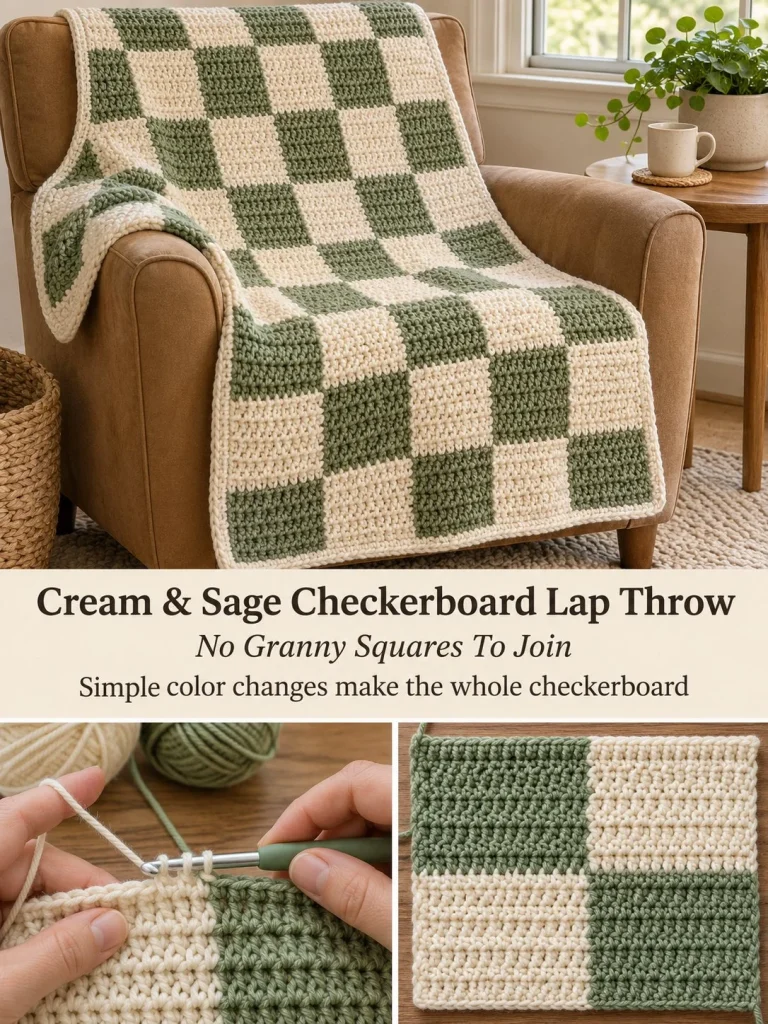
The cream and muted sage hues woven into a checkerboard lap throw offer a subtle yet captivating balance between classic and contemporary style. This project features a straightforward yet visually striking checkerboard pattern constructed with half double crochet stitches, delivering a fabric that is both cozy and appealing. The use of alternating color blocks creates a dynamic surface texture that catches the eye without overwhelming the space, making it suitable for a range of décor styles.
This lap throw is crafted in a single rectangular piece worked from the foundation chain upward, alternating color blocks horizontally and then vertically to build the checkerboard motif. The construction emphasizes clean color changes at the edges of each color block, with an option to carry yarn neatly or manage separate yarn bobbins for each block to prevent color bleeding and maintain crisp lines. The project finishes with a simple cream-colored single crochet border that frames the piece, adding a polished and comfortable edge.
Crafted primarily from half double crochet stitches, this throw is accessible to crocheters with basic skills while offering enough colorwork challenge to be engaging. The piece’s manageable size and approachable stitch pattern make it a perfect project to enhance living spaces or gift as a thoughtful handmade item. This detailed guide will walk through materials, construction, pattern instructions, and finishing touches, including tips for managing color changes and maintaining stitch consistency throughout this charming checkerboard lap throw.
Pattern at a Glance
Skill level: Intermediate (due to color changes and yarn management)
Terminology: US crochet terms
Construction: Worked flat in rows, one rectangular piece with color blocks
Finished size: Approximately 40 × 48 inches after blocking
Yarn weight: Worsted weight (#4) yarn
Hook: 6 mm (approximately US size J) crochet hook
Main stitch: Half double crochet (hdc)
Gauge: 12 hdc x 8 rows = 4 inches
Motifs: Solid color 12-stitch blocks in alternating colors
Layout: Horizontal and vertical checkerboard pattern across width and length
Border: Relaxed single crochet round in cream with 3 sc in each corner
Seaming: None (worked in one piece)
Materials
- Approximately 1100 yards of cream worsted weight yarn
- Approximately 900 yards of muted sage worsted weight yarn
- A 6 mm crochet hook (US size J), chosen for gauge and fabric drape
- A tapestry needle for weaving in yarn ends
- Scissors for cutting yarn
- Optional: stitch markers to mark block boundaries for color changes or row ends
The cream yarn forms the lighter color blocks and border, while the muted sage creates the contrasting blocks. Both yarns should ideally be of a similar fiber content and texture to ensure even gauge and feel.
Yarn and Color Notes
Selecting yarns with smooth texture and consistent thickness will make the half double crochet stitch pattern crisp and well-defined. Wool blends, acrylics, or cotton blends can work, but avoid highly fuzzy or novelty yarns to preserve the clean checkerboard look. Solid colors are key to the block pattern’s visual sharpness; variegated or highly speckled yarns might obscure the checkerboard design.
The muted sage complements the soft cream for a calming palette, but the pattern lends itself well to other two-color combinations. Considering high-contrast colors such as navy and white or charcoal and blush can create a modern graphic throw, while earth tones enhance cozy warm vibes. For additional ideas, exploring similar lap throw designs like the sage and cream gingham bed throw might inspire complementary colorwork or project scale.
Finished Measurements
The finished throw measures approximately 40 inches wide by 48 inches long after blocking. These dimensions make it ideal for lap use, lounging on a sofa, or adding a decorative layer over a chair. The size is practical for draping without excess bulk.
The width includes ten color blocks of 12 stitches each (total 120 stitches per row), establishing the checkerboard’s width across the entire throw. The length is formed by twelve blocks of eight rows each, combining to about 96 rows in total.
Gauge
The gauge target for this pattern is approximately 12 half double crochet stitches and 8 rows per 4 inches measured in the body fabric.
To measure: crochet a 4-inch square swatch using the half double crochet stitch in the specified yarn and hook. Count the number of stitches across and the number of rows within the 4 inches to ensure a match.
Why gauge matters: Matching gauge will help maintain the correct dimensions and the checkerboard blocks’ proportionality. A looser gauge produces a larger and potentially more draped fabric, while a tighter gauge tightens the stitch and shortens the length and width. Since this is a lap throw, some variance in gauge is acceptable, but aiming close to the target ensures the block sizes remain readable and the finished item fits typical lap throw expectations.
Abbreviations
- ch: chain
- hdc: half double crochet
- sc: single crochet
- st(s): stitch(es)
- rnd: round
These are US crochet terms used throughout the pattern.
Important Pattern Notes
- The first chain does not count as a stitch. Begin working half double crochet in the second chain from the hook for the foundation row.
- The fabric is worked flat in rows; each row ends with a turning chain as required by the half double crochet stitch height.
- Color changes occur every 12 stitches across a row to form color blocks. Change yarn color cleanly at each block boundary to avoid loose loops or gaps.
- You may carry the unused color yarn along the row inside the stitches if the carried yarn does not show on the right side; otherwise, use separate yarn balls or bobbins for each color block to maintain neatness.
- Rows repeat in blocks of 8 rows, with the color scheme reversing every 8 rows to create the checkerboard vertical stacking.
- The border is worked after the main body is completed, employing single crochet stitches in cream around all edges, placing three single crochets in each corner to ensure corners lie flat and are rounded gently.
- Blocking after completion is recommended to achieve the final dimensions and even the border’s relaxed edge.
Special Stitches and Techniques
- Half double crochet (hdc): Yarn over, insert hook into stitch, yarn over, pull up a loop, yarn over and pull through all three loops on hook. This stitch forms a dense yet flexible fabric.
- Color changes: Change colors at block boundaries by finishing the last stitch of the current color with the new color yarn to keep transitions smooth. Careful tension is important here to avoid holes.
- Carrying yarn: When possible, carry the unused color along the wrong side within the stitches to minimize ends to weave in and keep yarn cleaner. If carrying creates visible loops, use separate yarn balls/bobbins.
- Single crochet border: Works to give a framed and finished look; three stitches in corners ensure the angle turns without puckering.
Understanding the Construction
The lap throw is worked as a single rectangular piece, beginning with a foundation chain of 121 stitches. This chain gives a stitch count of 120 half double crochets per row (since the first chain remains unworked). The width is arranged into 10 blocks of 12 stitches each, alternating color by block horizontally.
The height is approximately 48 inches, achieved by repeating 12 blocks of 8 rows vertically (total 96 rows). Each 8-row segment alternates colors so that blocks stacked vertically form the checkerboard pattern—cream blocks sit above sage blocks and vice versa in the alternating row sets.
This method highlights crisp color-blocking without joining multiple motifs or panels. The alternating colors in both directions create a visually engaging checkerboard grid.
Once the main rectangle is complete, a single crochet border in cream color is added, providing a soft frame that ties the design together.
Complete Pattern Instructions
Foundation Row
Chain 121.
Row 1
Half double crochet in second chain from hook and in each chain across to end of row (120 stitches).
Divide the row into ten blocks of 12 stitches each.
Rows 1–8 (First Color Block Sequence)
For these rows, alternate colors every 12 stitches horizontally:
- Begin by working 12 half double crochet in cream.
- Change to sage yarn and work 12 half double crochet.
- Alternate colors every 12 stitches across the row, maintaining a total of 120 stitches per row.
Make sure to change colors cleanly at each block boundary, finishing the last stitch of the block with the new color. When carrying yarn along the row, carry the unused color behind the work only if it does not show on the right side; otherwise, manage separate yarn balls for each block to maintain clean color transitions.
Repeat these color patterns for each of rows 1 through 8.
Rows 9–16 (Second Color Block Sequence)
Repeat the same 12-stitch color blocks as in the previous set but reverse the colors vertically:
- Above every cream block, place a sage block.
- Above every sage block, place a cream block.
This reversal creates the checkerboard vertical pattern.
Continuing the Pattern
Repeat the 8-row color block sequence (Rows 1-8 and 9-16 alternations) until there are twelve block rows of 8 rows each total, meaning:
- 96 rows worked in total (8 rows × 12 block rows)
- The piece should measure approximately 48 inches long.
Border
Once the main body is complete, with cream yarn, work a single crochet round evenly around the blanket edges, placing 3 single crochet stitches in each corner to allow smooth corner turns without puckering or stretching.
Optionally, add a second single crochet round around the edge to strengthen the border and add dimension.
Finishing
Weave in all yarn ends securely using a tapestry needle.
Block the finished piece to approximately 40 by 48 inches. Blocking evens out stitches, softens the fabric, and ensures the border lays flat and relaxed.
Helpful Checkpoints
- After foundation and Row 1, you should have 120 stitches across—check carefully to avoid adding or missing stitches.
- Every 8 rows, visually confirm color blocks alternate as expected—cream above sage and vice versa.
- The checkerboard squares should measure approximately 2 inches wide (based on gauge).
- At row 96, the length should measure about 48 inches before border application.
- The border should lay flat and corners should be rounded, not pulled or curling in.
Assembly and Joining
This pattern is worked as a single piece and does not require assembly or joining separate panels or motifs. The checkerboard effect is achieved through color changes within rows and color-blocked rows stacked vertically.
Ensure neat yarn-end weaving to prevent unraveling, particularly at color change points.
Border and Finishing Tips
- To maintain a relaxed and flat border, avoid working single crochet stitches too tightly.
- When placing 3 sc in the corners, crochet the first stitch into the corner stitch, then work two more in the same space to create a gentle curve.
- Weaving in ends neatly during finishing avoids lumps and heaviness around edges.
- Blocking helps smooth edges and relax stitches; use pins or a blocking board and mist lightly with water to shape.
For more ideas on creating cozy cozy lap throws, consider patterns with similar soothing palettes such as the cream and marlowe geometric lap blanket which also uses skillful colorwork to great effect.
How to Resize
To adjust width:
Add or subtract 12 stitches per block to the starting chain in multiples of 12 to maintain the checkerboard pattern. Each block of 12 stitches corresponds to one color block horizontally.
To adjust length:
Add or subtract full 8-row blocks. Since the pattern repeats every 8 rows, length increases or decreases in increments of 8 rows to preserve the checkerboard vertical stacking.
Note that altering stitch count or row count affects total dimensions proportionally. Adjust yarn requirements accordingly.
Useful Variations
- Single Color Version: Work the entire throw in a single color to highlight texture.
- Alternative Colors: Use high-contrast colors for a bolder checkerboard effect or pastel pairs for a softer look.
- Scrap Yarn Version: Use multiple colors alternating blockwise for a scrap busting project with checkerboard-style color planning.
- Smaller Lap Size: Reduce the number of blocks in width and height for a smaller baby or lap blanket.
- Larger Throw: Increase blocks to create a full-size throw or small blanket size.
Troubleshooting
Why Are My Color Changes Messy?
Make sure to complete the last stitch of the previous color by pulling through with the new color. Tighten yarn tension evenly. Consider bobbins or separate yarn balls if carrying yarn causes loops showing on the wrong side.
Why Is My Blanket Warping or Edges Curling?
Edges curling can result from tight tension or uneven color pulls. Block your finished piece for even shaping. Don’t work border stitches too tightly—loose and relaxed single crochet rounds help flatten edges.
Why Are My Checkerboard Blocks Not Aligning?
Check stitch counts regularly. Confirm that rows and stitches remain even. Missing or added stitches distort block widths. Use stitch markers for every 12 stitches and end of rows to track boundaries accurately.
Why Does the Fabric Feel Too Stiff or Loose?
Adjust your hook size if gauge is significantly off. A smaller hook tightens stitches (stiffer fabric); a larger hook loosens stitches (more drape). Aim for the gauge given for best results.
Frequently Asked Questions
Can I use a different yarn weight?
This pattern is designed for worsted weight (#4) yarn to maintain gauge and fabric texture. Lighter or heavier yarns will change the fabric drape, gauge, and overall size. If substituting, make a gauge swatch and adjust hook size and stitch count accordingly.
Can I use cotton yarn for this throw?
Yes, cotton is suitable, but it may produce a less stretchy fabric and less drape compared to acrylic or blends. The stitch definition remains excellent with cotton. Consider a slightly larger hook for softer drape.
Is this pattern suitable for beginners?
It is accessible to confident beginners comfortable with half double crochet and managing color changes. Newbies should practice changing colors cleanly and carrying yarn before starting the project.
Can I make the throw larger or smaller?
Yes, modify width by adding or subtracting multiples of 12 stitches and length by adding or subtracting 8-row repeats to keep the checkerboard consistent.
How should I block this throw?
Lightly mist with water or use a steam iron held above without touching and pin to the desired size on a blocking board or flat surface. Allow to dry completely. Blocking settles stitches and evens edges.
Are the color changes reversible on the wrong side?
The wrong side shows carried colors or ends where separate yarns are used. The right side displays the clean checkerboard design.
Optional Related Uses
The half double crochet checkerboard technique and two-color block pattern can adapt well to smaller projects such as pillow covers, table runners, or even scarves. The simple color-block division lends to versatile home décor items where crisp geometry is appreciated.
Final Thoughts
This checkerboard lap throw is a harmonious blend of simple stitches and skillful colorwork. The project’s charm lies in its methodical repetition and clean color blocks crafted in one continuous piece. By managing yarn colors carefully and maintaining consistent tension, crocheters create a comfortable, visually inviting throw perfect for everyday use or as a gift. The border ties the piece together with a subtle finish, completing a timeless and elegant home accessory.
Whether you are refreshing your crochet colorwork skills or creating a thoughtful handmade blanket, this project offers ample satisfaction with every square counted and color changed.



