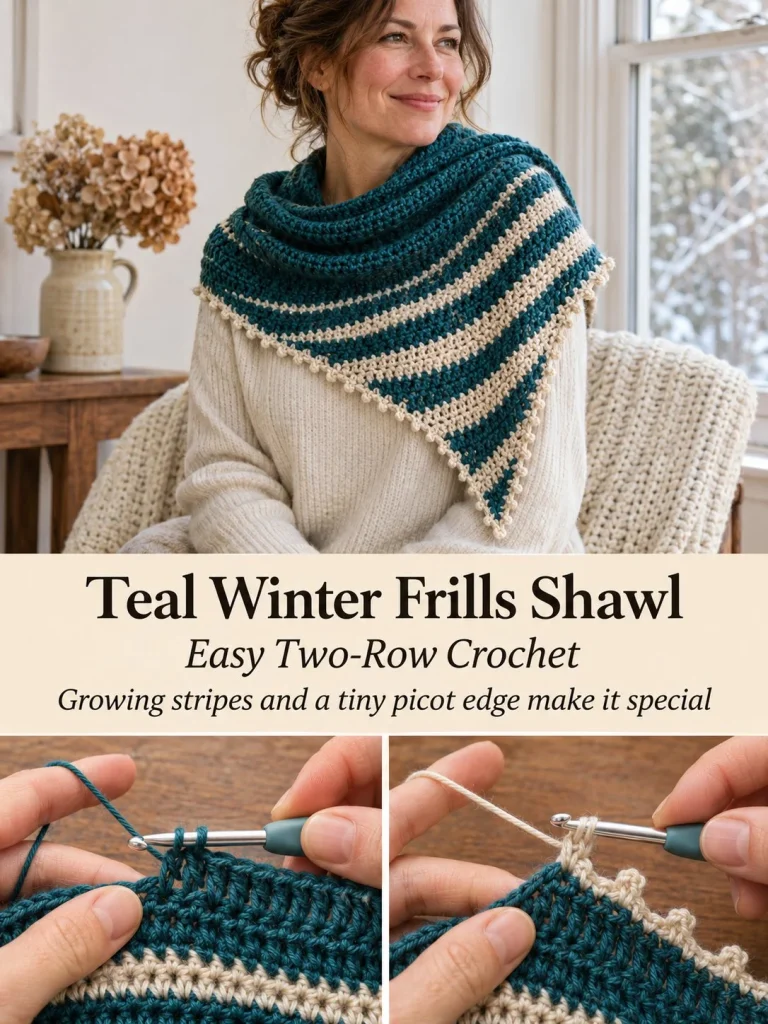
The teal-hued fabric of this winter shawl creates a stunning accessory that combines warmth, style, and a touch of whimsy. The asymmetrical triangle shape offers a modern silhouette that gracefully drapes around the shoulders, perfect for chilly days and evenings. Its delicate frills, achieved with a picot edging in a complementary oatmeal color, add an elegant finishing touch that elevates the overall design. Crafted primarily using half double crochet and double crochet stitches, this project showcases how simple stitches can be manipulated in clever ways to build texture, dimension, and shape.
This shawl is worked using an innovative construction method—starting with just four stitches and building diagonally into a sizable asymmetric triangle. The meticulous stitch increases and decreases alter the fabric’s geometry, yielding a dynamic visual effect and a comfortable fit that wraps naturally around the neck and shoulders. Alongside the main teal yarn, oatmeal stripes are introduced with increasing width towards the edges, adding subtle contrast and interest without overwhelming the overall aesthetic. For those seeking inspiration or complementary projects, viewing the teal-themed shawls featuring similar color palettes can spark creative ideas.
Pattern at a Glance
Skill level: Intermediate (due to shaping and color changes)
Terminology: US crochet terms
Construction: Worked in rows to form an asymmetric triangle with diagonal progression
Finished size: Neck edge approximately 50 inches, depth about 27 inches
Yarn weight: DK/light-worsted
Hook: 4.5 mm (approx. US size 7)
Main stitches: Half double crochet (hdc), double crochet (dc), slip stitch (sl st), chain (ch)
Gauge: Not explicitly given but should maintain consistent tension for drape and size
Colorwork: Mostly deep teal with gradually widening oatmeal stripes
Border: Picot edge along two outer edges using oatmeal yarn
Seaming: None required – worked as a single piece
Materials
-
Approximately 300 yards of deep teal DK or light-worsted yarn: This forms the majority of the shawl fabric. DK yarns are lightweight yet warm, offering a lovely drape suitable for wraps and shawls.
-
Approximately 200 yards of oatmeal-colored DK yarn: Used primarily for the decorative stripes and picot edging to add a soft contrast.
-
4.5 mm crochet hook: This hook size suits DK yarn well, ensuring clear stitch definition without creating a stiff fabric.
-
Tapestry needle: For weaving in ends neatly and securing color changes.
-
Scissors: Essential for trimming yarn ends and cutting yarn when switching colors.
Using the right yarn and hook combination is vital to maintain the flexibility and softness that make the shawl comfortable to wear. Smooth yarns with a slight sheen will highlight the stitch textures beautifully.
Yarn and Color Notes
Choosing yarn fiber can significantly impact the shawl’s appearance and feel. This pattern lends itself best to a wool or wool-blend yarn for warmth and a bit of elasticity. Acrylic or cotton yarns could be used as alternatives, but may alter the texture and drape. The deep teal provides a rich, seasonal color, while the oatmeal stripes introduce visual interest and break up the solid blocks of color. The contrast is subtle yet effective, giving a timeless, cozy vibe.
Stripes widen gradually toward the edges, encouraging the eye to move across the shawl and accentuating the triangular shape. For those interested in experimenting, a similar stripe technique is explored in the teal shawl featuring line loops and complementary shade contrasts for inspiration on integrating color transitions beautifully.
Finished Measurements
This shawl is designed to reach an approximate neck edge length of 50 inches, allowing ample wrap room for comfort and styling versatility. The depth measures about 27 inches, shaping an elegant triangle that provides coverage without overwhelming bulk. These dimensions create a piece sizable enough to drape across shoulders and chest, perfect for layering in cooler weather.
Gauge and personal tension can slightly affect finished size; if you find your fabric is tighter or looser, measure frequently and adjust hook size accordingly. The asymmetrical shaping will be more apparent when the shawl reaches the recommended dimensions.
Abbreviations
- ch = chain
- hdc = half double crochet
- hdc2tog = half double crochet two together (decrease)
- dc = double crochet
- dc2tog = double crochet two together (decrease)
- sl st = slip stitch
Important Pattern Notes
- Turning chains: Rows begin with the specified turning chain (ch2 or ch3), which do not count as stitches unless otherwise stated.
- Color changes: Work mostly in teal yarn, adding oatmeal stripes that gradually widen toward the outer edges. Change colors cleanly at stripe boundaries.
- Shaping: The diagonal fabric growth is achieved by carefully balancing increases and decreases along opposing edges, creating an asymmetric triangle.
- Picot edging: The outer edges of the triangle are finished with a picot border worked only on these sides, leaving the neck edge plain for comfort.
- Work from the center base outward: Starting from a small chain foundation and building upward along a diagonal axis for the shawl.
Special Stitches and Techniques
Half Double Crochet Two Together (hdc2tog)
This decrease stitch combines two half double crochet stitches into one to shape and contour fabric edges.
Double Crochet Two Together (dc2tog)
Similarly, this stitch decreases by combining two double crochet stitches, used here primarily on the opposite edge to control fabric width dynamically.
Picot Edge
The picot, created by chaining 3 and slip stitching back into the 2nd and 3rd chains, creates tiny decorative loops along the edge, giving the shawl its signature frilly finish.
Color Stripe Integration
The pattern integrates oatmeal stripes gradually widening outward, requiring clean color changes mid-project without interrupting the fabric continuity.
Understanding the Construction
This shawl is worked from a very small foundation chain of four loops, growing upward and outward in a diagonal asymmetrical triangle shape. The initial chains establish the starting point for the first row, which forms a foundation of four half double crochet stitches.
From there, alternating rows of half double crochet and double crochet build the fabric while carefully modulating stitch decreases at one edge and more substantial increases at the opposite edge. This progressive shaping creates a dynamic slant and an elegant asymmetry.
Most of the shawl is worked in deep teal yarn, interspersed with strips of oatmeal that widen as you progress outward, adding visual interest and subtlety to the design. The shaping ensures that the fabric drapes naturally around the neck and shoulders, with ample depth for warmth.
Complete Pattern Instructions
Foundation
Begin with a chain of 4 stitches.
Row 1
- Work 1 half double crochet (hdc) into the 2nd chain from the hook.
- Work 1 hdc into the next chain.
- Work 2 hdc stitches into the final chain.
- You will have a total of 4 stitches at the end of this row.
Row 2
- Chain 2 and turn your work.
- Work a half double crochet two together (hdc2tog) over the first 2 stitches. This begins a decrease on the start edge.
- Work half double crochet stitches (hdc) evenly across the row until the last stitch.
- In the final stitch, work 3 half double crochet stitches. This aggressive increase on the other edge widens the shawl.
- This row shifts the fabric diagonally while increasing the total width by one stitch.
Row 3
- Chain 3 and turn.
- Work 2 double crochet stitches into the first stitch.
- Work a double crochet (dc) stitch across each remaining stitch until the last two stitches.
- Work double crochet two together (dc2tog) on the final two stitches to decrease the edge.
Repeat Rows 2 and 3
Continue repeating Rows 2 and 3, maintaining the asymmetric increase and decrease pattern which forms the diagonal, asymmetric triangular shape of the shawl. The decrease will always occur at one edge (starting edge) while the increase occurs strongly at the opposite edge (ending edge), creating the distinctive slant.
Mostly work with the deep teal yarn during this phase. Gradually add oatmeal stripe sections as you progress toward the edges, increasing their width for a subtle color shift effect.
Continue until the neck edge reaches about 50 inches in length, with the depth of the shawl approximately 27 inches, creating a generous figured triangular wrap.
Picot Edge
- Join the oatmeal yarn at one outer corner of the shawl.
- Work a picot edging along the two outer edges only (the edges formed by the increase and decrease rows), leaving the neck edge plain for comfort.
- The picot is created by repeating the following along each edge: chain 3, slip stitch in the 2nd chain and the next chain to form the picot, then slip stitch into the next edge stitch.
This edging adds a delicate, frilly finish that brings the entire design together.
Checkpoints
- After Row 1, confirm you have exactly 4 stitches.
- After Row 2, the width of your shawl will increase by one stitch overall.
- The fabric should start diagonally slanting after Row 3 due to the asymmetrical increase and decreases.
- The neck edge measurement when completed should be approximately 50 inches, and the depth (point to neck) about 27 inches.
- The oatmeal stripes should start narrow near the center and gradually widen toward the edges.
Assembly
This shawl is made in a single continuous piece without seaming. After finishing the body and edging, securely weave in all yarn ends using a tapestry needle to prevent unraveling. Special attention should be given to ends at color change points for a neat finish.
Finishing
Blocking is recommended to enhance stitch definition and set the shape. Gently wet or steam block the shawl, pinning it to the correct dimensions without overstretching. Emphasize the triangular shape and picot edging.
Use the tapestry needle to weave in yarn tails along the edges unobtrusively. The neck edge remains unadorned by the picot border, ensuring the shawl sits comfortably against the skin.
How to Resize
To resize this shawl, maintain the alternating Row 2 and Row 3 repeats to control the triangular shape. Increasing the total number of repeats will make the shawl larger; simply continue until your preferred neck edge and depth measurements are reached.
Conversely, reducing repeats will create a smaller wrap suitable for different styling or seasonality. Adjusting hook size will also affect the final size and drape, but keep consistent tension across the fabric.
Useful Variations
- Single Color Version: Work the entire shawl in one color for a streamlined, classic look.
- Multi-Stripe Variation: Introduce more than two colors in the stripes for a more colorful, playful look.
- Longer Depth: Extend the depth of the shawl for more coverage, perfect for colder climates.
- Matching Accessories: Use leftover yarn to crochet matching mittens or headbands in complementary stitch patterns.
Troubleshooting
Why Is My Shawl Not Lying Flat?
Uneven tension or inconsistent stitch height may cause curling. Keep tension even, and block the shawl after completion.
How Do I Keep Color Changes Clean?
Carry the unused yarn loosely along the edge when switching colors. Avoid pulling too tight to prevent puckering.
Why Is My Edge Wavy?
This is common with picot edgings if the tension is too tight or loose. Work picots consistently and block the shawl to settle the border.
Frequently Asked Questions
Can I use a different yarn weight?
Yes, but adjusting hook size and number of repeats is necessary to achieve similar dimensions and drape.
Is this shawl suitable for beginners?
Intermediate level is recommended due to shaping and color changes, but adventurous beginners can attempt with patience.
How do I care for this shawl?
Hand wash gently in cool water and lay flat to dry to preserve shape and color.
Can I make this shawl reversible?
The current pattern is not designed for reversibility because of the picot edge and color transitions.
How should I block the picot edges?
Pin the picot edges gently, spacing the picots evenly without stretching the fabric to maintain frilliness.
Can I add fringe or tassels?
Fringes can be added on the neck edge for extra flair, but this is an optional embellishment.
Optional Related Uses
The construction principle of this asymmetrically shaped triangle can inspire other projects such as scarves, cowls, or wraps. Using the same stitch patterns and color-blocking approach can adapt the design to home decor accents like throws or table runners.
Final Thoughts
This shawl combines precise shaping with simple, elegant stitch patterns and thoughtful color work to create a wearable piece that is visually captivating and functional. Starting from a small foundation and building out diagonally with controlled increases and decreases allows for a flattering asymmetrical triangle shape. The play of deep teal and oatmeal stripes, completed with delicate picot frills, makes this shawl a sophisticated winter accessory for layering with ease and style.



