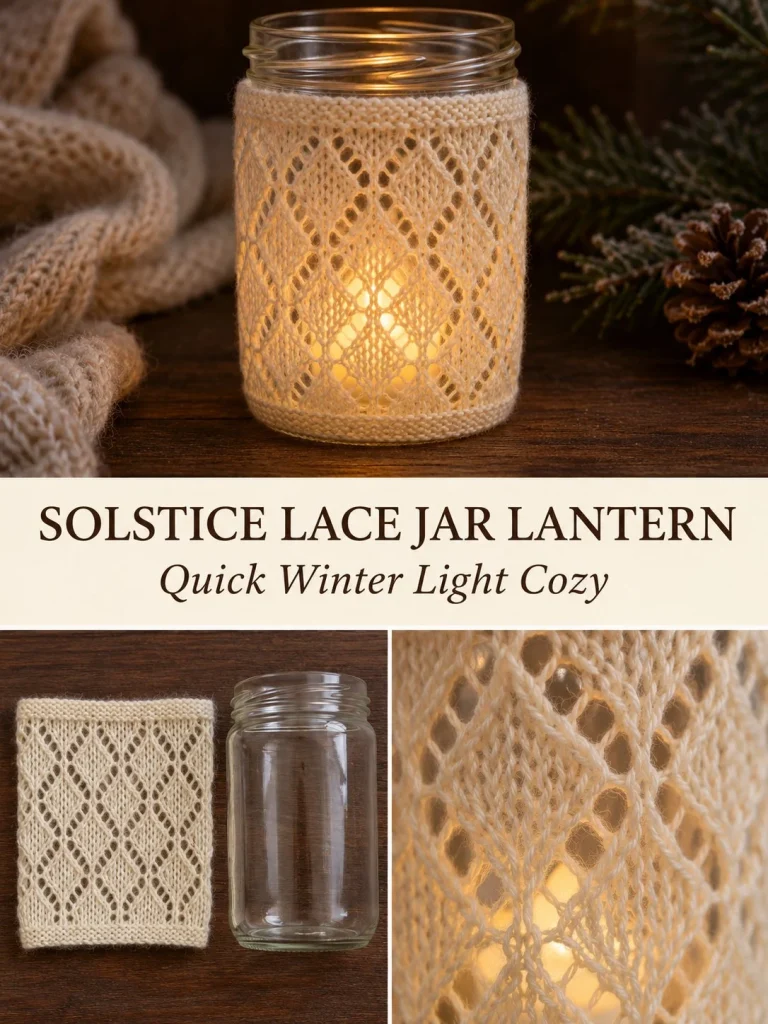
Creating a delicately patterned lace jar cozy adds a soft, glowing ambiance to your winter evenings, transforming an ordinary jam jar into a charming lantern. This project employs lace knitting techniques to build a lightweight, textured cover that filters warm light through a series of eyelets created by strategically placed yarn overs and decreases. The cozy fits snugly yet comfortably around the jar, elevating seasonal décor with handmade artistry.
Constructed entirely in the round, this cozy uses fingering-weight wool worked on US 3 (3.25 mm) needles, ensuring a fine gauge that complements the lace pattern’s intricate openwork. The design works with a calculated negative ease to gently hug the jar for a secure fit without overstretching the yarn. Because the project is knit in continuous rounds using a simple but effective lace motif interspersed with garter knitting rounds, it provides both texture and breathability. The final piece becomes a reusable winter accent perfect for decorating mantles, shelves, or windowsills with the soft flicker of LED tea lights—chosen deliberately for safety over open flames.
For crafters intrigued by seasonal homely projects, this cozy shares design principles with other patterns like the charming adult sock patterns with delicate lace edges, highlighting the versatility of lace knitting across functional and decorative items.
Pattern at a Glance
Skill level: Intermediate knitters comfortable with lace techniques and working in the round
Terminology: Standard US knitting terms
Construction: Worked seamlessly in the round from the bottom upwards
Finished size: Designed to fit a jam jar with approximately 10-inch circumference, stretchy to fit slightly smaller or larger jars with negative ease
Yarn weight: Lace or fingering-weight wool
Needles: US 3 / 3.25 mm circular or small-circumference needles
Main stitch pattern: Lace round comprising paired decreases and yarn overs, framed by garter stitch rounds
Gauge: Not explicitly specified, knitted to fit jar circumference with negative ease adjustment
Motifs: Continuous lace round motifs repeated vertically
Joining: Seamless circle via joining cast-on stitches in the round
Border & Finishing: Simple loose bind-off edges, wet-blocked to shape
Materials
To successfully make this cozy, you will need:
- 30-35 yards of lace or fingering-weight wool yarn: The delicate fiber thickness accentuates the lace pattern and provides warmth without being bulky. Wool is preferred for its elasticity and ease of blocking.
- US 3 / 3.25 mm knitting needles: Circular or double-pointed needles suitable for small-circumference knitting. Needles must comfortably accommodate at least 72 stitches in the round.
- One clean jam jar: The base form for your cozy; typically a standard 10-inch circumference mason or jam jar works well.
- LED tea light: Only use battery-powered lights to avoid any fire hazard, since wool and fibers are flammable.
- Stitch marker: To mark the beginning of rounds for accurate pattern repeats.
- Tapestry needle: For weaving in ends after binding off.
Each material plays a key role in ensuring that the finished cozy fits well and looks beautiful while being safe and functional for decorative lighting purposes.
Yarn and Color Notes
Choosing the right yarn for lace projects enhances both ease of knitting and finished appearance:
- Fiber content: Wool is ideal due to its elasticity, natural warmth, and excellent blocking qualities which open up lace patterns beautifully. Avoid superwash if you want more natural blocking behavior.
- Texture: Smooth, plied yarns showcase lace stitches more clearly than highly textured or fuzzy yarns such as mohair blends.
- Color: Solid or semi-solid hues allow the eyelets and pattern to show through clearly, though tonal or lightly variegated yarns can add subtle depth without obscuring pattern details.
- For those interested in seasonal adaptations or complementing related cozy décor, this lace pattern concept fits well alongside projects like the harvest mouse knitting pattern featuring autumn themes, both providing a warm, homey aesthetic.
Finished Measurements
The cozy is designed to fit a jar approximately 10 inches in circumference. It incorporates about 10-15% negative ease, which means the cozy’s circumference when relaxed is slightly smaller than the jar’s circumference to allow for a snug fit. The length varies depending on the jar height but should finish approximately 1/2 inch shorter than the jar body height to avoid covering the rim or interfering with placement.
Because the size depends on your choices around jar dimensions and personal fit preference, blocking and yarn elasticity can slightly adjust final dimensions.
Gauge
While no specific stitch gauge is provided, gauge here is primarily determined by jar dimensions and the pattern’s stitch multiple:
- Measure your jar circumference and calculate the number of stitches to cast on, ensuring an even number of stitches and allowing for about 10-15% negative ease.
- For a typical 10-inch circumference jar, 72 stitches is recommended.
- Gauge affects fit—too loose and the cozy will slip off, too tight and it might be difficult to slide onto the jar or may distort the lace.
Because this is an accessory with some stretch, precise matching of gauge is somewhat flexible but still essential for a neat fit and pattern appearance.
Abbreviations
- K: knit
- K2tog: knit two stitches together (right-leaning decrease)
- YO: yarn over (creates an eyelet)
- SSK: slip, slip, knit (left-leaning decrease)
- sts: stitches
These are standard US knitting abbreviations used in the lace round.
Important Pattern Notes
- The pattern is worked in the round with a joined cast-on. Use a stitch marker to keep track of rounds.
- The cast-on stitch count must be even to maintain symmetry in the lace pattern.
- The lace pattern round consists of a repeat of 5 stitches (K2tog, YO, K2, YO, SSK), repeated around the circumference.
- Garter stitch rounds knit all stitches to frame the lace round with texture and height contrast.
- The pattern repeat consists of 4 rounds: 3 garter stitch rounds, followed by 1 lace round, repeated vertically.
- Final binding off should be loose to maintain stretch and avoid puckering.
- Blocking is essential to open the eyelets and shape the cozy.
Special Stitches and Techniques
- K2tog (knit two together): decreases one stitch, leaning right; creates a decrease that shapes the lace pattern.
- YO (yarn over): adds a stitch by pulling yarn over the needle; creates a decorative hole essential for lace texture.
- SSK (slip, slip, knit): a decrease leaning to the left, balancing the K2tog.
- Garter stitch in the round: knitting all stitches in each round to create rows of ridges, adding body above and below lace rows.
- Wet blocking: soaking and shaping the finished piece on a jar-shaped form to open the lace eyelets evenly.
Understanding the Construction
This cozy is a simple, seamless tube knit from the bottom edge upwards to just below the jar’s rim. It starts with a measured cast-on for your jar’s circumference and negative ease to ensure the fit is snug but not stretched.
The work alternates three garter stitch rounds with one lace round featuring a symmetrical 5-stitch lace motif that runs continuously around the jar. This sequence repeats until the cozy length is just under the jar height, preserving a neat edge without covering the rim. The piece concludes with garter stitch rounds and a loose bind-off.
By knitting in rounds, the cozy maintains consistent pattern flow and fits smoothly without seams. Wet blocking on a jar-shaped form properly opens the lace, ensuring consistent sizing and beautiful drape.
Pattern Instructions
Foundation
- Measure the jar circumference carefully using a flexible tape measure.
- Calculate negative ease by multiplying the jar circumference by about 0.85 to 0.90 (10-15% less than jar size) to find target cozy circumference.
- Choose an even cast-on number of stitches that matches your gauge and target circumference. For example, a 10-inch jar typically needs 72 stitches.
Round 1–3
- Join the cast-on stitches carefully to work in the round, avoiding twists.
- Place a stitch marker to mark the start of each round.
- Knit 3 rounds entirely in garter stitch pattern. Since garter stitch in the round is achieved by knitting every round, this creates ridges and texture framing the lace.
Round 4 (Lace Round)
-
Work K2tog, YO, K2, YO, SSK around:
- K2tog: knit two stitches together.
- YO: yarn over.
- K2: knit two stitches.
- YO: yarn over.
- SSK: slip slip knit.
-
Repeat this 5-stitch sequence until the round is complete.
Repeat Sequence
- Repeat the 3 garter stitch rounds followed by 1 lace round (total 4 rounds) until the sleeve length is approximately 1/2 inch shorter than the jar body height.
- This ensures the cozy fits neatly without covering the jar rim.
Final Rounds and Bind-Off
- Knit 3 final rounds in garter stitch.
- Bind off loosely using your preferred stretchy bind-off method to maintain elasticity and avoid tightening the edge.
Blocking
- Wet-block the finished cozy by soaking it in cool water, gently squeezing out excess water, then stretching it over a jar-shaped form.
- Pin or secure in place so the lace eyelets open evenly and the cozy dries in the correct shape.
- Once fully dry, slide the cozy over your clean jar.
Safety Use
- Use only battery-powered LED tea lights inside the jar.
- Never use a real candle or open flame, as wool fibers can catch fire.
Checkpoints
- After casting on and joining, verify 72 stitches and that the round marker is in place.
- After 3 garter stitch rounds, the fabric has a textured ridge base.
- After the first lace round, eyelet pattern will be clearly visible.
- Repeat pattern rounds until the piece measures approximately the height of your jar minus 1/2 inch.
- Binding off should leave a flexible edge to slip over the jar rim.
- After blocking, the lace openings should be fully expanded for maximum visual effect.
Assembly
This cozy is a single seamless piece. Simply slide it over the jar after blocking and dry. The snug fit combined with negative ease holds it firmly in place without extra fasteners.
Finishing
- Weave in yarn ends neatly with the tapestry needle.
- Ensure edges are even.
- Careful blocking prevents distortion and maximizes lace visibility.
- Handle gently when placing on and removing from the jar to avoid stretching or snagging.
How to Resize
- Measure your jar’s exact circumference.
- Multiply the circumference by 0.85–0.90 to calculate cozy circumference with negative ease.
- Determine your gauge by knitting a small swatch using the lace round and garter stitch rounds.
- Calculate the cast-on stitches necessary for your gauge to match the target cozy circumference.
- Ensure the cast-on number remains even and divisible by 5 to maintain lace stitch pattern repeats.
- Adjust cozy length by repeating rounds to be about 1/2 inch shorter than your jar’s height.
Useful Variations
- Create longer sleeves to cover taller jars or to add extra texture below the rim.
- Use contrasting colors for the garter stitch rounds and lace rounds for added visual interest.
- Experiment with different lace motifs that fit the same stitch multiple to customize the look.
- Work the cozy in a different fiber like alpaca for softer drape and warmth.
- Combine this lace sleeve with similar cozy projects for home accent sets, linking textures and motifs.
Troubleshooting
Why does my cozy feel too loose?
If your cozy slips down the jar or lacks shape, your cast-on circumference might be too large or the negative ease insufficient. Consider casting on fewer stitches next time or using smaller needles.
Why is the lace pattern distorted?
Uneven tension during lace rounds or incorrect stitch counts in the pattern repeat can distort the eyelets. Double-check lace stitch order and stitch counts.
Why won’t the cozy slide over the jar?
If too tight, the fit may need to be adjusted by adding stitches. Also check binding off tightly; a very tight bind-off can reduce stretch.
Why do my eyelets not open after blocking?
Ensure the cozy is fully wetted and blocked on the shaped form for enough drying time. Resist the urge to stretch too aggressively which can damage the yarn.
Why is my garter stitch uneven in the round?
Since garter stitch in the round is all-knit rounds, small gauge fluctuations create ridges. Use consistent tension for smooth texture.
Frequently Asked Questions
Can I use a different yarn weight?
Lace or fingering weight yarn works best to highlight the lace pattern and provide proper fit. Heavier yarns may obscure lace and create a bulky fit.
Can I use cotton yarn?
Cotton lacks elasticity and blocking behavior for lace, resulting in a less stretchy fit and poor eyelet opening. Wool or wool blends are preferred.
Can I make this cozy for a larger jar?
Yes, by measuring the jar circumference and adjusting cast-on stitch count accordingly while maintaining the stitch multiple and lace repeat.
Is this pattern suitable for beginners?
This pattern assumes familiarity with knitting in the round and basic lace techniques. Intermediate knitters will find it enjoyable, but beginners may want to practice lace and garter stitch in the round first.
How should I block my cozy?
Wet-block over the jar or a similar form to open eyelets evenly and shape the cozy. Gently shape and allow to dry completely.
Can I use an open flame with this cozy?
No. Always use battery-powered LED tea lights to prevent fire risk, as wool and fibers are combustible.
Optional Related Uses
This lace stitch motif and construction technique adapts well to creating other decorative items like candle holders, vases, or bottle cozies. The same lace pattern and construction logic can inspire cozy mitts, bottle covers, or even lightweight scarves linked to seasonal décor themes.
Final Thoughts
In essence, this project is a graceful knitting exercise in creating a delicate lace sleeve to dress a common household jar. The construction revolves around seamlessly knitting from base to near rim in the round, alternating texture-rich garter stitch and lace rows. Precise measurement and knitting gauge ensure the cozy fits snugly with negative ease for secure placement. Proper finishing through wet blocking unlocks the lace’s full visual appeal, while practical safety advice underscores the utility of LED lights for a cozy, glowing winter lantern. This simple but elegant accessory delivers warmth and ambiance typical of hand-crafted winter décor, ideal for gifting or seasonal enhancement.
For a broader inspiration on cozy, workable knitwear and home objects incorporating delicate details, consider exploring other patterns like the harvest mouse knitting pattern that celebrates cozy autumn décor to expand your seasonal crafting repertoire.



