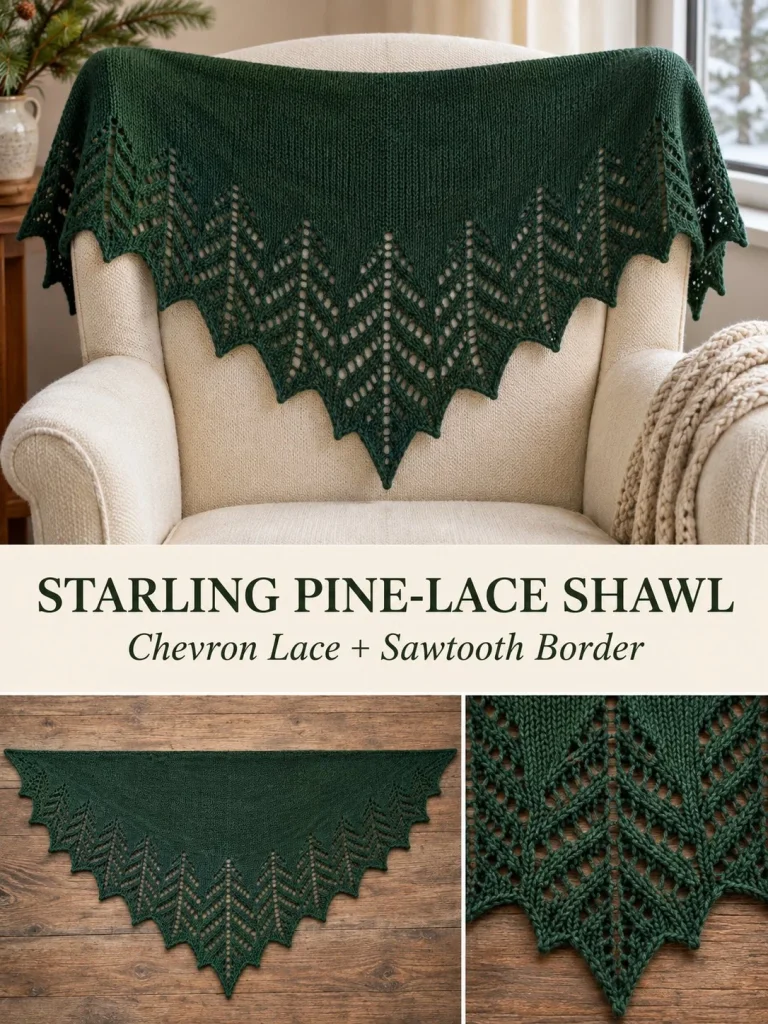
The Starling Pine-Lace Shawl with its sawtooth border is a skillful knitting project showcasing elegant lace motifs inspired by natural pine-tree shapes and the classic sawtooth edge detail. Crafted in DK-weight merino/cashmere, this shawl balances intricate stitch work with a graceful silhouette ideal for a stylish layering piece. Its delicate geometry brings a refined texture and a cozy drape, making it an excellent accessory for both everyday wear and special occasions.
This shawl is constructed starting from a unique garter tab, which anchors the triangular shape and allows the pattern to grow seamlessly. The central motif features stacked chevrons that resemble pine trees realized through paired yarn overs and decreases, while the edge culminates in a pointed sawtooth lace border enhancing the overall visual appeal. The interplay of lace openness and structured increases throughout the piece yields a fabric that is both airy and defined. For knitters interested in refined lace projects, this pattern offers a satisfying blend of technique and artistry. It can be compared in complexity and elegance to other lace-focused accessories, such as the vintage lace shawl with eyelet border, which also employs delicate yarn overs and borders for a timeless effect.
Pattern at a Glance
Skill level: Intermediate lace knitting
Terminology: Standard US knitting terms
Construction: Triangular shawl worked from a garter tab base, top-down
Finished size: Approximately 54 inches wide across the top edge by 21 inches deep at center point
Yarn weight: DK (double knitting) merino/cashmere blend
Needle: US 6 (4 mm) circular needle, suitable for working large stitches counts comfortably
Markers: Used to denote center stitch and sections for ease of increases
Main stitch pattern: Pine-lace chevron lace stitches with sawtooth edge
Gauge: 22 stitches x 28 rows = 4 inches in stockinette stitch
Motifs: Stacked chevron pine-lace motif, classic sawtooth lace border
Layout: Triangular, increasing each right-side row from a garter tab foundation
Joining: None (constructed in one piece)
Border: Sawtooth lace border with extended chevron points
Seaming: Not applicable
Materials
To complete this shawl as designed, gather the following materials:
- Approximately 765 yards (700 meters) of DK-weight merino/cashmere yarn, chosen for its softness, stitch definition, and drape
- US 6 / 4 mm circular knitting needle, long enough to hold the increasing number of stitches comfortably
- Stitch markers for marking important points such as center stitch and pattern multiples
- Tapestry needle for weaving in ends at project completion
The yarn’s softness supports comfortable wear close to the skin, while its smooth fiber enables the lace details to stand out. Circular needles provide flexibility for growing width and reduce stress on the wrists compared to straight needles.
Yarn and Color Notes
A DK merino/cashmere blend is ideal because merino provides elasticity and warmth while cashmere adds luxurious softness. For this open lace pattern, a smooth yarn with a bit of halo is acceptable but overly fuzzy yarns may obscure fine lace details.
Solid colors generally highlight lacework best by showing off the intricate play of light and shadow within the chevrons and sawtooth points. Variegated or gradient yarns could be used creatively but may lessen the crispness of the pine-lace motif.
Finished Measurements
The finished shawl is designed to be about 54 inches wide across the top edge and 21 inches deep from the center top down to the bottom point. This size is intended to provide ample coverage over shoulders or around the neck while maintaining a graceful triangular shape.
These measurements depend on adhering to the specified gauge and blocking properly, which dramatically affects lace openness.
Gauge
The pattern gauge is:
- 22 stitches x 28 rows = 4 inches in stockinette stitch
To check gauge:
- Knit a swatch at least 24 stitches wide and 32 rows tall in stockinette, using the same yarn, needles, and blocked as you will the final shawl
- Measure stitches and rows over the middle of the swatch (avoid edges)
- Exact gauge is important to maintain the intended size and the clarity of the lace pattern
A looser gauge may result in a larger, more open fabric and a shawl larger than intended; a tighter gauge will reduce size and compress the lace altogether.
Abbreviations
This shawl pattern uses standard US knitting abbreviations including:
- CO — Cast on
- K — Knit
- RS — Right side
- WS — Wrong side
- YO — Yarn over
- K2tog — Knit two together (right-leaning decrease)
- SSK — Slip, slip, knit (left-leaning decrease)
- PM — Place marker
- SM — Slip marker
- BO — Bind off
Important Pattern Notes
- The shawl begins with a garter tab to form a neat triangular starting point.
- Increases are worked only on right-side (RS) rows to shape the triangle: four stitches added each RS row (one near each outer edge, and one on each side of the center stitch)
- Wrong side (WS) rows are worked without increases to maintain stitch count pattern
- The central stitch is clearly marked with stitch markers to maintain stitch placement for increases and lace pattern
- Stitch multiple for pine-lace section is a multiple of 12 stitches plus fixed edge and center stitches
- The sawtooth border employs a chevron motif consistent with the pine-lace section, extending the triangle’s points
- A loose bind off and thorough wet-blocking are essential to open the lace and achieve final size and shape
Special Stitches and Techniques
The lace pattern uses common lace knitting techniques combined in a thoughtful way:
- Paired yarn overs: To create larger eyelets and maintain stitch count, yarn overs are paired and placed strategically.
- Decreases (K2tog, SSK): Used in pairs on either side of the yarn overs to create symmetrical chevron shapes that look like pine trees.
- Garter tab cast on: A specialized technique to create a triangular starting area with neat edges — starting with a small garter tab, then picking up stitches along its edges.
Mastering these techniques ensures crisp, consistent lace motifs and smooth shaping.
Understanding the Construction
This shawl is built top-down, beginning with a tiny garter tab that forms the initial triangle point. From that point, stitches are picked up along the side edges of the tab to create a growing base of stitches.
Upon this base, increases are strategically placed every right-side row:
- One stitch increase near each outer edge
- One stitch increase on each side of the center stitch
This quadruple increase on RS rows shapes the fabric as a broad triangular shawl, growing wider with each row.
Once the shawl has been built to around 15 inches in depth, the body transitions into the pine-lace section. This lace pattern works over a stitch multiple of 12 plus center and edge stitches, forming stacked chevrons that resemble pine trees.
Finally, the shawl is finished with a distinctive sawtooth lace border: the same chevron lace pattern carries forward but extends into pointed teeth, giving a refined look to the lower edge.
The piece is bound off loosely to preserve stretch and lunging stitches, then wet-blocked aggressively to open the lace and set the shape neatly.
Pattern Instructions
Foundation: Garter Tab
- Cast on 3 stitches. This small number starts the very tip of the triangle.
- Knit 6 garter rows (knit every row). This forms a sturdy garter tab foundation.
- Rotate the strip 90 degrees and pick up 3 stitches along the side edge of the garter tab, and 3 stitches across the cast-on edge. This adds 6 stitches, making a total of 9 stitches on the needle.
- Set markers around the center stitch (the fifth stitch), clearly marking the central stitch boundary for increases.
Increasing Rows
- Work right side (RS) rows by increasing 4 stitches per row:
- One increase near each outer edge of the shawl
- One increase on each side of the center stitch
- On wrong side (WS) rows, knit without increases.
This shaping continues with either garter or stockinette stitch according to your preference until the shawl measures about 15 inches deep from the top.
Pine-Lace Section
- Begin the lace pattern when the work is about 15 inches deep.
- Work the pine-lace section over the established number of stitches, which is a multiple of 12 plus edge and center stitches.
- The lace uses paired yarn overs and decreases (such as K2tog and SSK) to create stacked chevrons forming the pine-tree motif.
- This motif is repeated vertically, stacking the chevrons for a rich textured look.
Sawtooth Lace Border
- After completing the pine-lace body, transition into the sawtooth lace border.
- The border reuses the same chevron motif, but the pattern extends the chevrons into pointed sawtooth teeth along the lower edge of the shawl.
- The border creates a delicate, decorative finish with sharp points that complement the overall pine-lace design.
Bind Off and Blocking
- Bind off stitches loosely to maintain elasticity and prevent puckering.
- Wet-block aggressively: Soak the shawl and stretch it to about 54 inches wide by 21 inches deep.
- Use blocking wires or pins to open the lace fully and straighten the upper edge for a crisp finish.
Pattern Checkpoints
- After picking up stitches post-garter tab, confirm there are 9 stitches on the needle and the center stitch marker is in place.
- During increasing rows, verify you are increasing exactly 4 stitches on every RS row in the indicated places.
- When starting the pine-lace section, ensure the total number of stitches fits the lace pattern multiple (multiple of 12 plus edges/center).
- Check the depth of the fabric regularly; the transition to lace is at approximately 15 inches.
- After blocking, the shawl should measure roughly 54 x 21 inches, with lace fully opened.
Finishing
Proper finishing is key to revealing the beauty of the lace:
- Use a tapestry needle to weave in any yarn ends carefully within the lace to avoid bulk.
- After wet-blocking, let the shawl dry fully on flat blocking mats or a surface that supports pinning.
- Consider using blocking wires along straight edges to keep edges sharp and prevent scalloping.
- Store folded or draped loosely to maintain shape over time.
How to Resize
To resize the shawl, adjust the number of increase rows during the initial shaping phase before beginning the lace. This will affect both the width and depth proportionally. Because the pine-lace pattern requires a stitch multiple of 12 plus edges and center stitches, increases must maintain stitch counts compatible with this multiple.
If you want a narrower shawl, decrease the number of RS increase rows. For a wider shawl, increase them. Keep in mind, gauge adjustments will also change final size and fabric hand. Maintaining the lace multiple will ensure the pine-lace sections stay consistent.
Useful Variations
- Solid Color Version: Use one yarn color to beautifully show off the chevrons and sawtooth border in vivid detail.
- Two-Color Play: Incorporate subtle stripes or gradients that transition on sections, highlighting motifs.
- Longer Shawl: Extend the number of increase rows and pine-lace repeats for a larger wrap.
- Matching Accessories: Try making a coordinating scarf, such as the reversible rib scarf pattern, which can complement this shawl nicely and provide a range of knitwear in your wardrobe (learn more about reversible rib scarves).
- Yarn Substitutions: Though DK wool blends work best, a soft cotton or alpaca DK yarn could offer different drape and warmth.
Troubleshooting
Why Is My Shawl Getting Wider Than Expected?
Check that you are increasing exactly four stitches on every right-side row—missing these increases or adding stitches incorrectly will change the shape. Also, measure your gauge carefully.
Why Does the Lace Look Tight or Dense?
The lace opens best with the recommended gauge and after wet-blocking. If your fabric seems tight, try larger needles or more aggressive blocking.
Why Are My Edges Curling?
Stockinette stitch tends to curl. The garter tab start and the sawtooth border help prevent curling, but proper blocking is essential. Blocking wires can assist in keeping edges flat.
Why Is the Sawtooth Border Not Forming Sharp Points?
Make sure you are following the lace pattern for the border exactly and binding off loosely. Tight bind-offs or skipped yarn overs may affect border shaping.
How Do I Keep The Center Stitch Marker in Place?
Securely place stitch markers on the center stitch after each row as it serves as a critical reference point for increases.
Frequently Asked Questions
Can I Use a Different Yarn Weight?
This pattern is designed for DK weight yarn to achieve the gauge and drape. Using a heavier or lighter yarn will significantly affect size and lace openness. If you substitute, adjust needle size and swatch carefully.
Is This Shawl Reversible?
The main body’s construction using stockinette and garter portions means the right side displays the lace best. This shawl is not fully reversible but has a neat wrong side.
Can Beginners Knit This?
Intermediate knitters with some experience in lace knitting and increases will find this project rewarding. Familiarity with paired yarn overs and decreases is recommended.
How Should I Block This Shawl?
Wet-block by soaking the shawl, gently squeezing out water, then pinning it flat to the target measurements, opening the lace and straightening edges.
Can I Make This Shawl Longer or Deeper?
Yes, increase the number of RS increase rows before the lace section to make the triangle larger. Just maintain the stitch multiple requirements for the lace.
What Are Good Alternative Projects Using Similar Techniques?
You might also enjoy making lace shawls with eyelet borders or reversible rib scarves that use similar increase and lace concepts to create delicate textures.
Optional Related Uses
The pine-lace chevron motif and sawtooth edging can be adapted for:
- Elegant scarves that show off lace details along the length
- Lightweight summer wraps using cotton blend DK yarn
- Home décor pieces like lace table runners or wall hangings in a triangle or rectangular format
This versatility makes the stitch pattern well-suited for knitters looking to experiment beyond shawls.
Final Thoughts
The construction of this shawl skillfully blends structural shaping with repeat lace motifs to depict pine-tree-inspired chevrons and a striking sawtooth border. Beginning with a garter tab foundation that facilitates neat growth in a triangular shape, increasing four stitches each RS row strategically guides the fabric’s expansion. Transitioning into the pine-lace stacked chevron motif adds texture and depth, culminating in the pointed sawtooth lace border for a refined finish. Careful stitch count management, loose bind off, and wet-blocking unlock the full lace potential, delivering a shawl that is as beautiful in form as it is functional in wear.
For knitters seeking a detailed lace project with natural inspiration and precise shaping, this pattern offers a richly satisfying experience that honors traditional lace design with contemporary construction elegance.



