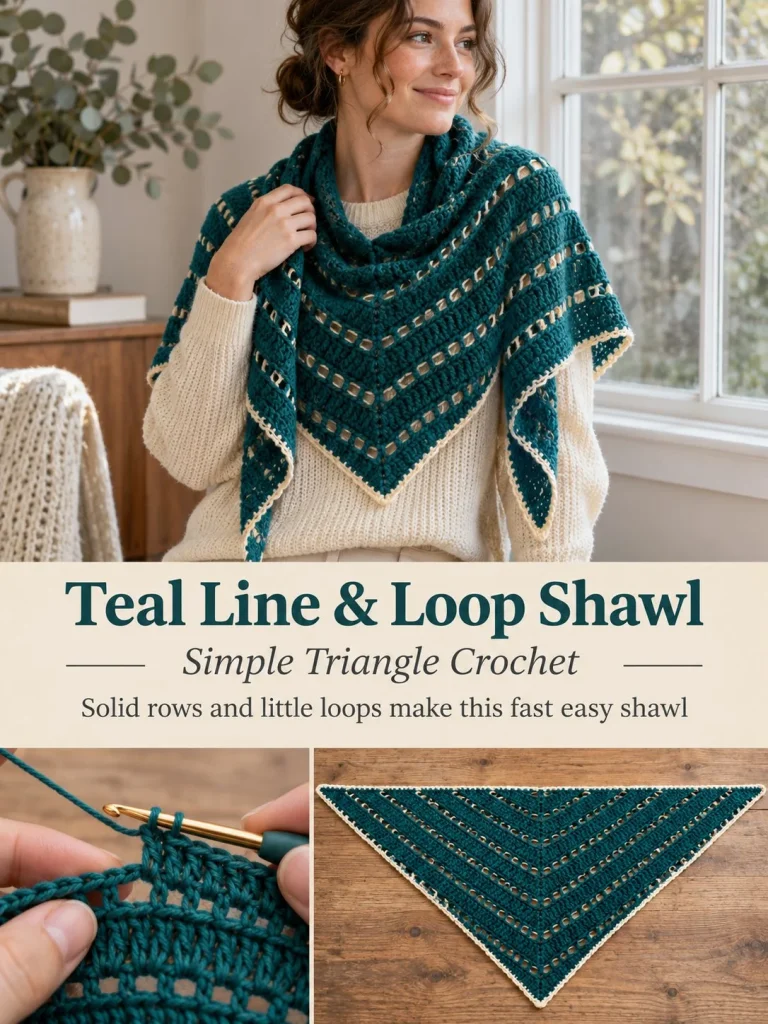
The Teal Line & Loop Shawl is a captivating crochet accessory that blends simplicity with an elegant texture, creating a triangular shawl with both warmth and style. Crafted using aran/worsted weight yarn in a rich deep teal color accented by a subtle cream edge, this shawl features a unique combination of solid and airy rows achieved through carefully placed double crochet stitches and chain loops. Constructed from the lower point upward, its gradual increase design offers a flattering drape and wearable size, perfect for wrapping around shoulders or layering over outfits.
This shawl’s design highlights alternating rows that increase solid fabric with closely spaced double crochets and lacy rows incorporating chain loops to add both lightness and visual interest. The use of two contrasting colors for the main body and the edging frames the shawl beautifully, providing a polished finish that complements the textured pattern. Working from the bottom point upward allows for precise control over the size and shape, making it adaptable to your preferred dimensions.
Crocheters familiar with double crochet stitches and comfortable with increases will find this shawl both accessible and rewarding. The combination of solid and looped rows introduces rhythmic pattern variation without complexity, enabling a relaxed crafting experience. For those interested in further exploring shawl projects with nuanced stitchwork, this design can be a gateway, much like the delicate construction found in projects such as the Teal Autumn Fog Shawl, which showcases similarly refined stitch details and color contrasts.
Pattern at a Glance
Skill level: Intermediate (requires knowledge of double crochet and stitch increases)
Terminology: US crochet terms
Construction: Works from the lower point upward in rows
Finished size: Approximately 47 inches wide along the top edge, 23 inches center depth
Yarn weight: Aran/Worsted (#4)
Hook: 4.5 mm (approximately size 7 US) crochet hook
Main stitch: Double crochet with chain-loop accents
Gauge: Not explicitly specified; drape is influenced by tension and hook size
Motifs: None (single large triangular piece)
Layout: Triangular shawl formed by incremental row increases
Joining: Not applicable beyond final edge join
Border: Single relaxed single crochet row worked in contrasting cream yarn
Seaming: None required
Materials
To create this shawl, you will need the following supplies:
- Approximately 450 to 500 yards of aran or worsted weight yarn in deep teal—this is the main color for the body of the shawl.
- Additional 50 yards of cream-colored yarn to add a subtle contrast for the edging.
- A 4.5 mm crochet hook, suitable for aran/worsted yarn, providing a balanced tension that keeps the fabric pliable without being too tight or loose.
- Tapestry needle for weaving in ends and finishing.
- Scissors for cutting yarn.
Each material serves an important role: the main yarn constructs the textured body of the shawl, while the cream yarn frames and finishes the piece elegantly. Using a hook size that complements your yarn ensures consistent stitch size and an overall balanced fabric.
Yarn and Color Notes
Choosing the right yarn can affect both the look and feel of your shawl. The aran/worsted weight yarn provides sufficient warmth while maintaining drape and structure in the fabric. Yarns with a smooth finish work best for this pattern, as they highlight the alternating solid and looped rows clearly, while heavily fuzzy or halo yarns may obscure the delicate chain loops.
The deep teal color offers a rich, versatile tone that can be easily paired with various outfits. The cream edging acts as a gentle frame, providing a subtle break from the main color without overpowering it. If you prefer a different color combination, consider solids or semi-solids that contrast softly for a similar effect.
Finished Measurements
Upon completion, the shawl measures approximately 47 inches (120 cm) along the top edge (the widest part) and about 23 inches (58 cm) in depth at the center point. These dimensions offer generous coverage suitable for wearing draped over shoulders, wrapped around the neck, or used as an elegant cover-up. Measurements depend on maintaining consistent gauge and tension throughout the project.
Gauge
A specific gauge is not provided for this pattern; however, your stitch size will influence the overall dimensions and drape. To achieve the intended size, work with a 4.5 mm crochet hook and yarn weight as recommended. If your tension tends to be loose, consider switching to a smaller hook to ensure fabric integrity. Conversely, if your stitches are tight, a larger hook may help achieve the proper drape.
Taking the time to measure your progress periodically ensures that your shawl maintains the intended shape and size, especially as the edge increases in width and the depth grows.
Abbreviations
- Ch: chain
- Dc: double crochet
- Sc: single crochet
- St(s): stitch(es)
- Turn: turn your work to begin the next row
Important Pattern Notes
- Work starts at the lower point (the tip) of the triangle, progressing upward to the widest edge.
- The turning chain in each row counts as the first double crochet, following standard US crochet conventions.
- The pattern uses alternating rows with different increases: a solid row with dense double crochets and an open row introducing chain loops.
- At the ends of each row, increases are made on both outer edges to widen the shawl incrementally.
- The final touch is a border worked in the contrast cream yarn, forming a neat and relaxed edge along the two diagonal sides of the triangle.
Special Stitches and Techniques
This shawl primarily uses standard double crochet (dc) stitches combined with strategic chain loops created by chaining and skipping stitches in loop increase rows. The loop rows involve chaining 1 and skipping 1 stitch, creating open spaces that add texture and visual interest.
No advanced or unusual stitches are required, making it accessible to crocheters proficient in basic stitches and increases.
Understanding the Construction
The shawl is constructed as a single triangular piece, starting at the narrowest point and growing wider with every row. The shaping is achieved through increases on both edges of each row to maintain a triangle.
The construction alternates between two types of rows:
- Solid increase rows: These rows add fabric with dense double crochet stitches, incrementing stitch count by 2 per row (one on each outer edge), creating a sturdy base for the shawl.
- Loop increase rows: These rows incorporate chain loops (chain 1, skip 1 stitch, dc in next stitch) adding lacy openings and alternating with solid rows for a balanced texture. Careful adjustment ensures the loops finish cleanly with chain 1 and two double crochets near the edge.
The sequence of these rows is repeated steadily until the desired size is reached, creating a steady growth in width and depth.
After completing the body, the cream yarn is joined to add a final relaxed single crochet border along both diagonal edges, giving the shawl a softly framed look and stabilizing the edges.
Complete Pattern Instructions
Foundation
- Begin by making a chain of 4.
Row 1
- Work 3 double crochet (dc) stitches into the 4th chain from the hook.
- This results in 4 double crochet stitches including the turning chain.
- This small unit forms the lower tip of the shawl.
Row 2 — Solid Increase Row
- Chain 3 (counts as the first dc), turn your work.
- Work 1 dc into the same first stitch as the turning chain.
- Continue by working 1 dc into each stitch across the row.
- At the end of the row, work 2 dc in the last stitch to increase the width.
- The stitch count increases solidly with these edge increases.
Row 3 — Loop Increase Row
- Chain 4 (counts as dc + ch1), turn.
- Work 1 dc into the same first stitch as the turning chain.
- Now work the loop pattern across the row:
- Chain 1, skip 1 stitch, dc in next stitch
- Repeat this pattern across, adjusting the final repeat so the row ends with chain 1 and 2 dc in the final stitch.
- These loops create open spaces that add texture and delicacy to the shawl.
Row 4
- Chain 3 (counts as first dc), turn.
- Work 1 dc into the same stitch as the turning chain.
- Now work 1 dc in every dc stitch and every ch1 space across the row.
- At the end, work 2 dc in the last stitch for the increase.
Repeat Rows 3 and 4
- Continue alternating between loop increase (Row 3) and solid increase (Row 4) rows, always increasing by 2 stitches on each outer edge every row.
- Repeat these two rows until the top edge measures approximately 47 inches wide and the center depth is about 23 inches.
Final Border
- Join the cream-colored yarn.
- Work one relaxed single crochet (sc) row along the two diagonal edges of the shawl.
- This final row softens and frames the shawl, providing a polished finish and structural stability to the edges.
Checkpoints
- After completing a few repeats, measure your work to ensure progress toward the target dimensions.
- The piece should steadily grow wider at the top edge and deeper at the center point without curling or distortion.
- Count stitches at the edges to confirm the expected increases have been made (2 stitches added per row on each side).
Assembly and Joining
This shawl is worked as one continuous piece with no seaming or motif joining required. The only joining step is attaching the cream edge yarn after the body is fully complete. Work the relaxed single crochet border carefully along both diagonal edges, ensuring even tension to avoid puckering.
Border and Finishing
The contrasting cream single crochet border softens the edges and prevents stretching or distortion during wear. Work this edge with slightly loose tension to maintain flexibility and keep the fabric flat.
After finishing, weave in all ends securely using a tapestry needle to prevent unraveling.
Blocking the shawl lightly on a flat surface may help even out the fabric and enhance drape. Use pins or blocking mats to gently shape the triangle, focusing on the chain loop rows to open up the lacy spaces.
How to Resize
To resize the shawl, adjust the number of repeats of Rows 3 and 4:
- Each repeat adds increases on both edges, gradually widening the shawl evenly.
- To make a smaller shawl, stop repeating earlier when the triangle reaches your desired dimensions.
- For a larger shawl, continue the repeats until the top edge and depth match your preferred size.
Maintaining the alternating solid and loop row pattern preserves the original texture and design integrity.
Useful Variations
- Single color version: Use one yarn color throughout for a monochrome effect that highlights texture rather than color contrast.
- Color block edging: Substitute the cream border with any color contrasting or complementing the main teal for seasonal or style variations.
- Gradient yarn: Use a gradient or variegated aran or worsted yarn in place of solid teal to produce a color-shifted body.
- Different yarn weight: For a lighter or heavier shawl, substitute yarn maintaining the hook size ratio, but adjust repeats for size as needed.
For exploring other interesting stitch patterns in shawls, consider the intricate twisted stitch details in this Birdhouse Wide Shawl Knitting Pattern, which offers inspiration for textured accessories.
Troubleshooting
Why Does My Shawl Curl at the Edges?
The alternating dense double crochets and chain loop rows may cause slight curling initially. Ensuring consistent tension and blocking after completion will flatten the shawl.
My Loop Rows Don’t Line Up Correctly; What Can I Do?
Ensure that you adjust the final repeat in loop rows so that each ends with chain 1 followed by 2 dc in the final stitch. Counting chain and skipped stitches is crucial for proper alignment.
The Edges Feel Tight After Adding the Border
Work the relaxed single crochet border with slightly looser tension than the body to prevent pulling or shortening the edges.
My Shawl Is Too Small or Too Large
Adjust the number of repeats of Row 3 and 4 pairs to scale size. Use measuring tools to check width and depth periodically.
Why Does the Fabric Feel Too Dense or Too Open?
Hook size adjustments affect drape: smaller hooks tighten fabric, larger hooks loosen it. Try swatching rows to find the balance you prefer.
Ends Are Difficult to Weave in on Loop Sections
Use a blunt tapestry needle and weave ends carefully through solid dc rows surrounding the chain loops for a secure finish.
Frequently Asked Questions
Can I Use a Different Yarn Weight for This Shawl?
Yes, but you may need to adjust hook size and repeat counts to maintain the shape and desired size. The aran/worsted yarn weight is recommended for balanced warmth and drape.
Is This Shawl Suitable for Beginners?
Crocheters familiar with double crochet stitches, increases, and chaining should find this pattern approachable. It is intermediate due to the increasing shaping and alternating row patterns.
Can I Make the Shawl Larger?
Absolutely. Continue repeating Rows 3 and 4 until the top edge and center depth reach your desired measurements.
Do I Need Special Techniques for the Loop Rows?
No special stitches are required; just standard chaining and skipping stitches as instructed.
How Should I Block This Shawl?
Light blocking on a flat surface after washing will help open the loops and even out stitches. Pin the shawl in the triangular shape carefully before letting it dry.
Is the Pattern Reversible?
The texture created by looped rows and solid rows presents a right side and a less textured wrong side; however, it can be worn on either side depending on personal preference.
Can I Use a Variegated or Self-Striping Yarn?
Yes, though this might obscure the subtle pattern repeat. Solid or semi-solid yarns are best for highlighting texture.
Optional Related Uses
The stitch combination used in this shawl lends itself well to other accessories such as scarves or cowls, where the alternating solid and looped rows add visual interest. Using the same technique in a rectangular format could create elegant wraps or table runners.
Final Thoughts
This triangular shawl combines straightforward construction with a pleasing rhythmic stitch pattern of alternating solid and open rows. Starting at the tip and working upward with symmetrical increases allows the shawl to expand naturally to a wearable size, culminating with a soft cream border that frames the piece elegantly. Whether for layering warmth or dressing up an outfit, this piece offers an adaptable and satisfying crochet project. Its balanced texture and shape make it a versatile addition to any accessory collection.



