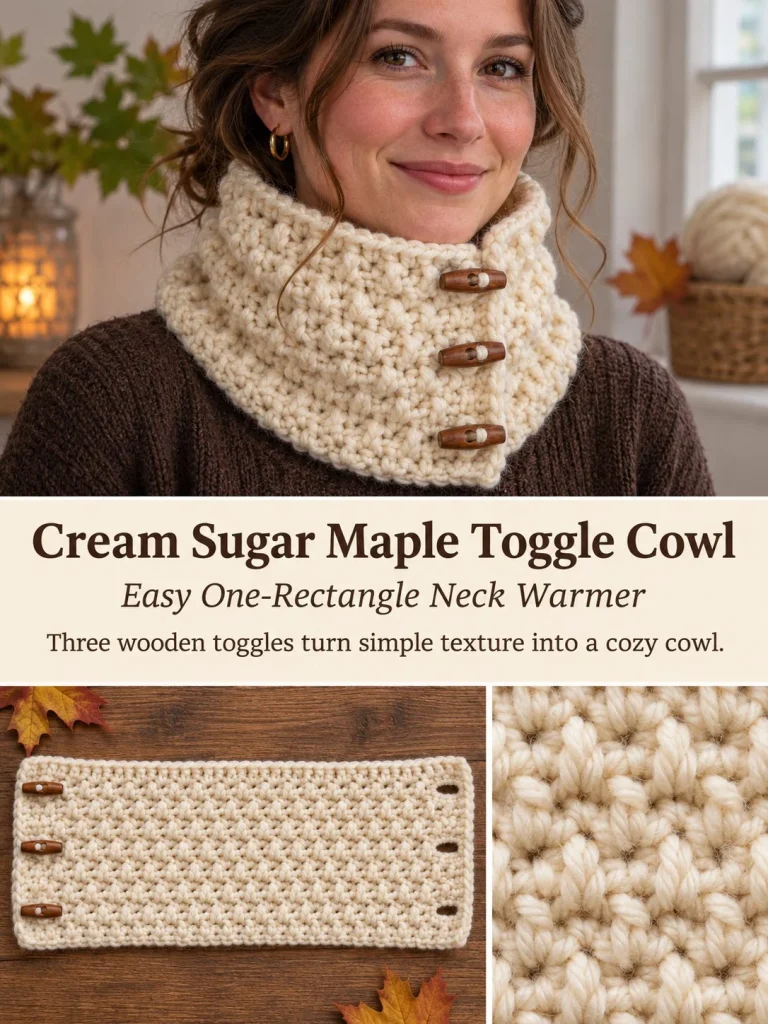
This cozy crochet cowl is designed to envelop the neck in warmth and charm with its soft cream color and eye-catching toggle closures. Constructed from a single rectangular panel using a textured lemon-peel stitch pattern, this accessory combines simplicity with subtle sophistication. The use of wooden toggles adds a rustic yet refined touch, making it not just a practical winter essential but also a stylish statement piece for any wardrobe.
Crafted with bulky yarn and a textured stitch repeat, the fabric yields a plush and squishy feel while maintaining good structure. Its construction involves working a rectangle in rows, then finishing with a relaxed single crochet edging and attaching wooden toggles for adjustable closure. This toggle cowl is particularly appealing to crocheters who appreciate quick projects that offer both functional warmth and a tactile, rich texture reminiscent of classic knit patterns like ribbing or seed stitch.
The project is straightforward, ideal for those comfortable with single and double crochet stitches, while the lemon-peel texture adds visual interest without requiring complex stitch work. For a similar project with a knit-inspired ribbed design, you might find inspiration in the ribbed shoulder cowl pattern, which explores a related style using different techniques.
Pattern at a Glance
Skill level: Intermediate (comfortable with single and double crochet, texture maintenance)
Terminology: US crochet terms
Construction: Worked flat in rows as a single rectangle, then edged and toggled for closure
Finished size: Approximately 28 inches long by 8.5 to 9 inches wide (measured flat)
Yarn weight: Bulky (#5)
Hook: 6.5 mm crochet hook
Main stitch: Alternating single and double crochet for lemon-peel texture
Gauge: Project gauge depends on stitch repetition to achieve dimensions; see Gauge section for details
Motifs: None – simple rectangle with textured stitch pattern
Layout: Rectangular panel
Joining: No joins required until assembly and edging
Border: One round of relaxed single crochet around all edges
Seaming: Attaching toggles with strong thread; buttonholes created using spacing between stitches
Materials
To create this warm cream cowl, you will need:
- Bulky #5 yarn: Approximately 220 to 260 yards in warm cream color — bulky yarn ensures a thick, cozy fabric with excellent stitch definition. Choosing a smooth yarn will help highlight the lemon-peel texture.
- 6.5 mm (K/10.5) crochet hook: Perfectly sized for bulky yarn to maintain stitch definition and fabric drape.
- 3 medium cocoa wooden toggles: These toggles serve as the closure mechanism, adding functional charm and allowing for an adjustable fit.
- Tapestry needle: For weaving in yarn ends cleanly.
- Sewing needle and strong matching thread: To securely sew the toggles onto the cowl.
- Scissors: For cutting yarn and thread neatly.
Each material is essential to achieving the final look and function. The wooden toggles provide a natural, warm contrast to the cream yarn. If you prefer a different texture or closure, these materials can be adapted accordingly.
Yarn and Color Notes
When selecting yarn for this project, consider fibers that offer softness and some elasticity for comfort around the neck. Smooth bulky acrylic or wool blends work well, as the stitches will show clearly with minimal fuzziness.
The warm cream yarn provides a neutral, versatile color that fits well with many outfits and seasons. You may also consider a lightly variegated or heathered bulky yarn for subtle color variation without distracting from the textured stitch pattern.
The medium cocoa wooden toggles are deliberately chosen to give a pleasing contrast and rustic aesthetic. If you want a different vibe, you can explore toggles in other finishes like matte black, metal, or even brightly painted wood. Just ensure the toggles match the buttonhole size created by your stitch spacing.
Finished Measurements
The rectangle piece should measure about 28 inches in length and 8.5 to 9 inches in width, making for a snug but comfortable neck wrap with a 2 to 3-inch overlap when fastened. These dimensions provide ample warmth and flexibility, accommodating various neck sizes.
Measuring accurately during the project helps ensure the toggles align correctly and that the finished cowl wraps as intended. Blocking isn’t mandatory but might help achieve the final desired width and flatten edges.
Gauge
This cowl uses a texture defined by alternating single crochet (sc) and double crochet (dc) stitches. The gauge isn’t precisely given in stitches per inch but is derived from the specified chain count and row repeats to yield the rectangle dimensions.
It’s best to focus on achieving a fabric that measures approximately 28 inches long and 8.5 to 9 inches wide after repeating the main stitch pattern. If your fabric is too tight (smaller than dimensions), consider loosening your tension or switching to a larger hook.
If the fabric ends up too loose or larger than dimensions, try using a slightly smaller hook or tightening your tension. Stitch definition and fabric density are important for the toggling mechanism to work properly.
Abbreviations
- Ch: Chain
- Sc: Single crochet
- Dc: Double crochet
- St(s): Stitch(es)
- Sl st: Slip stitch (used for edging adjustments)
All terms follow US crochet terminology consistent with the instructions.
Important Pattern Notes
- The initial chain counts as a base foundation; stitches begin in the 2nd chain from the hook.
- The alternating sc/dc pattern creates the unique lemon-peel texture, which requires careful stitch placement each row.
- The toggle openings rely on the natural spaces at the edge stitches—do not cut the fabric to accommodate toggles. Instead, adjust buttonholes with slip stitches to enlarge as needed.
- The edging in relaxed single crochet softens edges and secures the fabric for assembling toggles.
Special Stitches and Techniques
- Lemon-peel texture: Formed by alternating single crochet and double crochet stitches in a staggered manner on each row to create a nubby, pebbled surface.
- Relaxed edging: Single crochet around all edges to provide a uniform border without tension distortion.
- Toggle buttonholes: Created by using natural stitch spacing on the edge and adjusting with loose slip stitches if toggles don’t fit easily.
Understanding the Construction
This cowl is a single rectangular piece worked flat from side to side. The stitches alternate to form a reversible textured fabric with a “lemon-peel” effect.
After completing the rectangle to size, work a single round of edging around the perimeter for a neat finish. Then, sew 3 evenly spaced wooden toggles on one short edge.
The opposite short edge acts as button loops or openings, accommodating the toggles using stitch spaces. This allows wrapping the cowl around the neck with a slight overlap and fastening securely.
The structure is simple yet clever, combining ease of execution with functional finishing details. This wrap style is similar in concept to other toggle cowls, such as the bandana cowl, which also uses toggles for adjustable closure but with a different shape and drape.
Full Pattern Instructions
Foundation
Chain 21 stitches. This chain length forms the base width of the rectangular cowl panel.
Row 1
- Work 1 single crochet (sc) in the 2nd chain from the hook.
- Continue working 1 sc in each chain stitch across the row.
- Total stitches: 20 sc.
- This establishes the foundation row of the fabric.
Row 2
- Chain 1 (this acts as the turning chain, and does not count as a stitch).
- Turn your work.
- Work 1 single crochet (sc) into the first stitch.
- Work 1 double crochet (dc) into the next stitch.
- Repeat this pattern of alternating sc, dc across the entire row.
- The stitch count remains at 20.
- This begins the lemon-peel texture by alternating the two stitch heights.
Row 3 and Beyond
- Chain 1, turn.
- For each stitch in the row:
- Work dc into every stitch that was a sc on the previous row.
- Work sc into every stitch that was a dc on the previous row.
- This staggered approach maintains the lemon-peel texture by reversing stitch types on each corresponding stitch.
- Repeat Row 3 until your fabric measures approximately 28 inches in length and 8.5 to 9 inches in width (measured flat).
- This repetitive texture ensures a dense, cushioned fabric suitable for warmth and comfort.
Edging
- Work one round of relaxed single crochet evenly around all four sides of the rectangle.
- The edging should be loose enough to prevent curling or puckering while securing the edges.
- This finish helps prepare the edges for toggle attachment and final wearability.
Toggle Attachment
- Sew exactly 3 medium cocoa wooden toggles evenly spaced along one short edge of the rectangle.
- Use a sewing needle and strong matching thread to securely fasten toggles.
- Ensure that toggles are sewn tightly to prevent loosening over time.
Buttonhole Testing and Adjustment
- On the opposite short edge, test fit the toggles by using the natural spaces between edge stitches as button openings.
- If any toggle is too large to pass through the natural buttonhole opening, carefully enlarge that opening by adding a few loose slip stitches rather than cutting or damaging the fabric.
- This method maintains the integrity of the edges and keeps the cowl durable.
Final Wear
- Wrap the rectangle around your neck with a 2 to 3-inch overlap.
- Fasten all 3 toggles to secure the cowl comfortably.
- Adjust toggles if needed for personal fit.
Helpful Checkpoints
- After Row 1: You should count 20 stitches across, confirming starting width.
- After reaching desired length (~28 inches): Measure the fabric flat and confirm width of 8.5 to 9 inches.
- Edging round: The border should lie flat without curling.
- After toggle sewing: Toggles should be secure without pulling the fabric.
- Buttonhole test: Toggles should fit snugly but pass through buttonholes comfortably.
Assembly and Joining
Assembly primarily consists of attaching the toggles to the short edge of the rectangle using sewing thread and a needle. Space the toggles evenly along the edge to distribute closure tension well.
The opposite edge remains free to serve as button loops. Because the natural stitch spaces form the buttonholes, the attachment is clean and minimal.
No seams or joins are required; the rectangle wraps fully around the neck, overlapping slightly to fasten.
Border and Finishing
The relaxed single crochet border stabilizes the edges and prevents rolling. When working the edging:
- Use a gentle tension to avoid puckering.
- Work smooth corners by placing 3 sc in each corner stitch.
- Weave in ends with a tapestry needle, hiding yarn tails for a polished look.
Blocking is optional but can help achieve smooth edges. Light steam blocking may relax stitches without stretching the bulky fabric excessively.
How to Resize
To make the cowl larger or smaller:
- Adjust the starting chain by adding or subtracting multiples of 2 chains to ensure the alternating sc/dc pattern remains consistent.
- Add or remove rows of the lemon-peel stitch (Row 3 repeat) to increase or decrease the length.
- Keep in mind that both width and length affect the final fit and toggle placement.
- If resizing, adjust the number of toggles and buttonholes accordingly for balanced closure.
Useful Variations
- Color Blocking: Use two or three colors in stripes by changing yarn between rows while maintaining the lemon-peel pattern.
- Different Toggles: Experiment with buttons, snaps, or decorative beads in place of wooden toggles.
- Longer Cowl: Work more rows for a longer wrap — consider doubling toggles to maintain closure.
- One-Color vs Multicolor: While the original is cream, variegated or ombré yarn can add depth to the texture.
- For toggle cowl inspiration in a different style, explore the ribbed high neck shoulder cowl, which showcases an alternative approach to cowl design using toggle closures.
Troubleshooting
Why Is My Fabric Curling At The Edges?
This can occur if the tension is too tight or if the edging was worked too tightly. Relax your tension in the edging and consider adding extra stitches in corners.
Why Are My Toggles Too Large For The Buttonholes?
Do not cut fabric. Instead, enlarge the openings gently by working a few loose slip stitches around the problem buttonhole for added space.
Why Is The Cowl Too Tight Or Too Loose?
Check your gauge and finished measurements. Adjust hook size or yarn tension accordingly. Resizing the chain or number of rows also helps.
Why Is My Lemon-Peel Texture Uneven?
Ensure you alternate stitches correctly each row: dc into sc from previous row and sc into dc, never skipping this pattern.
Why Are My Edges Rippling After Finishing?
Watch edging tension and block lightly if needed. The relaxed edging round helps minimize this issue but tight edges cause rippling.
Frequently Asked Questions
Can I use a different yarn weight?
You can, but this will affect the size and texture. Adjust chain length and row count to match desired finished measurements. Bulky yarn maintains the cowl’s cozy thickness.
Can I use cotton yarn?
Cotton lacks elasticity and may be less warm. For a structured cowl, consider wool or acrylic blends instead.
Can I make the cowl larger?
Yes, increase the starting chain in multiples of 2 and add more rows of the lemon-peel pattern to reach wider and longer dimensions.
Is this pattern suitable for beginners?
Intermediate skill is recommended due to alternating stitches and toggle assembly, but adventurous beginners willing to learn single and double crochet can try it.
How should I wash this cowl?
Follow yarn manufacturer instructions. Typically, hand washing in cool water and laying flat to dry preserves texture and prevents deformation.
Do the toggles come pre-made?
No, toggles must be purchased separately. Choose medium cocoa-colored wooden toggles to match the pattern aesthetic.
Can this cowl be worn as a scarf?
Yes, styling as a scarf or neck warmer works well by adjusting toggle placement or overlap amount.
Optional Related Uses
The lemon-peel stitch and toggle closure concept are adaptable to other projects such as:
- Wide knitted or crocheted scarves with button/toggle closures.
- Simple wraps or shawls where adjustable fastening is desired.
- Ear warmers or neckbands featuring textured stitch and closures.
- Lightweight shoulder cowls in similar construction for mild weather.
Final Thoughts
This textured toggle cowl combines ease of construction with functional design and tactile interest. Working a single rectangle in lemon-peel stitch and finishing with a minimal border streamlines the process, while the wooden toggles add rustic charm and practical adjustability.
The project’s modular construction makes it approachable for many crocheters and allows customization through yarn choice, sizing, and toggle style. Whether for casual wear or gifting, this cowl provides cozy neck coverage with a beautiful, textured finish.
By understanding the stitch pattern, maintaining proper gauge, and carefully assembling toggles, you achieve a warm, durable, and stylish accessory perfect for cool weather.



