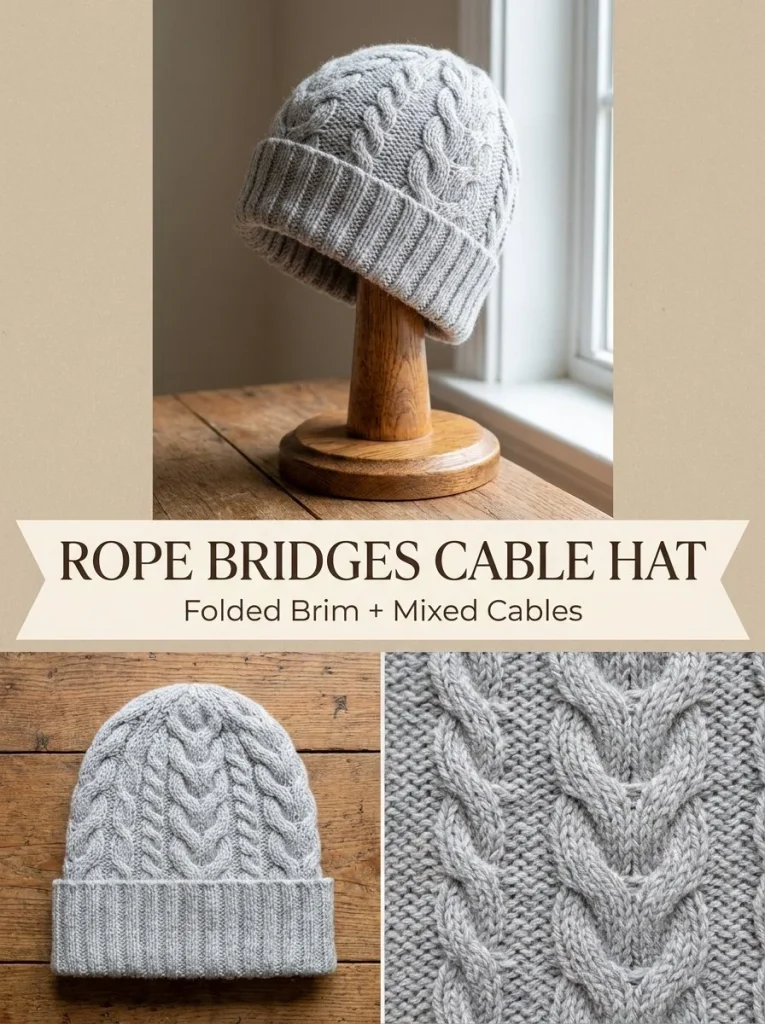
This sophisticated knitted hat combines classic cable textures with a generously folded rib brim for warmth and style. Crafted using DK-weight merino yarn, the design emphasizes rich, three-dimensional rope cables alternating with subtle narrow twist cables, separated by purl valleys to enhance definition. The substantial 2.75-inch folded brim not only ensures a cozy fit but also frames the cable pattern beautifully, making this a versatile winter accessory that blends traditional craftsmanship with contemporary construction.
The hat is knit in the round, starting with a deep ribbed brim that can be folded double for an extra-thick edge. The transition to a larger needle introduces the intricate cable motif composed of alternating narrow 1-over-1 crossing cables and a wider nine-stitch rope cable that "travels" upward around the crown. This interplay creates a visually striking texture reminiscent of a rope bridge’s interwoven strands, giving the piece its unique character.
Crafted for an adult head size of about 21.25 to 22 inches in circumference, this hat’s finished height measures approximately 8.25 inches with the brim folded, ensuring a flattering fit over multiple head shapes. The construction technique preserves cable stitch direction through decreases during crown shaping, maintaining pattern continuity, a detail appreciated by advanced knitters. For those familiar with knitting cables and circular knitting, this project offers a rewarding intermediate-level challenge that results in an elegant, snug winter hat.
Pattern at a Glance
Skill level: Intermediate
Terminology: US knitting
Construction: Knitted in the round with folded rib brim and cable pattern body; decreases shaped for crown
Finished size: Fits 21.25–22 in (54–56 cm) adult head circumference; finished height with brim folded is approximately 8.25 in (21 cm)
Yarn weight: DK (Double Knitting)
Needles: US 2.5 / 3 mm 16 in circular for brim; US 4 / 3.5 mm 16 in circular for body; longer circular or double-pointed needles (DPNs) for crown decreases
Main stitch: 2×2 rib for brim; applied cable stitches and purl valleys for body
Gauge: 22 stitches x 36 rows = 4 in (10 cm) in stockinette stitch after blocking
Motifs: Alternating narrow 1-over-1 crossing cables and wider nine-stitch rope cables separated by purl valleys
Joining: None (knit seamlessly in the round)
Border: Folded 2.75 in rib brim for warmth and fit
Seaming: None required
Materials
To bring this pattern to life, you’ll need:
- Yarn: 2 balls of DK weight merino wool (the example uses DROPS Daisy in light gray, a soft and breathable fiber ideal for cable work)
- Needles: A set of US 2.5 / 3 mm 16-inch circular needles for the rib brim, which provides the necessary tight gauge to hold the folded brim securely; US 4 / 3.5 mm 16-inch circular needles for the main body to help the cable stitches bloom with softness; a longer circular or sets of double-pointed needles for shaping the crown decreases comfortably without bunching stitches
- Cable needle: To execute the 1-over-1 cable crossings smoothly and maintain stitch definition
- Marker: To mark the beginning of rounds and pattern repeats, essential when working in the round
- Tapestry needle: For weaving in ends neatly after finishing
- Blocking tools: Wet blocking and drying tools such as pins and mats to set the cables and brim shape
Each material contributes critically: the DK merino yarn balances warmth and stitch definition beautifully, while the choice of needle sizes supports the structural differences between the brim and the body. The smaller needles create a dense rib that folds well, while the larger needles give the cables their flexibility and texture.
Yarn and Color Notes
DK-weight merino is an excellent choice for this hat because it offers a fine balance of warmth, breathability, and elasticity — all key to making cables pop and ensuring a comfortable fit. Smooth, plied merino yarn like DROPS Daisy enhances stitch clarity; fuzzy or heavily textured yarns tend to obscure cable details.
For color selection, solid or semi-solid shades work best to keep cable patterns visible. Variegated yarns can distract from the structural intricacies of the cables. Light gray, as in the sample, is a versatile neutral; however, rich jewel tones or earthy hues would also complement the rope cable aesthetic.
If you seek a reversible rib treatment or a related pattern with a soft, double-fold rib brim, it’s worth exploring the tied with a bow reversible rib scarf pattern, which shares similar rib construction techniques.
Finished Measurements
- Head circumference fit: Approximately 21.25 to 22 inches (54 to 56 cm), suitable for average adult heads
- Total finished height: About 8.25 inches (21 cm) when the brim is folded 2.75 inches (7 cm) upward
- Brim width before folding: Approximately 5.25 inches (13 cm), allowing for the doubled thickness when folded
Because the brim is designed to be folded up, it not only adds warmth around the ears but also frames the cabled body of the hat attractively.
Gauge
The specified gauge is 22 stitches x 36 rows = 4 inches (10 cm) in stockinette stitch after blocking. Measuring gauge accurately over stockinette stitch is important since the cables will slightly alter fabric density.
Measurement tips:
- Use needles specified for the brim and body for respective fabric sections.
- After knitting a swatch flat or in the round, wet block it as you plan to treat your finished project to get an accurate reading.
- If gauge is tighter (more stitches per 4"), your hat may turn out smaller and less stretchy. If looser, the hat may be baggy. Adjust needle size accordingly.
Precise gauge helps ensure that the finished hat fits as intended around the head and has the correct height and drape.
Abbreviations
- CO: Cast On
- k: Knit
- p: Purl
- p2/k2 rib: Pattern repeat of 2 purl stitches, 2 knit stitches
- st(s): Stitch(es)
- rnd(s): Round(s)
- DPNs: Double-Pointed Needles
- CO: Cast On
Note: The pattern retains US knitting abbreviations and terminology.
Important Pattern Notes
- The brim is knit first using the smaller needles, in the round, with a classic p2/k2 ribbing, which provides excellent elasticity and a comfortable folded edge.
- The brim length before folding is about 5.25 inches to achieve a folded height of approximately 2.75 inches.
- After the brim, the stitch count increases evenly from 112 to 133 using the larger needles for the cabled body section.
- The cable pattern consists of narrow 1-over-1 crossing cables alternating with a wider 9-stitch rope cable, separated by purl valleys to emphasize the cables’ definition.
- The pattern works through an 8-round cable sequence repeated five times, followed by the first 2 rounds once more before beginning crown shaping.
- Decreases during the crown shaping preserve the traveling cable direction to maintain visual flow and stitch integrity.
Make sure to mark the beginning of the rounds and use a cable needle to manage the crossings neatly. When shaping the crown, carefully follow the decreases while respecting the cable pattern’s twists and directional flow.
Special Stitches and Techniques
- 1-over-1 Cable Crossings: This technique involves holding one stitch in front or back of the work and knitting the next stitch before the held stitch to create a twist in the fabric. It forms the narrow cable columns.
- Rope Cable: A wider cable typically made of 9 stitches, this looks like two strands twisting over each other, resembling a sturdy rope — a perfect fit for the "rope bridges" concept.
- Purl Valleys: Purl stitches between cables create a recessed valley that dramatically defines the cables on either side.
- Folded Rib Brim: The brim is knit long enough to be folded double, creating a thick comfy edge.
Cabling in the round requires attention to stitch order and consistent tension on the cable needle; too tight and the fabric puckers, too loose and the cables lose shape.
Understanding the Construction
This hat is knit completely in the round, starting from the bottom edge up:
-
Ribbed Brim: Begin with smaller needles and cast on 112 stitches. The ribbing is worked in p2/k2 (purl two, knit two) establishing elasticity and texture. The brim is knit long (5.25 inches) to allow folding halfway up for a double-thick edge, enhancing warmth and fit.
-
Cable Body: Transition to larger needles and evenly increase stitch count to 133 to accommodate the expanded cable pattern width. The cables consist of alternating narrow 1-over-1 crossing cables and wider rope cables, separated by purl stitch valleys for an eye-catching texture.
-
Cable Repeat: The complex 8-round cable sequence is repeated five full times, establishing the full textured panel.
-
Crown Shaping: After the cable repeats, the hat transitions into crown decreases performed by reducing the purl valleys and cable sections strategically, preserving the cable direction to maintain pattern continuity.
-
Finishing: The last 11 stitches are grafted or drawn tight to close the top, then ends are woven in carefully.
-
Blocking and Folding: The hat is wet-blocked to soften and define the cables, then the rib brim is folded up approximately 2.75 inches, covering the bottom trim and adding warmth.
This seamless, top-down construction allows for a smooth fit and sophisticated texture without seaming.
Complete Pattern Instructions
Foundation (Brim)
CO 112 stitches using US 2.5 / 3 mm 16 in circular needles. Join to knit in the round, being careful not to twist stitches.
Work p2/k2 ribbing (purl 2 stitches, knit 2 stitches) continuously in the round until the brim measures approximately 5.25 inches (13 cm). This length supports a double fold brim of about 2.75 inches (7 cm).
Transition and Body
Switch to US 4 / 3.5 mm 16 in circular needles.
Increase evenly from 112 stitches to 133 stitches, spaced out uniformly to prepare for cable layout without distorting stitch pattern.
Establish Cable Pattern
The cable layout consists of:
- Alternating narrow 1-over-1 crossing cable columns, which are thin twist cables created by crossing one stitch over one stitch.
- A wider 9-stitch rope cable section resembling a twisted rope.
- These cables are separated by purl valleys—rows of purl stitches that serve to highlight the cables by crowning them with texture contrast.
Work the 8-round cable sequence — a defined set of cable crossings and purl stitch rounds — five times through, forming the textured body of the hat.
Then, knit the first 2 rounds of the cable sequence once more to prepare for shaping.
Crown Shaping
Begin crown decreases by decreasing purl valleys and cable sections, carefully ensuring that the traveling cables stay aligned and continue in their twist direction.
Follow the published staged decrease sequence until only 11 stitches remain.
Finishing
Cut yarn, leaving a long tail. Use the tapestry needle to draw the tail through the remaining stitches, pulling tightly to close the crown neatly.
Weave in ends securely.
Wet Blocking and Folding
Wet-block the hat carefully to relax and set the stitch fabric, enhancing cable definition and brim flexibility.
Once dry, fold the rib brim upward approximately 2.75 inches (7 cm) so it neatly frames the lower edge of the cable pattern, providing a soft, insulating cuff.
Checkpoints
- After ribbing, the brim should measure approximately 5.25 inches before folding.
- After increasing to 133 stitches, cable pattern stitches should align without gaps or crowding.
- Cable repeats produce distinctly defined twists and valleys; blurry cables may indicate tension issues.
- Crown decreases should preserve cable direction, preventing distortion of the rope pattern.
- Blocking should smooth and define equipment knitting without loss of elasticity.
Assembly and Joining
This hat is knit seamlessly in the round with no assembly required after finishing. Use the tapestry needle to securely close the crown tip and weave in yarn tails neatly on the inside of the hat. Folding the rib adds no seams; ensure the fold is even for a professional finish.
Finishing Tips
- Block your hat flat to allow cables to relax evenly.
- Ensure the brim is evenly folded and snugly fits around the lower edge.
- Use steam sparingly if you wish to reshape cables for more definition, but avoid flattening the structure.
- Store with the brim folded to maintain shape.
For similar rib brim folding techniques in hats, consider the Elin textured rib beanie pattern, which shares the concept of a double-folded brim for added warmth.
How to Resize
To adjust this hat for a larger or smaller head:
- Increase or decrease the cast-on stitches in multiples of 4 to maintain the p2/k2 rib and cable repeats, respecting the established stitch multiple for cable pattern repeats.
- Adjust the brim length proportionally if a different brim height is desired.
- Maintain the same number of cable repeats vertically for proportional fabric height, or add/remove repeats to lengthen or shorten the hat.
- When resizing, swatch your gauge carefully as stitch density affects fit and cable definition.
- Follow the same staged decrease pattern for crown shaping, modifying stitch counts evenly.
Avoid changing stitch types to preserve cable twist direction and texture integrity.
Useful Variations
- Use a hand-dyed gradient DK merino to add subtle color shifts within the cables without overpowering the pattern.
- Knit the brim in a contrasting color for a bolder edge highlight.
- Make a version with a shorter brim for milder climates.
- Add a pom-pom or tassel on top for fun personalization.
- Pair with other rib-textured accessories, such as mittens or scarves using reversible ribbing techniques like those found in the tied with a bow scarf pattern for a coordinated winter set.
Troubleshooting
Why Is My Cable Pattern Not Aligning?
Check your stitch count at the beginning of cable repeats — missing or extra stitches will shift cable crossings. Use stitch markers to separate cable sections clearly.
Why Does the Brim Not Fold Neatly?
Confirm that the ribbing length before folding is approximately 5.25 inches. Too short ribbing will not fold nicely; too long may create bulk.
Why Are My Cable Twists Loose or Uneven?
Ensure consistent tension on cable needle stitches; practice crossing cables evenly. Blocking can help settle cables but does not fix major tension issues.
Why Is the Hat Too Tight or Loose?
Verify your gauge with the specified yarn and needles. Adjust needle size or yarn choice if your gauge differs from 22 sts x 36 rows per 4 inches.
How Can I Maintain Cable Direction During Decreases?
Follow the pattern’s staged decrease sequence carefully, reducing purl valleys and cable stitches symmetrically, and do not twist or reverse cables during crown shaping.
Frequently Asked Questions
Can I use a different yarn weight?
This pattern is designed for DK weight yarn. Using heavier yarns will change gauge and size; if substituting, knit a gauge swatch and adjust needle size and cast-on accordingly.
Can I make this hat smaller or larger?
Yes, by adjusting cast-on stitches in multiples of four for rib and cable repeats, and modifying the number of cable repeat rounds, you can resize the hat while preserving the design.
Do I need experience with cables to knit this hat?
Intermediate knitting skills, especially familiarity with cable crossings and knitting in the round, are recommended to navigate the pattern confidently.
How should I block this hat?
Wet block gently by soaking, then lay flat to dry, shaping the cables and brim. Avoid overstretching to maintain elasticity.
Is the brim reversible or only meant to fold upwards?
The brim is worked in 2×2 rib designed to fold upwards for double thickness; it’s not intended as a reversible brim like some other ribbed patterns.
Can beginners follow this pattern?
Beginner knitters comfortable with circular needles and basic purl and knit stitches may find it challenging due to cables and decreases; beginners may prefer to practice with simpler rib or cable projects first.
Optional Related Uses
The rope cable motif and folded rib concept can translate well into other accessories:
- A cozy scarf featuring the alternating narrow and wide cables, finished with ribbed edges
- Wrist warmers incorporating the same cable and ribbing for hand warmth and style
- A cowl using the folded rib as a lower edge for extra neck insulation
For inspiration on ribbed accessories with similar folded ribbing, see the reversible rib techniques showcased in the tied with a bow scarf pattern.
Final Thoughts
This hat balances functional warmth with timeless style using well-defined rope cables and a substantial folded rib brim. The seamless in-the-round construction combines stretch and structure, while staged crown decreases preserve the intricate cable directions for a polished finish. By carefully monitoring gauge and following cable repeats faithfully, knitters can create a comfortable, elegant hat perfect for chilly seasons. Its thoughtful design and detailed shaping make it a rewarding project for knitters seeking texture-rich headwear with classic appeal.



