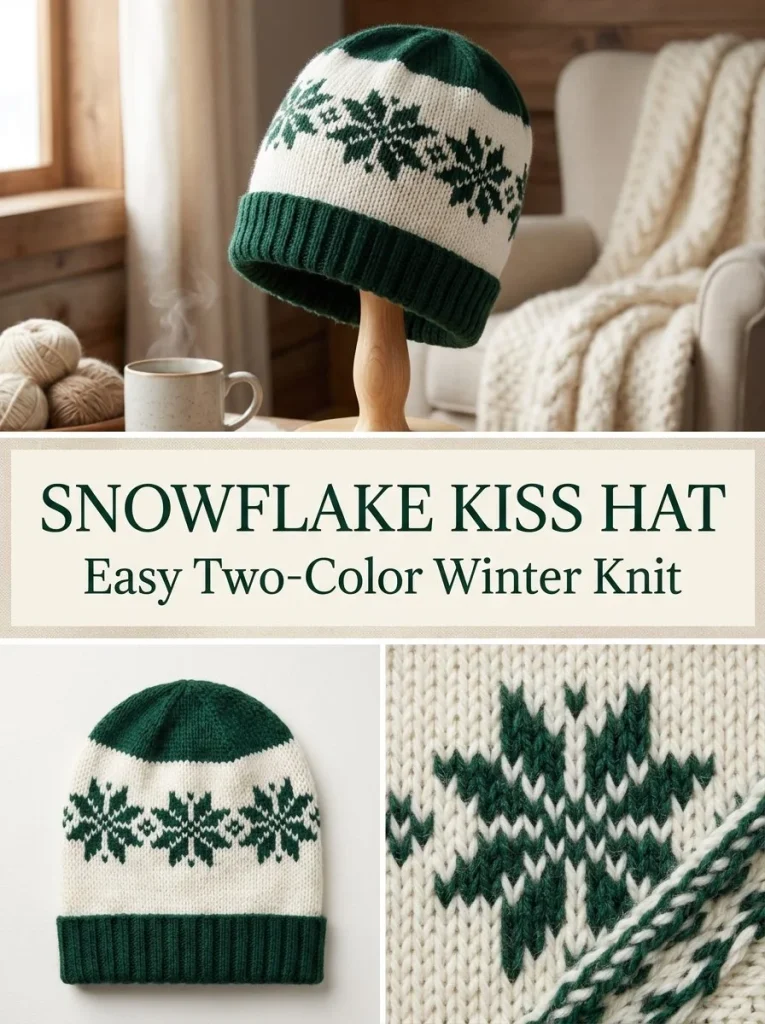
The design is a charming knitted hat featuring a series of elegant two-color snowflakes, using a combination of white as the background and deep evergreen as the contrast motif color. This winter accessory blends seasonal cheer with classic colorwork, providing both warmth and a visually striking pattern that beautifully highlights the snowflake motif in an easy-to-follow chart. Crafted seamlessly in the round, this hat uses fine gauge knitting to achieve a soft, neatly fitted shape.
Knitted from the bottom up, the hat begins with a ribbed brim that ensures elasticity and comfortable fit. The transition to a smooth stockinette body creates a clean canvas for the two-color snowflake band. As the pattern progresses, the dominant evergreen color takes center stage above the snowflake band, and the crown is shaped carefully with uniform decreases to preserve the hat’s silhouette. Optional finishing details include a pom-pom in matching or contrasting colors for added playful flair.
The seamless nature of this project and the utilization of the traditional stranded colorwork technique make it an excellent opportunity to practice color management skills and tension control, especially with the importance placed on relaxed floats and catching long floats to maintain yarn floats tidily on the back of the work. Whether for personal use or as a thoughtful handmade gift, the hat is an appealing project that merges technique, aesthetics, and function.
Pattern at a Glance
Skill level: Intermediate (colorwork and circular knitting experience recommended)
Terminology: Standard American knitting terms
Construction: Seamless, bottom-up circular knitting
Finished size: Approximately 23.6 inches (60 cm) circumference, 8.1 inches (20.5 cm) height
Yarn weight: DK (Double Knitting) yarn
Needles: US sizes 2.5–3 (3–3.25 mm) 16-inch circular for ribbing; US 4 (3.5 mm) 16-inch circular plus DPNs or magic loop for body and crown
Main stitch: Stockinette stitch (knit in the round)
Gauge: 30 stitches and 29 rounds = 4 inches (10 cm) in stockinette on larger needles
Motifs: Two-color snowflake band using stranded colorwork
Layout: Ribbed brim, snowflake band, upper body with dominant contrast color, crown decreases
Joining: None (knit seamlessly in the round)
Border: Short ribbed brim
Seaming: None
Materials
- DK weight yarn in two contrasting colors:
- Approximately 110 meters (120 yards) of white yarn for the background color
- Approximately 110 meters (120 yards) of deep evergreen yarn for the snowflake motif and upper body
- Optional 20 to 40 meters of the main or contrast yarn for making a pom-pom
- US 2.5 to 3 needles (3 to 3.25 mm), 16-inch circular needle for knitting the ribbed brim
- US 4 needles (3.5 mm), 16-inch circular needle for the main body and crown area
- Double-pointed needles (DPNs) or the magic loop method to handle the decreasing crown rounds comfortably
- Stitch markers (optional) to mark pattern repeats or crown decreases
- Tapestry needle for weaving in yarn ends
The finer needles create the firm ribbing that hugs the wearer’s head, while the slightly larger needles help form the smoother fabric with consistent gauge needed for the stranded colorwork section. Having both circular and double-pointed needles allows for a flexible workflow when completing the crown decreases.
Yarn and Color Notes
Selecting yarn for stranded colorwork requires attention to fiber content, smoothness, and elasticity. A wool or wool-blend DK yarn works well for warmth and stitch definition in the snowflake motif. Smooth yarns help the texture and color pattern stand out clearly, whereas fuzzy or haloed yarns might obscure details.
The chosen combination of a crisp white background and a rich evergreen contrast creates a classic winter palette reminiscent of snowy forests. When choosing colors, aim for high contrast to keep the snowflake motif visually distinct.
Avoid variegated or highly textured yarns for the stranded section, as they may complicate the readability of the snowflake design and uneven float tension. Solid or semi-solid colors produce the best results for this pattern.
Finished Measurements
This adult-sized hat measures approximately 23.6 inches (60 cm) in circumference, suitable for an average adult head. The length from brim to crown top is about 8.1 inches (20.5 cm), providing good coverage over the ears and forehead for warmth.
These dimensions are based on the recommended gauge and yarn weight. Because the hat is knit in the round, the fit is slightly flexible, but knitters should be mindful of gauge, particularly if substituting yarn or changing needle sizes, to maintain the intended sizing.
Gauge
The gauge for this hat is:
30 stitches x 29 rounds = 4 inches (10 cm) in stockinette stitch using the larger US 4 (3.5 mm) needles.
To check gauge accurately, knit a swatch of at least 4×4 inches in the round or flat stockinette stitch using the colors and needles planned for the project. Measuring gauge is crucial because it affects the final fit, especially for close-fitting hats where stretch and accurate circumference are needed.
- If your gauge is larger (more stitches per inch), the hat will be smaller than expected. You may need to go up a needle size or loosen tension.
- If your gauge is smaller (fewer stitches per inch), the hat might be too large or loose. You might try smaller needles or tighter knitting tension.
Maintaining a consistent gauge during stranded knitting requires smooth tension and careful float management to avoid puckering.
Abbreviations
- k: knit
- p: purl
- st(s): stitch(es)
- rnd(s): round(s)
- CO: cast on
- DPNs: double-pointed needles
- k2tog: knit two stitches together (decrease)
- SSK: slip, slip, knit (decrease)
Important Pattern Notes
- Begin by working in the round using a stretchy, circular cast-on to ensure a comfortable brim fit.
- Work the ribbed brim on the smaller needle size to maximize elasticity.
- Switch to the larger needles to knit the main body for a softer fabric and better stitch definition.
- The hat is knit seamlessly in the round from the bottom up, avoiding any side seams.
- The two-color snowflake motif is created using stranded colorwork (Fair Isle) technique, with the evergreen as the motif color on a white background.
- Floats (the cable of yarn carried behind stitches) should be kept loose to avoid puckering; catch long floats as needed to keep the yarn tidy without tensioning tightly.
- The upper hat section reverses the dominant color scheme, featuring more evergreen as the background and less white, creating a pleasing contrast and balanced design.
- Crown shaping is done via evenly distributed decreases until only a small number of stitches remain, which are then drawn together securely, shaping a neat top.
- An optional pom-pom can be added to the crown top for decoration.
- This pattern relies on an external designer chart for the exact Snowflake Kiss motif and does not include the chart itself in the instructions.
Special Stitches and Techniques
This pattern uses the following key knitting techniques:
- Stranded colorwork (Fair Isle knitting): Carrying two colors of yarn across a row, knitting stitches in one color while the alternate color is stranded behind. Floats must be kept relaxed and carefully managed to avoid distortion.
- Circular knitting: Working in the round from the bottom up without seams.
- Stretchy cast-on: A method of casting on stitches that produces an elastic edge suitable for the ribbed brim. Techniques such as the Long-Tail Cast On, German Twisted Cast On, or Tubular Cast On are good options.
- Ribbing: Combination of knit and purl stitches worked in rounds to create a stretchy brim (commonly k1, p1 or k2, p2).
- Crown shaping with decreases: Even decreases spaced across rounds (such as k2tog and SSK) reduce the stitch count and taper the hat’s crown smoothly.
- Pom-pom making (optional): Wrapping yarn to create a fluffy decorative ball to attach to the crown top.
Understanding the Construction
This hat is constructed in one continuous piece, starting with a ribbed brim that fits snugly around the head. The ribbing is knitted first on smaller needles to create elasticity.
After casting on, you switch to larger needles to establish a smooth stockinette stitch background for the main colorwork and body sections. The white background provides a fresh wintery canvas.
Next comes the two-color snowflake band with evergreen motifs, knitted in stranded colorwork technique. The floats from the contrast color (evergreen) are carried along the back and caught to maintain tension and prevent snagging.
Once the snowflake section is complete, the color dominance switches with the upper body mainly in evergreen, providing an attractive color block. This section proceeds in stockinette stitch.
Finally, the hat crown is shaped by gradually decreasing stitches evenly all around to form a rounded top. The last few stitches are drawn together tightly, securing the shape.
An optional pom-pom may be added after finishing, adding a playful winter touch.
This bottom-up, seamless circular construction ensures a smooth, fitted shape ideal for cold weather.
Complete Pattern Instructions
Foundation and Brim
- Using US 2.5–3 (3–3.25 mm) 16-inch circular needles, CO a suitable number of stitches with a stretchy cast-on method so the brim will fit comfortably (stitch count matches gauge and circumference). The adult size uses approximately 23.6 inches circumference at gauge.
- Join carefully to work in the round without twisting the stitches. Place a stitch marker to mark the beginning of round.
- Work a short ribbing for the brim (e.g., k1, p1 or k2, p2 rib) for a length that fits the wearer (commonly 1.5 to 2 inches or desired cuff height).
Main Body and Snowflake Band
- Switch to US 4 (3.5 mm) 16-inch circular needles. Knit one round establishing white stockinette background.
- Begin stranded colorwork round(s) for the Snowflake Kiss motif band, using deep evergreen as the motif color on the white background. Refer to the official designer chart for the exact snowflake stitch placement.
- Carry both yarns with relaxed floats. Catch long floats of contrasting yarn at intervals to avoid long strands behind fabric. Managing float tension is key for smooth fabric without puckering.
- Work through the snowflake pattern rounds completely to form the decorative band that encircles the hat.
Upper Body with Evergreen Dominant
- After completing the snowflake band, continue knitting the body of the hat with the deep evergreen as the dominant color, maintaining white contrasts as per the color pattern or as solid if desired.
- Work stockinette stitch in the round until the hat reaches approximately the planned length before crown shaping. For adult size, this is approximately 8.1 inches (20.5 cm) total length from brim.
Crown Shaping
- Begin evenly spaced decrease rounds using k2tog and SSK to reduce stitch count gradually while maintaining stitch pattern continuity.
- Continue decreases in regular intervals according to stitch count and gauge until only a small number of stitches remain, usually around 8–12 stitches depending on total count.
- Break yarn leaving a long tail, draw the tail through the remaining stitches using a tapestry needle, pull tightly to close the opening neatly at the crown top. Weave in securely.
Finishing
- Weave in all yarn ends with a tapestry needle on the wrong side of the fabric to keep the exterior neat.
- Optional: Make a pom-pom using leftover yarn and sew firmly to the crown top for a festive finish.
- Block the hat lightly if desired to even out the fabric and smooth stitches, avoiding stretching the ribbed brim excessively.
Your hat is now complete and ready to wear or gift!
Helpful Checkpoints
- After ribbing, the brim should measure approximately 23.6 inches (60 cm) in circumference. Adjust if necessary before continuing.
- Upon completing the snowflake band, ensure the floats are well managed and the motif is clearly visible. The fabric should lie flat without puckering.
- Before beginning crown decreases, measure the length from brim to current knitting — it should be about 6.5 to 7 inches (16.5 to 18 cm), leaving room for crown shaping to complete the total length.
- The crown should shape evenly and lie mostly flat at the top after drawing the remaining stitches together.
Assembly and Joining
No assembly or seaming is required since the hat is knit seamlessly in the round. The only finishing work involves weaving in ends and possibly attaching a pom-pom. Careful weaving in of yarn ends on the wrong side ensures durability and a neat appearance.
Finishing Tips
- Carefully weave ends to avoid loose fibers inside the hat, which can cause discomfort.
- If blocking, soak the hat gently in lukewarm water, then shape on a head-sized object or blocking form without stretching the brim. Air dry flat.
- Use gentle steaming to smooth the fabric if preferred.
- For the pom-pom, ensure tight wrapping and secure stitching to prevent shedding or detachment during wear.
How to Resize
To resize this hat, consider:
- Circumference: Adjust cast-on stitch count in multiples that maintain the stitch pattern and gauge. The base gauge is 30 sts per 4 inches (10 cm), so calculate the desired head circumference and multiply accordingly. Be mindful of the stitch multiple required for the snowflake motif.
- Length: Modify the length of ribbing or stockinette phases to lengthen or shorten. Maintain balance with the crown shaping for a consistent final shape.
- Motif scaling: To keep the snowflake band proportionate, increase or decrease the number of motif repeats around the hat if you adjust stitch count significantly. Use the official motif chart for accurate spacing.
If you want to work this pattern for a child or larger adult, gauge swatching and recalculating stitch counts ensure the best fit.
Useful Variations
- Knit the hat entirely in one color for a minimalist winter accessory.
- Swap colors for a different seasonal palette, such as red and cream or navy and silver, to suit tastes or celebrations.
- Use the two-color snowflake technique on other projects like mittens or fingerless gloves following a similar stranded colorwork process—great for coordinated winter sets.
- Add a contrasting colored brim to create an eye-catching border effect.
- Omit the pom-pom for a sleek, classic silhouette or replace it with a faux fur pom-pom for luxury.
Troubleshooting
Why Is My Hat Too Tight or Too Loose?
Gauge is critical. If the brim feels tight or the hat doesn’t fit, try adjusting to larger needles or loosening your tension. A hat that’s too loose may require smaller needles or tighter stitches.
Why Are My Colorwork Floats Not Lying Flat?
Floats must be held loosely. Tight floats cause puckering. Catch floats every few stitches to anchor them without pulling the fabric.
Why Is My Crown Shaping Uneven?
Distribute decreases evenly; count stitches carefully and use markers to maintain balance around the crown.
Why Does the Snowflake Motif Look Distorted?
Check stitch counts carefully during the colorwork rounds. Relax tension and verify you are following the motif chart exactly.
How Can I Make a Stretchy Brim?
Use a stretchy cast-on like the German Twisted Cast-On and ribbing stitches such as k1, p1 or k2, p2.
Frequently Asked Questions
Can I use a different yarn weight?
This pattern is designed for DK weight yarn to match gauge and fit. Using thicker yarn will change size and fit, requiring needle and stitch count adjustments.
Can I substitute different needles?
Use needles suitable for your yarn and gauge. The pattern calls for US 2.5–3 and US 4 for the ribbing and main body respectively. Circular and DPN needles or magic loop techniques are recommended.
Can beginners knit this hat?
Intermediate skill with colorwork and circular knitting is recommended. Beginners might find the stranded knitting challenging but can learn by practicing simple two-color charts first.
How should I manage the long floats in stranded knitting?
Catch floats every 3 to 5 stitches to prevent long strands that snag or pull too tightly.
Is blocking necessary?
Blocking can help even out stitches and improve drape but is optional. Avoid stretching ribbing when blocking.
Where can I find the Snowflake Kiss motif chart?
The original designer chart is recommended to ensure accurate motif repetitions; this article does not provide it directly.
Optional Related Uses
The two-color snowflake motif and construction technique can be adapted to other knit projects like fingerless gloves, cowls, or scarves. For example, a simple lace shoulder scarf uses similarly manageable repeated patterns and can be a next-step project after practicing stranded knitting. You might want to explore an easy 4-row lace shoulder scarf knitting pattern to complement your winter accessory wardrobe.
Similarly, if you appreciate seasonal knitted hats, patterns like a detailed deer motif beanie knitting pattern offer creative inspiration for more colorwork projects.
Final Thoughts
This hat combines seamless circular knitting with the beautiful challenge of two-color stranded snowflake motifs to create a warm, stylish winter accessory. The careful management of floats, strategic crown shaping, and elegant color transitions showcase the artistry of colorwork knitting. With practice and attention to gauge, you can knit a piece that offers both comfort and festive charm, perfect for cold days or gifting to loved ones. The thoughtful construction starts from a stretchy ribbed brim, flowing seamlessly through the snowy motif band, to a neatly tapered crown, embodying the essence of classic winter design.



