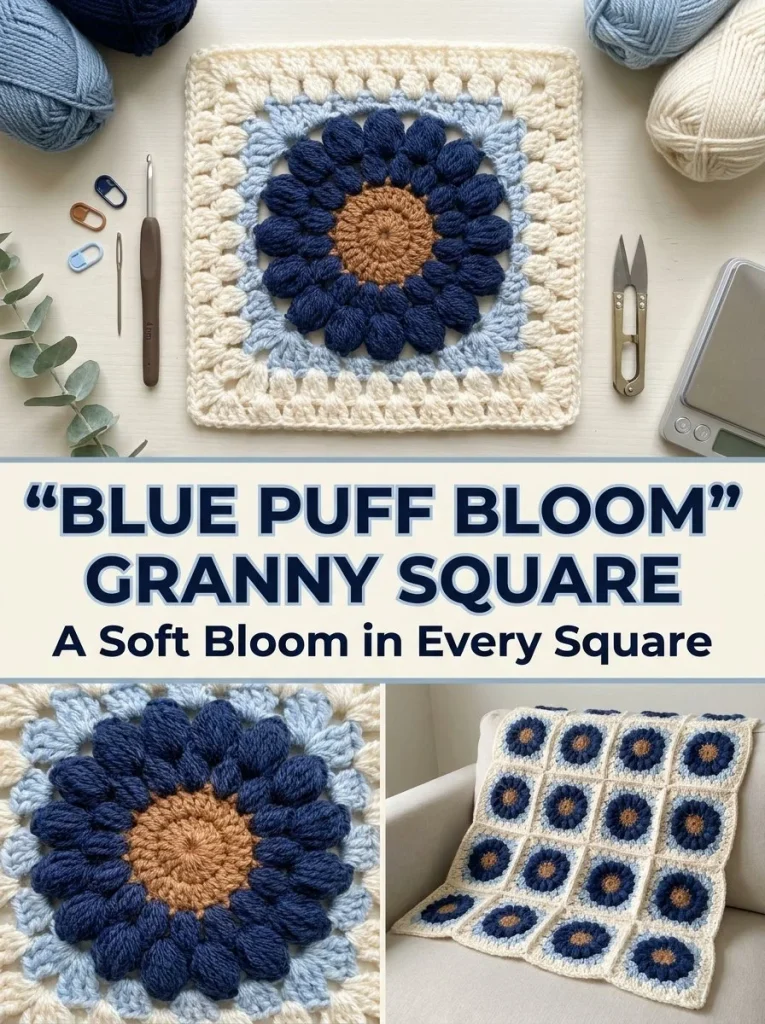
This cozy baby blanket features textured puff stitches nestled within a traditional granny square motif, worked in smooth DK-weight cotton or acrylic for softness and durability. The design highlights clusters of puffs in rich navy, soft powder blue, toffee beige, and ivory, creating a charming bloom effect that is both visually engaging and tactilely pleasing. The blanket is constructed from individual motifs joined into a rectangular layout, allowing for versatile sizing and easy customization.
The construction uses classic crochet techniques with a focus on puff stitches to add depth and interest. Each square starts with a magic ring foundation and evolves through rounds of single crochets, puff stitches, and clusters of double crochets that form the iconic granny square corners. The raised puffs create a textured surface that’s delightful for babies to touch, while the sturdy joining and edging ensure a durable and long-lasting finished piece.
Working with washable yarns in DK weight guarantees easy care and comfortable warmth, making this blanket both practical and aesthetically pleasing. This design offers an excellent opportunity to practice and showcase special puff stitches within a modular layout, perfect for intermediate crocheters looking to expand their skills. The blanket’s modular composition also makes it ideal for quilting enthusiasts interested in crocheted motifs — much like the lovely examples seen in designs such as the Cloud Puff Baby Blanket, where texture and color block play a starring role.
Pattern at a Glance
Skill level: Intermediate
Terminology: US crochet terms
Construction: Individual granny square motifs joined into a rectangular blanket
Finished size: Determined by motif size; example layout 7 x 8 squares for a baby blanket (56 squares)
Yarn weight: DK (double knitting) weight cotton or washable acrylic
Hook size: 4 mm
Main stitch: Puff stitch, double crochet clusters, single crochet
Gauge: Based on actual blocked motif measurements (refer to Blanket Conversion)
Motifs: 12-stitch base magic ring puff bloom granny square
Layout: Rectangle of motifs joined at corners and edges
Joining: Mattress stitch, whip stitch, or slip stitch with matching yarn
Border: Five rounds: including single crochet and half double crochet with corner increases
Materials
For this project, you’ll select smooth DK cotton or washable acrylic yarns in four colors: toffee beige, deep navy, powder blue, and ivory. These fibers are chosen for their softness and ease of care — essential qualities for a baby blanket. The smooth texture helps the puff stitches stand out clearly, while acrylic blends ensure durability through frequent washing.
You’ll need a 4 mm crochet hook for optimal stitch definition and fabric drape. Additionally, stitch markers are invaluable for marking your removable corners, which helps maintain even shaping throughout your granny square rounds. A tapestry needle is necessary for weaving in ends tidily, and scissors for trimming yarn. A scale is suggested to weigh your completed blocked square, aiding in yarn quantity calculations.
Since this blanket is constructed from multiple identical squares, you’ll first create and block a full motif, then weigh it to estimate total yarn needs — this method accounts for yardage variations caused by blocking, tension changes, and weaving in ends. Plan for a 15-25% additional yarn reserve beyond your baseline calculation, accommodating joining, edging, and pattern waste. For example, a single blocked square multiplied by 56 (7 x 8 layout) provides a good baseline for a baby blanket.
Yarn and Color Notes
Using DK weight yarn tailored for softness and washability is essential in baby projects. Cotton offers breathability and a clean stitch definition, which enhances the visibility of the puff stitches, while acrylic adds resilience and color retention.
The chosen colorway is thoughtfully balanced: the warm toffee beige anchors the motif base, while deep navy provides striking puff stitch contrast. Powder blue accents soften the look, and ivory rounds off the squares with neutral edging to unify the design. Working with solid colors ensures the textured bloom effect remains prominent and doesn’t get lost in variegated yarn patterns.
Feel free to experiment with substituted colors or yarn bases, but maintain smooth yarn characteristics for best stitch clarity and stitch definition. Avoid fuzzy or novelty yarns which may obscure the puff stitch texture.
Finished Measurements
The finished size is determined by the number of completed motifs and their blocked dimensions. Because of the modular nature, each motif block’s flat side length (denoted here as S) is your fundamental measurement unit in centimeters.
For example, the sample layout suggests a 7 x 8 grid of squares, resulting in 56 total motifs. When assembling, multiply your motif size S by 7 motifs horizontally and 8 vertically to estimate the approximate unbordered dimensions of the blanket. Note that assembly and border rounds may slightly alter final measurements.
Since each motif tends to block softly to the intended size, precise blocking after completing a sample square is crucial. Accurate measurement of the square’s blocked side length and weight allows precise conversion between motif count and overall blanket size.
Gauge
This pattern does not rely on a strict stitch gauge but depends heavily on measuring a blocked motif. After crocheting one complete square and blocking it gently, measure the flat side length of the motif (in centimeters) and weigh it (in grams).
This method is essential because the motif’s size can vary depending on yarn fiber, hook tension, and blocking technique. Using this motif measurement, you calculate exactly how many motifs to create to reach your desired blanket size, and estimate yarn quantities accordingly.
While gauge is less critical for garment fit in this blanket, maintaining consistent tension is recommended to ensure uniform squares that join smoothly.
Abbreviations
- MR: Magic Ring
- ch: Chain
- sl st: Slip Stitch
- sc: Single Crochet
- hdc: Half Double Crochet
- dc: Double Crochet
- sp: Space
- st: Stitch
- sc2tog: Single Crochet Two Together (single-crochet decrease)
- 3-dc group: Three separate double crochets worked into one space (not a closed cluster stitch)
- Corner: (3 dc, ch 2, 3 dc) worked into one ch-2 space
- standing dc: New-yarn double crochet made directly into the named space (sometimes counted as first dc in a round)
Important Pattern Notes
- Always work with the right side facing throughout the rounds.
- Join each round with a slip stitch in the first dc or the top of the initial counted ch 3.
- Fasten off yarn at color changes to keep color transitions clean.
- Use removable corner markers to identify and maintain corner spaces during motif rounds.
- The locking chain 1 after the puff stitch is part of the puff and not considered a ch-1 space between puff stitches.
- When the instructions say to join with a standing dc, you may create a new yarn dc in the space or chain 3 and count it as the first dc of the round.
- The 3-dc group is distinct from cluster stitches; these are three separate double crochets in the same space, not joined at the top.
Special Stitches and Techniques
Special Puff Stitch
This pattern features a raised special puff stitch created as follows:
- Yarn over, insert your hook into the specified stitch and pull up a tall loop.
- Repeat this yarn-over, insert hook, pull loop action four times in the same stitch. You will have 9 loops on your hook after this step.
- Yarn over and draw through all 9 loops on the hook in one motion.
- Chain 1 to lock the puff stitch. This locking chain belongs to the puff and is not an additional space between puff stitches.
These special puff stitches create the textured bloom effect that defines the motif’s character and tactile appeal.
Magic Ring (MR)
The motif foundation begins with a magic ring, allowing the first round to be worked in the round without leaving a hole in the center. This technique tightens the center for a neat appearance below the puff stitches.
Double Crochet Group and Corner
- A 3-dc group consists of three double crochet stitches worked separately into one space (do not cluster or join at the top).
- Corner spaces are created by working
(3 dc, ch 2, 3 dc)into one chain-2 space to allow the motif to grow into its square shape neatly.
Understanding the Construction
The project is composed of identical granny square motifs, each featuring puff stitches arranged in a circular bloom pattern. The motif construction follows a strict color sequence and stitch progression over five rounds:
- Round 1 forms the base circle of single crochets.
- Round 2 introduces the puff stitches and chains separating them.
- Rounds 3 and 4 build the granny square shape by working double crochet groups and corners into the chain spaces between puff stitches.
- Round 5 finishes each motif with single crochet edging and reinforces corners.
Once you complete one motif and block it flat, you create multiple identical motifs laid out in a rectangular grid (7 motifs across by 8 motifs down for a baby blanket). The motifs are then joined horizontally into rows, and the rows are joined vertically to assemble the blanket body.
After joining all motifs, the entire blanket is finished with a neat border worked in single and half-double crochets, including increased stitches at outer corners to keep the border flat and smooth.
This modular approach allows easy resizing by adding or subtracting motif counts in rows or columns.
Full Pattern Instructions
Special Puff Stitch
- Yarn over, insert hook into the specified stitch, pull up a tall loop.
- Repeat yarn over, insert, pull through four times total in the same stitch (you will have 9 loops on the hook).
- Yarn over and draw through all loops.
- Chain 1 to lock the puff. The locking chain belongs to the puff, not as space between puff stitches.
Round 1 (toffee beige)
- Begin with a magic ring (MR).
- Work 12 single crochets (sc) inside the ring.
- Join with a slip stitch (sl st) to the first sc. You now have 12 sc.
Round 2 (deep navy)
- In each of the 12 sc from Round 1, work one special puff stitch, then chain 1 (this chain 1 is placed after the locking ch of the puff).
- Repeat 12 times, alternating puff, ch 1 around the circle.
- Join with sl st to the base of the first puff. You have 12 puff stitches separated by 12 ch-1 spaces.
Round 3 (powder blue)
- Work only into the chain-1 spaces between the puff stitches from Round 2, in sequence.
- In chain-1 spaces numbered 1, 4, 7, and 10, make corners by working (3 dc, ch 2, 3 dc).
- In the other eight chain-1 spaces, work 3 dc.
- Chain 1 between all consecutive worked groups.
- At the end, join with sl st to complete the round.
- This round creates 16 groups total: 48 dc (3 dc groups) plus 4 corners, and 12 side chain-1 spaces.
Round 4 (ivory)
- Work corners (3 dc, ch 2, 3 dc) into each corner ch-2 space from the previous round.
- On each side between corners, work 3 dc into three of the chain-1 spaces.
- Chain 1 between groups to maintain stitch separation.
- Join with sl st.
- This round totals 20 groups: 60 dc groups, 4 corners, and 16 side chain-1 spaces.
Round 5 (ivory finishing round)
- Work single crochet (sc) into the top of every double crochet (60 sc total) and each of the 16 side chain-1 spaces.
- In each of the four corner ch-2 spaces, work (2 sc, ch 2, 2 sc) to form rounded corners and maintain square shape.
- Total count: 92 sc including corners.
- Join, fasten off, weave ends, and block motif flat.
Checkpoint
At this point, your motif should lie flat with pronounced puff stitches in navy and a balanced square shape framed by double crochet groups and clean single crochet edging.
Weave in all yarn ends neatly to prevent snagging, which is important for baby-friendly projects.
Layout and Assembly
Plan your blanket layout based on the number of motifs needed for your desired size. The example layout uses 7 motifs across and 8 motifs down, totaling 56 squares for a baby blanket.
To accurately estimate blanket size:
- After blocking one motif, measure its flat side length S (cm) and weigh it W (grams).
- Decide on blanket dimensions: desired width and length in cm.
- Calculate C = round(desired width ÷ S) (number of columns) and R = round(desired length ÷ S) (number of rows).
- Create and block C x R identical squares.
- Join motifs into rows by seaming along inner loops or slip stitching aligned edge loops using matching yarn.
- Join rows together ensuring corner ch-2 spaces align perfectly at intersections without adding extra motifs.
The joining method can vary depending on your preference — mattress stitch and whip stitch techniques provide flat, secure seams, while slip stitching along edges offers a decorative join.
For enhanced durability and aesthetic cohesion, lay out all motifs flat, photograph them, and arrange them until you are satisfied with color placement and alignment.
Border
With the blanket assembled and right side facing:
- Round B1: Work single crochet stitches evenly around the blanket edge, placing 3 sc in each outer blanket corner to keep corners flat.
- Round B2: Work half double crochets (hdc) in every stitch around, increasing with 3 hdc in each outer corner’s middle stitch. Mark these corners with stitch markers.
- Repeat Round B2 if desired to add extra border height.
- Fasten off and weave in all ends.
- Wash and block the finished blanket following yarn care instructions.
This border stabilizes the blanket edges and complements the soft texture of the motifs.
Finishing and Care
After weaving in all yarn ends, gently wash or steam block the blanket according to your yarn manufacturer’s recommendations. Blocking evens out stitches and smooths motifs, emphasizing the puff stitch texture and ensuring consistent square size.
When washing the blanket, use gentle cycles and mild detergents safe for delicate fibers and baby use to maintain softness and color vibrancy.
Ensure your blanket complies with safe-sleep guidelines and avoid loose or oversized blankets in infant sleep environments.
How to Resize Your Blanket
Because the blanket is motif-based, resizing is straightforward:
- Decide the desired finished dimensions in centimeters or inches.
- Crochet and block a sample motif, measure its side length S, and use this to calculate how many motifs are needed horizontally and vertically.
- Larger sizes require adding more motif rows and/or columns. Smaller sizes mean fewer motifs.
- Adjust your yarn quantities accordingly using the weight multiplied by the total number of motifs plus reserves.
- Consider the border width, which may add a few centimeters on all sides, adjusting final size accordingly.
This modularity allows for easy adaptation to throws, crib covers, bed blankets, or lap throws.
Useful Variations
- Single Color Version: Use one yarn color throughout for a timeless look emphasizing stitch texture.
- Gradient or Ombre Palette: Choose coordinating yarn shades that graduate gently across the blanket to highlight round progression.
- Scrappy Version: Use leftover DK yarn scraps for a colorful patchwork effect.
- Alternate Puff Colors: Change the puff stitch color in Round 2 to a contrasting or complementary shade to customize bloom colors.
- Different Yarn Fibers: Cotton for summer warmth, acrylic for easy care, or bamboo blends for softness and drape.
These variations keep the core motif and construction intact while allowing creative expression.
Troubleshooting
Why Are My Motifs Not Lying Flat?
Uneven tension or skipped chains in corners can cause motif curls. Use stitch markers in corners and ensure chain 2 spaces are consistent to maintain square shape.
Why Don’t My Puff Stitches Look Defined?
Ensure you are pulling up tall loops fully during the special puff stitch process and locking each puff with the required chain 1. Using smooth yarn enhances stitch definition.
Why Are My Joined Squares Misaligned?
Measure motifs after blocking carefully. Join squares slowly, checking corner alignment regularly. Use removable corner markers during assembly.
Why Is My Border Curling?
If the border pulls inward, increase corner stitches to prevent tugging and maintain border flatness.
Frequently Asked Questions
Can I use a different yarn weight?
This pattern is designed for DK weight. Using lighter or heavier yarns requires adjusting hook size and recalculating motif counts after blocking.
Can I substitute yarn fibers?
Yes, cotton or washable acrylic are recommended for softness, durability, and easy care. Fuzzy or highly textured yarns obscure puff textures.
Can beginners attempt this blanket?
Intermediate skills are helpful due to puff stitch complexity and joining techniques. However, confident beginners who practice the special puff stitch can enjoy this project.
How do I care for the finished blanket?
Hand wash or machine wash gently per yarn instructions, avoiding bleach and fabric softeners. Dry flat after reshaping.
Is the blanket reversible?
The right side with puff stitches is the intended finished side. The wrong side shows chain spaces and joins.
Can I make a larger version for a bed?
Yes, simply add more motifs in rows and columns. Measure and calculate motif size carefully before starting.
Related Patterns and Projects
For crocheters who enjoy the tactile charm of puff stitches and granny squares, exploring other motifs like the Strawberry Granny Square Blanket offers complementary crocheting experiences with similar modular construction and charming pop-out details.
Final Thoughts
This textured granny square baby blanket showcases the beauty and tactile delight of special puff stitches arranged in a classic square layout. Constructed from multiple identical blocks joined neatly, it blends tradition with playful texture and color. By carefully measuring and blocking your motifs, and following the clear joining and border steps, you create a durable, charming keepsake, perfect for baby showers, gifts, or personal use.
The project’s modular nature invites personalization of size, color, and yarn choices, ensuring this pattern remains a versatile favorite in any crocheter’s repertoire. Start with one motif, savor the puff stitch process, and watch your blanket bloom stitch by stitch.



