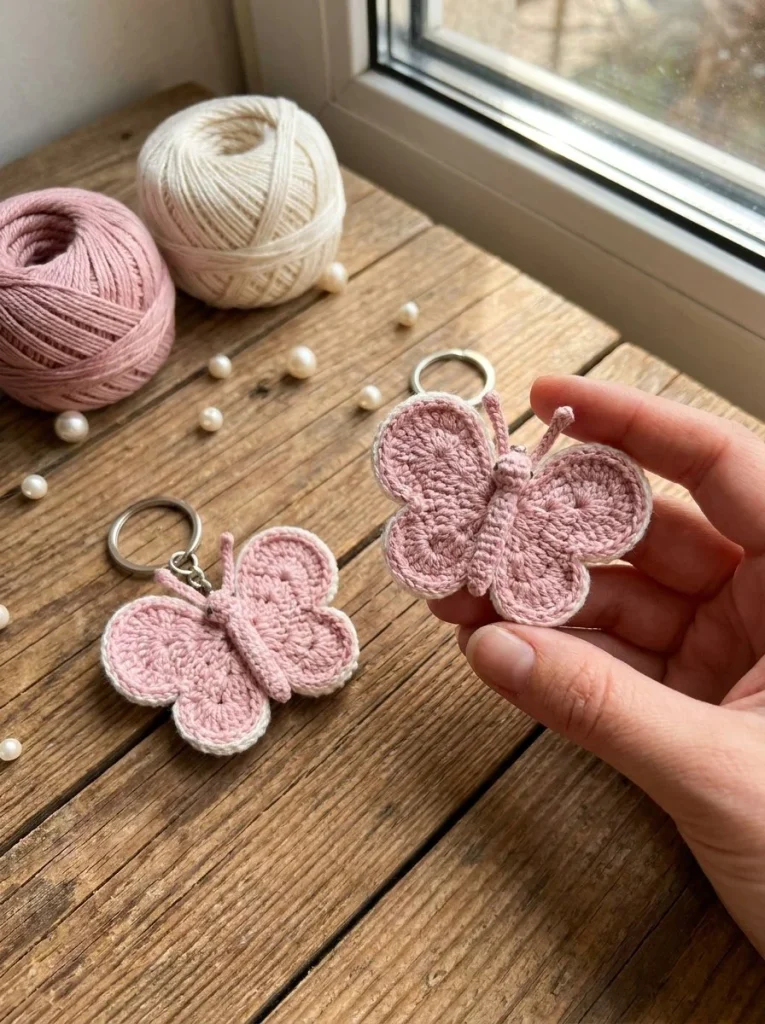
Creating a delicate, soft pink crochet butterfly keychain with subtle white accents offers a charming accessory that is both visually delightful and delightfully tactile. This handcrafted piece involves constructing a flat, four-winged butterfly using sport-weight cotton yarn, which gives it a gentle texture and a lightweight feel perfect for a keychain or even appliqué decoration. The butterfly’s design highlights the contrast between the dusty pink main color and the white accent stitches along the wings’ edges, creating a refined, subtle detail that enhances its whimsical charm.
The construction revolves around crafting a small flat butterfly with two large upper wings and two smaller lower wings symmetrically attached to a slender body. The pattern uses basic crochet stitches such as single crochet (sc), double crochet (dc), and half double crochet (hdc), with the wings formed from rounds starting in magic rings. The fold-and-sew technique imparts a natural wing shape, and lightly outlining the wing edges in white provides an appealing highlight without obscuring the delicate pink base yarn. This project is perfect for those interested in quick, satisfying motifs following traditional crochet methods and who enjoy adding functional artistry to everyday items like keychains.
For inspiration on similar petite project ideas, you might appreciate exploring a blue star keychain mini crochet pattern that also transforms simple stitches into charming accessories.
Pattern at a Glance
Skill level: Intermediate beginner – requires familiarity with magic ring, basic crochet stitches, and hand-sewing.
Terminology: US crochet terms
Construction: Separate components (body, wings) crocheted flat and assembled by sewing
Finished size: Approximate butterfly size suitable for keychain attachment (small scale)
Yarn weight: Sport cotton
Hook: 3 mm
Main stitch: Single crochet, double crochet, half double crochet
Gauge: Not explicitly specified due to small motif size but maintaining stitch count is crucial
Motifs: Four wings (two upper, two lower), one body, antennae
Layout: Butterfly shape with symmetrical wings
Joining: Sew wings to body and body edges over wing joins
Border: White slip stitch accent or embroidery around wing edges
Seaming: Tapestry needle hand sewing for assembly
Materials
To successfully create this soft pink butterfly keychain, gather the following items:
-
Sport cotton yarn: 8 grams in dusty pink (primary body and wings) and 3 grams in white (for accent embroidery or edging)
Sport cotton is a lightweight yarn that provides a smooth texture and good stitch definition, making it ideal for small motifs where detail counts. -
Crochet hook: 3 mm
A 3 mm hook is well-suited for sport-weight yarn, allowing the stitches to be firm yet flexible, which helps maintain the butterfly’s shape. -
Split key ring and jump ring
Used for attaching the finished butterfly securely to keys or bags. The jump ring fastens the crochet piece to the key ring. -
Tapestry needle
Necessary for sewing the wings onto the body, weaving in yarn tails, and reinforcing the attachment of the jump ring. -
Scissors
For cutting yarn ends neatly.
Having quality tools like a sharp yarn needle and sturdy metal key rings contributes to the durability of the finished project and ease of assembly.
Yarn and Color Notes
Choosing sport cotton yarn enhances this butterfly’s delicate appearance with its soft sheen and light weight. Opt for smooth, plied yarn over fuzzy or heavily textured yarn to ensure the stitches are clear and the wings’ definition sharp. The use of dusty pink gives a subtle, vintage vibe, while the white accent adds a crisp outline that does not overpower the main color.
For variations, solid colors are recommended to maintain the pattern’s stitch visibility. However, subtle tonal variegation in pink could add depth without distracting from the butterfly’s neatly stitched wing shape.
Finished Measurements
Though exact dimensions are not specified in the pattern, the finished butterfly will be small, proportional to a typical keychain accessory. The 3 mm hook and sport cotton yarn produce a dense fabric, resulting in a butterfly approximately 5–7 cm wide from tip to tip when shaped symmetrically.
The finished size depends mainly on the yarn tension and hook size, so consistent tension and checking stitch counts will ensure uniformity for gifting or multiple repeats.
Gauge
This pattern does not specify a formal gauge, but monitoring stitch count is essential, especially in magic ring rounds and wing folding. Maintaining the exact stitch counts:
- Body: 7 single crochets after foundation chain
- Upper wings: 8 double crochets in first round, then 16 single crochets
- Lower wings: 6 half double crochets in first round, then 12 single crochets
Ensuring these counts helps the wings and body form the expected shape without distortion.
If your stitches are too loose, the wings may appear floppy; too tight, and the butterfly can be stiff and difficult to fold and sew symmetrically.
Abbreviations
- ch – chain
- sc – single crochet
- dc – double crochet
- hdc – half double crochet
- sl st – slip stitch
- st(s) – stitch(es)
- MR – magic ring (magic loop)
Important Pattern Notes
- The magic ring is used to start each wing, allowing tight, adjustable centers.
- Chains at beginnings of rounds count as stitches as specified (e.g., ch 3 counts as first dc).
- Each wing is worked in joined rounds.
- Wings are folded after completion, creating a 3D effect from a flat disk.
- The butterfly body is worked flat and serves as the base for attaching wings.
- The antennae are formed by chaining and returning with slip stitches for a firm but flexible structure.
- The white accent stitch is worked lightly to add detail without obscuring underlying pink stitches.
- Assembly stitching is crucial for securing the jump ring and ensuring symmetry.
Special Stitches and Techniques
- Magic ring: This technique starts rounds with an adjustable loop rather than a fixed chain ring, enabling a tight center especially useful in small circular motifs like wings.
- Slip stitch edging: A neat way to outline the wing edges, which in this project doubles as an accent without adding bulk.
- Folding and sewing wings: Folding discs into semicircles is a finishing step that imparts realistic wing shapes before sewing them to the body.
- Chain and slip stitch antennae: This creates flexible, curved antennae with firmness.
For broader exploration of versatile accessory motifs incorporating key rings, one can consider the burgundy hooded crochet scarf with rectangular hood pattern, which offers another perspective on crochet accessory construction and finishing.
Understanding the Construction
The butterfly is composed of five main crochet elements worked separately:
- Body: A simple chain foundation with single crochet rounds to form a slender, elongated shape serving as the butterfly’s core.
- Upper wings (make 2): Larger circular motifs made from a magic ring, doubled in stitch count, then folded in half to achieve the wing shape.
- Lower wings (make 2): Smaller circular motifs with half double crochet rounds, similarly folded and sewn.
- White accents: Slip stitches or embroidery around the wing edges to elevate design detail.
- Antennae: Chain and slip stitch loops attached at the body top, lending character and balance.
This modular approach allows you to crochet wings separately, accurately shape them, and then securely assemble to create a balanced, symmetrical butterfly.
Full Pattern Instructions
Body
- Using dusty pink yarn, chain 8 stitches.
- Beginning in the second chain from the hook, single crochet once in each chain stitch across (7 single crochets total).
- Do not join; finish off this piece leaving a yarn tail approximately 20 cm long for sewing later.
Upper Wings (Make 2)
- Begin with a magic ring.
- Chain 3 (counts as first double crochet), then work 7 double crochets into the ring (8 double crochets total).
- Slip stitch into the top of the starting chain 3 to join the round.
- Chain 1, then work 2 single crochets in each of the next 8 stitches around (16 single crochets).
- Join with a slip stitch to the first single crochet of the round.
- Cut yarn and leave a tail for sewing.
- Fold each completed disc into a semicircle by gently pressing the circular motif to create a wing shape, with the straight edge formed along the fold.
- Secure the folded wing at the straight edge to the upper half of the body using the long yarn tail and a tapestry needle.
Lower Wings (Make 2)
- Begin with a magic ring.
- Chain 2 (counts as first half double crochet), then work 6 half double crochets into the ring.
- Slip stitch to the first half double crochet to close the round.
- Chain 1, then work 2 single crochets in each stitch around for 12 single crochets total.
- Join with a slip stitch to the first single crochet of this round.
- Finish the round; leave a long yarn tail for sewing.
- Fold the disc gently in half, creating the wing shape.
- Sew each folded lower wing onto the lower half of the body.
White Accent
- Using white yarn, work a light slip stitch along the curved edge of each folded wing as an accent, or opt to embroider a small white line just along the edges using a tapestry needle.
- Avoid covering the dusty pink in the main wing body with too many white stitches to preserve the original color.
Final Assembly
- Stitch the body over the wings’ join edges to secure the parts firmly.
- Attach the antennae by fastening pink yarn at the top center of the body, chaining 5, then slip stitching back along the chain for 4 stitches, forming a curved antenna.
- Repeat on the other side.
- Make sure antennae are symmetrical.
- Use the tapestry needle to sew a metal jump ring through reinforced loops at the top of the body and connect it to a split key ring.
- Shape the butterfly so the wings are symmetrical, with two larger upper wings and two smaller lower wings balanced nicely.
Note: If you prefer, omit the key ring for using this butterfly motif as an appliqué on hats, bags, or clothing.
Checkpoints
- After upper wings are complete, ensure each disc has 8 double crochets in the first round and 16 single crochets in the second round, and that folding produces a neat semicircle wing.
- Lower wings should have 6 half double crochets in the first round and 12 single crochets in the second round; the fold should create a smaller wing matching the body’s lower half.
- Antennae chains and slip stitches must create sturdy loops without twists.
- Overall butterfly width should be visually balanced before final sewing and attachment.
Assembly and Joining
Proper assembly ensures your butterfly keychain holds its shape and remains durable during use.
- Lay the body flat. Position the folded upper wings flush against the upper third of the body, aligning the straight folded edges against the body edge.
- Sew firmly with matching yarn via tapestry needle, stitching over wings and body joins to create a seamless appearance.
- Position the lower wings similarly on the body’s bottom half, maintaining symmetry side-to-side.
- After attaching the wings securely, stitch over the entire body’s joins for reinforcement and neaten the appearance.
- Insert the metal jump ring through the top loops of the body yarn—this area should be well reinforced by multiple stitches or wrapping yarn—to avoid tearing with daily use.
- Attach the jump ring to the split key ring for use.
Finishing
- Carefully weave in all yarn ends using a tapestry needle to prevent snagging or unraveling.
- Optionally, block the butterfly by pinning it lightly flat on a foam board or towel and spraying lightly with water; allow drying to enhance shape firmness and smoothness.
- Be cautious not to over-block or stretch, as the small motif should retain its shape for maximum durability.
How to Resize
To create a larger or smaller butterfly:
- Changing the yarn weight and hook size can adjust the overall scale. A thicker yarn and larger hook yield a larger butterfly, while finer yarn and smaller hook create a more delicate, miniature version.
- If you want to keep the pattern but resize the wings proportionally, increase the rounds of double crochets or half double crochets before moving to the single crochet round—maintaining increases to keep the circular shape.
- Adjust the starting chain length of the body proportionally for balance.
- Always maintain multiples to preserve symmetry and wing fold consistency.
Useful Variations
Here are some alternative ideas to personalize the butterfly:
- One-color butterfly: Crochet the wings and body all in dusty pink or white for a monochromatic look.
- Two-tone wings: Use contrasting colors for upper and lower wings to create a bolder effect.
- Variegated yarn: Use yarn that changes subtly in shades of pink or white to add depth and interest.
- Embroidered accents: Instead of slip stitch outlines, embroider delicate patterns like dots or veins to mimic real butterfly wings.
- Remove key ring: Convert the motif into a brooch by attaching a pin back or into a hairclip for wearable art.
Troubleshooting
Why Is My Butterfly Wings Not Folding Nicely?
Ensure you have the correct stitch counts and that your tension is consistent. Too tight stitches make folding difficult; too loose stitches let the wings flop. Blocking lightly can help set the folds naturally.
Why Are My Wings Asymmetrical?
Double-check stitch counts in rounds and make sure you are folding each wing at the same spot. Lay the wings flat before sewing and adjust placement carefully.
How Can I Make the White Accents Neater?
Use a fine tapestry needle and work very loose slip stitches or embroidery stitches just on the topmost yarn loops to avoid covering pink stitches. Practice on a swatch first.
The Antennae Are Floppy—What Can I Do?
If the antennae feel too loose, try using a smaller hook or tighter tension in your chains and slip stitches. You can also reinforce by adding a small wire inside the yarn chains if desired for stiffness.
The Keyring Feels Loosely Attached—How to Secure it?
Make sure the jump ring passes through yarn loops reinforced by several secure stitches. You can reinforce by wrapping yarn multiple times around attached loops before inserting the jump ring.
Frequently Asked Questions
Can I use a different yarn weight?
You can, but adjust your hook size accordingly. Thicker yarn may obscure stitch detail in small motif wings, and thinner yarn might make parts too delicate.
Can I use acrylic instead of cotton?
Yes, acrylic yarn works well, but note it might have less crisp stitch definition and a different feel. Choose a smooth acrylic with minimal fuzziness.
Is this pattern suitable for beginners?
Intermediate beginners who know magic rings and basic crochet stitches will enjoy this project. Beginners might need practice with magic rings and small motif finishing.
Can I omit the white accent?
Yes, the butterfly looks lovely in just dusty pink, though the white accent adds extra charm and definition.
How long should yarn tails be for sewing?
About 20 cm tails are recommended to allow easy stitching without frequent joining or breaks.
Is the butterfly reversible?
No, the back will show sewn seams and folded wing edges, so it is best displayed flat with the front side out.
Optional Related Uses
This butterfly motif can be adapted beyond keychains:
- Sew as an appliqué on hats, scarves, or bags to add a feminine touch.
- Combine multiple butterflies in a garland or mobile for decoration.
- Attach to hair accessories like barrettes or headbands.
- Use as a delicate brooch or pin by attaching a brooch backing.
For accessory projects incorporating soft shapes with built-in keychain attachments, consider exploring detailed motifs such as the linked blue star keychain mini crochet pattern for extended inspiration.
Final Thoughts
This charming crochet butterfly combines simple stitches, traditional construction techniques like magic rings and folding, and careful finishing to create a lightweight, aesthetically pleasing accessory. The project’s modular assembly focusing on separate body and wings makes it approachable yet rewarding. By carefully adhering to stitch counts and neat stitching, you’ll craft a balanced four-winged butterfly accented with delicate white highlights and practical antennae—all finished with a secure jump ring attachment perfect for keychain use or appliqué. This sweet motif serves as an excellent opportunity to refine your crochet skills and produce a functional, beautiful handmade keepsake.



