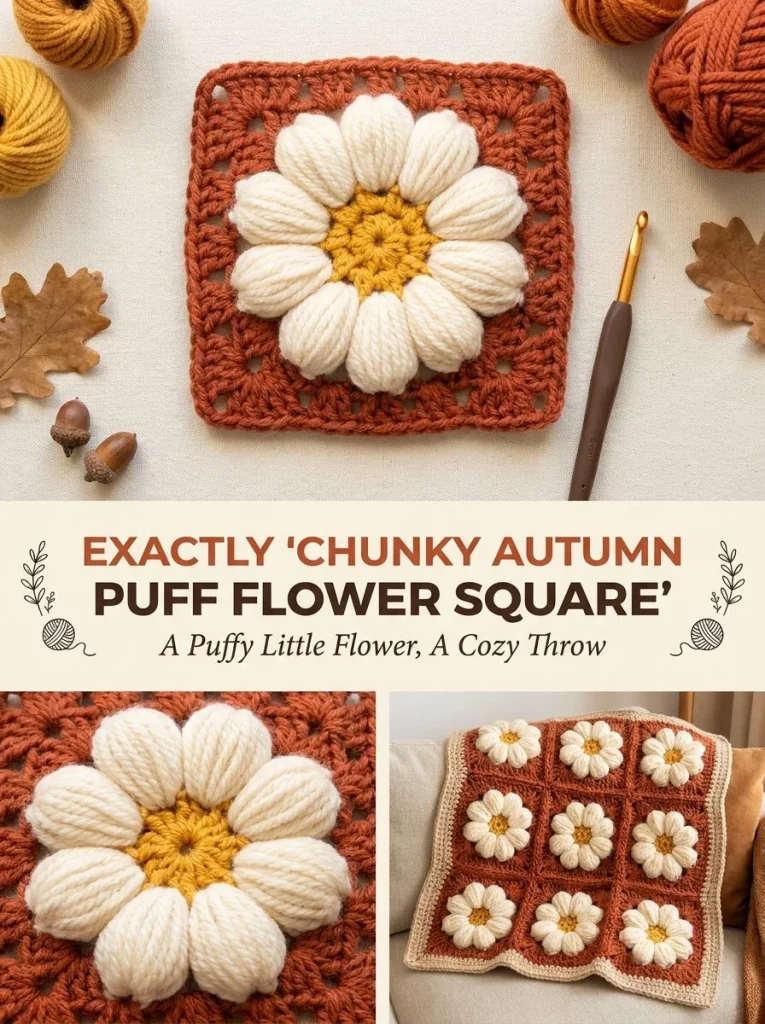
This textured crochet throw is crafted using a repeated motif technique that brings together a charming puff-flower design framed by cozy autumnal hues. The core visual appeal lies in the soft, plump petals encircling a warm honey-yellow center, all neatly squared into a grid of joined motifs. Its construction focuses on joining individual crochet squares, making the blanket customizable in size and shape. The use of bulky yarn and an 8.0 mm hook yields a substantial, plush throw ideal for autumn days. This project not only showcases sophisticated stitch work — featuring puff stitches and clusters — but also offers a rewarding process for crocheters interested in motif blankets.
Besides creating a cozy accent for living room or bedroom, the combination of tactile puff petals with a geometrically squared frame adds an interesting dimensional texture to home décor. If you appreciate designs that integrate color blocking and textured crochet techniques, you might find inspiration in a related chunky color block scarf pattern that complements the aesthetic and construction style.
Pattern at a Glance
Skill Level: Intermediate
Terminology: US crochet terms
Construction: Worked in joined rounds, motif-based blanket made of repeated squares
Finished Size Examples:
- Baby/small: 99 x 118 cm (approx.) with 30 squares
- Throw: 137 x 175 cm (approx.) with 63 squares
- Bed example: 213 x 251 cm (approx.) with 143 squares
Yarn Weight: #5 bulky wool-acrylic blend
Hook Size: 8.0 mm
Main Stitches: Puff stitch, single crochet, double crochet, treble crochet, clusters
Gauge: Sample motif approximately 19 cm after blocking
Motifs: Square motifs with 8 puff petals
Layout: Grid style, arranged in rows and columns
Joining: Whip stitch seams, edges aligned corner-to-corner
Border: Two rounds of single crochet with corner chain-spaces for smooth edges
Seaming: Flat whip stitch on wrong side
Materials
For this project, use a bulky (#5) soft wool-acrylic blend yarn to achieve a plush and warm texture. The specified colors create a harmonious autumn palette:
- Honey-yellow for the center of the flower motif
- Puffy soft cream for the puff petals
- Burnt-terracotta for the square framing
- Sand-beige for the finishing border edge
An 8.0 mm crochet hook is recommended to ensure the bulky yarn produces a firm yet flexible fabric. Additional tools include a yarn needle for seaming, scissors for cutting yarn ends, and a measuring tape to verify dimensions.
You will also need blocking supplies appropriate for the yarn’s fiber content to shape the motifs to a consistent size, approximately 19 cm square. For accurate yarn planning, use a kitchen scale with at least 1g precision to weigh test squares by color. This helps estimate total yarn needs with about 15-20% extra allowance for seams, borders, and tails.
All yarn for large projects should be purchased from matching dye lots where possible to avoid color variations across the blanket. Since gauge and final motif dimensions depend on individual tension and yarn, sample swatches are essential before proceeding.
Yarn and Color Notes
Selecting a bulky wool-acrylic blend provides the ideal balance of warmth, softness, and easy care. Wool adds insulation and loft to emphasize the puff stitch texture, while acrylic blends enhance durability and colorfastness.
Smooth yarns can highlight stitch definition, especially for the puff petals and cluster stitches. Avoid overly fuzzy or loosely spun yarns, which may obscure the detailed texture.
The chosen colors evoke autumn warmth: the honey-yellow centers shine through the soft cream petals, framed by burnt-terracotta squares to introduce depth, and finished with a neutral sand-beige border for a natural, grounded look.
This color-blocked approach works best with solid or semi-solid yarns to maintain clarity in stitch patterns. Avoid highly variegated yarns, which could muddle the puff petals’ form.
Finished Measurements
The size of the finished blanket depends on the number of motifs joined and the blocked motif dimensions. Sample motifs measure approximately 19 cm square after blocking, which is the benchmark for size planning.
Examples of layout sizes based on this measurement (plus about 4 cm added collectively by the border on each dimension):
- Baby/Small: 5 motifs across x 6 motifs down = roughly 99 x 118 cm
- Throw: 7 motifs across x 9 motifs down = roughly 137 x 175 cm
- Bed: 11 motifs across x 13 motifs down = roughly 213 x 251 cm
Since blocking and joining techniques can influence the actual size, precise measurement of sample join-to-join pitch is recommended before final assembly.
Gauge
Gauge is based on the motif size after blocking, not a traditional flat swatch. Ensure your motifs measure close to 19 cm square to maintain sizing predictability. To check gauge:
- Crochet a complete motif using the recommended yarn and hook.
- Wash and fully block the motif without overstretching.
- Measure the motif sides accurately with a measuring tape.
If your motif is larger than 19 cm, use a smaller hook for tighter gauge; if smaller, use a larger hook.
For blankets, gauge discrepancies are less critical but still influence final measurements and yarn required.
Abbreviations
- ch = chain
- sl st = slip stitch
- sc = single crochet
- hdc = half double crochet
- dc = double crochet
- tr = treble crochet
- sp = space
- st = stitch
- MR = magic ring
- RS = right side
- yo = yarn over
Important Pattern Notes
- Work all rounds as joined rounds with slip stitch joins; do not work in spiral rounds.
- Corner chain-2 spaces function as spaces, not stitches.
- For color changes, attach new color with standing double or treble crochet where possible. If unable, start with chain 3 (for dc) or chain 4 (for tr) and reduce following stitch count accordingly to maintain stitch totals.
- Fasten off yarn only when instructed.
- The slip stitch join does not count as a stitch.
- Three-dc-cluster stitches involve three incomplete dc stitches worked into the same stitch/space and closed together, counted as one stitch.
Special Stitches and Techniques
Puff Stitch (Special Puff)
This pattern features a distinctive puff stitch forming the petals:
- Begin with one loop on the hook.
- Repeat [yo, insert hook into the same single crochet, yo, draw up a long loop] three additional times to have 7 loops on the hook.
- Yo through all 7 loops and chain 1 to close the puff (the closing chain is not part of the following chain-2 space).
Between each puff stitch, a chain-2 is worked to separate the petals, resulting in 8 puff petals and 8 chain-2 separator spaces.
Three-dc Cluster
Work three incomplete dc into the same stitch or space:
- Yo, insert hook, yo, pull up loop (leave last loop on hook). Repeat two more times (3 incomplete dc total, 4 loops on hook).
- Yo and pull through all 4 loops to close the cluster as one stitch.
Understanding the Construction
This blanket is constructed from square motifs featuring an eight-petaled puff-flower centered on 8 single crochets. The motifs are squared in the later rounds, forming corners and sides that facilitate neat joining.
Each motif is worked in joined rounds, starting with a magic ring and progressing through puff petals, clusters, and square frame rounds. The final motif includes corner and side groups totaling 16 stitch groups.
The blanket size is determined by the number and arrangement of motifs joined in a grid (rows x columns). Joining is done by sewing outer edges of motifs together from corner space to corner space to ensure proper alignment.
The two-round border frames the entire joined blanket, creating a smooth edge without holes or ripples.
Motif Instructions
Round 1 (Center Ring with Honey-Yellow Color)
- Start with a magic ring (MR).
- Chain 1 (does not count as a stitch).
- Work 8 single crochets (sc) into the MR.
- Join with slip stitch to the first sc.
- Fasten off honey-yellow.
Stitch count: 8 sc.
Round 2 (Puff Petals with Cream Color)
- Join cream yarn in the first single crochet.
- Work a puff stitch in that same sc, then chain 2.
- Repeat (puff stitch, ch 2) in each of the other 7 sc around.
- Join with sl st to the first puff.
- Fasten off cream.
Result: 8 puff petals separated by ch-2 spaces.
Round 3 (Double Crochet Groups)
- In each chain-2 space between puff petals, work 3 double crochets (dc), chain 1.
- Repeat for all 8 ch-2 spaces.
- Join with sl st to the first dc.
- Fasten off.
Total groups: 8 groups of 3 dc separated by chain 1.
Round 4 (Squaring and Corner Formation with Burnt-Terracotta Color)
- Use the 8 chain-1 spaces created in round 3 to place stitches.
- Repeat the following sequence 4 times:
- (3 treble crochets (tr), chain 2, 3 tr) into one corner gap (the ch-1 spaces alternating around the round) to create a corner.
- Chain 1.
- 3 dc in the next gap.
- Chain 1.
- Join with sl st to the first tr.
- Fasten off.
Outcome: 4 corner groups of (3 tr, ch 2, 3 tr) with 4 side groups of 3 dc.
Round 5 (Final Outline with Burnt-Terracotta Color)
- In each of the four corner chain-2 spaces, work (3 dc, ch 2, 3 dc) to strengthen the corners.
- In each of the two side chain-1 spaces, work 3 dc.
- Add chain 1 between adjacent groups along the sides as in previous round.
- Join with sl st to the first dc.
- Fasten off.
Total groups: 16 groups (4 corners and 12 side stitch groups combined as indicated).
Square Counts and Finished Size Planning
Your blanket layout can vary based on desired dimensions. Approximate planning based on 19 cm blocked square:
| Size | Squares Across | Squares Down | Total Squares | Approximate Size (cm) |
|———–|—————-|————–|—————|—————————|
| Baby/Small| 5 | 6 | 30 | 99 x 118 (plus border) |
| Throw | 7 | 9 | 63 | 137 x 175 (plus border) |
| Bed | 11 | 13 | 143 | 213 x 251 (plus border) |
Measure your individual motif samples after blocking. Adjust the grid or hook size accordingly for correct fit. The blanket size can be customized simply by changing the number of squares horizontally and vertically without altering the motif.
Finish and Join
After completing a sample motif, wash and block carefully without overstretching. Measure the motif pitch (distance from join-to-join edges).
If your project involves flower and plain motifs, sample both and ensure their edges are identical. For joining motifs:
- Arrange motifs in desired grid with right sides facing up.
- Use matching yarn and a yarn needle.
- Sew outer-edge loops of motifs together with a flat, moderately loose whip stitch, aligning corner spaces and stitch groups.
- Join motifs row-wise, then join rows together.
- Secure all yarn ends on the wrong side.
When stitch counts or counts in corners differ slightly, align motifs corner-to-corner and distribute joining evenly to avoid gathering or distortion.
Two-Round Border Around the Entire Blanket
Attach the border yarn with right side facing in any outside corner chain-2 space.
Round 1:
- At each of the four outside corners, work (sc, ch 2, sc).
- Along outer edges, work one sc in each exposed edge stitch and each exposed side chain-1 space.
- At flat internal seam crossings, add one sc only if needed to prevent holes.
- Do not add corner increases at internal square joins.
- Join with sl st to first sc.
Round 2:
- Work single crochet evenly in each sc around.
- In each of the four outside corner ch-2 spaces, work (sc, ch 2, sc).
- Join with sl st, fasten off, and weave in ends.
Maintain an even and flat border to prevent rippling or pulling. This two-round border adds approximately 4 cm to each side of the blanket, but exact width depends on yarn and tension. Always measure on samples.
Custom Blanket Sizing Tips
To size your blanket:
- Measure your mattress or desired drape size before deciding motif counts.
- Calculate columns = ceiling ((desired width – border allowance) ÷ blocked motif width).
- Calculate rows = ceiling ((desired length – border allowance) ÷ blocked motif height).
- Refine with actual join-to-join pitch measurements by joining sample squares.
- Add measured border width to total dimensions.
Note that seam tension can impact dimensions, so favor adding whole motif columns or rows for larger sizes or overhangs rather than skimping on counts.
Yarn Requirement and Planning
Make and finish a sample square with your chosen yarn and hook. Wash and block it identically to planned usage.
- Weigh the finished sample motif per color segment.
- Multiply each by the number of motifs planned by color.
- Add approximately 15-20% extra for joining, border, sewing tails, and spare yarn.
- For 100g skeins, round up the total required weight divided by 100 per color.
Avoid guessing skeins without this weighing method, as different yarns, hook tensions, and personal tension affect consumption.
Care and Safety
This blanket is intended for supervised use by babies and children. Avoid loose blankets in infant sleep spaces to reduce risk.
Raise flower petals and appliqués should be firmly secured with neat yarn tails and inspected frequently to avoid loose ends that may pose hazards.
How to Resize This Blanket
Adjusting blanket size is accomplished by changing the number of motifs across and down. Since motifs are repeated and identical in dimension, scaling is achieved by increasing or decreasing the grid size.
If your blocked motifs differ from 19 cm, adjust hook size or yarn choice before making many motifs.
For significant size changes, maintain motif stitch counts and arrange motifs so corner and side joins remain uniform.
Variations and Related Ideas
- Create a plain motif tile variant without puff petals to alternate motifs for a more subtle textural effect. Sample both motif types as sizes should perfectly match.
- Use color variations for petals or square frames to create vibrant or muted versions.
- This motif style can be adapted for smaller projects like pillow covers or scarves. Explore examples such as the textured motifs in our autumn lattice throw knitting pattern for complementary inspiration.
Troubleshooting
Why Are My Motifs Different Sizes?
Motifs may differ due to inconsistent tension or blocking. Always work sample motifs with your intended yarn and hook, then block before measuring. Adjust hook size to compensate.
Why Are My Puff Petals Not Puffing?
Ensure you complete all yarn overs and long loop pulls evenly per puff stitch instructions. Use a hook size that allows full loop height without being too tight.
Why Do My Seams Look Tight or Rippled?
Use a moderately loose whip stitch to join. Tight seams can distort motif edges and shrink fabric. Position motifs corner-to-corner and distribute joining evenly.
Why Is the Border Curling or Wavy?
Maintain even tension in border single crochets. If curling persists, a third border round with different stitch patterns may help or a blocking spray after finishing.
Why Are Color Changes Sometimes Misaligned?
Always join new colors with standing stitches to preserve stitch count. Starting rounds with chains instead may vary count if adjustments are not made, causing alignment problems.
Frequently Asked Questions
Can I use a different yarn weight?
This pattern is designed for bulky #5 yarn. Using lighter or heavier yarns will affect the motif size and texture. Adjust hook size accordingly and sample test motif.
Can I make this in one color?
Yes, using a single color motifs simplifies color changes, but the design impact of puff petals might be less pronounced.
Is this pattern suitable for beginners?
Intermediate crocheters will find the puff stitch and cluster stitches approachable with practice. Joining motifs and working joined rounds require careful counting.
How should I block my motifs?
Wash gently following yarn care. Lay flat to dry without stretching. Pin motifs to desired square shape during blocking.
Can motifs be joined as you go?
This pattern expects motifs to be fully completed and blocked before joining for best edge consistency and size.
Are the puff petals reversible?
The puff stitches form a raised texture visible from the front (right side). The wrong side will show chain spaces and back loops but is neater with practice.
Final Thoughts
This crochet throw combines thoughtful motif construction with a charming autumnal palette and a tactile floral texture perfect for cozy spaces. The project involves creating individual puff-flower squares that are squared off and joined in neat grids, enclosing petals in a burnt-terracotta frame and a soft border. By working test squares, carefully blocking, and accurately joining, you can create a blanket perfectly suited to your size preference.
Its design balances warmth, texture, and visual interest, while the modular motif technique gives versatility and room for expression through color choice and layout — a satisfying project for intermediate crocheters who appreciate sophisticated puff stitch work and motif blankets.



