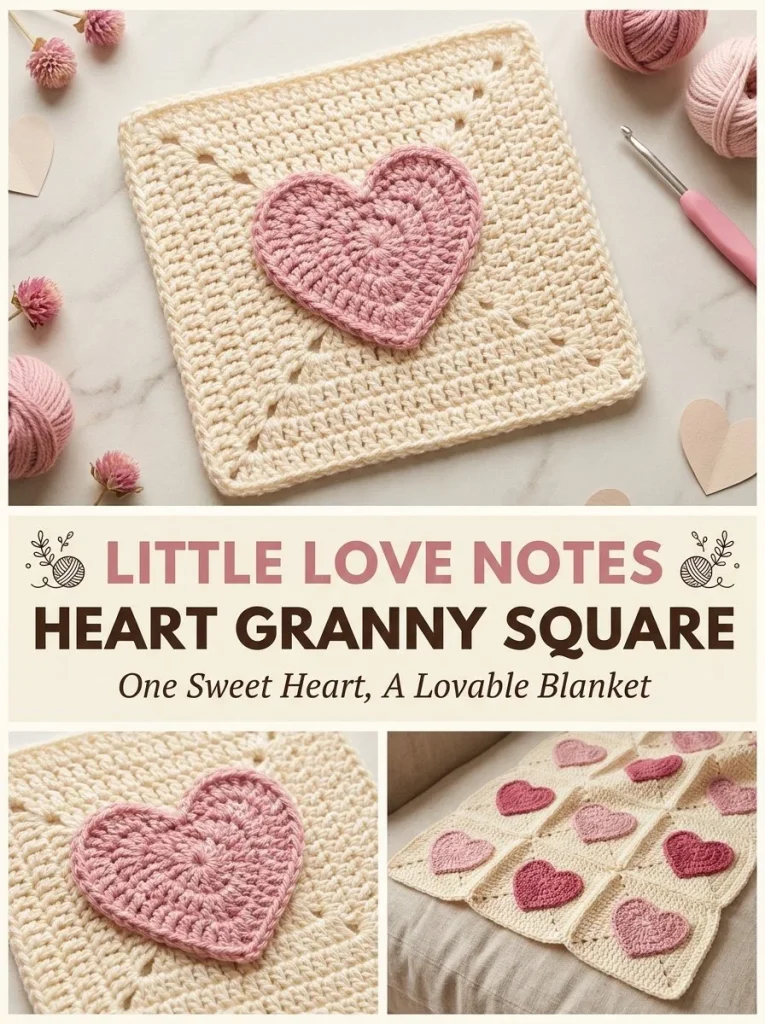
Creating a charming and heartfelt crochet blanket involves more than just stitching squares together—it’s about crafting a cozy, visually appealing piece that combines thoughtful design with careful construction. This blanket features a repeated motif of solid granny squares in a soft buttermilk-cream color, each adorned with delicate heart appliques in dusty pink and soft berry hues. The clear contrast between the gentle background and the colorful hearts brings a warm, tender charm to the finished fabric.
The construction technique centers around a solid granny square made with four distinct joined rounds, ensuring consistency in stitch counts and motif dimensions. Each square is topped with a symmetrical crochet heart applique that is sewn securely onto the right side, turning simple granny motifs into personalized tokens of affection. The blanket’s assembly involves sewing squares together with considered alignment of edges and corners, followed by a neat two-round border that frames the project elegantly.
This project is particularly satisfying for those who appreciate precise motif work and the opportunity to play with color placement in an organized grid. It also serves as a lovely gift piece or a keepsake that can grow in size with added squares. Since the motif size and gauge can vary, the planning stage involves creating and measuring sample squares carefully before committing to your final blanket dimensions and yarn quantities.
For additional inspiration in working with cozy, heart-themed crochet projects, consider exploring designs like the chunky teddy heart blanket, which showcases similarly sweet motifs with a plush texture.
Pattern at a Glance
Skill level: Intermediate – demands familiarity with joined rounds and motif sewing
Terminology: US crochet terms
Construction: Repeated motif and joined blanket
Finished size examples:
- Baby/Small: approx. 95 x 108 cm (7 x 8 squares)
- Throw: approx. 134 x 173 cm (10 x 13 squares)
- Bed example: approx. 212 x 238 cm (16 x 18 squares)
Yarn weight: #4 worsted weight cotton-acrylic blend
Hook: 5.0 mm
Main stitch: Double crochet (dc) in solid granny pattern; treble and double crochet in heart applique
Gauge: Sample square approximately 13 cm after blocking
Motifs: Square solid granny backgrounds with separate heart applique sewn on front
Layout: Grid of squares with one heart applique per square
Joining: Whip stitch with matching yarn through outer loops of squares
Border: Two-round sc border with ch-2 corner spaces
Seaming: Flat, moderately loose whip stitch aligning corner spaces and stitch groups
Materials
- #4 worsted washable cotton-acrylic blend yarn in three colors: buttermilk-cream (for granny backgrounds), dusty pink, and soft berry (for heart appliques)
- Crochet hook size 5.0 mm suitable for this yarn weight
- Yarn needle for seaming and embroidery of appliques
- Scissors for yarn ends
- Measuring tape to verify motif dimensions and calculate blanket size
- Blocking supplies compatible with the yarn used (blocking mats, pins, etc.)
- Kitchen scale accurate to 1 gram for weighing sample squares and estimating yarn needs
It’s critical to create at least one full test square (and two if working with a flower/plain variant), then wash and block it to determine the actual size and weight for accurate yardage planning. Yarn quantities vary and should be calculated by weighing motifs in each color, multiplying by the number of pieces, and adding extra for seams, borders, and sewing tails. Buying yarn from the same dye lots ensures color consistency across the entire project.
Yarn and Color Notes
Because the blanket relies on crisp stitch definition for the solid granny squares and clear heart motifs, selecting a smooth, worsted weight cotton-acrylic blend provides structure along with pleasant drape and durability. Yarn fiber content affects blocking and overall feel; cotton blends often block well and maintain shape.
Solid colors are best for this design to highlight the texture and structure without visual noise. The soft buttermilk-cream background establishes a neutral canvas that lets the dusty pink and berry hearts stand out vividly, evoking a loving, gentle ambiance. Experimenting with analogous or complementary color schemes can personalize the blanket while maintaining its harmonious look.
Finished Measurements
The approximate sample block measures 13 cm per square side after blocking, which underpins all size planning. Actual sizes depend on individual gauge and blocking techniques, so always measure your finished test squares.
Blanket size examples based on this square size and joining pitch (allowing for seam width and border):
- Baby/Small: 7 columns × 8 rows = 56 squares; approx. 95 cm × 108 cm including border
- Throw: 10 columns × 13 rows = 130 squares; approx. 134 cm × 173 cm including border
- Bedspread example: 16 columns × 18 rows = 288 squares; approx. 212 cm × 238 cm including border
Keep in mind these dimensions are approximate and intended as starting points, since seam tension and joining can slightly alter final measurements.
Gauge
Gauge is based on the blocked sample square (~13 cm sides) achieved with the specified yarn and a 5.0 mm hook.
Measuring gauge precisely is essential to ensure your finished blanket reaches the intended dimensions. Differences in tension or yarn substitution will impact motif size and thus overall blanket size. To check:
- Make a full motif square and block it as you plan to do for the blanket.
- Measure the blocked square side length and note this dimension.
- This measurement will allow calculation of how many squares are needed to achieve your desired blanket size.
For blankets and other home decor projects, gauge variability is more forgiving than in garments, but measuring is still imperative for planning yarn quantities and size.
Abbreviations
- ch: chain
- sl st: slip stitch
- sc: single crochet
- hdc: half double crochet
- dc: double crochet
- tr: treble crochet
- sp: space
- st: stitch
- MR: magic ring
- RS: right side (front of work)
- yo: yarn over
Note: Corner chain-2 spaces count as spaces, not as stitches.
New color rounds attach with a standing dc or tr, or by starting chains (ch 3 for dc, ch 4 for tr) and adjusting subsequent stitches accordingly. Joined rounds end with slip stitches to the first completed stitch or counted chain top.
Important Pattern Notes
- Work all rounds in joined rounds, not spirals, to maintain clean edges.
- Do not count slip stitches as motif stitches.
- Use a three-dc-cluster as indicated: three incomplete double crochets worked into the same stitch or space and closed together as one stitch.
- Preserve exact corner and side stitch counts to ensure proper square alignment when joining.
- Fasten off only where instructed; avoid continuous yarn to keep clean motif edges.
- For color changes within rounds, attach yarn with a standing stitch or use starting chains carefully to maintain stitch counts.
Special Stitches and Techniques
- Three-dc-cluster: Work three unfinished double crochets into one stitch or space, leaving the last loop on the hook after each. Yarn over and pull through all 4 loops to close as one cluster stitch.
- Joined rounds: Complete each round by joining to the first actual completed stitch or the top of the counted turning chain to create a seamless circle rather than a spiral.
- Magic ring (MR): Start rounds with a tightly pulled adjustable loop to work centralized stitches without a hole center.
- No complex stitches beyond standard dc, tr, corner ch-2 spaces, and clusters are required.
Understanding the Construction
The blanket is composed of multiple solid granny squares built through four joined rounds, each square worked entirely in a creamy buttermilk color. Upon completion and blocking, each square measures approximately 13 cm per side.
After finishing the background square, a separate heart applique is crocheted using dusty pink or berry yarn. This singular round creates two treble lobes and a central treble point forming a symmetric heart motif.
Once both pieces are complete and blocked, the applique is carefully positioned centered on the front (right side) of the square and sewn securely to avoid puckers or loose edges. No additional embellishments like beads are added, ensuring safety and maintaining simplicity.
Squares are then joined together in rows, and the rows are joined to form the blanket’s full size. The joining uses a yarn needle and a moderately loose whip stitch that aligns edges and corner spaces neatly.
Finally, the entire assembled blanket is edged with a two-round single crochet border that adds approximately 4 cm around the blanket’s dimensions, helping to even out edges and contribute a polished finish.
Full Pattern Instructions
Background Square (Buttermilk-Cream Color)
Round 1:
Create a magic ring (MR). Into the MR, repeat the following sequence four times: 3 double crochets (dc), chain 2 (ch 2). For the first 3-dc group, start with ch 3 (counts as first dc) plus 2 actual dc. Pull the ring closed tightly and join with a slip stitch (sl st) into the top of the starting ch 3. This round results in 12 dc and four corner ch-2 spaces.
Round 2:
In each corner ch-2 space, work (2 dc, ch 2, 2 dc). On each side between corners, work 1 dc into each of the three dc stitches. Join with a sl st to the first dc. Do not create chain-1 gaps along the straight edges. This round creates 7 dc per side, totaling 28 dc.
Round 3:
In each corner ch-2 space, work (2 dc, ch 2, 2 dc) again. Then work 1 dc in each of the seven dc stitches along each side. Repeat all four sides and join. This makes 11 dc per side, totaling 44 dc for the round.
Round 4:
Repeat the same corner sequence: (2 dc, ch 2, 2 dc). Then work 1 dc into each of the 11 side dc stitches. Join and fasten off here. This round has 15 dc per side, totaling 60 dc.
Heart Applique (Dusty Pink or Soft Berry Color)
- Make a magic ring.
- Work the following stitches inside the ring, all on the right side (RS):
- chain 3 (ch 3), 3 treble crochet (tr), 3 double crochet (dc), ch 1,
- 1 treble crochet (heart’s bottom point), ch 1,
- 3 double crochet (dc), 3 treble crochet (tr), ch 3.
- Join with a slip stitch into the magic ring.
- Pull the ring closed tightly and fasten off, leaving a long sewing tail for attachment.
This single-round heart creates two prominent treble lobes on the sides and a central treble point, forming a symmetrical heart shape.
Secure Attachment of Heart Applique
Place the heart centered on the blocked background square with the RS facing up. Using the yarn needle and the long tail, sew the heart securely all around the edge, catching underlying stitches of the square to prevent puckering or loose areas. Weave and tightly secure all ends on the wrong side. Do not use beads or other decorations that may come loose.
Checkpoints
- After completing and blocking a background square, your square should measure approximately 13 cm per side.
- The heart applique should sit evenly and symmetrically on the square without wobble or distortion.
- When joining squares, edges should align, especially at corners where ch-2 spaces meet evenly.
- Sew seams moderately loose for a flat join; avoid tight pulling that shortens the blanket.
- After adding border rounds, the blanket dimensions should increase by roughly 4 cm overall.
Making the Specified Number of Squares
Decide your blanket size in terms of squares grid: for example, a baby blanket is typically 7 squares across by 8 squares down; larger throws and bedspreads require more squares.
For planning quantities:
- Make at least one full test square with attached heart, block it, and weigh it by color to estimate yarn usage accurately.
- Multiply the grams per color per square by the total number of squares, then add 15-20% for seaming, border, and spare.
- Purchase all yarn from matching dye lots to ensure color consistency.
Arranging the Color Grid
For the all-heart version, place one heart applique on each square. If you want selective hearts, plan which squares remain plain, count appliques accordingly, and estimate pink/berry yarn amounts. The background remains consistent in buttermilk cream.
This project allows some creative flexibility in color patterning, but careful planning ensures balance and visual harmony.
Joining the Squares
- Arrange your blocked squares with the RS facing up, forming rows and columns in your desired layout.
- Using a yarn needle and matching yarn, sew the squares together by stitching the corresponding outer-edge loops from one corner space to the next.
- Use a flat, moderately loose whip stitch to join pieces, aligning corners and stitch groups.
- Join squares into rows first, then join the rows to complete the blanket body.
- Secure all yarn ends on the wrong side for a neat finish.
- If minor stitch count discrepancies occur at corners, adjust joins evenly without gathering fabric forcefully.
Border
The blanket is finished with a two-round single crochet border for a polished look:
-
Round 1: Attach border yarn in any outside blanket corner ch-2 space with the RS facing you. Work (sc, ch 2, sc) at each of the four outside corners. Along straight edges, place one sc in each exposed edge stitch and one sc in each exposed side ch-1 space where present. Add at most one sc at seam crossings to avoid holes. Do not add corner increases at internal joins (where squares meet inside the blanket). Join with sl st to the first sc.
-
Round 2: Work sc in each sc around from Round 1. In each four outside corner ch-2 space, work (sc, ch 2, sc). Join, fasten off, and weave in ends.
This border adds approximately 4 cm to each blanket dimension, though actual size depends on yarn and tension; measure on a blocked sample.
Custom Blanket Sizing
Before starting, measure the mattress or intended drape size. Use the blocked square dimension to calculate the number of squares for width and length:
- Columns = ceiling((desired width – total border allowance) / blocked square width)
- Rows = ceiling((desired length – total border allowance) / blocked square height)
Refine by joining a few sample squares and measuring the actual pitch (join-to-join distance) to account for seam width and tension effects.
For bedspreads, always allow extra for mattress dimensions and overhang. For larger bedding such as king or queen, add entire rows and/or columns instead of adjusting within a fixed grid.
Yarn Requirement Estimation
Make and finish a fully blocked sample square and weigh each color segment separately. Multiply by total squares (and applique numbers), then add around 15-20% extra. This method provides accuracy versus guessing skein counts.
Avoid relying on fixed yarn estimates due to variations in yarn brands, tension, and hook size. Complete small gauge and border samples before purchasing large quantities.
Care and Safety Notes
- This blanket is appropriate for supervised awake-time use in babies; do not place loose blankets in infant sleep spaces to prevent suffocation risk.
- Appliques must be sewn securely; routinely check for loose ends or features that could fall off, especially in pieces with raised motifs.
Troubleshooting Tips
Why Are My Squares Not the Same Size?
Ensure consistent tension, use the right hook, and check your gauge with a test square. Blocking may adjust sizes; always block your motifs before joining.
Why Do Seams Look Uneven?
Align corner ch-2 spaces carefully. Use a moderately loose whip stitch to prevent puckering. Adjust joins for minor corner stitch discrepancies without forcing the fabric.
How to Fix a Wavy or Ripply Border?
Your border tension might be too tight or too loose. Relax tension and even out stitches, adding minimal increases only at outer corners, not internal joins.
How Do I Prevent Applique Puckering?
Sew the heart evenly all around the edge, securing to multiple stitches beneath. Avoid pulling too tight in one spot.
Frequently Asked Questions
Can I Use Different Yarn Weights?
This pattern is designed for #4 worsted weight yarn. Using significantly lighter or heavier yarn will change gauge and motif size, requiring recalculation of blanket size and yarn quantities.
Is Cotton-Acrylic Blend Recommended?
Yes, it balances softness, durability, and ease of care. Pure cotton may be less elastic, while pure acrylic can be fuzzier. The blend typically blocks well and is washable.
Can I Omit the Heart Appliques?
Yes, you can keep the blanket as solid granny squares for a simpler, more textured look. Plan yarn accordingly and consider working complementary color variations in the solid backgrounds.
How Do I Block Motifs?
Wash gently as per yarn instructions, lay flat on blocking mats with pins keeping shape, and allow to dry fully to fix size and shape.
Is This Blanket Suitable for Beginners?
Intermediate skills are recommended due to joined rounds, seam sewing, and applique attachment. However, confident beginners can undertake it with patience.
How Do I Calculate Yarn Amounts?
Weigh your blocked sample squares by color, multiply by planned number of squares, and add about 15-20% extra for waste and borders.
Can I Use Different Color Schemes?
Certainly. Choose colorways that balance base and applique colors. A pastel palette or contrasting bright hearts on neutral backgrounds all work well.
What Seaming Method is Best?
A flat, moderately loose whip stitch through outer loops aligns squares well and yields a subtle join, improving blanket drape.
Useful Variations
- One-Color Version: Use a single color for both background squares and appliques for a minimalist effect.
- Selective Applique Placement: Add hearts only to specific squares for a subtle pattern.
- Alternate Color Backgrounds: Work granny squares in two or more background colors, arranging hearts accordingly for color balance.
- Larger Throws or Bedspreads: Increase rows and columns of motifs following the sizing guidelines.
- Matching Cushions or Smaller Throws: Adapt motif count for different project sizes and use this motif for matching accessories.
For ideas on combining warm tones and textures in a blanket design, the alpine tweed boucle blanket knitting pattern offers helpful inspiration, especially on mixing materials and color layers.
Final Thoughts
This crochet blanket project builds on reliable granny square construction with a tender heart applique, combining texture and meaningful design. The motif-and-join method allows for straightforward motif repetition and assembly, making it easy to customize the blanket size to your needs. Careful sample making, blocking, and yarn planning lead to beautiful finished results that are both functional and heartfelt. The soft cream and subtle berry tones create an inviting blanket perfect for gifting or personal comfort, embodying the cozy intimacy of handmade love notes.



