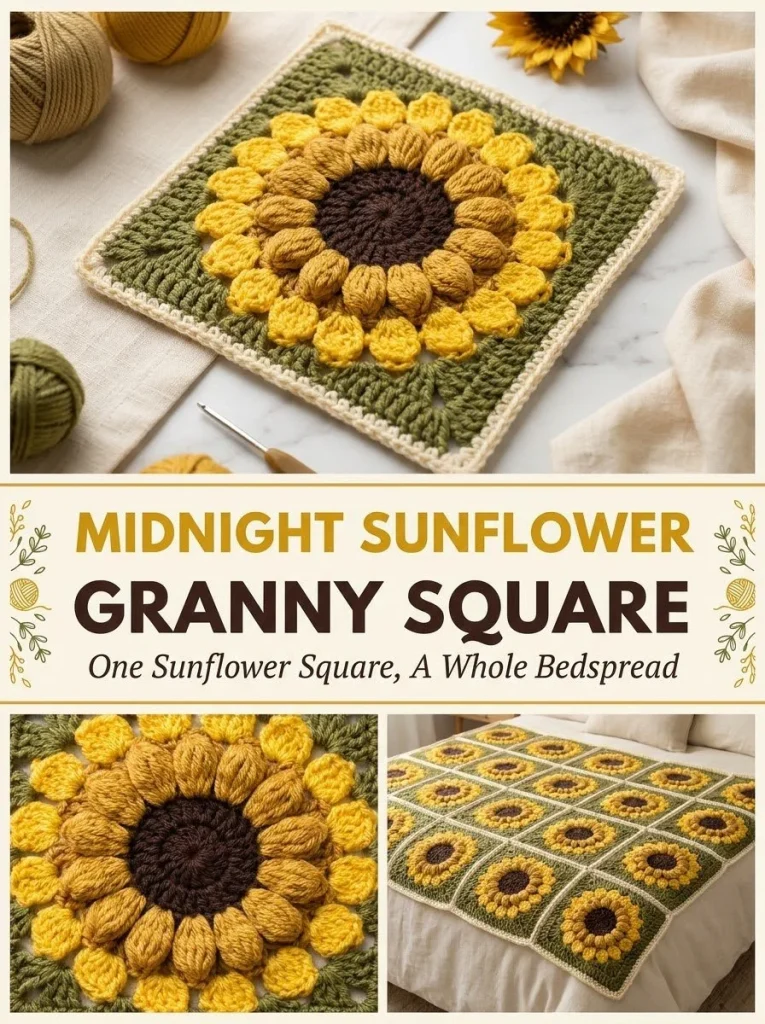
Crocheting a blanket that radiates warmth and intricate beauty, this project highlights a motif inspired by sunflowers—the emblem of summer’s golden glow. Crafted using a combination of textured puff stitches and elegant cluster crowns, the striking contrast of deep espresso-brown centers and bright mustard, yellow, and olive frames creates a visually captivating motif. The repeated square pattern is joined seamlessly to form a bedspread that is both comforting and decorative.
The construction involves working each motif in joined rounds with careful color changes to ensure crisp pattern definition. This technique, combined with closed clusters and specialized puff stitches, produces a raised, tactile surface that mimics the layered petals of a sunflower nestled within a framed square. The final assembly includes a neat, ivory edging that enhances the overall finish, making this bedspread suitable not only for beds but also as throws or decorative layers.
Beyond its pleasant aesthetics, this blanket is designed for intermediate crocheters comfortable with advanced stitches and color changes. The project is ideal for exploring texture-rich crochet techniques while creating a practical item with seasonal charm. For those aiming to make a coordinated accessory, it could be paired beautifully with sunflower-inspired elements, such as a sunflower glasses chain to carry the motif beyond the blanket.
Pattern at a Glance
Skill level: Intermediate
Terminology: US crochet terms
Construction: Repeated joined square motifs worked in joined rounds
Finished size examples:
- Baby/Small: approx. 100 x 116 cm (42 squares)
- Throw: approx. 132 x 164 cm (80 squares)
- Bed example: approx. 212 x 244 cm (195 squares)
Yarn weight: #4 worsted (acrylic or wool blend suggested)
Hook: 5.5 mm crochet hook
Main stitches: Double crochet (dc), puff stitch, 3-dc cluster, treble crochet (tr), single crochet (sc), chains (ch)
Gauge: Approximate blocked motif size 16 cm square
Motifs: 5-round sunflower centers with square frames
Layout: Rectangular grid of identical motifs
Joining: Flat whip stitch through corresponding outer loops
Border: Two-round sc border with corner ch-2 spaces
Seaming: Moderately loose whip stitch to maintain flatness
Materials
This project requires #4 worsted weight yarn, preferably an acrylic or wool blend that provides some elasticity and durability. The suggested color palette includes:
- Espresso-brown for the motif center to ground the sunflower’s design
- Mustard-gold for the puff petals that add texture and warmth
- Sunflower-yellow for the cluster crowns that mimic petals
- Olive-green for the square framing the flower
- Warm ivory for the edging, giving a soft clean finish to the blanket
A 5.5 mm crochet hook is recommended to achieve the ideal texture and gauge. Additional tools include a yarn needle for joining squares, scissors, and a measuring tape to verify motif dimensions. Blocking supplies compatible with your yarn type will help shape and stabilize the motifs.
For accurate yarn planning, at least one full test square should be made and weighed once washed and dried. Using a kitchen scale accurate to 1 gram allows practitioners to estimate total yarn needs by multiplying the weight by the number of motifs planned and adding 15-20% for seam allowances, border, tails, and spare. Matching dye lots are strongly recommended for large projects to ensure color consistency.
Yarn and Color Notes
Choosing the right yarn can greatly affect the blanket’s hand and appearance. A smooth worsted acrylic or wool blend enhances stitch definition, especially with puff and cluster stitches that rely on clear structure. Fuzzier or loosely spun yarns may obscure stitch texture and make motifs less distinct.
The color scheme evokes late summer sunflowers with earthy and vibrant tones. The espresso center contrasts well with the mustard puff petals, while bright sunflower-yellow cluster crowns pop against the olive frame. The warm ivory edging provides a neutral boundary that complements rather than competes with the central design.
Subtle variations in color tones can create a more rustic or modern look. For instance, substituting the olive for a deeper forest green or the mustard for a goldenrod shade may personalize the blanket. However, it’s best to maintain the key contrast zones to preserve the motif’s iconic sunflower appearance.
Finished Measurements
Motif squares measure approximately 16 cm per side after blocking, though this may vary with yarn choice, tension, and blocking technique. The actual blanket size depends on the number of motifs and the border applied.
Three example blanket sizes include:
| Size | Squares (width x height) | Approximate Dimensions (cm) |
|————|————————–|—————————–|
| Baby/Small | 6 x 7 (42 total) | 100 x 116 |
| Throw | 8 x 10 (80 total) | 132 x 164 |
| Bed | 13 x 15 (195 total) | 212 x 244 |
Each dimension includes an approximate 4 cm border added all around. Remember to verify your gauge and joining tension before starting a larger project, as seam compression may alter final measurements. Bedspread size should be adjusted for mattress dimensions and preferred overhang.
Gauge
The pattern is worked in joined rounds using US terms. Gauge relies on the motif’s blocked finished side measuring close to 16 cm.
Maintaining gauge is important for a neat layout and consistent sizing across motifs. If your motifs come out larger, the blanket will be bigger; smaller motifs shrink the dimensions. To adjust gauge, try a smaller or larger hook but keep in mind stitch texture especially for the puff stitches.
For household items like throws or bedspreads, exact gauge is somewhat flexible, but matching motif sizes is essential to ensure proper joining and a flat finished blanket.
Abbreviations
- ch = chain
- sl st = slip stitch
- sc = single crochet
- hdc = half double crochet
- dc = double crochet
- tr = treble crochet
- sp = space
- st = stitch
- MR = magic ring
- RS = right side
- yo = yarn over
Note: A corner ch-2 space counts as a space, not stitches. The slip stitch is never counted as a stitch in the motif rounds. Rounds are worked in joined, not spiral, rounds.
Important Pattern Notes
- Join rounds by slip stitching into the top of the counted starting chain or first completed stitch.
- Work color changes by attaching new yarn with a standing dc or tr where possible. If starting with chains (ch 3 or ch 4), reduce the number of following dc/tr to keep stitch count consistent.
- The “puff” stitch includes a separately instructed closing chain (ch 1) that is distinct from the ch-1 spacer between puffs. Be mindful not to confuse these.
- The 3-dc cluster stitch involves working three unfinished double crochets into one stitch or space, then closing together as one cluster.
- Fasten off yarn only where indicated to maintain clean color changes.
Special Stitches and Techniques
Special Puff Stitch:
Start with 1 loop on hook, then (yo, insert hook in indicated dc, yo and pull up an elongated loop) three times (for a total of 7 loops on hook). Yarn over and pull through all loops, then chain 1 to lock the puff. The subsequent chain 1 is a spacer, not to be confused with the puff’s closing chain.
3-Double Crochet Cluster:
Work three incomplete double crochets into the same stitch/space, leaving loops on hook after each yo pull-through. With four loops on hook after third stitch, yarn over and pull through all loops, forming a cluster counted as one stitch.
Knowledge of joined rounds technique is essential as motifs are worked in a circular method and joined at the end of each round.
Understanding the Construction
Each motif consists of several joined rounds that build a sunflower center, texture-rich petals, and a square frame. The sunflower focus uses four distinct rounds:
- Brown center ring with 16 double crochets worked into a magic ring.
- Mustard-gold puff petals worked into each dc of round 1 with chain 1 spacer.
- Sunflower-yellow cluster crowns filling gaps between puffs with 3-dc-cluster and chain 1 spacers.
- Olive-green square frame made of treble and double crochets arranged to create corners and straight edges.
- Finally, warm ivory edging is worked in single crochets with chain-2 corners for a soft border on each motif before joining.
Motifs are blocked individually to ensure uniform size and shape before joining. They get sewn row by row with a whip stitch through corner and edge loops, carefully aligning the motifs for a smooth blanket surface.
Full Motif Instructions
Round 1 – Brown Center
- Begin with a magic ring. Chain 3 (counts as first dc), then crochet 15 double crochets into the ring for a total of 16 dc.
- Close the ring and join with a slip stitch to the top of the starting chain 3.
- Fasten off brown yarn.
Round 2 – Mustard-Gold Sunflower Puffs
- Attach mustard-gold yarn in any double crochet of the previous round.
- Work a puff stitch into that stitch; then chain 1 as a spacer (this ch 1 is distinct from the puff closing chain).
- Repeat (puff stitch, ch 1) in every remaining dc around, completing 16 puffs and 16 ch-1 spaces.
- Join to the top of the first puff with a slip stitch.
- Fasten off mustard-gold yarn.
Round 3 – Sunflower-Yellow Petal Crowns
- Attach sunflower-yellow yarn in any ch-1 space between puffs from round 2.
- Work (3-dc cluster, ch 1) in each of these 16 gaps.
- Join to the first cluster with slip stitch.
- Fasten off sunflower-yellow yarn.
Round 4 – Olive Square Frame
- Attach olive-green yarn in a ch-1 space; mark this as corner 1.
- Into this corner space, work (3 tr, ch 2, 3 tr) to create a corner.
- Chain 1 spacer, then work (3 dc, ch 1) into each of the next three ch-1 spaces along the side.
- Repeat from the corner work sequence 4 times total, placing corners every fourth gap.
- Join to the first treble crochet with slip stitch.
- Fasten off olive yarn.
Round 5 – Warm Ivory Square Edge
- Attach ivory yarn in a round 4 corner ch-2 space.
- In each corner, work (sc, ch 2, sc) for flexibility and shape.
- Between corners, single crochet into each treble and double crochet stitch and into every ch-1 space along the edges.
- Join with slip stitch to first sc and fasten off.
- Each side has 21 single crochets, counting one sc shared from neighboring corners.
Checkpoint: Motif Size and Consistency
Your finished motif should measure approximately 16 cm square after blocking. Confirm all motif edges are even to ensure neat joining.
If sizes vary, adjust your hook or tension accordingly before continuing with the full blanket.
Making the Specified Number of Squares
Decide your desired blanket size before producing all motifs. Plan according to your measured motif size and intended layout, referencing the example counts:
- Baby/small: 6 across x 7 down = 42 motifs
- Throw: 8 across x 10 down = 80 motifs
- Bed sample: 13 across x 15 down = 195 motifs
Make all motifs identical in stitch construction and finished size for smooth assembly. Color order variations are allowed if stitch counts and dimensions remain consistent.
Arranging the Exact Color Grid
Assign a repeating pattern or alternate color placements within the sunflower motif for visual interest, but ensure that all motifs use the same stitch construction and blocking method.
This consistent motif preparation ensures uniform joined edges, avoiding irregular tension or distortions when sewn together.
Joining Motifs
Block motifs flat without overstretching. Arrange the motifs right side up in the desired grid.
Using a yarn needle and yarn matching the motif edges, join outer loops with a moderate, flat whip stitch from corner space to corner space, aligning stitch groups. Work row by row: join squares into rows first, then join rows together.
If stitch counts vary slightly in corners, distribute joins evenly and align corner-to-corner to avoid gathering fabric.
Border
Once all motifs are joined, add a two-round border around the entire blanket:
- Attach border yarn at any outside blanket corner ch-2 space with RS facing.
- Round 1: Work (sc, ch 2, sc) in each of the four outside blanket corners. Along straight edges, make one single crochet in each exposed edge stitch and each exposed side ch-1 space. Add at most one sc at flat seam crossings to prevent holes. Do not add corner increases at internal joins. Join with slip stitch to first sc.
- Round 2: Single crochet in each stitch of the previous round, maintaining corners with (sc, ch 2, sc) in each corner ch-2 space. Join, fasten off, and weave in ends.
This border adds an approximate 4 cm around the entire blanket, but measure your border stitches to confirm.
Custom Blanket Sizing
Measure your mattress or desired drape size before deciding how many squares to make. For an initial estimate:
- Columns = Ceiling of [(desired width – total border allowance) / blocked motif width]
- Rows = Ceiling of [(desired length – total border allowance) / blocked motif height]
Refine these calculations by joining 2 or 3 motifs and measuring the actual join-to-join pitch, including seam width.
Remember to allow for mattress thickness and desired overhang when planning bedspread size. To increase or decrease overhang, add or reduce whole columns or rows rather than partial adjustments.
Yarn Requirement and Planning
Make a full test square with your chosen yarn and hook. After washing, blocking, and drying, weigh the sample motif by color segments when possible.
Calculate yarn needs as:
(Weight of test motif) × (Number of motifs) × 1.15 to 1.20 (for seams, border, tails, spare)
For skeins, divide total grams by 100 and round up; buy yarns from matching dye lots for large projects.
This method avoids guesswork and accounts for yarn and tension variability.
Caring for Your Blanket
Care for the blanket according to the most delicate fiber used among all yarn colors. Make sure all yarns in the project have compatible care instructions.
Use the same yarn weight and fiber type per motif to maintain consistent texture, elasticity, and washing characteristics.
Troubleshooting Common Issues
Why Are My Motifs Not the Same Size?
Adjust your tension or hook size. Always block motifs to relax stitches before measuring.
Why Does the Joining Look Uneven?
Ensure edges are straight and all corners aligned. Sew with moderate tension to avoid puckering or gaps.
Why Is My Puff Stitch Not Defined?
Make sure each puff stitch is closed properly with the chain 1 as a lock, and do not confuse it with the ch-1 spacer.
Why Is the Border Wavy?
Work the border with even tension, and avoid adding extra stitches at internal joins. Block the blanket flat after finishing.
Frequently Asked Questions
Can I Use a Different Yarn Weight?
You can, but motif size and gauge will vary. Adjust hook size and yarn accordingly, and make test motifs to confirm size consistency.
Can I Make the Blanket Larger or Smaller?
Yes, by adjusting the number of motifs in width and height. Just calculate total motif count and yarn needed.
Do I Need Special Hooks?
No, a standard 5.5 mm crochet hook suitable for worsted weight yarn is recommended for the pattern texture.
How Should I Block the Motifs?
Block flat without overstretching, pinning edges gently to shape each square to approximate 16 cm sides.
Is This Pattern Suitable for Beginners?
It requires intermediate skills, especially with cluster and puff stitches, along with color changes and joined rounds.
Can I Substitute Acrylic for Wool?
Yes, but consider fiber hand and care. Acrylic is easier to wash, but wool provides warmth and elasticity.
Useful Variations
- Use a monochrome palette with the same stitch structure for a subtle, textured look.
- Substitute different hues for a seasonal vibe, like autumnal tones or pastels.
- Make smaller throws by reducing motif count.
- Experiment with spotlighting motifs by alternating stitch colors for an ombre effect.
For inspiration on how sunflower motifs look beyond blankets, check out related accessories like the charming sunflower glasses chain, which carries the bright petal motif into fashion.
Final Thoughts
This project centers around building an elegant sunflower motif in joined rounds framed by a textured square. By combining puff stitches and three-dc clusters, the design brings tactile depth reminiscent of real sunflowers. The individual motifs are carefully blocked and joined to create a cohesive blanket that can be sized to many needs from baby blankets to full bedspreads. Attentive color changes and gentle edge borders add finishing touches to an heirloom-quality piece.
The construction unfolds in five major rounds per motif, joined with a two-round single crochet border around the joined blanket. Swatch, block, and measure carefully to customize your dimensions and yarn needs before committing to the full blanket. Once complete, the blanket’s textural richness and vibrant hues are sure to brighten any room or bed.
This detailed approach ensures your project achieves the beauty and usability that makes repeated motif blankets endlessly appealing.



