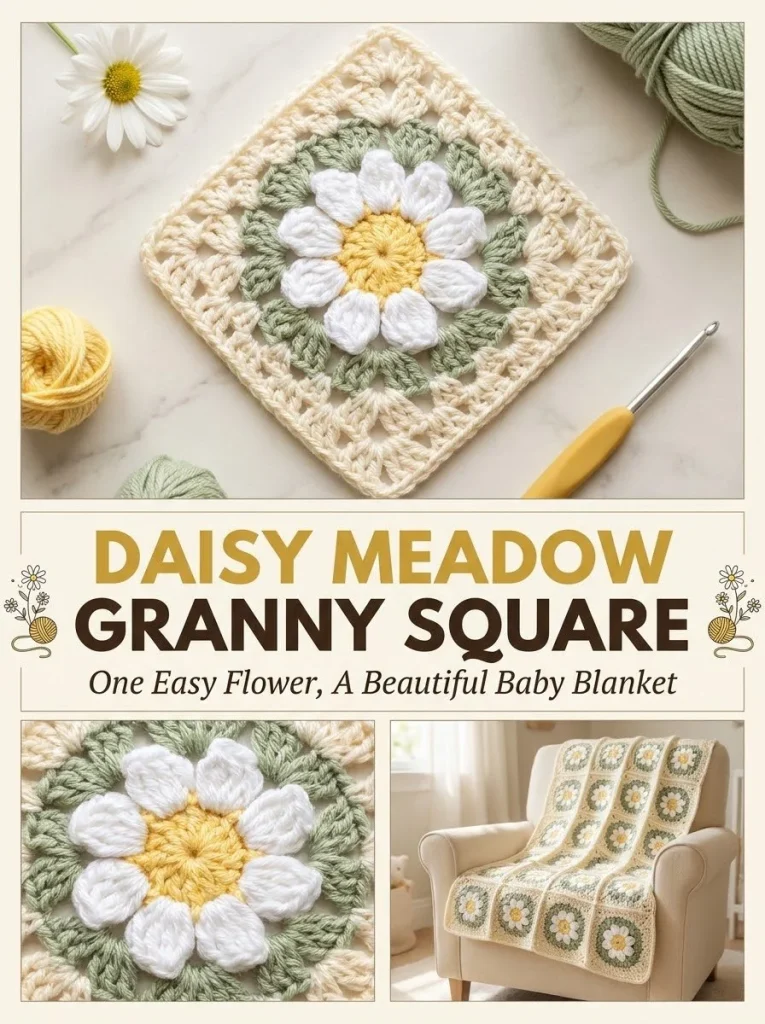
This crochet blanket features a charming motif of daisies, with delicate petals and a softly squared frame that brings a subtle floral touch to your handmade linens. Constructed from individual motifs that form a repeated joined-square blanket, it blends prim aesthetics with classic stitching techniques in smooth machine-washable yarns. The design highlights clusters and shells that shape into eight daisy petals around a centered circle, accented by alternating squared corners framed with treble and double crochet groups. This thoughtful structure makes the blanket visually engaging yet straightforward to assemble in modular fashion, suitable for a versatile baby blanket or larger bed throws.
Working in joined rounds with US crochet terms, this project calls for basic cluster stitches and several yarn color changes to create distinctive color zones: from butter-yellow centers to chalk-white petals, muted sage halos, and warm ivory frames. The pattern is ideal for crocheters familiar with clusters and joined motifs who enjoy crafting delicate floral motifs with clear stitch definitions. This makes the resulting blanket a practical yet decorative item for nurseries or thoughtful gifts, marrying softness with ease of care. For a beautifully coordinated handmade look, consider pairing it with similarly styled baby accessories like the Firefly Meadow Baby Blanket which shares the motif-based construction style and pastel palette elegance.
Pattern at a Glance
Skill level: Intermediate (experience with clusters and joining motifs recommended)
Terminology: US crochet terms
Construction: Repeated joined motifs, worked in joined rounds (not spirals)
Finished size (example):
- Baby/small: approx. 102 x 116 cm (56 motifs, 7 x 8 squares)
- Throw: approx. 144 x 172 cm (120 motifs, 10 x 12 squares)
- Bed example: approx. 214 x 242 cm (255 motifs, 15 x 17 squares)
Yarn weight: #4 worsted, smooth acrylic or cotton blend
Hook: 5.0 mm crochet hook
Main stitch: 3-double-crochet clusters, treble crochet, single crochet
Gauge: Sample square approx. 14 cm blocked (measure your own)
Motifs: Square daisy motifs (daisy flower center with cluster petals and square frame)
Layout: Gridded motif assembly, same motif repeated
Joining: Whip stitch by hand through outer-edge loops
Border: Two-round granny-style border with corner ch-2 spaces and sc edges
Seaming: Flat whip stitch joining of squares by corresponding corner and side loops
Materials
To achieve the best results, use smooth, soft, yet machine-washable yarns in a worsted (#4) weight. Cotton blends or acrylic fibers that provide durability and softness for baby items are ideal. The specified colors create the signature look: butter-yellow for the daisy centers, chalk-white for petals, muted sage for the halo round the petals, and warm ivory for the square frame. Using yarn needle and scissors will aid in neat finishing and weaving ends. A measuring tape is essential to gauge squares after blocking, helping ensure your blanket’s final size meets your project goals.
In addition to these basics, you’ll need:
- At least one fully completed test square to check gauge and color transitions (two if sampling flower and plain variants)
- A kitchen scale precise to 1 gram to measure yarn usage for more accurate planning
- Blocking supplies compatible with your yarn (pins and a blocking mat) to flatten and even out motif edges
Remember, all quantities are approximations; weigh your finished, washed motifs by color to calculate yarn amounts more reliably and purchase enough yarn, including 15-20% extra for borders, joins, and yarn tails. Using yarn from matching dye lots avoids color mismatches in large projects.
Yarn and Color Notes
The choice of a smooth worsted yarn enhances stitch definition, especially for cluster and treble crochet stitches that shape the daisy petals and square frames. A fibrous or novelty yarn could obscure these details and make joining tricky. Cotton or cotton blends add breathability and durability, good for baby items, while machine-washable acrylic provides easy care.
The palette is intentionally soft and natural, with contrasting center and petals, then a halo in muted sage that subtly separates the flower from its square frame in warm ivory. This layered color approach highlights the motif’s structure beautifully without overwhelming. Variegated yarns are discouraged for this pattern because uniform color blocks create the intended floral and geometric contrast. For inspiration on similar projects crafted in coordinated color schemes, see the blush-toned Blush Windowpane Baby Blanket for a complementary aesthetic.
Finished Measurements
The approximate size of one motif after blocking is about 14 cm (5.5 inches) square. Blanket size depends on the number of joined motifs:
- Baby/small size: 7 motifs wide by 8 motifs tall — approximately 102 x 116 cm including border
- Throw size: 10 x 12 motifs — approximately 144 x 172 cm
- Bed size example: 15 x 17 motifs — approximately 214 x 242 cm
These dimensions include an approximate 4 cm (1.5 inch) wide two-round border around the entire blanket. Because tension and blocked square size vary between crocheters and yarns, these are estimates only; always measure your blocked sample squares and calculate join pitch before committing to a layout.
Gauge
Gauge is measured by the finished size of one fully blocked motif, approximately 14 cm square. This is your primary reference point for sizing. If your motif is larger, the blanket size increases accordingly, and you will need fewer squares to reach the desired dimension. A smaller gauge means motifs are tighter and the final blanket shrinks, requiring more squares.
Since this is a home textile where exact size is not crucial like in apparel, small gauge deviations are tolerable but be aware that motif joining may affect dimensions and tension can alter final widths, especially with seams or borders. It is advised to block motifs as you intend to handle your final piece to get the most accurate measurement.
Abbreviations
- ch = chain
- sl st = slip stitch
- sc = single crochet
- hdc = half double crochet
- dc = double crochet
- tr = treble crochet
- sp = space
- st = stitch
- MR = magic ring
- RS = right side
- yo = yarn over
Important Pattern Notes
- Work in US crochet terms.
- The pattern uses joined rounds, never spirals, ensuring each round connects to its start for a closed motif appearance.
- A corner ch-2 space counts as a space, not stitches. Count carefully.
- When changing colors, ideally attach yarn with a standing dc or tr to maintain stitch counts; if using a chain start (ch 3 or ch 4), reduce the motif’s stitch count accordingly.
- Join rounds with sl st into the first actual completed stitch or the top of the counted starting chain. Do not count sl st as a stitch.
- A three-dc cluster consists of three unfinished dc stitches worked into one stitch or space and closed together (considered a single cluster stitch).
Special Stitches and Techniques
- Three double crochet cluster (3-dc cluster): Yarn over, insert hook into indicated stitch or space, yarn over, pull up a loop, yarn over, pull through first two loops on hook; repeat this 3 times in the same stitch or space, yarn over, pull through all 4 loops on hook to close the cluster.
- Standing double or treble crochet: Used for color changes to start rounds cleanly while preserving stitch counts.
- Joined rounds: At the end of each round, slip stitch into the first actual completed stitch or the top chain to close the round.
- Chains described as a “non-counting height” chain do not add stitches and do not add petals or corners.
- The motif combines cluster petals and granny-style corners to maintain a sculptural floral look with geometric square balance.
Understanding the Construction
The blanket consists of many identical square motifs featuring a central daisy flower made of 8 petals created by 3-dc clusters on a small 8-sc circle. Around this central flower, additional rounds form a halo and then transform the circle into a geometric square with rounded corners. The last round applies a flat granny-style frame.
These motifs are worked individually and then joined together using whip stitch seaming. The finished motifs maintain the same side lengths to fit neatly in a grid pattern. A two-round border surrounds the entire assembled blanket for a neat edge, adding about 4 cm to each dimension.
Motifs feature a consistent color order: a butter-yellow center, chalk-white petals, muted sage for the flower’s halo, and warm ivory for the square frame, emphasizing the floral and geometric design elements.
Full Motif Instructions
Round 1: Center Circle (Yellow)
- Begin with the yellow yarn. Create a magic ring (MR).
- Ch 1 (does not count as a stitch).
- Work 8 single crochet (sc) stitches into the MR.
- Pull the ring closed tightly.
- Join with a slip stitch (sl st) to the first sc to close the round. (8 sc)
- Fasten off.
Round 2: Petal Clusters (White)
- Attach white yarn to any sc from Round 1.
- Ch 2 (counts as height, does NOT count as a stitch).
- In the same sc, work a 3-dc cluster, then ch 2.
- In each of the remaining 7 sc, work (3-dc cluster, ch 2).
- Join with sl st to the top of the first cluster. (8 clusters, 8 ch-2 spaces)
- Fasten off.
Note: Each cluster forms a petal, with the ch-2 spaces creating separation.
Round 3: Flower Halo (Sage)
- Attach muted sage yarn to any petal’s ch-2 space from Round 2.
- Work (3 dc, ch 1) in each of the 8 ch-2 spaces around.
- Join with sl st to first dc. (8 groups of 3 dc, 8 ch-1 spaces)
- Fasten off.
This round forms a halo surrounding the petals.
Round 4: Square Conversion (Cream)
- Attach warm ivory yarn into any Round 3 ch-1 space.
- Repeat the following 4 times:
- In the same ch-1 space: work (3 tr, ch 2, 3 tr) for a corner.
- Ch 1.
- In the next ch-1 space: work 3 dc, ch 1.
You will use all 8 ch-1 spaces, creating 4 corners and 4 side groups.
- Join with sl st to the first treble crochet.
- Fasten off.
This round shapes the previous round’s circle into a square with defined corners.
Round 5: Flat Granny Frame (Cream)
- Attach the frame yarn in any corner ch-2 space.
- In every corner, work (3 dc, ch 2, 3 dc).
- Between adjacent corners, make 3 dc in each of the two side ch-1 spaces, separated by ch 1 between all consecutive 3-dc groups.
- Join with sl st to the first dc. (16 total 3-dc groups, 4 corners)
- Fasten off.
This completes the flat granny-style border around the motif, with 16 three-dc groups framing each square.
Making the Specified Number of Squares
For a baby or small size, make 56 squares arranged 7 across and 8 down. For larger throws or bed coverings, increase the number of motifs accordingly (120 or 255 squares are examples provided).
Because motif size depends on your tension and blocking, always measure your motif after blocking. Then calculate rows and columns based on desired finished size and blocked dimensions, allowing space for seams and borders.
Start by making one test square, washing and blocking it, then use a kitchen scale to measure its weight for yarn estimation. Make a few test motifs if working with flower/plain variations to ensure size matching.
Arranging the Color Grid
This pattern uses a fixed color order for consistency. When laying out the blanket, arrange motifs so their color zones align uniformly—color variation is allowed between motifs only if stitch construction and blocked dimensions match exactly. For designs mixing flower and plain motifs as in advanced versions, ensure equal blocked sizes and matching joins.
Joining the Squares
- Wash and block all motifs individually before joining.
- With right side facing up, arrange motifs in intended rows and columns.
- Use a yarn needle and matching frame color yarn to sew outer edge loops of corresponding motifs together.
- Use a flat whip stitch, moderately loose to avoid puckering, joining corner space to corner space sequentially.
- Join squares horizontally first, then join the completed rows vertically.
- Secure and weave in all ends on the wrong side.
- When minor stitch count differences occur in small corners, align corners and distribute adjustments evenly; avoid gathering or pulling fabric.
Joining done properly ensures a smooth, flat blanket surface without stretching.
Border Instructions
The final border surrounds the entire joined blanket for a polished finish.
-
With right side facing, attach border yarn at an outside corner ch-2 space.
-
Round 1:
- At each outside corner, work (sc, ch 2, sc) for a corner.
- Along outer edges, work one sc in each exposed stitch and side ch-1 space.
- At flat seam crossings, add at most one sc to avoid holes.
- Do not add corner increases at internal joins.
- Join with sl st to first sc.
-
Round 2:
- Sc in each sc from Round 1.
- At each of the four outside corner ch-2 spaces, work (sc, ch 2, sc).
- Join and fasten off, weave in ends.
This border adds approximately 4 cm to each dimension but varies with yarn and tension. Measure on a test sample to confirm.
Custom Blanket Sizing
Measure your mattress, desired drape, or preferred throw width and length before deciding the grid size. Use the following approach:
- Calculate columns = ceiling((desired width – border allowance) / blocked square width)
- Calculate rows = ceiling((desired length – border allowance) / blocked square height)
Refine by measuring the join-to-join pitch between two or three joined test squares to include seam width accurately. Add the outer border dimension measured from your sample to finalize dimensions.
For bedspreads requiring overhang, add full motif columns or rows rather than guessing universal mattress sizes.
Yarn Requirement Estimation
Because yarn usage depends on yarn fiber, hook tension, and blocking, always:
- Make and complete a test square using your chosen yarn and hook.
- Weigh the washed and blocked motif or motifs by color segment if colorwork is involved.
- Multiply weight per motif by the number of motifs for the layout.
- Add 15-20% extra for joining, border, sewing tails, and spares.
For high precision, weigh a seam or border sample separately and factor that into total yarn amounts.
Avoid fixed skein counts as usage varies widely; buy matching dye lots to avoid color variation.
Care and Safety Notes
This blanket is suitable for supervised awake-time for babies. Do not place loose blankets in infant sleep spaces due to safety hazards.
If adding raised flower appliqués or clusters, secure each feature firmly and inspect regularly for loose ends to avoid choking risks.
Troubleshooting
Why are my motifs different sizes after blocking?
Ensure you use the same hook size and yarn brand consistently. Blocking technique impacts size — do not overstretch. Weigh and measure sample motifs carefully, adjusting hook size or tension if needed for consistent dimensions.
Why do my seams look puckered or stretched?
Join motifs loosely and flatly; avoid pulling seams tight. Use a moderate loose whip stitch that gently holds without bunching. Align corners exactly and distribute minor stitch count differences evenly.
Why does my border ripple or stand out unevenly?
Measure your border width on a test motif first. Use consistent tension and add sc stitch adjustments sparingly on edges to keep border flat. If border waves, try a slightly larger or smaller hook for it or block again gently.
My flower petals look uneven or loose. How can I fix that?
Ensure clusters are worked fully and consistently. Clusters should close all 4 loops on the hook. Maintain uniform stitch tension over petals and check that ch-2 height chains are non-counting. Practice cluster stitches separately if needed.
Frequently Asked Questions
Can I use heavier or lighter yarn?
Stick with #4 worsted weight to maintain motif dimensions and stitch definition. Using lighter yarn will make smaller motifs; heavier yarn may make the blanket too bulky or hard to join precisely.
Can I substitute a different hook size?
Adjust hook size to get the specified gauge (approx. 14 cm blocked square). Larger hooks create bigger motifs, smaller hooks smaller motifs. Always make a sample and measure before proceeding with a full project.
Can I make a one-color version?
Yes, omitting color changes results in a delicate textured motif where petals and the square frame appear in relief rather than color contrast, offering a minimalist aesthetic.
How should I block motifs?
Wet block motifs by gently soaking and pinning edges flat on a blocking mat, avoiding overstretching. Allow to dry completely before joining. Blocking evens stitches and ensures motif size uniformity.
Is this pattern suitable for beginners?
Basic crochet skills are needed, including clusters and joining rounds. Experience with motifs and joins is helpful for best results. Beginners may need practice motifs before starting a large project.
What joining method is recommended?
Use whip stitch by hand through corresponding stitches and loops on the motif edges with matching yarn for a flat, neat seam without puckering.
Can I adjust the size?
Add or remove motifs from the grid. Use blocked motif size and join measurements to calculate the number of squares needed for your target dimension.
Useful Variations
- One-color motifs for a simple textured blanket
- Two-color or scrap yarn combinations keeping motif structure intact for a playful look
- Larger throws or bedspreads by increasing motif rows and columns
- Matching accessories like baby hats or cushions using the flower motif
- Use the same motif structure for lightweight wraps or lapghans
Assembly Recap
Complete and block all motifs before joining. Arrange motifs right side up in rows and columns. Join horizontally first, then join rows vertically. Join neatly with whip stitch at corners and edges to keep motifs aligned. Finally, add a two-round decorative border to complete the blanket with a soft, flat edge.
This modular daisy motif blanket combines joyous floral texture with clear geometric framing for an enduring, practical, and beautiful piece. With careful gauge control and precise assembly, it delivers a charming handmade blanket well-suited for baby gifts and cherished home accessories. For additional motif-based baby blanket inspiration, explore the softly hued designs like the Blush Windowpane Baby Blanket that also showcase elegant stitchwork framed in clean joinery.



