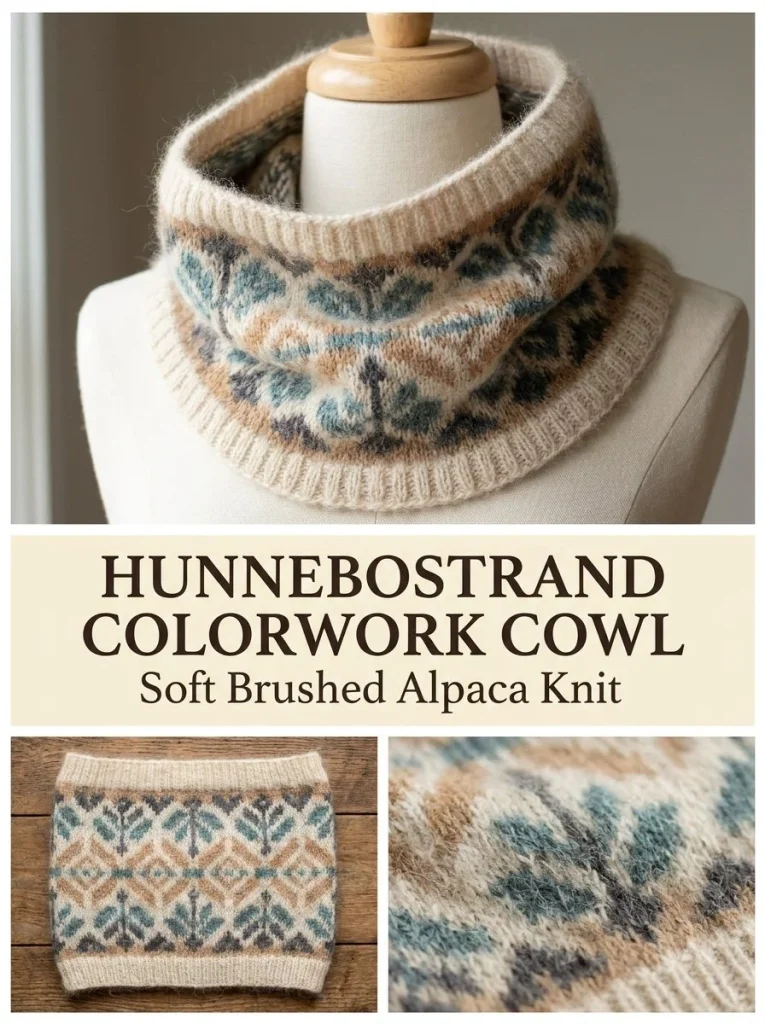
Knitting a cowl that combines warmth, texture, and eye-catching colorwork is a delightful challenge with fantastic results. This brushed-alpaca colorwork cowl achieves that balance beautifully. It features a softly fluffy fabric from brushed alpaca yarn that forms a cozy halo, combined with a graphic stranded pattern that wraps around the neck with visual interest and subtle movement.
The construction focuses on working seamlessly in the round with a mixture of ribbing and stranded knitting. Starting with a firm yet flexible ribbed edge, the cowl transitions into a smooth stockinette frame for the colorwork section, where two or three softly contrasting colors interplay in a distinctive 12-stitch repeat motif. The sleeves-free circular design ensures warmth and comfort without bulk, making it an elegant accessory for cooler months.
This project is particularly appealing for knitters interested in stranded techniques who want a workable repeat that balances complexity and speed. While the colorwork may look intricate, the pattern uses repeating block shifts and alternating color sections, providing rhythm and flow that make it easier to memorize and track. This piece is ideal not only for showcasing the soft brushed alpaca fiber but also for learning a striking color movement technique that elevates classic stranded knitting. For a complementary project focused on color texture and practical design, you might enjoy the ribbed high neck shoulder cowl pattern, which also combines texture and warmth.
Pattern at a Glance
Skill level: Intermediate
Terminology: Standard American knitting terms
Construction: Circular knitting, stranded colorwork
Finished size: Approximately 28-29 inches circumference, 7-8 inches height
Yarn weight: Light worsted / DK weight brushed alpaca
Needles: 4 mm (US 6) circular for rib edges, 6 mm (US 10) circular for body
Main stitch: Stockinette with stranded colorwork panels, K1/P1 ribbing
Gauge: 15 stitches x 19 rows = 4 inches in stranded colorwork
Motifs: 12-stitch stranded repeat worked 9 times around
Layout: Circular tube with ribbed borders
Joining: Joined in round after cast on
Border: K1/P1 ribbing at top and bottom edges
Seaming: None (knit in continuous rounds)
Materials
To create this beautifully soft and warm cowl, you will need the following materials:
- Approximately 289 yards (264 meters) of brushed alpaca yarn, ideally in 2 to 3 colors to highlight the colorwork pattern. The source yarn is Svarta Fåret Brushed Alpaca (composed of 91% alpaca and 9% nylon), chosen for its plush halo and durability.
- A 4 mm (US 6) circular knitting needle, used for the ribbed edges to provide a firm yet elastic start and finish.
- A 6 mm (US 10) circular knitting needle, ideal for the main body to give a soft fabric with nice stitch definition while allowing the brushed alpaca fibers to bloom.
- A stitch marker will help mark the beginning of the round and track repeats.
- A tapestry needle for weaving in ends after finishing.
The use of circular needles ensures a seamless tube construction, essential for the comfort and style of the cowl. The smaller needle at the edges gives a snug finish, and the larger needle for the body creates a gently looser fabric.
Yarn and Color Notes
Brushed alpaca yarn is renowned for its softness, warmth, and fuzzy halo created by gently brushing the fibers. This texture gives the cowl a luxurious feel but also requires some attention in colorwork:
- Fibers with a halo can cause the floats to blend together, making tension control crucial to avoid puckering.
- Choose solid or semi-solid colors rather than highly variegated yarns to allow the block-pattern colorwork to stand out clearly.
- Selecting 2-3 colors with good tonal contrast will emphasize the geometric striping and shifting blocks of the stranded repeat.
- Avoid too many colors as multiple strands can create bulk; two colors can work for a classic look, while three colors add complexity without overwhelming the pattern.
The balance between brushiness and stitch definition is key—smooth alpaca yarns reveal pattern stitches but lack halo, while heavily brushed yarns hide details but add softness. This pattern embraces the brushed alpaca’s halo to create a glowing, plush texture.
Finished Measurements
The cowl’s final size after blocking should measure approximately:
- Circumference: 28–29 inches (allowing for a comfortable positive ease to slip over the head and fit around the neck).
- Height: 7 to 8 inches, providing coverage from collarbone to chin or nose depending on styling.
Because the pattern is knit in the round with stranded colorwork, the measurements are relatively fixed. Blocking is crucial to relax the stitches and establish correct circumference and shape while preserving the fiber halo.
Gauge
This pattern specifies a gauge of:
- 15 stitches x 19 rows = 4 inches in stranded colorwork using the larger needle (6 mm / US 10).
Gauge matters greatly in this stranded knitting project to ensure the cowl fits as intended. Too loose a gauge will create a slouchy, open fabric that may not hold the pattern well, while too tight a gauge will make the cowl stiff and possibly too small.
Measure a swatch in stranded stockinette using your chosen colors before starting. If your gauge differs, choose needles accordingly (larger needles for a tighter gauge, smaller needles for looser stitches).
Abbreviations
- K: Knit
- P: Purl
- Rnd(s): Round(s)
- St(s): Stitch(es)
- CO: Cast on
- RS: Right side
- WS: Wrong side
Important Pattern Notes
- The cowl is worked in the round starting with a smaller needle for the ribbing, then switching to a larger needle to knit the main body.
- The colorwork is stranded knitting, carrying two colors across the back of the fabric in floats. Care should be taken to keep floats loose, especially because brushed alpaca has poor recovery and tight floats may distort the fabric.
- The colorwork motif is a 12-stitch repeat, worked 9 times around each round.
- The stranded pattern involves alternating blocks of two stitch colors, including small 2-st sections and larger 6-st blocks with positional shifts every two rounds to create a graphic, flowing effect.
- The cowl finishes with a ribbed edge and is bound off very loosely for elasticity.
- The pattern is designed for one adult size but can be adapted by adjusting the stitch multiple in increments of 12 stitches.
Special Techniques and Tips
Stranded Colorwork
- Carry two yarns simultaneously, alternating every few stitches to create the color blocks.
- Keep floats loose enough to avoid puckering; do not pull the yarn taut.
- Twist yarns at color changes to prevent holes.
- Consider using a yarn guide or a second strand in your non-dominant hand for even tension.
Ribbing
- Use K1/P1 ribbing to create a flexible, textured edge that hugs the neckline.
- The ribbing rounds (8 at the bottom and 8 at the top) provide structure and prevent curling.
Needle Changes and Gauge Control
- Switching from smaller needles at edges to larger needles for the body creates a neat frame.
- Keep consistent tension during needle transitions.
Understanding the Construction
This cowl is knit as a seamless tube in the round. The construction proceeds in this order:
- Cast on 108 stitches with the smaller needle and main color (Color A). This number is divisible by the 12-stitch stranded repeat times 9 for even distribution around the tube.
- Join to knit in the round carefully to avoid twisting stitches.
- Knit 8 rounds of K1/P1 ribbing to establish a stretchy edge that contours the neckline.
- Switch to the larger needle.
- Knit 4 rounds of stockinette in Color A as a clean transition zone before the colorwork.
- Begin the 12-stitch stranded repeat, worked 9 times around. The repeat spans 12 rounds with shifting color blocks to produce a dynamic pattern:
- Rounds 1–2: Alternate 2 sts Color A / 2 sts Color B.
- Rounds 3–4: Shift the blocks by 2 stitches to the right.
- Rounds 5–6: Work larger blocks of 6 sts Color A / 6 sts Color B.
- Rounds 7–8: Reverse the color order (6 sts Color B / 6 sts Color A).
- Rounds 9–12: Return to the small 2-st alternating blocks while shifting them in the opposite direction.
- Repeat the 12-round motif twice, or until the body is about 7–8 inches tall.
- Keep floats very loose, especially since the brushed alpaca fibers have little elasticity and can pull fabric out of shape.
- Work 4 rounds of Color A stockinette.
- Switch back to the smaller needle and knit 8 rounds K1/P1 ribbing.
- Bind off loosely to maintain stretchiness.
This sequence creates a cozy, softly textured cowl with beautifully flowing color blocks that wrap around the neck evenly.
Complete Pattern Instructions
Foundation and Ribbing
- Using smaller circular needle (4 mm/US 6) and Color A, cast on 108 stitches.
- Join to knit in the round, taking care not to twist.
- Place a stitch marker to indicate the start of the round.
- Work K1, P1 ribbing for 8 rounds to create a stretchy bottom edge.
Transition to Body
- Change to larger circular needle (6 mm/US 10).
- Knit 4 rounds in stockinette stitch (knit every stitch in rounds) using Color A for a smooth transition to colorwork.
Colorwork Repeat (12-stitch stranded motif)
This section is worked 9 times around per round (108 sts total).
Rounds 1 and 2:
Alternate blocks of 2 stitches in Color A, then 2 stitches in Color B. This creates a checkered effect of small blocks around the circumference.
Rounds 3 and 4:
Shift the 2-stitch blocks by 2 stitches relative to previous rounds, creating a staggered block placement for visual interest.
Rounds 5 and 6:
Work larger blocks of 6 stitches Color A, followed by 6 stitches Color B. This produces bold horizontal stripes.
Rounds 7 and 8:
Reverse block colors to 6 stitches Color B, then 6 stitches Color A. This inversion adds contrast and movement.
Rounds 9 to 12:
Return to small 2-stitch blocks, but shift them in the opposite direction compared to rounds 3 and 4, completing the dynamic color interplay.
Repeat this 12-round motif twice, or continue until the body of the cowl reaches approximately 7 to 8 inches in height.
Floats and Tension
- Maintain loose floats when carrying the yarns across the backside to avoid puckering.
- Because brushed alpaca has minimal recovery, tight floats will distort the fabric.
- Use a yarn guide or float looseners as needed.
Top Edge and Finishing
- Knit 4 rounds Color A stockinette stitch to frame the colorwork band.
- Switch back to the smaller needle (4 mm/US 6).
- Knit 8 rounds K1/P1 ribbing, mirroring the bottom edge.
- Bind off very loosely to preserve elasticity.
- Use the tapestry needle to weave in all ends neatly on the wrong side.
Blocking
- Gently wet-block the finished cowl to smooth stitches and shape it.
- Aim for a final circumference of about 28-29 inches with positive ease.
- Avoid excessive stretching to preserve the alpaca fiber’s halo effect and softness.
Checkpoints
- After casting on and ribbing, confirm you have 108 stitches joined in the round.
- The stranded colorwork repeat requires precise stitch multiples and float tension.
- The cowl should measure about 7-8 inches tall after two repeats of the 12-round motif.
- Ensure ribbing edges are stretchy and neat before binding off to keep the cowl comfortable.
Assembly
This pattern is worked entirely in the round, so there is no seaming or assembly needed. Simply weave in ends and block for a polished finish.
Finishing and Styling Tips
- Wet-block gently to relax the stitches while preserving the fluffy halo.
- Consider pairing this cowl with other fall accessories or layering a larger project, like a slip-stitch colorwork bag for ambitious colorwork knitters. If interested in colorwork bags, explore the Autumn Drawstring Bag pattern which combines slip stitch and colorwork artistry.
- When weaving in ends, be sure to tuck the tails securely into the floats to prevent snagging.
- Store the finished cowl flat or gently folded to preserve softness.
How to Resize
To make this cowl larger or smaller:
- Adjust the cast on stitch count in multiples of 12 stitches to maintain complete repeats of the stranded motif.
- Modifying the number of repeats around the round changes circumference proportionally.
- To increase height, knit more repeats of the 12-round motif before working the final ribbing.
- Gauge and yarn behavior should be checked carefully if adjusting needle size or yarn brand.
This flexible repeat system allows comfortable resizing while preserving pattern integrity.
Useful Variations
- Monochrome version: Use a single color for a subtle, textured cowl focusing on the brushed alpaca’s halo rather than color contrast.
- Two-color vs three-color: Simplify to two colors for classic contrast or add a third color for nuanced effects in the stranded blocks.
- Shorter or taller cowl: Knit fewer or additional repeats to suit your preference.
- Matching accessories: Combine with coordinating knitted or crocheted hats and mittens to complete a set.
Troubleshooting
Why Are My Color Floats Too Tight?
Because brushed alpaca fibers have little elasticity, tight floats will make fabric pucker or distort the pattern. Gently tug floats looser by pulling the working yarn less tightly or using a yarn guide to regulate tension.
Why Does My Color Pattern Look Uneven?
Check your stitch counts carefully for each repeat. The color blocks rely on exact 12-stitch repeats and their shifting pattern across rounds. Use a stitch marker to track repeats and count stitches regularly.
Why Is the Fabric Curling at Stockinette Sections?
Stockinette naturally curls; however, the K1/P1 ribbing at top and bottom edges counteracts this tendency. Ensure ribbing is tight and elastic enough. Blocking also helps flatten the fabric.
Why Is My Cowl Too Small or Too Large?
Check your gauge before starting. Adjust needle size or yarn choice accordingly. Remember to measure swatches using stranded colorwork stitches, not just plain stockinette.
Frequently Asked Questions
Can I use a different yarn weight?
This pattern is designed for brushed alpaca in a yarn weight comparable to DK/light worsted to achieve the correct gauge. Using heavier or lighter yarn will alter size and fabric drape. Adjust needle size and stitch count if substituting.
Can I use a non-brushed yarn?
Yes, but the fluffy halo effect characteristic of brushed alpaca will be lost. The fabric may appear crisper and less soft but still maintains pattern clarity.
Can beginners try this pattern?
Intermediate knitters are best suited due to stranded colorwork complexity. Beginners may find managing yarn tension and floats challenging but can attempt with practice and patience.
How should I block the cowl?
Wet-block gently on a flat surface, stretching lightly to target circumference. Air dry flat to maintain shape and softness.
Is the pattern reversible?
No, stranded knitting shows color dominance on the right side and floats on the wrong side. This cowl is designed to be worn with the right side out.
Can I make the cowl longer?
Yes, simply repeat the 12-round colorwork motif additional times until preferred height is reached before finishing the top ribbing.
Optional Related Uses
The soft, rounded stranded repeat motif and tubular construction could inspire projects like:
- Warm neck gaiters or headbands using a similar stranded pattern.
- Colorwork mittens or fingerless gloves incorporating the block color sequence.
- Simple slip-stitch or stranded bags echoing color block themes.
For those interested in slip-stitch colorwork projects, the Autumn Drawstring Bag knitting pattern offers a different but complementary technique.
Final Thoughts
This brushed-alpaca cowl is an elegant project that blends technical stranded knitting with the soft luxury of halo-rich alpaca fiber. Its construction uses three main sections: ribbed edges for fit, smooth stockinette transitions, and a dynamic 12-stitch stranded colorwork repeat that shifts for optical texture. The seamless round design offers warmth without seams or bulk, making it a perfect accessory for cold weather.
Keeping floats loose, managing tension carefully, and blocking gently preserve the delicate balance between structure and softness. Whether you choose a two- or three-color yarn palette, this cowl will become a cherished piece, showcasing the artistry of colorwork paired with the irresistible appeal of brushed alpaca.



