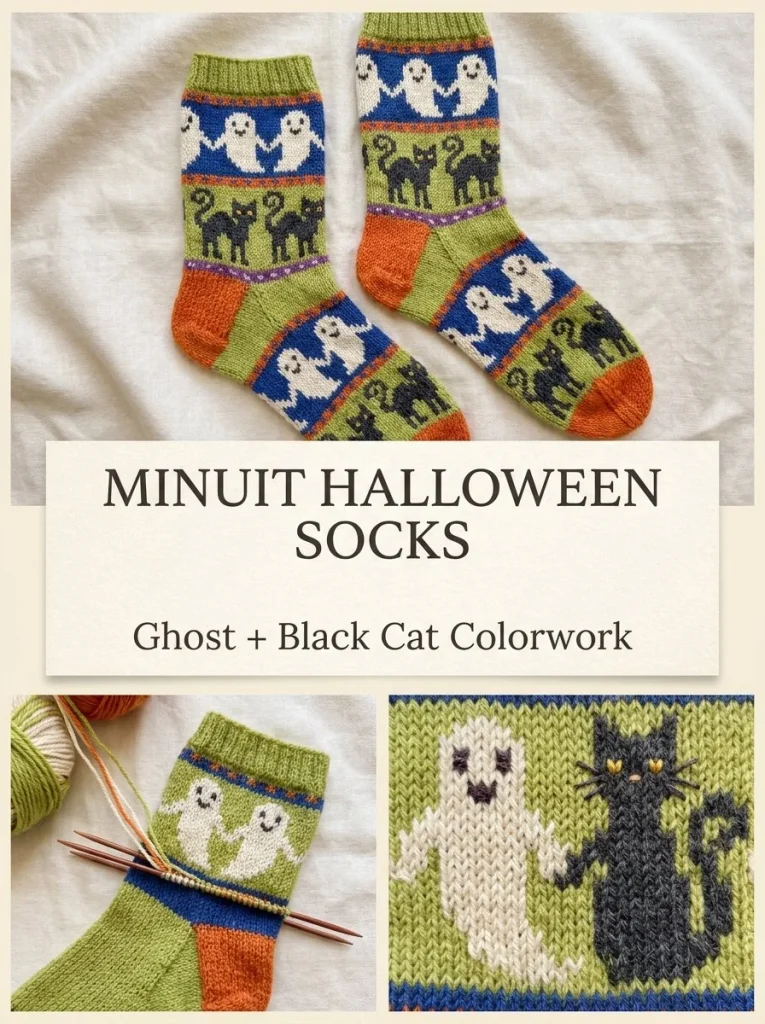
The Minuit Ghost and Black Cat colorwork socks showcase a charming blend of whimsy and technique, perfect for knitters eager to create seasonally inspired wearable art. These socks employ stranded colorwork to depict playful ghost and black cat motifs around the leg, capturing a festive yet subtle autumn aesthetic. Constructed seamlessly in the round, the socks combine functional knitting with captivating visual storytelling, making them a delightful project to knit for yourself or as a thoughtful gift.
The design’s clever use of contrasting colors and iconic Halloween imagery adds a lively personality to a classic sock silhouette. Knitters will appreciate the balance between the intricate colorwork band and the simplicity of stockinette sections, providing both challenge and rhythm throughout the knitting process. The use of stranded colorwork in this pattern invites knitters to refine their skills in managing floats and color tension, resulting in a snug, comfortable fit that maintains elasticity.
These socks are worked top-down in the round using fingering-weight yarn, with a ribbed cuff, stranded motif band, short-row heel, and wedge toe finished with Kitchener stitch. This comprehensive pattern applies a practical assembly technique tailored to maintain elasticity and comfort, while the distinct spiritual motifs bring a charming seasonal character.
For knitters looking for complementary autumn-themed knitting projects featuring colorwork, this pattern shares a creative spirit with other seasonal accessories, such as the cozy Easy Pumpkin Socks Knitting Pattern, which similarly embraces fall hues and festive motifs, broadening your colorwork knitting repertoire.
Pattern at a Glance
Skill level: Intermediate (experience with stranded colorwork and short-row shaping recommended)
Terminology: Standard US knitting terms
Construction: Top-down, knit in the round with stranded colorwork motif bands and short-row heel
Finished size: Adult sizes approximately 8 (9, 10) inches in unstretched circumference
Yarn weight: Fingering sock yarn
Needles: 2.25 mm / US 1 long circular needle (for magic loop) or Double Pointed Needles (DPNs)
Main stitch: Stockinette stitch with K1/P1 rib cuff
Gauge: 32 stitches x 36 rounds = 4 inches in blocked colorwork
Motifs: Ghost and black cat repeated stranded colorwork bands
Layout: Rib cuff, colorwork bands on leg, plain stockinette below, short-row heel, stockinette foot, wedge toe
Joining: Knitted in the round (no seams)
Border: K1/P1 rib cuff
Seaming: Kitchener stitch grafted toes
Materials
To craft these charming socks, you will need:
-
Fingering weight sock yarn totaling approximately 300 to 400 yards. This range covers the use of multiple colors, including six mini-skeins in the palette: Lemongrass, Royal, Natural, Charcoal, Satsuma, and Spooky Retro. These colors contribute to the distinct ghost and black cat imagery.
-
A 2.25 mm (US 1) long circular needle suitable for magic loop knitting or a set of DPNs (Double Pointed Needles) if preferred for knitting in the round.
-
A tapestry needle for weaving in ends and grafting the toe with Kitchener stitch.
These tools and yarns work harmoniously to maintain precise gauge and achieve the detailed colorwork motifs that define this pattern.
Yarn and Color Notes
Choosing yarn with good stitch definition is crucial for clear colorwork motifs. Smooth, plied fingering-weight sock yarns will showcase the ghost and cat silhouettes crisply. Avoid extremely fuzzy or loosely spun yarns which can obscure stranded patterns.
The color palette provided is vibrant and directional: a natural light background sets the stage for the ghost figure in white (Natural), accented by dark Charcoal eyes. For the black cat band, contrasting backgrounds in Satsuma (a rich orange) or Royal blue highlight the black cat silhouettes outlined in Charcoal. Such solid colors maintain clean edges in stranded knitting better than highly variegated yarns.
Using mini-skeins for color changes offers neat transitions and is economical for stranded colorwork that requires only small color sections per round. If substituting yarn, keep fingering weight and similar fiber content (preferably wool or wool blends for elasticity and durability) to preserve fit and drape.
Finished Measurements
The socks are sized to yield an approximate unstretched circumference of 8 inches (small), 9 inches (medium), or 10 inches (large). These dimensions correspond to adult sock sizes and are intended to fit snugly without restricting.
Finished length and overall fit depend on leg length customization during knitting. The short-row heel and wedge toe enable shaping that conforms well to the foot.
Gauge
The pattern gauge is a critical aspect of achieving both fit and motif clarity. The specified gauge is 32 stitches by 36 rounds per 4 inches when the socks are blocked flat and colorwork is tensioned properly. This gauge pertains specifically to the blocked colorwork fabric, a measurement taken laid flat after the socks are finished.
Maintaining this gauge ensures that:
-
The stranded motifs align correctly around the circumference without distortion.
-
The sock circumference matches the intended fit.
A gauge larger than specified will result in a sock too loose with stretched motifs, while a smaller gauge makes the fabric too tight and potentially uncomfortable.
Always knit a swatch in stranded colorwork and block it to test your tension before beginning these socks.
Abbreviations
- K: Knit
- P: Purl
- St(s): Stitch(es)
- Rnd(s): Round(s)
- K1/P1 rib: Knit 1, purl 1 ribbing
- DPNs: Double Pointed Needles
- Kitchener stitch: A grafting technique used to join live stitches seamlessly
Important Pattern Notes
-
The pattern is knit entirely in the round from the cuff downward, encouraging sock elasticity and smooth color transitions.
-
The ribbing at the cuff is a classic K1/P1 set for 16 rounds, providing a stretchy, comfortable fit.
-
Stranded colorwork requires carrying two yarns and keeping floats loose to maintain flexibility and prevent fabric puckering.
-
The motif band is worked over 18 rounds, incorporating two distinct stranded repeats: ghosts and black cats.
-
Color changes are planned per motif repeat, so careful counting of stitches per color repeat (12 stitches per ghost repeat, 12 stitches for cat repeat) is essential for motif accuracy.
-
After the motif bands, plain stockinette forms the leg and foot, allowing the knitted fabric to stretch and fit the foot comfortably.
-
The heel uses short-row shaping to contour the sock to the heel cup without extra seaming, enhancing fit and durability.
-
The wedge toe is decreased with staged four-stitch decreases every alternate round, finishing with a final round of decreases once half the stitches remain.
-
The toe is mated closed using Kitchener stitch for a smooth, comfortable finish.
Special Stitches and Techniques
-
Stranded Colorwork (Fair Isle): Carrying two colors in each row/round to create motifs. Tension must be maintained loosely to avoid puckering.
-
Short-Row Heel: Shaping technique that knits only part of the stitches while turning at strategic points to create a curve for the heel.
-
Kitchener Stitch: A grafting method joining toe stitches to create an invisible seam.
-
Magic Loop / DPN Technique: Method of knitting small circumferences in the round using a long circular needle or double-pointed needles.
Understanding these techniques is essential to knit the socks successfully and achieve professional results.
Understanding the Construction
These socks are worked top-down in the round to allow fitting during knitting and to facilitate the ribbed cuff. After casting on the required stitches and joining in the round, the cuff is knit in K1/P1 ribbing to ensure elasticity at the ankle.
Following the cuff, the pattern transitions to plain stockinette to set a clean canvas before the stranded colorwork bands. The motif band is worked over an 18-round repeat incorporating ghost and black cat designs.
After the motif bands, the leg is knit in plain stockinette to the desired length. The heel is turned using short rows over half the stitches, then stitches are picked up to resume knitting in the round for the foot.
The foot is knit plain stockinette with the main color to nearly full length, then tapered into a wedge toe with staged decreases followed by grafting the toe stitches together.
The second sock is knit identically to the first to ensure matching pairs.
Full Pattern Instructions
Foundation
For adult size 2 (medium), cast on 72 stitches using your preferred provisional or stretchy cast-on method, join carefully in the round, ensuring stitches are not twisted.
Cuff Ribbing
Work 16 rounds of K1/P1 ribbing in Charcoal yarn. This forms a stretchy cuff that fits comfortably around the ankle.
Stockinette Section
Knit 4 rounds of stockinette stitch (knit all stitches) in Charcoal after the ribbing to transition smoothly to the motif band.
Stranded Motif Band
The motif band consists of 18 rounds of stranded colorwork, worked using Natural as background.
-
Ghost Repeat (Rounds 1–8):
Work an 8-round stranded motif incorporating a 12-stitch ghost repeat around the leg. The ghost motif features a rounded white body beginning at 6 stitches, expanding visually to 8 stitches, accented with two 1-stitch Charcoal eyes and a stepped lower edge. -
Transition Rounds (Rounds 9–10):
Knit 2 plain rounds in Natural to separate the ghost and cat motifs visually. -
Black Cat Repeat (Rounds 11–18):
Switch to an 8-round stranded black cat repeat with either Satsuma or Royal as the background color. Each 12-stitch repeat shows a silhouette of a black cat made of Charcoal ears, head, and body within the repeats.
Throughout stranded knitting, carry the floats loosely on the wrong side to prevent pulling and preserve elasticity.
Leg Length Continuation
After completing the motif band, continue knitting plain stockinette in your preferred main color until the sock leg reaches the desired length.
Heel Construction
Work a short-row heel in Charcoal over half the stitches:
-
Place markers if needed to mark heel stitches (36 stitches for size 2).
-
Work short rows by knitting partway across, turning work when short rows reach the heel “cup” shape, forming the curve.
This method contours the heel without added seams or gussets.
Foot
Resume knitting all stitches in the round in the main color. Knit the foot in stockinette to about 1.75 inches (approximately 4.5 cm) short of the total foot length.
Toe Shaping
Shape the wedge toe with decreases as follows:
-
Begin by decreasing 4 stitches every other round until only half the original total stitches remain, which would be 36 stitches for size 2.
-
Then decrease 4 stitches every round until only 16 stitches remain.
-
Finish by grafting the toe stitches together using Kitchener stitch for a seamless, comfortable finish.
Complete Second Sock
Make the second sock identical to the first to create a matched pair.
For the exact designer motif chart, we recommend consulting the original source pattern, as this reconstruction captures an equivalent look rather than an exact copy.
Checkpoints
-
After cuff ribbing and initial stockinette, your sock circumference should match the size (approx. 8–10 inches).
-
Confirm floats in stranded colorwork remain loose but not too slack to avoid ladders.
-
Your motif repeats should align evenly around the leg circumference.
-
The short-row heel should form a smooth heel cup without holes or puckering.
-
Toe decreases should progress steadily and knit smoothly to 16 stitches before grafting.
Assembly and Finishing
These socks are knit in the round and require no seaming. After completing both socks and weaving in all ends with a tapestry needle, block gently to even tension and relax the stitches.
To finish the toes smoothly, the Kitchener stitch grafting creates an invisible join that prevents discomfort when worn inside shoes.
How to Resize
The pattern’s stitch multiple is fixed at 12 stitches per motif repeat for the color bands. To resize:
-
Circumference:
Increase or decrease the number of motif repeats by adjusting cast-on stitches in multiples of 12 while maintaining the rib cuff pattern. -
Leg length:
Knit longer or shorter plain stockinette sections after the motif band before starting the heel. -
Foot length:
Adjust the foot stockinette length before toe shaping.
Always re-check gauge after resizing because stitch counts and motif repeats will affect fabric tension.
Useful Variations
-
Substitute the motif colors to reflect personalized seasonal palettes, shifting from classic Halloween oranges and blacks to softer pastels or bold jewel tones.
-
Knit the motif bands on different sock backgrounds for varied contrast effects.
-
For a simpler, less intricate project, omit one of the motif bands or substitute solid color stripes.
-
Combine this pattern’s stranded knitting skills with other autumn accessories for a coordinated set; for example, explore the richly textured Autumn Drawstring Bag in Slip Stitch Colorwork to complement your sock collection.
Troubleshooting
Why Are My Floats Too Tight or Too Loose?
Floats are the strands of yarn carried across the back in stranded knitting. If floats are too tight, the fabric puckers and lacks stretch; if too loose, there are loops that snag easily.
Solution: Consistently tension floats gently as you knit, allowing enough slack for 5 stitches or so before catching the yarn again without excessive looseness.
Why Is My Motif Distorted?
Uneven tension in either color or stitch gauge can stretch or scrunch motifs.
Solution: Practice stranded knitting on a swatch to maintain balanced tension; ensure color changes are made smoothly without pulling the yarn tightly.
My Socks Feel Tight or Loose—How Do I Fix That?
Gauge deviation is the most common cause of size issues.
Solution: Try adjusting needle size and knitting a larger or smaller gauge swatch before starting; remember that the elasticity of the ribbed cuff compensates slightly.
How Do I Ensure My Short-Row Heel Is Smooth?
Incorrect turning points can cause holes or gaps.
Solution: Use wrap and turn techniques carefully; pick up wraps neatly during completing short rows to close gaps.
What Do I Do If My Grafted Toe Feels Bulky?
Too tight grafting or uneven tension creates lumps.
Solution: Practice Kitchener stitch with scrap yarn until you achieve a smooth join; pull yarn gently when grafting.
Frequently Asked Questions
Can I Use Different Yarn Weights?
This pattern is designed for fingering-weight sock yarn. Using a heavier yarn will require resizing and gauge adjustment.
Can I Substitute Circular Needles for DPNs?
Yes, a long circular needle used with the magic loop method, or DPNs, are both suitable depending on your preference.
Is Experience with Stranded Colorwork Necessary?
Intermediate knitting skills, including familiarity with stranded colorwork, are recommended for an enjoyable experience.
How Should I Block These Socks?
Lightly wet block the socks by hand shaping them flat to relax the stitches without overstretching. Dry flat away from direct heat.
Can I Make a Single Sock Instead of a Pair?
Yes, you can knit a single sock, but colorwork motifs especially shine in pairs.
Are These Socks Suitable for Wearing in Shoes?
Yes, ensure no loose floats inside to prevent discomfort and use yarns with durability and elasticity.
Optional Related Uses
The stranded ghost and black cat motifs lend themselves well to other knitted accessories. Consider adapting the colorwork pattern for:
-
Fingerless gloves or mitts
-
Cozy wrist warmers
-
Decorative cuffs for hats or cowls
These additions create coordinated seasonal wearables that express autumn charm.
Final Thoughts
Knitting these socks is a rewarding project combining seasonal motifs and classic techniques. The construction flows from a sturdy rib cuff through engaging stranded colorwork bands to practical shaping with short-row heels and wedge toes. Maintaining gauge, managing floats with care, and spacing motifs evenly will yield socks that are not only cozy but visually striking.
Capturing the spirit of autumn in wearable form, these socks blend attention to detail and knitting skill, resulting in a memorable and festive addition to your wardrobe or gift collection.



