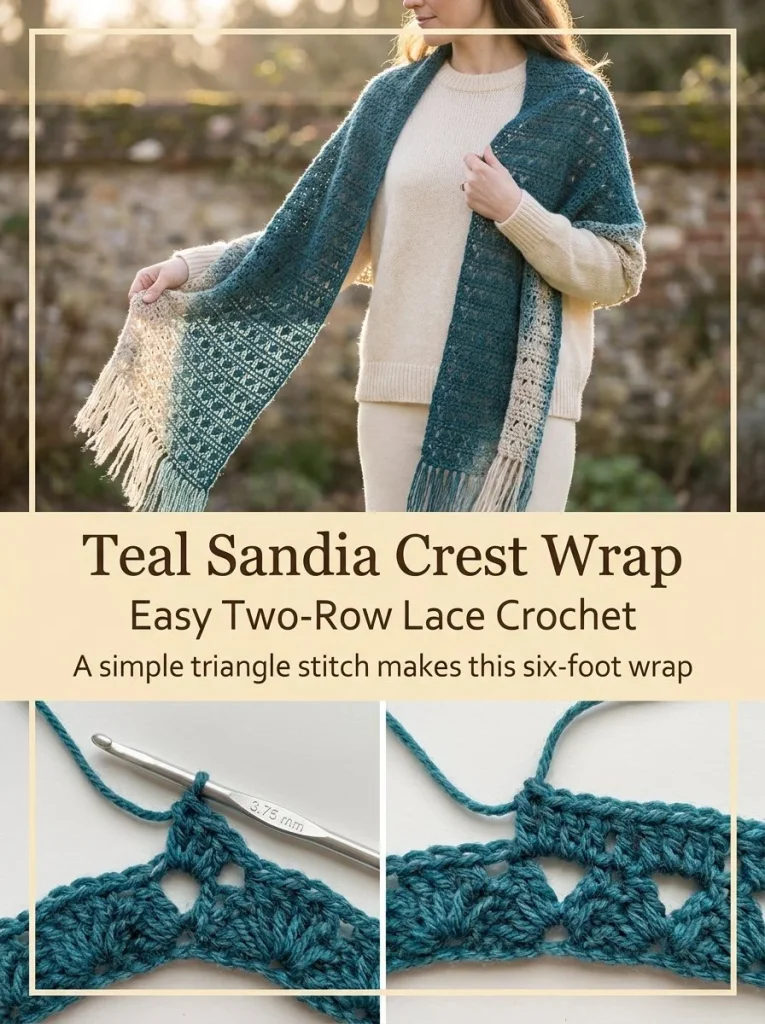
Creating a stunning wrap that’s both elegant and cozy is a rewarding experience for any crochet enthusiast. This project delivers a sophisticated triangular motif pattern, worked in fingering weight wool for a light yet warm garment. Its soothing teal hue gradually fading into oatmeal tones gives the finished piece a subtle ombré effect, perfect for layering throughout the seasons.
The wrap’s construction features an intriguing interplay of half double crochet and double crochet stitches arranged to form textured triangular shapes that form a dynamic, geometric design. This method introduces both visual interest and a fabric with plenty of drape and softness. The repeated stitch pattern creates a consistent structure that elongates gracefully to about 72 inches in length, making it a versatile accessory that can be wrapped, draped, or tied in multiple stylish ways.
Working with fingering weight yarn and a 3.75 mm hook balances delicacy and warmth, producing a lightweight wrap ideal for cooler evenings. This technique, while straightforward, introduces a unique triangle stitch motif that distinguishes the design from more traditional wraps. As you progress through the two-row repeats, you’ll see how the triangular texture emerges strikingly, creating an elegant fabric without added bulk.
For those intrigued by similarly textured projects, you might enjoy exploring patterns like the Dusty Teal Granny Wrap, which also incorporates layered textures with a fresh color palette.
Pattern at a Glance
Skill level: Intermediate
Terminology: US crochet terms
Construction: Horizontal rows with alternating textured triangle and fill rows
Finished size: Approximately 18 inches wide by 72 inches long
Yarn weight: Fingering (#1) wool
Hook: 3.75 mm (approximate US size 5)
Main stitch: Half double crochet (hdc), double crochet (dc) partial cluster forming triangle shapes
Gauge: About 7 triangle stitches and 10 two-row repeats = 4 inches
Motifs: 32 triangle groups across per row
Layout: Flat rectangular wrap created by repeating triangle and fill rows
Joining: Not applicable; worked in one piece
Border: None specified; edges finish naturally
Seaming: None required
Materials
- Yarn: Fingering weight wool, approximately 1300 yards in deep teal for the main body, plus an additional 200 yards of oatmeal for subtle color gradation at each wrap end. Fingering yarn ensures a lightweight drape and cozy warmth. Wool provides elasticity and softness, which enhances the wrap’s comfort and wearability.
- Hook: 3.75 mm crochet hook, suitable for the fine yarn weight, ensuring a balanced fabric that’s neither too tight nor loose.
- Notions: Tapestry needle for weaving in ends and gentle finishing touches.
- Optional but recommended: stitch markers to help track pattern repeats or row milestones, especially during the color transition rows.
This specific yarn and hook combination produces the ideal fabric density and softness. However, if substituting yarn, maintaining similar weight and fiber content will produce the best match to the pattern’s gauge and drape.
Yarn and Color Notes
Choosing wool for this wrap is intentional for its breathable insulation and elasticity. Wool fibers trap warmth but also allow moisture wicking, making the wrap comfortable for various climates.
The two-color scheme adds visual depth. The predominant deep teal serves as the rich base color, while the oatmeal gradually fades at each end for a gentle ombré effect. This color transition requires thoughtful gradient changing during the final 12–16 rows at both ends of the wrap. Using solid colors rather than variegated yarns helps preserve the clarity of the triangular texture pattern.
If you prefer a monochrome look, omitting the oatmeal sections creates a deep teal wrap throughout. For further inspiration, other color combinations or even a single-color interpretation could highlight the triangle motif’s geometric charm distinctly.
Patterns focusing on texture and color gradation like the Autumn Sampler Wrap offer complementary inspiration for choosing your shades and yarn types.
Finished Measurements
The completed wrap measures approximately:
- Width: 18 inches
- Length: 72 inches
These dimensions are ideal to wear as a shoulder wrap, neck scarf, or belt-style accessory. The length is generous for multiple styling options while the width is narrow enough for layering without bulk.
Note that these measurements are approximate and depend heavily on achieving the stated gauge and neat blocking. Variations in tension or yarn used can slightly alter size.
Gauge
The target gauge is:
- 7 triangle stitches by 10 two-row repeats = 4 inches
Gauge is measured over the triangle stitch motif, counting clusters horizontally and the two-row pattern vertically. Achieving this gauge ensures the wrap’s final size matches the pattern’s dimensions and the textured fabric behaves as intended.
If your gauge swatch yields larger stitches, the finished wrap may be wider and shorter than designed. Conversely, a tighter gauge will result in a narrower, longer piece. Adjust your hook size if necessary to meet the gauge.
Since this is an accessory rather than a fitted garment, slight gauge variation is acceptable, but staying close to gauge helps ensure the geometric motifs hold their crisp shape and the wrap lies flat.
Abbreviations
- ch: chain
- hdc: half double crochet
- dc: double crochet
- st(s): stitch(es)
- YO: yarn over
- tog: together
- rep: repeat
Important Pattern Notes
- Turning Chains: The pattern starts with a chain foundation. Turning chains count as the first half double crochet in Row 1.
- Triangle Stitch Construction: The triangle row uses a partial cluster double crochet technique forming distinct triangles across the width.
- Chain Spaces: Chains of two (ch2) between triangle clusters create open spaces filled in the subsequent fill row.
- Color Changes: If using the two-tone version, plan your color changes gradually for a smooth transition into oatmeal.
- Row Repeats: The pattern alternates Triangle Rows and Fill Rows throughout.
- Edge Stitches: Maintain all stitches at row edges as half double crochet for a clean, stable edge.
Keep stitch markers handy to mark the start of rows or significant pattern repeats to keep track of progress, especially across the 32 triangle groups.
Special Stitches and Techniques
-
Partial Cluster Double Crochet (Triangle Stitch):
Each triangle is formed by partially working double crochets into consecutive stitches, leaving loops on the hook, then pulling through some loops to create the raised triangle effect. -
Half Double Crochet (hdc) Fill:
The fill rows contain half double crochets worked into the triangle tops and chain spaces to create a dense fabric between the triangle motifs.
Understanding these stitch constructions is essential to create the distinctive textured fabric. Partial dc clusters are worked without completing each double crochet fully, then loops are pulled through strategically to create the triangle shape.
If unfamiliar with partial dc cluster techniques, practice the method on a small swatch before starting the wrap.
Understanding the Construction
The wrap is constructed horizontally by repeating a two-row pattern across the width and length:
- Foundation: Starting with a chain of 96, which sets the wrap’s width.
- Row 1: A row of half double crochet stitches establishes the base row with 95 hdc.
- Triangle Row: This row introduces 32 triangle groups, formed by partial double crochet clusters separated by chain spaces.
- Fill Row: Following the triangle row, a filling row of half double crochet stitches fills the chain spaces and completes each triangle top, maintaining the stitch count of 95 hdc.
- These two-row repeats continue for 181 rows total, which creates the length of approximately 72 inches.
The design’s beauty lies in the alternating texture rows forming an array of triangular shapes that interplay with solid half double crochet fills, crafting both visual and tactile interest.
If choosing the two-tone variation, the color shifts gradually near the top and bottom ends by substituting oatmeal yarn in the final 12–16 rows at each edge, blending organically with the deep teal main body.
Full Pattern Instructions
Foundation Chain
Chain 96 stitches loosely to begin. This foundation sets the width of the wrap.
Row 1
- Skip the first chain (the one closest to the hook).
- Work one half double crochet (hdc) into the 2nd chain from the hook.
- Continue hdc in every chain across the row.
- You will have 95 hdc stitches by the end.
Turn your work; this establishes a sturdy base for the triangle motif rows.
Triangle Row
- Start the first triangle using the first two stitches:
- Insert your hook into the first stitch and begin a double crochet (dc), but do not finish it; leave the unfinished loops on the hook.
- Repeat this partial dc step for the next 3 stitches similar to a partial cluster. For each of the next 3 stitches, partially work a double crochet, leaving the last loops on the hook but not completing the stitch.
- After partially working these 3 dc stitches, pull the yarn through the first 3 loops on the hook (combining the loops from the partial dcs).
- Yarn over and pull through the remaining 2 loops to complete the triangle stitch.
- Chain 2 between triangle stitches to create a small open space.
- Repeat this triangle group 32 times across the row.
- This creates 32 triangle groups separated by ch2 spaces.
Fill Row
- Chain 1 and turn the work.
- Work one hdc into the top of the first triangle stitch.
- Work 3 hdc into every chain 2 space across the row.
- Finish with one hdc in the final triangle top.
- The total stitch count remains 95 hdc.
Repeat Pattern Rows
Repeat the Triangle Row and Fill Row alternately until you reach a total of 181 rows or approximately 72 inches in length.
Color Gradation (Optional Two-Tone Version)
To create the Velora two-tone effect:
- Use deep teal yarn for the majority of the wrap.
- Gradually switch to oatmeal yarn for the final 12 to 16 rows at each end of the wrap.
- Make the color transitions smooth by alternating rows or stitches between the two colors.
- This creates a subtle fading effect enhancing the wrap’s visual appeal.
Finishing
- After completing all rows, gently block the wrap to approximately 18 inches wide by 72 inches long.
- Blocking helps flatten the stitch pattern and relax the fabric, ensuring the triangles and fill rows display their full texture and clarity.
- Use pins and a flat surface, shaping the wrap carefully during the blocking process.
Final Touches
- Weave in all yarn ends securely using a tapestry needle.
- Inspect edges to ensure no loose stitches or gaps.
- The wrap is now ready to wear or gift.
Your textured, elegant wrap is complete!
Checkpoints
- After Row 1: Count should confirm 95 hdc stitches.
- After Triangle Rows: Confirm formation of 32 distinct triangle groups separated by ch2 spaces.
- After Fill Rows: Stitch count returns to 95 hdc, and chain spaces are filled with 3 hdc clusters.
- Length Progress: By row 181 (end of pattern repeat), piece should measure roughly 72 inches in length.
- Color Transition: If using two-tone, check gradual change over the last 12–16 rows at each end for smooth blending.
These checkpoints help ensure proper stitch counts and pattern formation throughout your project.
Finishing and Blocking Tips
Lightly blocking your wrap shapes the fabric beautifully.
- Soak the wrap in lukewarm water with a gentle wool wash.
- Gently squeeze out excess water without wringing.
- Lay flat on a blocking board or clean towel.
- Pin edges to desired measurements, smoothing out any curls or waves.
- Allow to dry completely before unpinning.
Blocking not only enhances drape and texture but also evens out stitches and improves overall hand feel.
After blocking, inspect for any loose ends and weave them in for a polished finish.
How to Resize the Wrap
To adjust the size of this wrap while maintaining the design logic:
-
Width Adjustment:
The width is determined by the foundation chain of 96. To make it wider or narrower, adjust the chain by increments that maintain the triangle stitch multiple. Each triangle group spans approximately 3 stitches plus 2 chains between; thus, increasing or decreasing sets of stitches divisible by this motif will maintain pattern integrity. -
Length Adjustment:
Each two-row repeat adds roughly 0.4 inches (based on gauge). Add or subtract pairs of rows (triangle + fill) to reach your desired length. Maintain the alternating row pattern to preserve texture.
Because stitch counts and repeats are precise, ensure your foundation chain and row repeats conform to the triangle multiple to keep edges aligned and avoid incomplete motifs.
If larger adjustments are desired, swatching with different hook sizes or yarn weights can help you find the right balance without distorting the pattern.
Useful Variations
- Single Color Version: Work the entire wrap in one solid color instead of the two-tone gradient for a classic, understated look.
- Color Block Ends: Instead of a gradient transition, switch abruptly to the oatmeal yarn for the last 12–16 rows at each end, creating bold color blocks.
- Extended Length: Add additional row repeats for a longer wrap or scarf-like accessory.
- Different Fiber: Substitute fingering wool with a soft alpaca blend for an even warmer finish while retaining the textural detail.
- Blend with Other Patterns: Combine this triangle motif with other textured stitch wraps like the granny wrap projects to build a diversified accessory collection.
These variations allow you to customize the wrap to your personal style or gifting needs.
Troubleshooting
Why Is My Wrap Wider Than Expected?
This typically happens if your gauge is larger than the pattern’s target. Check your tension and try using a smaller hook to tighten your stitches. Also, verify you are chaining the correct initial foundation chain.
Why Are My Triangle Stitches Not Forming Properly?
Ensure you leave loops on the hook for the partial double crochet steps and pull through them correlatively as described. Skipping or finishing partial dcs prematurely will break up the triangle texture.
Why Does the Edge Curl or Ripple?
An uneven tension or inconsistent turning chains might cause curling. Make sure turning chains count as stitches and maintain consistent stitch tension. Blocking usually resolves minor edge inconsistencies.
How Do I Achieve a Smooth Color Transition?
Alternate stitches or rows between the old and new color progressively over 12–16 rows to blend edges. Avoid abrupt color cut-offs unless a bold block is desired.
How Can I Keep Stitch Counts Consistent?
Count stitches at the end of rows. The pattern requires 95 hdc stitches per fill row and a corresponding number of triangular groups plus ch2 chain spaces per triangle row. Using stitch markers at every triangle group can help track stitch placement.
What If I Don’t Like the Two-Tone Version?
The wrap works beautifully as a single-color wrap too. This simplifies the project and highlights the texture without color changes.
Frequently Asked Questions
Can I use a different yarn weight?
Using a thicker or thinner yarn will affect gauge and the wrap’s size and drape. To maintain size, adjust the hook and foundation chain accordingly and check gauge carefully.
Is this pattern suitable for beginners?
The triangle stitch is a unique technique, so beginners comfortable with half double and double crochet stitches can try it but may want to practice partial clusters first.
Can I use acrylic yarn instead of wool?
You can substitute acrylic, but the fabric will have a different drape and temperature regulation. Wool’s elasticity and warmth suit this wrap well.
Can I make this in one color?
Absolutely. A single-color wrap focuses more on texture and is simpler to execute without color transitions.
Do I need special tools to complete this wrap?
Besides the standard crochet hook and yarn, a tapestry needle for finishing and blocking materials are recommended. Stitch markers help but are not essential.
How should I block this wrap?
Use gentle hand-washing and lay flat to block, shaping to the specified dimensions and smoothing out the triangular textures.
Is the wrap reversible?
Yes, while the triangle texture is raised on one side, the fabric is neat enough on both sides to wear either way.
How do I care for this wool wrap?
Hand wash gently and dry flat to preserve shape and fiber quality.
Optional Related Uses
The triangular textured stitch pattern is versatile:
- Scarves: Work fewer rows for a triangular scarf version.
- Shawls: Extend length and shape edges into a triangular shawl.
- Table Runners: Adjust width for a decorative table accent using the repeating triangle motif.
- Pillow Covers: Create square motifs of the triangle stitch for decorative cushions.
Exploring these project types can extend your enjoyment of this striking stitch pattern.
Final Thoughts
This wrap’s design centers on alternating rows of triangular partial double crochet clusters with half double crochet fill rows, resulting in a textured yet lightweight fabric. Constructed flat from a foundation chain, the piece grows in length with repeated two-row sets that define the geometrical pattern. The beautiful color gradient on the two-tone version subtly enhances the visual interest without detracting from the tactile richness.
Careful attention to stitch counts and gauge ensures a balanced fabric that measures approximately 18 by 72 inches, perfect for stylish layering. With its accessible stitches and stunning outcome, this project offers both a satisfying crochet experience and a wearable, eye-catching accessory for many occasions.



