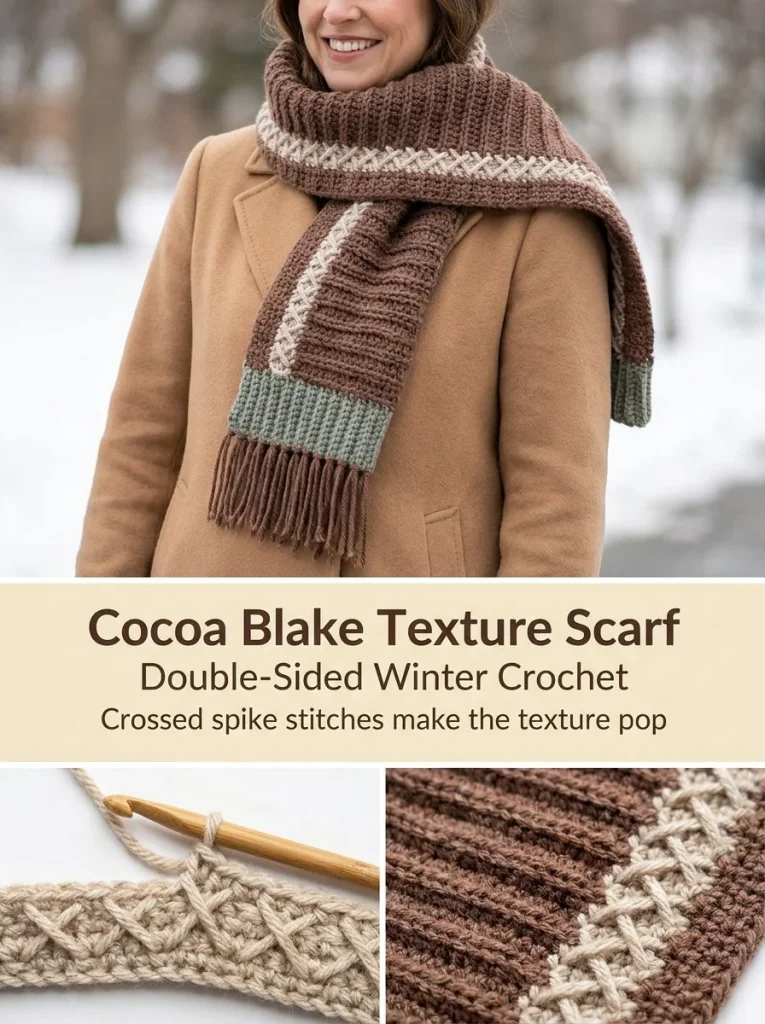
The Cocoa Blake Texture Scarf is a captivating crochet project that combines elegant color changes with an innovative play on texture. This scarf showcases a charming mix of rich cocoa, soft oatmeal, and muted sage yarns, creating a harmonious palette ideal for cozy, stylish cold-weather accessories. The fabric is beautifully sculpted using a combination of traditional and special stitches, including the distinctive third-loop half double crochet and intricate spike stitches, which lend a contemporary ripple and layered depth to the piece.
The construction of this scarf involves working back and forth in rows, and carefully layering textural blocks that alternate colors and stitch techniques. A subtle ribbed edging frames the scarf, adding structure and polish while reinforcing the cozy feel. The use of long spike stitches interwoven in cross patterns creates an engaging “woven” surface effect that tours away from plain scarf options, offering any crocheter a chance to develop their skills and produce a wearable piece that stands out.
This richly textured design leverages stitches that, while approachable, require attention and a little dexterity, making it perfect for intermediate crocheters looking to elevate their scarf repertoire. For more inspiration on combining texture and color in scarf designs, consider exploring the fascinating stitch work in the Burgundy Leaf Texture Skinny Scarf, which also expertly balances stitch variation with subtle color shifts.
Pattern at a Glance
Skill level: Intermediate
Terminology: US Crochet terms
Construction: Worked in rows from foundation chain
Finished size: Adjustable; recommended length by repeating texture blocks 6–7 times
Yarn weight: Worsted (#4)
Hook: 5 mm (H/8) crochet hook
Main stitch: Half double crochet (hdc), spike hdc, single crochet (sc), front post double crochet (fpdc), back post double crochet (bpdc)
Gauge: Not explicitly stated; stitch consistency important for texture definition
Motifs: None (texture blocks instead)
Layout: Repeated textured blocks alternating colors and stitch techniques
Joining: Not applicable; worked in one continuous piece
Border: Ribbing with alternating front and back post double crochets
Materials
To complete this scarf, you will need the following materials:
- Worsted weight (#4) yarn in three colors:
- Approximately 330 yards of cocoa (rich brown) for the main body
- Approximately 100 yards of oatmeal (light neutral) for textured spike sections
- Approximately 60 yards of muted sage (soft greenish-grey) for ribbing edges
- A 5 mm (H/8) crochet hook, suitable for worsted weight yarn
- A tapestry needle for weaving in ends and finishing
- Scissors to trim color-change tails evenly into subtle fringe
Each yarn color is strategically used to highlight different stitch textures, so selecting yarns with similar weights and fiber content will ensure consistent drape and stitch definition.
Yarn and Color Notes
Choosing a smooth worsted weight yarn will enhance the stitch texture visibility and provide sufficient stitch definition for the third-loop hdc and spike stitches to pop visually. Yarns with a slight sheen or smooth surface, such as superwash wool blends or acrylics, work well, while overly fuzzy or loosely spun yarns may obscure texture details.
The color palette of cocoa, oatmeal, and muted sage creates a warm, earthy feel with subtle contrast. The oatmeal’s light tone beautifully highlights the spike stitches’ intricate crossing, making them stand out without overwhelming the overall warmth of the cocoa background. Muted sage frames this combination with a softened ribbed edge, tying the colors together naturally.
For an alternative visual vibe, you might experiment with different but harmonious palettes, or create a one-color version to emphasize the layered stitch structure without color distraction. This technique of using color to separate texture zones is reminiscent of designs like the Cocoa Spike Granny Scarf, which similarly uses color shifts to highlight textured stitch sections.
Finished Measurements
The size of the finished scarf depends on how many textured pattern blocks you repeat. The original pattern suggests repeating the core texture block 6 to 7 times to reach a desired length that comfortably wraps around the neck.
- Width: Approximately established by the initial chain and stitch count – 32 stitches wide
- Length: Variable; repeating the texture block 6–7 times usually creates a scarf about 60–72 inches long, a standard length for versatile wear
Because the scarf is worked flat in rows, you can adjust length by adding or subtracting repeats of the texture block without worrying about changing stitch count or width.
Gauge
While no formal gauge is provided, maintaining consistent tension throughout is important to ensure neat stitch definition and an even fabric width. The stitch count per row is fixed at 32 stitches after the turning chain adjustments.
You may want to make a small swatch of the third-loop half double crochet rows to familiarize yourself with tension and fabric behavior:
- Measure width after 12 rows of third-loop hdc
- Confirm that your 5 mm hook produces a firm but flexible fabric
If your gauge is noticeably bigger, the scarf may turn out wider or looser; if smaller, it may be more tightly textured and narrower. Adjust hook size if needed for desired fabric drape.
Abbreviations
- ch = chain
- dc = double crochet
- hdc = half double crochet
- sc = single crochet
- fpdc = front post double crochet
- bpdc = back post double crochet
Important Pattern Notes
- The starting chain is worked with muted sage yarn to frame the scarf with ribbing.
- Turning chains for rows are generally per US crochet conventions; for example, chain 3 to count as first dc where applicable.
- Edge stitches (first and last stitch in a row) are worked in standard loops for neat edges, while interior stitches use the third loop to create horizontal ridges.
- Color changes occur between sections: sage ribbing, cocoa hdc texture block, and oatmeal spike sections, with clean yarn carry and tails left for subtle fringe.
- The spike stitch rows involve working stitches into spaces beneath stitches two rows below, creating long vertical reaches distinctive to the texture.
- The two-row offset spike rows form a crossing pattern that must be counted carefully to maintain stitch count and pattern integrity.
- Repeat structure is a texture block comprising cocoa third-loop hdc rows and oatmeal spike rows, repeated 6–7 times to achieve the desired scarf length.
Special Stitches and Techniques
Third-Loop Half Double Crochet
This key technique involves inserting your hook beneath the horizontal loop furthest from you (the third loop) on the half double crochet stitch instead of the usual front or back loops. This creates a fabric with subtle horizontal ridges that add horizontal visual texture and stretch.
- To find the third loop: look for the loop lying across the back of the stitch, away from the hook position.
- Working in the third loop creates a unique, rib-like surface that contrasts beautifully with normal loop stitches at edges.
Front Post Double Crochet (fpdc) and Back Post Double Crochet (bpdc)
These stitches work around the post (vertical part) of the stitch from the previous row, not the top two loops, to create raised ridges:
- fpdc: worked from the front of the fabric, wrapping the post from front to back
- bpdc: worked from the back of the fabric, wrapping the post from back to front
Their alternating placement on the ribbing edges produces robust, stretchy ribs along the scarf’s borders.
Spike Half Double Crochet
In this project, spike hdc stitches are elongated hdc worked into the space just beneath a stitch two rows below the current row. These stitches create dramatic vertical “spikes” and crossing patterns that give the oatmeal sections distinctive texture.
- Working a spike stitch involves skipping one stitch in the current row, going into a lower space, then crossing back over with another spike hdc to form an “X” shape.
- Paying attention to the offset rows and pairing is necessary for consistent texture.
Understanding the Construction
This scarf is worked top down in rows, starting with a foundation chain in muted sage yarn. The edges are framed with a sturdy ribbing made from alternating front and back post double crochets to keep its shape and create a finished look.
After the ribbing, the scarf body uses a repeating sequence:
- 12 rows of cocoa half double crochet worked in the third loop for horizontal ridge texture
- 3 rows of oatmeal spike stitches in a unique crossing spike pattern
This textured block is repeated multiple times (6–7 times suggested) until the desired length is reached. Then the scarf finishes by mirroring the beginning ribbing in sage with 12 cocoa hdc rows followed by 5 sage ribbing rows, creating a balanced, neat ending.
The design’s alternating colors and stitch techniques differentiate the edges and the intricate interior texture.
Full Pattern Instructions
Foundation
Using muted sage yarn, chain 34 stitches.
Row 1
Work 1 double crochet (dc) in the 4th chain from the hook to begin the first row, then dc across the rest of the chain, totaling 32 stitches. This skips the first 3 chains, which count as the turning chain and first dc.
Turn your work.
Rows 2 to 6
Begin each row with a turning chain appropriate for half double crochet (usually chain 2), then turn.
- Work half double crochet (hdc) in the first and last stitch of each row, maintaining firm edges.
- For the stitches between the first and last on each row, alternate front post double crochet (fpdc) and back post double crochet (bpdc) to create a stretchy ribbing along the scarf’s edges. This ribbing frames the scarf and provides a snug but flexible border.
At the end of Row 6, the ribbing should be well-established in sage yarn.
Change to Cocoa Yarn
Switch to the cocoa yarn for the main body texture.
Rows 7 to 18 (12 Rows)
Work 12 rows of half double crochet (hdc) across the entire width, while applying a special technique:
- For interior stitches (all except the first and last stitches of the row), work your hdc into the third loop of each stitch from the previous row instead of the top two loops. This creates horizontal ridges along the surface of the fabric.
- For the first and last stitches in each row, work the hdc in the normal loops to maintain smooth edges.
This technique develops a richly textured ridged surface throughout the cocoa section.
Change to Oatmeal Yarn
Prepare for the spike stitch section, which provides a dramatic textural contrast.
Spike Section Row 1
Work single crochet (sc) across the entire row, keeping stitch counts even and consistent for the foundation of the spike pattern.
Spike Section Row 2
- Begin with a single crochet in the first stitch.
- Then work a long half double crochet (hdc) into the space beneath the stitch two rows below the current stitch.
- Skip the next stitch on the current row.
- Work a single crochet in the following stitch on the current row.
- Work another long hdc, crossing back into the lower space beneath the skipped stitch, effectively creating a crossed spike shape.
Repeat this crossed spike stitch pair pattern across the row, maintaining the offset.
Spike Section Row 3
Work a second offset spike row repeating similar crossed spike pairs, but starting offset to the first spike row to create a staggered, woven effect.
Return to Cocoa Yarn
Repeat the earlier textured body section:
- Work 12 rows of third-loop hdc as previously, maintaining texture and color contrast.
Repeat Texture Blocks
Repeat the combined cocoa-texture and oatmeal-spike 15-row block (12 rows hdc + 3 rows spike) 6 to 7 times until your scarf reaches your desired length.
Final Ends
Finish the scarf by repeating:
- 12 rows of cocoa third-loop hdc
- Followed by 5 rows of sage ribbing matching the initial ribbing frame
This symmetry provides a polished ending and structural balance.
Finishing
Leave short yarn tails at both ends where colors change and weave them in using a tapestry needle. Trim these short tails evenly into a subtle fringe to complement the scarf’s textured surfaces.
Practical Checkpoints
- After ribbing and initial cocoa hdc rows, your work should be firmly edged with ribbed sage bands.
- Make sure spike stitch sections form clear “X” patterns across oatmeal rows; if spikes aren’t reaching two rows below properly, revisit spike stitch technique.
- At the end of each repeated texture block, check that stitch count remains consistent at 32 stitches.
- The scarf width should remain constant; any widening or narrowing suggests tension or stitch placement adjustments.
Finishing and Blocking
After completing the scarf, gently block it by lightly dampening and shaping on a flat surface. This will relax the yarn, soften ridges, and allow spike stitches to settle beautifully without stretching the edges.
Weaving in ends carefully will avoid bulk and maintain smooth edges for comfortable wear.
How to Resize
This scarf’s width is fixed by the initial chain of 34 (32 working stitches). To resize widthwise:
- For a wider scarf, increase starting chain by multiples of 2 (to maintain pattern alignment in ribbing and spike stitch rows), then adjust the number of ribbing repeats accordingly.
- To lengthen, simply repeat the 15-row combined texture block more times until desired length is achieved.
- Conversely, reduce repeat counts for a shorter scarf.
Always check edge ribbing balance when making width modifications to preserve neat framing.
Useful Variations
- Single-color version: Use one solid color for the entire scarf to emphasize only the textural contrast without color changes.
- Muted tone palette: Experiment with pale grays, dusty blues, or soft pinks for a softer visual.
- Seasonal palette: Swap cocoa for warm burnt orange, oatmeal for cream, and sage for deep forest green for autumn-inspired wear.
- Scarves with alternative widths: Adjust chain foundation for a narrow skinny scarf or a broad wrap.
If you enjoy working with texture-rich yarns and colorwork, the techniques here align well with projects like the Cocoa Spike Granny Scarf, which also beautifully combines spike stitches and tiered texturing.
Troubleshooting
Why Does My Edge Look Uneven?
If the edge ribbing made from fpdc and bpdc alternations appears wavy or uneven, check that you are alternating stitches correctly and maintaining even tension. Unequal tension or skipping stitches in the ribbing causes distortions.
Why Do My Spike Stitches Not Reach the Row Below Correctly?
Spike stitches must be worked into the space beneath a stitch two rows below; double-check you haven’t miscounted rows or worked into the immediate previous row instead. Marking rows or using stitch markers can help maintain precision.
Why Is My Scarf Getting Wider or Narrower?
Changes in gauge or incorrect stitch counts usually cause width issues. Count stitches after each row to ensure you have 32 stitches. Adjust your hook size if tension is too loose or tight.
Why Is My Color Change Noticeable or Bulky?
Leave short, neat tails when changing colors, and weave in ends on the wrong side under a few stitches to hide them. Avoid knotted or bulky joins by carefully carrying yarn or using invisible join techniques between color changes.
Frequently Asked Questions
Can I Use a Different Yarn Weight?
Using a different yarn weight will change the scarf’s size and texture. Thicker yarns produce a chunkier fabric but reduce the stitch pattern’s definition, while thinner yarns make a delicate, smaller scarf. Adjust hook size and stitch count accordingly if substituting yarn weight.
Can I Use Cotton Yarn?
Cotton yarn works if you prefer a firmer, less stretchy fabric. It will highlight textures differently—usually crisper but less elastic. Choose mercerized cotton for a smoother finish.
Is the Pattern Suitable for Beginners?
This scarf is best for intermediate crocheters comfortable with post stitches and spike stitches. Beginners may find the spike stitch technique challenging but can learn with practice.
Do I Need a Special Crochet Hook?
A standard 5 mm (H/8) hook for worsted yarn is sufficient. Using a hook with a smooth, ergonomic handle may help maintain even tension when working complex textures.
Is Blocking Necessary?
Blocking is highly recommended to relax stitches and shape the scarf evenly, especially for the spike stitch sections that may pull or twist slightly.
Can I Make the Scarf Longer?
Absolutely. Simply repeat the 15-row texture block more times before finishing the edges.
Optional Related Uses
The unique texture and color-blocking technique showcased here can be adapted for other projects such as:
- Wrap or shawl using wider starting chains and more repeats
- Textured cowls combining the ribbed edges and third-loop hdc sections
- Decorative table runners or placemats with block repeats and color segments
These variations let you explore the distinctive horizontal ridges and spike stitch motifs in different forms.
Final Thoughts
The allure of this scarf lies in its sophisticated interplay of color and texture, created by working half double crochets into the third loop, alternating post stitches along the edges, and crossing spike stitches that reach into lower rows. The fabric is elegant, slightly stretchy, and comfortable, making it a standout accessory for chilly days.
By carefully layering textural blocks of cocoa and oatmeal colors framed with sage ribbing, the scarf balances artistic detail with practical warmth. While the stitch techniques require attention, the resulting piece is rewarding to make and wear — a perfect project for anyone wanting to enhance their crochet skills with texture innovation.
The project’s foundation is simple: start with sage ribbing, build texture in cocoa with third-loop hdc, then add visual interest through oatmeal crossed spike stitches. Repeat for the length you desire, then finish neatly with ribbing to mirror the start. This repeatable construction offers flexibility and creativity for varied color palettes and lengths.
If you appreciate projects that elevate texture and stitchcraft, expanding your collection with textiles like the Burgundy Leaf Texture Skinny Scarf can complement this pattern beautifully by exploring alternate approaches to textured scarf design.



