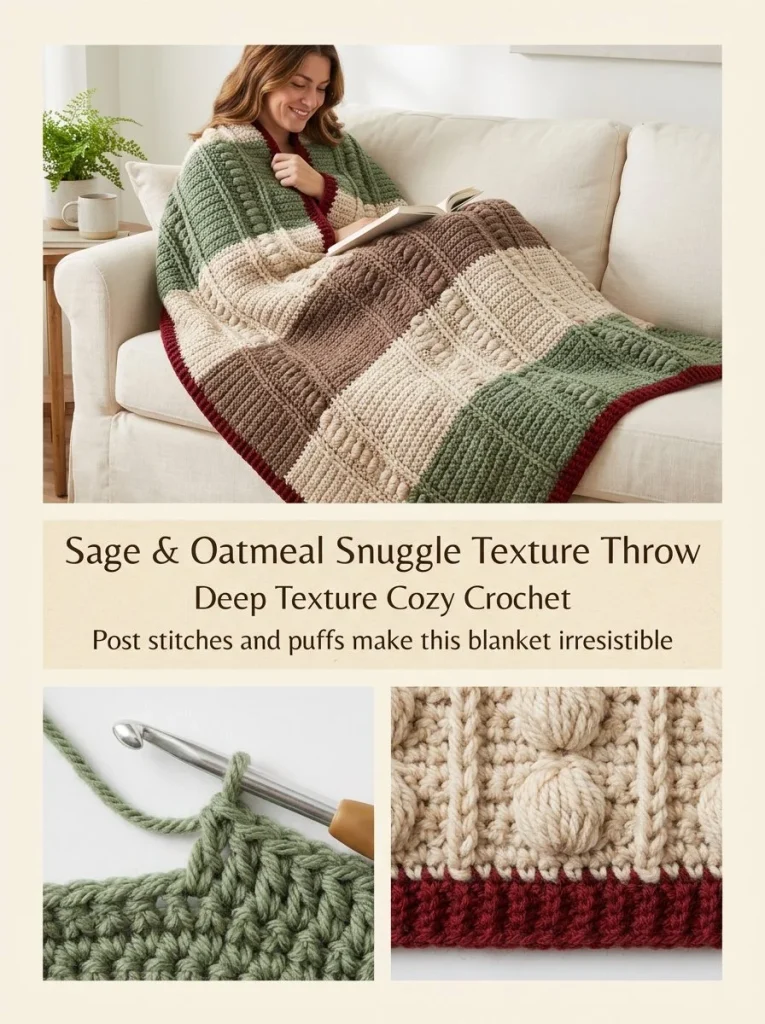
This textured crochet throw features a rich blend of sage, oatmeal, cocoa, and burgundy hues, creating a cozy and visually inviting fabric perfect for snuggling up on chilly days. The design uses a Velora texture adaptation that combines a variety of stitch techniques, including single crochet, half double crochet, front and back post double crochets, and puff stitches, producing a complex and tactile surface that adds depth and warmth. Worked in rows with strategic color changes, this throw showcases both craftsmanship and thoughtful construction. Its layered texture and color transitions invite both intermediate and confident beginners looking to challenge their skills while creating a beautifully tactile home accessory.
The stitch pattern involves alternating textured rows that create a sophisticated, multidimensional look. The finished size of approximately 44 × 54 inches makes it an ideal lap throw or accent blanket. The use of worsted weight yarn ensures a cozy density without excessive weight, while the color palette is both neutral and inviting, fitting well in a variety of decor settings. This kind of project not only provides warmth but also serves as a lasting piece of handmade art, and if you enjoy experimenting with textured stitches, consider comparing techniques found in the oatmeal chunky lap throw pattern for additional inspiration on stitch combinations and yarn handling.
Pattern at a Glance
Skill level: Intermediate (due to textured stitches and color changes)
Terminology: US crochet terms
Construction: Worked flat in rows with color changes at row ends; borders crocheted in rounds
Finished size: Approximately 44 × 54 inches (112 × 137 cm)
Yarn weight: Worsted (#4)
Hook: 6 mm (body), 5.5 mm (border)
Main stitch: Velora texture adaptation including sc, hdc, fpdc, bpdc, and puff stitches
Gauge: Not explicitly provided; gauge is flexible for blankets but maintaining consistency is recommended
Motifs: Single rectangular panel with textured rows
Layout: Continuous rows with color block sections
Joining: None required
Border: Three-round burgundy border with sc, fpdc, bpdc, and dc stitches
Seaming: Not applicable
Materials
To create this throw, you will need:
- Worsted weight (#4) yarn in four colors:
- Sage: approximately 650 yards
- Oatmeal: approximately 600 yards
- Cocoa: approximately 300 yards
- Burgundy (for border): approximately 150 yards
- Crochet hooks:
- 6 mm hook for the main body of the throw
- 5.5 mm hook for the border rounds
- Tapestry needle for weaving in ends
The yarn amounts reflect the color distribution and are calibrated to allow for a generous size throw with neat color transitions. Choose a yarn with a smooth, consistent texture to best showcase the complex stitch patterns. Acrylic or wool blends with good stitch definition will work beautifully.
Yarn and Color Notes
Selecting yarn for textured blankets requires attention to fiber type and color behavior. Smooth yarns with a firm twist highlight stitches like post double crochets and puff stitches, ensuring texture pops clearly. Fuzzy or loosely spun yarns can obscure stitch definition, reducing the impact of the texture.
The color palette here uses muted earth tones—sage and oatmeal serve as the primary colors, providing a soft, neutral base. Cocoa adds depth and contrast, while burgundy offers a distinct accent on the border to frame the piece elegantly. This palette can suit classic or contemporary aesthetics.
For variations, consider substituting these tones with other favorites while maintaining contrast between the main color blocks and border for visual interest.
Finished Measurements
The throw finishes at approximately 44 inches wide by 54 inches long (112 cm × 137 cm). This size is ideal for laps or as an accent on sofas and chairs.
Since this is a blanket or throw, precise gauge is less critical than in fitted garments, but maintaining consistent tension helps keep edges flat and the piece the intended size. The color changes are arranged in 20-row blocks, creating a pleasing striped effect across the length.
Gauge
While no specific gauge is supplied, the stitch pattern uses consistent stitch counts across rows, so the gauge can be measured by counting stitches and rows over a section of the fabric. For best results:
- Measure gauge at the center of the throw surface after working a sample swatch of the pattern
- Use the recommended hook sizes to achieve a firm but flexible fabric
- If your gauge is larger, your throw will be slightly bigger and drapier
- If smaller, the throw will be denser and smaller
For this project, gauge flexibility is acceptable since size can be adjusted by adding or skipping multiples of the starting chain in increments of the stitch pattern repeat.
Abbreviations
- ch = chain
- sc = single crochet
- hdc = half double crochet
- fpdc = front post double crochet
- bpdc = back post double crochet
- puff = puff stitch (explained below)
- st(s) = stitch(es)
- yo = yarn over
All stitch counts and techniques follow the US crochet terminology standards.
Important Pattern Notes
- The starting chain count is 122 chains to yield 121 stitches after the first sc row.
- Turning chains: For half double crochet rows, ch 2 counts as the first stitch of the row.
- Color changes occur only at the end of full rows to ensure neat transitions and smooth tension.
- The pattern is worked flat in rows, with textured rows repeating in a 4-row sequence (Rows A-D).
- Borders are worked in rounds using a smaller hook to create a neat frame and accentuate edges.
Special Stitches and Techniques
Front Post Double Crochet (fpdc)
Worked by yarn over twice, inserting the hook from front to back around the post of the stitch below, then completing the double crochet as usual. This creates raised stitches on the fabric’s front.
Back Post Double Crochet (bpdc)
Similar to fpdc but inserting the hook from back to front around the post, causing the stitch to be recessed.
Puff Stitch
A tall, textured stitch created as follows:
- Yarn over, insert the hook into the stitch, and pull up a tall loop—repeat this two more times for a total of 4 loops on the hook.
- Yarn over and draw through all loops on the hook, completing the puff.
This creates a soft, raised bobble, adding a tactile highlight to the pattern.
Understanding the Construction
This blanket is worked in a continuous rectangular piece from foundation chain to completion with a distinctive four-row texture repeat that cycles throughout its 100 rows. The color is blocked in sections of 20 rows in the following order:
- 20 rows sage
- 20 rows oatmeal
- 20 rows cocoa
- 20 rows sage
- 20 rows oatmeal
Each of these color blocks consists of five full repeats of the four-row texture pattern, ensuring color changes align neatly with the pattern’s rhythm.
Once the main body is complete, a three-round border frames the throw in burgundy, adding polish and durability to the edges.
Foundation
Begin by chaining 122 with the sage yarn color. This forms the base row of 121 stitches after the first single crochet row.
Row 1
- Work a single crochet in the 2nd chain from the hook and in each chain across for a total of 121 single crochet stitches.
- This establishes the base with a firm, dense row suitable for the texture pattern to build upon.
Texture Row A
- Chain 2 (counts as first half double crochet), turn your work.
- Work half double crochets across the entire row, placing one hdc in each stitch—total of 121 hdc.
This row creates a smooth, even surface to begin the first textured series.
Texture Row B
- Chain 2, turn.
- Work one half double crochet in the first stitch.
- Then alternate front post double crochet (fpdc) around the next stitch post and a half double crochet (hdc) in the following stitch, repeating this pattern across.
- End with a half double crochet in the final stitch.
This row introduces raised stitches and a subtle ribbed effect through post stitches.
Texture Row C
- Chain 2, turn.
- Begin with one half double crochet in the first stitch.
- Repeat the following sequence across the row:
- Back post double crochet (bpdc) around the next post
- Puff stitch in the next stitch
- Back post double crochet (bpdc) around the next post
- Half double crochet (hdc) in the next stitch
- Repeat until completing the row.
This adds a complex texture with puff stitches flanked by recessed stitches, creating a zigzag or wave visual movement.
Texture Row D
- Repeat the same instructions as Texture Row B:
Chain 2, turn, hdc first, then alternate fpdc and hdc, ending with an hdc.
This complements the texture set for harmony and balance.
Pattern Repeat
- Repeat the sequence of Texture Rows A to D continuously until you have completed a total of 100 rows.
- This equals 25 repeats of the 4-row texture sequence, building a richly patterned surface with deep tactile interest.
Color Changes
- Change colors only at the end of full rows, never mid-row, to maintain clean color blocks and strong fabric edges. The color changes are scheduled as:
- Rows 1–20: sage
- Rows 21–40: oatmeal
- Rows 41–60: cocoa
- Rows 61–80: sage
- Rows 81–100: oatmeal
This creates a harmonious striped pattern with repeating color blocks that complement the throw’s textured design.
Border
After completing all 100 rows, switch to the burgundy yarn and the 5.5 mm hook to add a refined edging.
-
Round 1: Single crochet evenly around the blanket edges.
- Work 3 single crochets in each corner to maintain shape and prevent curling.
-
Round 2:
- Alternate front post double crochet (fpdc) and back post double crochet (bpdc) around the posts of the previous round’s stitches wherever possible to accentuate texture on the edges.
- Place 3 regular double crochets (dc) at the corners for smooth turning.
-
Round 3:
- Finish with a relaxed single crochet round to smooth the edges and provide a clean finish.
This border technique frames the blanket beautifully, accentuating the textures within the main body and providing a stable edge that reduces curling and wear.
Blocking
Once the border is complete, block the throw to achieve the final dimensions of approximately 44 × 54 inches (112 cm × 137 cm). Blocking helps to:
- Even out stitches
- Relax the fabric for drape
- Set the shape and size
You can gently wet block by pinning the throw on a flat surface to measurements and allowing it to dry naturally.
Checkpoints
- After completing the initial single crochet foundation row, ensure you have 121 stitches.
- Verify your color changes occur only after finishing a full row.
- Check periodically that your stitch count remains constant across rows—121 stitches per row.
- After the first border round, edges should lay flat; adjust tension if curling appears.
Maintaining these checkpoints will ensure the throw grows evenly and finishes as intended.
Helpful Tips for Working Textured Stitches
- When working front or back post stitches, keep your tension consistent to avoid puckering.
- Puff stitches require pulling up loops smoothly without splitting the yarn.
- Use stitch markers to mark repeats if helpful—this can be especially useful during complex texture rows.
- If you are unfamiliar with puff stitches or post stitches, practicing on a small swatch before starting the throw will build confidence.
For those who enjoy exploring other stitch textures, you might also appreciate the dynamic stitch variations in the 3D textured pumpkin stitch coaster pattern, which creatively uses puff stitches in a different composition.
How to Resize
This project is constructed with a foundation chain of 122 to establish 121 stitches per row, working in a four-row texture repeat. To resize:
- Increase width: Add chains in multiples of the stitch pattern repeat (4 stitches) plus 1 to maintain balance.
- Increase length: Add additional full sets of the 4-row texture repeat as multiples of 4 rows, maintaining color block sizes in 20-row increments for consistent stripes if desired.
- Note: Adjust yarn quantities accordingly and maintain the border instructions with stitch counts scaled to your new dimensions.
Useful Variations
- Single-color version: Choose one color for the entire piece to highlight texture without color changes.
- Ombre gradient: Use yarn in subtle graduated colors for a soft fade instead of color blocks.
- Scrap yarn throw: Use leftover yarns in similar weights but varied colors to create a multicolored patchwork effect through the color change rows.
- Smaller lap throw: Work fewer repeat rows to create a lap-sized blanket for smaller spaces.
- Alternate border colors: Swap burgundy for a neutral like cream or smoky gray to tone down or brighten the edge.
Troubleshooting
Why Does My Edge Curl?
Edges curling can result from uneven tension or insufficient border rows. Make sure to:
- Work 3 single crochets in each corner on the first border round to prevent pulling.
- Use a border hook one size smaller to provide firmness.
- Block well after finishing to flatten edges.
Why Are My Puff Stitches Uneven?
Uneven puff stitches may be due to inconsistent loop pulls or splitting yarn. To fix:
- Pull loops smoothly and completely when making puff stitches.
- Don’t tug tightly; puff stitches should be full but relaxed.
Why Do My Color Changes Look Messy?
Color changes should only be made at row ends to ensure neat transitions. When switching colors:
- Complete the last stitch with old color, then join new color in the turning chain or first stitch of the next row.
- Carry yarn loosely along edges if tolerated.
Why Is My Stitch Count Off?
Always count stitches at the end of rows to verify you have 121 stitches. If counting indicates more or fewer:
- Check for skipped or added stitches.
- Confirm turning chains count as stitches per pattern notes.
- Use stitch markers to keep consistent counts in complex rows.
Frequently Asked Questions
Can I use a different yarn weight?
A similar worsted weight (#4) yarn is recommended to maintain texture definition and blanket size. Using heavier yarns may require larger hooks and adjustments in measurements.
Can I substitute cotton yarn?
Cotton can be used but may produce a stiffer, less cozy fabric. It will showcase stitch texture well but might lack warmth compared to acrylic or wool blends.
Is this pattern suitable for beginners?
This pattern suits adventurous beginners with some experience in post stitches and puff stitches, or intermediate crocheters. Practice the special stitches before starting.
How should I store the finished blanket?
Fold loosely and store away from direct sunlight to prevent fading. Avoid sharp folds that could distort texture.
Can I block with steam instead of wet blocking?
Steam blocking is possible but handle textured stitches gently to avoid flattening puffs and post stitches. A light steaming without pressure is preferable.
Does the pattern produce a reversible fabric?
The fabric is textured but not fully reversible because front and back post stitches create distinct fronts and backs.
Optional Related Uses
The textured stitch combination and color blocking style could be adapted for other cozy projects such as:
- Pillow covers to bring texture to sofas
- Scarves or cowls featuring the same four-row repeat
- Table runners with the puff and post stitch motif
- Small baby blankets for a tactile sensory experience
These variations maintain the rich texture and color interest while scaling to different needs.
Final Thoughts
This throw is built from a carefully structured four-row texture repeat worked across 100 rows, combining multiple stitch techniques with smart color blocking to create an inviting, richly textured blanket. The strategic use of post stitches and puff stitches adds dimension and warmth, while the clean burgundy border frames the piece beautifully for a polished finish.
Whether intended for personal comfort or as a gift, this snuggle throw offers a satisfying crochet experience and a visually striking result, perfect for adding layered texture and color to any cozy corner.



