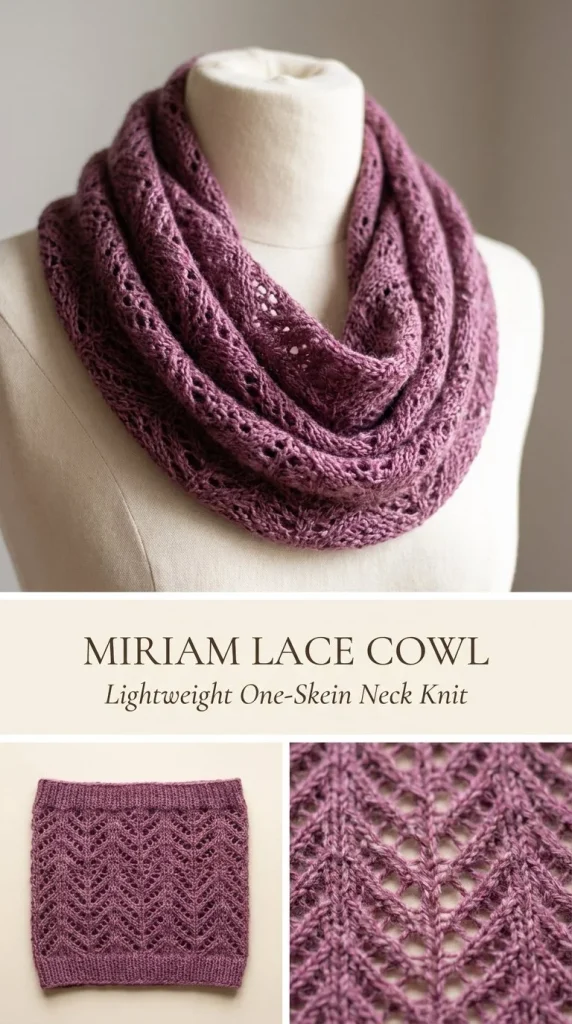
Creating a beautifully intricate yet wearable accessory, this lace cowl features an inviting combination of delicate openwork and classic ribbed edges. Designed to be worked in the round, it showcases a refined 4-round lace pattern framed by simple k1, p1 ribbing, offering both elegance and comfort. The subtle drape of the fingering-weight alpaca or wool yarn enhances the airy lace, making this cowl a perfect layering piece for cooler weather with just enough warmth without bulk.
The construction is straightforward yet sophisticated, starting with elastic ribbed edging that transitions smoothly into a series of balanced yarn overs and decreases forming a symmetrical lace motif. The finished cowl lies flat at approximately 11 inches high by 16 inches wide, an ideal size to plunge over your head and nestle softly around your neck. The finishing elastic ribbing ensures the cowl maintains its shape and resilience through wear.
This project is crafted on circular needles to create a seamless tube, avoiding any distracting seams or joins that could break the flow of the lace. Working in the round also allows the lace pattern to develop continuously, making each knit round a satisfying step closer to the final elegant piece. You can find similar inspirations and detailed treatments of ribbed necklines in the Alizé Shoulder Cowl pattern, which offers complementary techniques and styles for knitwear cowl designs.
Pattern at a Glance
Skill level: Intermediate — requires familiarity with lace knitting, increases, decreases, and circular needle techniques.
Terminology: Standard American knitting terms.
Construction: Worked in the round from the bottom edge upward.
Finished size: Approximately 11 inches (27.5 cm) high by 16 inches (40 cm) wide when laid flat.
Yarn weight: Fingering-weight yarn (alpaca or wool recommended).
Needles: US 1 (2.5 mm) 16-inch circular needle for ribbing; US 2 (3 mm) 16-inch circular needle for lace body.
Notions: Marker for beginning of round (BOR), yarn needle for weaving in ends.
Gauge: About 28 stitches x 40 rounds = 4 inches / 10 cm.
Main stitch: Eyelet lace with ribbed borders.
Layout: Continuous round knitting forming a seamless cowl tube.
Border: K1, p1 ribbing at top and bottom edges.
Seaming: None — seamless round knitting.
Materials
To create this lace cowl, you will need fingering-weight alpaca or wool yarn, requiring approximately 180 to 370 yards depending on your tension and yarn choice. These fibers provide a lovely blend of warmth, softness, and a gentle halo effect particularly notable in alpaca yarns. Use a US 1 (2.5 mm) 16-inch circular needle for the ribbed edges, chosen for its tighter gauge to create elastic cuffs. For the main lace section, switch to a US 2 (3 mm) 16-inch circular needle to allow more openness and drape in the lace fabric.
A stitch marker is helpful to mark the beginning of rounds, especially in circular knitting, ensuring your lace repeats line up correctly each round. Lastly, a yarn needle is essential for weaving in loose yarn ends cleanly after finishing your piece.
Yarn and Color Notes
Natural fibers like alpaca and wool not only provide warmth but also block beautifully, opening up the lacework to reveal it in its full glory. Alpaca, known for its luxurious softness and slight elasticity, makes a particularly good choice for this project, giving the lace pattern a lovely flow without stiffness.
Smooth yarns can emphasize the clarity of lace stitches, making each yarn over and decrease pop visually. In contrast, fuzzy or haloed yarns can soften the stitch definition but lend a cozy, diffused bloom effect. Consider your preference when choosing your yarn type.
Due to the delicate nature of the lace pattern, solid or tonal colors will showcase the details best, while highly variegated yarns could obscure the stitch pattern. For complementary coordination, explore color choices that contrast subtly with your wardrobe staples.
Finished Measurements
The cowl measures approximately 11 inches (27.5 cm) in height from edge to edge when laid flat, and about 16 inches (40 cm) in circumference without stretching. This size comfortably slips over the head, rests around the neck, and offers enough material to fold or scrunch for style and warmth.
Dimensions depend on the gauge; if your tension varies, the final size will adjust accordingly. Blocking can also affect finished size by opening the lace gently without stretching the ribbed edges.
Gauge
Gauge for this pattern is specified as:
28 stitches x 40 rounds = 4 inches (10 cm)
This gauge is crucial to achieving the specified finished size and fabric drape. Measure your gauge by knitting a swatch in the lace pattern on the larger needles, then blocking it as you would the finished piece for the most accurate measurement.
If your gauge results in fewer stitches per 4 inches, your cowl will be larger and potentially looser in fit. Conversely, a tighter gauge will produce a smaller, denser cowl. Swatching is an essential step to ensure your finished project matches intended dimensions.
Abbreviations
- CO – Cast On
- k – Knit
- p – Purl
- k1, p1 rib – Knit 1 stitch, purl 1 stitch ribbing
- k2tog – Knit 2 stitches together (right-leaning decrease)
- ssk – Slip, slip, knit (left-leaning decrease)
- yo – Yarn over (increase to create a lace hole)
- BOR – Beginning of round
- rnd(s) – Round(s)
Important Pattern Notes
- The cowl is worked in continuous rounds on circular needles, forming a seamless tube.
- Join the cast-on stitches carefully without twisting to ensure the lace pattern flows uninterrupted.
- The ribbed edging uses a smaller needle size for elasticity and structure, while the lace section requires a slightly larger needle to highlight stitch openness.
- Stitch repeats in the lace section are multiples of 11 stitches, adjusted to fit the number of stitches cast on.
- Marker placement at BOR helps maintain stitch count accuracy and identify pattern repeats comfortably.
- The pattern uses balanced increases (yarn overs) and decreases (k2tog and ssk) to maintain stitch count and produce symmetrical lace motifs.
Special Stitches and Techniques
This project employs several fundamental lace knitting techniques:
- Yarn Over (yo): Creates an intentional hole in the fabric, forming eyelets.
- K2tog (knit two together): A right-leaning decrease.
- SSK (slip, slip, knit): A left-leaning decrease.
- K1, P1 Ribbing: Alternating knit and purl stitches for a stretchy edge.
- Elastic Bind-Off: Ensures the cuff remains stretchy and pliable, important for edging.
Familiarity with knitting in the round and maintaining stitch count during lace work is necessary for a smooth knitting experience.
Understanding the Construction
The cowl begins with ribbed edging to stabilize the bottom border and provide a comfortable fit. After the ribbing is complete, the lace body section flows seamlessly, constructed from an original four-round lace repeat involving yarn overs and delicate decreases creating a subtle botanical-inspired motif. The piece ends with a matching ribbed edging to mirror the start, binding off elastically to preserve the stretch.
Because it is worked in the round, the cowl produces a continuous tubular shape without seams, which enhances comfort and emphasizes the lace pattern uninterrupted across the fabric.
Inside this lace section, stitch count remains constant, thanks to the built-in balance of increases and decreases, allowing knitters to focus on lace stitch execution rather than complicated stitch manipulations.
Full Pattern Instructions
Foundation and Ribbing
- Using smaller needles (US 1 / 2.5 mm), cast on 154 stitches evenly. Ensure the cast-on is loose enough to avoid tight edges but firm enough for structure.
- Place a marker to denote the beginning of round (BOR) and join carefully, making sure the stitches are not twisted around the needle. This is vital for the continuous circular construction.
- Work k1, p1 ribbing for 1.5 inches (4 cm). This ribbing creates a firm, elastic border that hugs the neck comfortably and supports the weight of the lace section.
Transition Round
- Change needles to the larger size (US 2 / 3 mm).
- Knit 1 round fully in knit stitch to prepare the fabric for the lace repeat and create a clean transition between rib and lace.
Lace Body Pattern
This section is worked over 4 rounds, repeating to form an 11-stitch lace motif:
-
Round 1: Knit all stitches.
-
Round 2: Repeat around:
- Knit 2 together (k2tog), yarn over (yo), knit 3 (k3), yarn over (yo), slip, slip, knit (ssk), knit 4 (k4).
Repeat this sequence across the entire round, adjusting the final repeat near the BOR to ensure stitch counts align perfectly.
- Knit 2 together (k2tog), yarn over (yo), knit 3 (k3), yarn over (yo), slip, slip, knit (ssk), knit 4 (k4).
-
Round 3: Knit all stitches.
-
Round 4: Repeat around:
- Knit 1 (k1), yarn over (yo), slip, slip, knit (ssk), knit 3 (k3), knit 2 together (k2tog), yarn over (yo), knit 4 (k4).
Repeat this sequence to the end of the round.
- Knit 1 (k1), yarn over (yo), slip, slip, knit (ssk), knit 3 (k3), knit 2 together (k2tog), yarn over (yo), knit 4 (k4).
Continue these 4 rounds, maintaining the balance of yarn overs and decreases to keep the stitch count steady, until the piece measures approximately 14.5 inches (36 cm) from the cast-on edge. End after completing a plain knit round for a clean finish to the lace section.
Top Ribbing and Bind-Off
- Switch back to the smaller needles (US 1 / 2.5 mm).
- Work k1, p1 ribbing for another 1.5 inches (4 cm) to match the bottom edge, creating a cohesive look and maintaining elasticity.
- Bind off elastically using your preferred elastic bind-off method, such as the sewn or stretchy bind-off, to maintain fabric flexibility and prevent a tight edge.
Finishing
- Wet block the cowl, gently shaping it to a final size of approximately 11 inches (27.5 cm) tall by 16 inches (40 cm) wide laid flat. Pay careful attention to opening out the lace without stretching the ribbed edges, preserving the elasticity and preventing distortion.
- Weave in all ends neatly on the wrong side for a clean finish.
Tip: If you are working with a yarn that is springier than alpaca (such as some wool blends), consider adding 1–2 extra repeats of the lace pattern before starting the upper ribbing to maintain a graceful drape and avoid a too-short shape.
Pattern Checkpoints
- After casting on and joining, your work should begin as a smooth circular tube without twisting.
- The initial ribbing should measure approximately 1.5 inches (4 cm) before switching to the lace section.
- After completing the lace section, the cowl length should be about 14.5 inches (36 cm) from the cast-on edge.
- Confirm that your stitch count remains constant at 154 stitches after each lace repeat to ensure pattern accuracy.
- The final ribbing adds an additional 1.5 inches (4 cm) to the total height.
Finishing and Blocking
Blocking is crucial to showcase the lace pattern beautifully. Use wet blocking to open the eyelets clearly and even out the fabric. Lay the cowl flat on a blocking surface, gently stretching the lace without pulling the ribbing edges out of shape. Pin in place if necessary.
Allow the piece to dry fully to set the shape. Proper blocking enhances the hand and suspended quality of lace knitting and ensures your cowl looks polished and professional.
How to Resize This Pattern
To resize this cowl, adjust the stitch count in multiples of 11 stitches to maintain the lace repeat pattern integrity. For example, increasing the cast-on stitches by 11 or 22 will widen the cowl without disrupting the lace design.
Length adjustments correspond to adding or subtracting the number of lace pattern repeats vertically. Be mindful that changes in needle size, yarn weight, or gauge will also impact the final measurements, so always swatch and check your gauge before starting a resized version.
For broader or longer cowls, consider adding about 1–2 repeats based on your desired fit and drape.
Useful Variations
- Single-Color or Variegated Yarns: Solid colors emphasize the lace motifs, while subtle variegation can add visual interest without overwhelming the design.
- Fingering to Sport Weight: While this pattern is designed for fingering-weight yarn, experimenting with sport weight or light DK yarn can produce a thicker, warmer cowl but will alter finished size and gauge. Adjust needle sizes accordingly.
- Extended Length Cowl or Infinity Scarf: Adding more lace repeats vertically creates a longer wrap-style cowl or infinity scarf.
- Contrasting Rib Edges: Use a complementary or contrasting color for ribbing edges to frame the lace body artistically.
For additional lace accessory ideas that feature picot edging and delicate stitchwork, consider exploring the Posy Lace Scarf pattern, which shares the same fingering-weight yarn sensibility in lightweight, elegant designs.
Troubleshooting
Why Does My Lace Pattern Look Uneven?
Check your stitch count regularly after each lace round to ensure yarn overs and decreases balance perfectly. Using stitch markers between repeats can help track progress and prevent misplaced stitches.
Why Is the Ribbing Too Tight or Too Loose?
Using a smaller needle size for ribbing creates elasticity, but if too tight, your cowl may feel constrictive. Conversely, using a needle too large might create floppy edges. Swatch both rib removal and lace sections to find the right tension.
How Can I Fix Twisting After Joining in the Round?
If you notice twisting immediately after joining, carefully remove the stitches from the needle and realign them ensuring the cast-on is not twisted before joining. This step is critical to a smooth circular pattern.
My Lace Holes Are Not Standing Out Well
Make sure to block your cowl properly using wet blocking. Yarn weight and fiber can also impact stitch definition; smooth yarns in lighter colors show lace better.
How to Maintain Stitch Count with Complex Lace?
Regularly count stitches every few repeats, especially after rounds with multiple decreases and yarn overs. Use a row counter or note rounds to avoid confusion.
Frequently Asked Questions
Can I use a different yarn weight?
You can substitute lighter or heavier yarns, but this will affect gauge and final size. Adjust needle size and stitch count accordingly and swatch before proceeding.
Can beginners knit this cowl?
The pattern calls for intermediate skills due to lace knitting and circular needles. Beginners with confidence in basic knitting and following charts or written lace instructions may find it a rewarding challenge.
Is the cowl reversible?
Yes, the seamless round construction and symmetrical lace pattern enable the cowl to be worn with either side facing out.
How do I care for the finished cowl?
Hand wash gently in cool water and lay flat to dry to preserve shape and fiber quality, especially if using alpaca or delicate wool.
Can I add fringe or tassels?
Yes, attaching fringe can personalize your cowl’s look but may affect drape and weight. Plan placement carefully.
What if the lace section is too short on me?
Add 1–2 extra repeats of the lace pattern before starting the upper ribbing to increase length while maintaining design balance.
Optional Related Projects
The elegant lace motif and ribbed edging used here can be adapted for other accessories such as lightweight scarves, wrist warmers, or a coordinating lacey shawl border. Patterns highlighting similar lace-work and rib cuffs include delicate scarf designs and high-neck accessories that share construction philosophies and finishing touches.
Final Thoughts
This lace cowl combines elegance and practicality through its seamless circular construction, balanced lace motifs, and supportive ribbed edges. By carefully selecting yarn, adhering to gauge, and embracing the stepwise lace repeats, knitters can create a wearable piece that elevates any cold-weather outfit. The thoughtful design invites customization in size and color, making it a versatile project whether for yourself or as a refined gift.
With just two needle sizes and a stitch marker, this pattern is accessible yet satisfying, providing a beautiful canvas for showcasing classic alpine fiber yarns like alpaca or fine wool. Enjoy the process of turning simple materials into a stunning heirloom-quality accessory.
For those inspired by stitch detail and elegant neckwear, exploring other well-crafted cowl designs such as the Alizé Shoulder Cowl or the Posy Lace Scarf can expand your skills and collection with complementary style elements.



