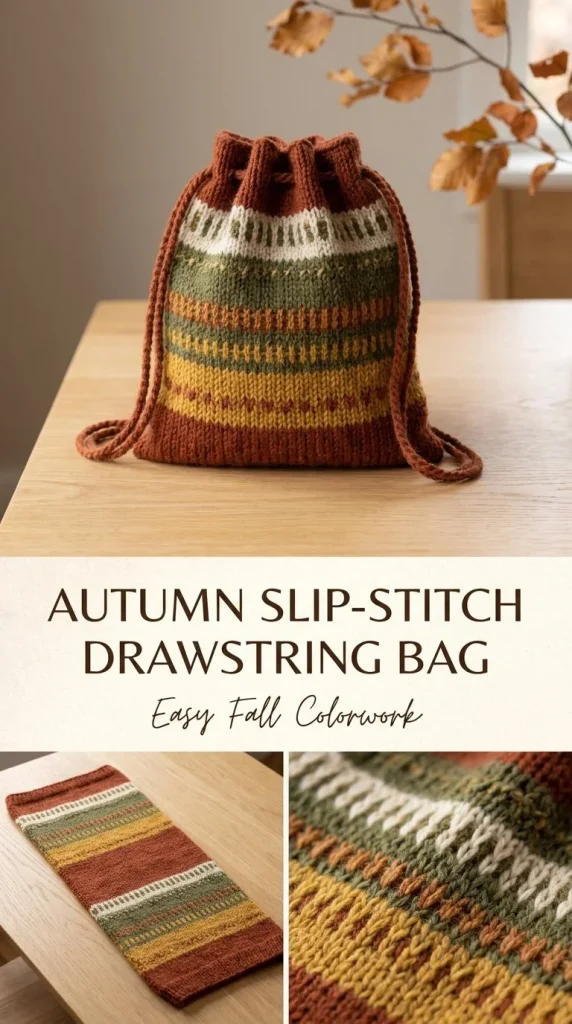
This autumn-inspired drawstring bag offers a charming blend of rustic colorwork and practical design, perfect for carrying small essentials during crisp fall outings. Crafted using slip-stitch knitting techniques, this project showcases a beautiful interplay of four coordinated shades reminiscent of autumn foliage. The bag’s straightforward rectangular construction simplifies knitting while allowing the subtle textural and color changes to take center stage.
The slip-stitch colorwork technique used here provides an eye-catching, dense fabric that adds warmth and durability—ideal for a small bag intended for everyday use. By knitting one seamless rectangle and folding it cleverly to form the pouch, the pattern maintains clean lines and a minimal seaming process. The drawstring casing at the top not only secures your belongings but also adds a lovely finish, letting you customize the bag’s closure with either a cord or a knitted I-cord drawstring.
The choice of yarn and colors is essential to enhance this design. For an enriched autumn palette and to best mimic the texture shown, selecting DK weight yarn in warm hues is recommended. The sequence of color changes follows a rhythmic pattern, producing a harmonious gradient that will delight both novice and experienced knitters. This drawstring bag is both a functional accessory and a wonderful introduction to slip-stitch colorwork, offering a satisfying balance of technique and immediate usability, similar in autumnal appeal to the autumn plaid slip-stitch cowl pattern.
Pattern at a Glance
Skill level: Intermediate (due to slip-stitch colorwork and seaming)
Terminology: Standard US knitting terms
Construction: Single rectangular panel folded in half with seamed sides and top casing for drawstring
Finished size: Approximately 21 in (53 cm) circumference x 11 in (28 cm) high
Yarn weight: DK (light worsted)
Needle size: US 6 (4 mm) knitting needles
Main stitch: Slip-stitch colorwork with garter and stockinette sections
Gauge: About 20 stitches per 4 in (10 cm) in stitch pattern
Layout: One long rectangle, folded and seamed
Seaming: Side seams with right side facing out
Border: Garter stitch beginning; stockinette around casing edge
Materials
To complete this project you will need:
- DK weight yarn: Approximately 360-400 yards (329-366 meters) total, divided among four coordinated autumn shades such as burnt orange, mustard yellow, deep rust, and olive green. These shades work well together to create the seasonal color scheme. Selecting smooth, plied yarn helps the slipped stitches pop visually.
- Knitting needles: US 6 (4 mm), recommended for resulting fabric density and gauge.
- Tapestry needle: For weaving in ends and seaming.
- Stitch markers: Two, to help keep track of pattern repeats or side edges.
- Optional cotton lining fabric: A lightweight cotton cut slightly smaller than the finished knitted bag to be hand-stitched inside for added structure.
- Drawstring cord: About 30 inches (76 cm) in length. You may use a purchased cord or create a matching knitted I-cord approximately 3 stitches wide.
- Measuring tape: To check gauge and finished dimensions.
Each material is carefully chosen to enhance the bag’s durability, texture, and autumn aesthetic. DK yarn strikes a good balance between warmth and ease of knitting, while the optional lining provides optional body and prevents stretch.
Yarn and Color Notes
When selecting yarn, opt for fibers that hold their shape well. Wool or wool blends are helpful here because the slip-stitch technique can create a dense, slightly thick fabric. Avoid overly fuzzy or halo yarns, as they may blur the slip-stitch pattern and reduce stitch definition.
The structured, multi-color fall palette is essential to evoke the seasonal feeling. Using four distinct autumn colors allows the bags’ slip-stitch pattern to read clearly, with slipped stitches forming contrasting grids. For smooth color transitions, use solids rather than variegated yarns in this project.
If you want a similar cozy colorwork effect in scarves or cowls, see the autumn color block chunky scarf knitting pattern, which shares a complementary approach to color sequencing and seasonal tones.
Finished Measurements
The finished drawstring bag measures approximately:
- Circumference: 21 in (53 cm) around the widest point.
- Height: 11 in (28 cm) from bottom to drawstring casing.
Because the construction involves folding a rectangle, the width of the single knitted panel is about half the total circumference (10.5 in / 26.5 cm wide). Lengthwise, the piece before assembly is 22 in (56 cm) long, including the bottom fold. The bag size provides ample space for essentials such as wallet, phone, and small accessories.
These measurements are dependent on reaching the specified gauge. Variations in gauge will affect the final size, which is critical to note for fit and proportion.
Gauge
Gauge is approximately 20 stitches per 4 inches (10 cm) in the slip-stitch pattern when knitted on US 6 (4 mm) needles.
- Gauge is measured horizontally across the fabric (width).
- Maintaining gauge is essential as the stitch count and row repeats are designed to produce a specific size.
If your gauge yields more stitches per 4 inches, your fabric will be denser and the bag smaller. Conversely, fewer stitches per 4 inches will create looser fabric and a larger bag but may compromise durability and pattern clarity.
Always knit a swatch in the slip-stitch pattern with your chosen yarn and needles before starting the project. This ensures your final bag will meet the intended dimensions.
Abbreviations
- CO: Cast on
- k: Knit
- p: Purl
- sl: Slip stitch
- wyib: With yarn in back
- k2tog: Knit two together (decrease)
- yo: Yarn over
- RS: Right side
- WS: Wrong side
Important Pattern Notes
- The pattern involves working a single rectangle panel with slip-stitch colorwork.
- The stitch multiple is 4 + 2 edge stitches, critical to maintaining the pattern repeat.
- Color changes occur every 4 rows following the specified autumn sequence (A-B-C-D-B-A).
- Slipped stitches are worked with yarn in back (wyib).
- The rectangle is folded at the bottom edge, then seamed on both sides to form the bag body.
- The drawstring casing is formed at the top with stockinette rows and a decorative eyelet row.
- Seams are done neatly on the wrong side, maintaining the right side out.
Special Stitches and Techniques
Slip-Stitch Colorwork
This technique involves slipping stitches while carrying one color of yarn and knitting stitches in another color to create a mosaic-like effect. Slipping stitches with the yarn held in the back (wyib) ensures a clean texture without puckering.
Garter Stitch
The initial 6 rows are in garter stitch (knitting every row), which forms a slightly textured border at the bag’s base and stabilizes the edge.
Stockinette Stitch
Used for the drawstring casing, stockinette involves knitting on the right side and purling on the wrong side to create a smooth fabric.
I-Cord
The drawstring can be a simple knitted I-cord with 3 stitches, offering a sturdy and uniform closure cord that matches the bag’s colors.
Understanding the Construction
The entire bag is worked in one simple knitted piece—a rectangle approximately 10.5 inches wide and 22 inches long.
- Cast on 54 stitches to achieve the gauge width of 10.5 inches.
- Begin with 6 rows of garter stitch in Color A for a stable base.
- Follow with the main slip-stitch colorwork pattern across 20 inches of length, alternating colors every 4 rows, cycling through four complementary autumn tones.
- The rectangle is then folded in half at the bottom edge (fold line at 11 in / 28 cm).
- A drawstring casing is knitted at the top with stockinette rows and an eyelet row for threading the drawstring.
- The side seams are sewn neatly, leaving the casing open.
- A cord or knitted I-cord is threaded through the eyelets to finish.
This clever folding and seaming method turns one flat panel into a roomy, functional drawstring bag.
Complete Pattern Instructions
Foundation
With US 6 (4 mm) needles and Color A, cast on 54 stitches. This stitch number is based on the required gauge and pattern multiple (4 + 2 edge sts).
Garter Stitch Base
Work 6 rows of garter stitch (knit every row) with Color A.
Main Slip-Stitch Colorwork Pattern
The pattern is a 4-row repeat worked over a multiple of 4 stitches plus 2 edge stitches.
-
Row 1 (Right Side) [Color A]:
Knit 1 (edge stitch), then knit 2, slip 2 stitches wyib repeat to last stitch, knit 1. -
Row 2 (Wrong Side) [Color A]:
Knit 1 (edge stitch), purl across all stitches (working slipped sts and knit sts as they appear), knit 1. -
Row 3 (Right Side) [Color B]:
Knit 1 (edge stitch), then slip 2 stitches wyib, knit 2 repeat to last stitch, knit 1. -
Row 4 (Wrong Side) [Color B]:
Knit 1 (edge stitch), purl across all stitches, knit 1.
Repeat these 4 rows, changing colors in an autumn sequence every 4 rows, cycling through colors A, B, C, D, B, A.
Continue until your piece measures about 20 inches (51 cm) in length (not including garter stitch base).
Drawstring Casing
Switch to stockinette stitch for the final section:
- Work 2 rows stockinette (knit right side rows, purl wrong side rows).
- Next row: Eyelet row – knit 2 together, yarn over across between edge stitches.
- Work 5 more rows stockinette.
- Bind off loosely in pattern.
Assembly
Fold the rectangle in half with the right side facing out, matching edges precisely.
Seam both side edges neatly using mattress stitch or preferred seaming technique, being careful to leave the top casing open.
Drawstring
Create a 3-stitch I-cord about 30 inches (76 cm) long or use a suitable purchased cord.
Thread the cord through the eyelets in the casing, allowing the bag to cinch securely.
Optional Lining
Lightweight cotton fabric cut slightly smaller than the bag can be hand-stitched to the inside below the casing for extra durability and shape retention.
Checkpoints
- After finishing the colorwork section, your piece should be about 20 inches long.
- Stitch count remains constant at 54 stitches throughout.
- The side edges should align perfectly when folded.
- Eyelet row placement is critical for proper drawstring threading.
- Ensure drawstring length is sufficient to comfortably cinch and open the bag.
Assembly and Joining
The bag is formed by folding the knitted rectangle at its bottom edge and seaming along both vertical sides.
- Use a tapestry needle and yarn tail to seam edges with the right side facing out.
- Mattress stitch is recommended for a nearly invisible seam.
- Leave the drawstring casing unobstructed at the top.
Turning the piece inside out is not needed, as the fabric is neat and finished on the right side.
Finishing
Weave in all yarn ends tightly, especially at color change points.
Optionally block the finished piece lightly with steam to even out stitches and ease seaming before inserting the lining or threading the drawstring.
How to Resize
The pattern is built on a stitch multiple of 4 plus 2 edge stitches for the slip-stitch pattern, making resizing straightforward in width:
- To increase width: Add multiples of 4 stitches to the cast on count, plus 2 edge stitches. Adjust length proportionally by adding more slip-stitch repeats.
- To change height: Knit additional sets of 4-row slip-stitch repeats before starting the drawstring casing.
- Maintaining gauge ensures the shape stays consistent.
Adjust the cord length proportionally if you change the bag’s circumference.
Useful Variations
- Single color version: Use just one color for the slip-stitch pattern to create a textured monochrome bag.
- Scrap yarn version: Use leftover autumn-colored yarn scraps for a patchwork effect in the slip-stitch pattern.
- Larger tote: Increase stitch count and length for a larger tote-style bag.
- Lining options: Experiment with different lining fabrics such as canvas or flannel for structure or softness.
- This slip-stitch technique also works beautifully for accessories like scarves or cowls, such as the autumn plaid slip-stitch cowl knitting pattern.
Troubleshooting
Why Does My Slip-Stitch Pattern Look Uneven?
Ensure you are slipping stitches with yarn held in back (wyib) consistently, and do not pull yarn too tightly when slipping stitches to maintain even tension.
Why Is My Bag Too Small or Too Large?
Check your gauge carefully before starting. Adjust needle size to get the correct gauge if needed.
Why Are My Seams Bulky?
Use mattress stitch and pick up only the loops from each side to create a flat, neat seam.
Why Is My Drawstring Casing Too Tight to Thread the Cord?
Ensure your eyelet row k2tog, yo is done loosely. Avoid binding off tightly.
Why Does My Bag Curl at the Edges?
The garter stitch section at the base helps reduce curling; if needed, add more garter rows or block the piece gently.
Frequently Asked Questions
Can I use a different yarn weight?
The pattern is designed for DK weight yarn. Using lighter or heavier yarn will affect gauge and final size. Adjust needle size and stitch count accordingly.
Is this bag suitable for beginners?
Basic knitting skills are needed, including color changes and slipping stitches. Intermediate knitters will find the project manageable.
Can I make the drawstring cord using a crochet chain?
Yes, but a knitted I-cord or purchased cord provides a smoother finish that complements the knitted bag best.
How should I care for the finished bag?
Hand wash in cool water and lay flat to dry to preserve shape and color.
Can I add pockets or embellishments?
Additional pockets or applique shapes can be sewn on after finishing, keeping the bag’s structure intact.
Will the stitch pattern be reversible?
The slip-stitch pattern shows best on the right side only. The wrong side has a simpler texture.
Optional Related Uses
This slip-stitch colorwork technique and seasonal palette lend themselves beautifully to projects such as cozy scarves or cowls, echoing the autumn tones and textures. Consider knitting complementary accessories to complete your autumn wardrobe, following patterns like the autumn color block chunky scarf knitting pattern.
Final Thoughts
This drawstring bag pattern elegantly combines simple rectangular construction with engaging slip-stitch colorwork to produce a versatile accessory steeped in autumnal charm. By following the clearly defined stitch pattern and color sequence, knitters create a sturdy yet attractive bag that serves practical daily needs. The open construction and optional lining offer opportunities for creative finishing touches, while the pattern remains accessible for intermediate knitters seeking a satisfying colorwork project that honors the spirit of the season.



