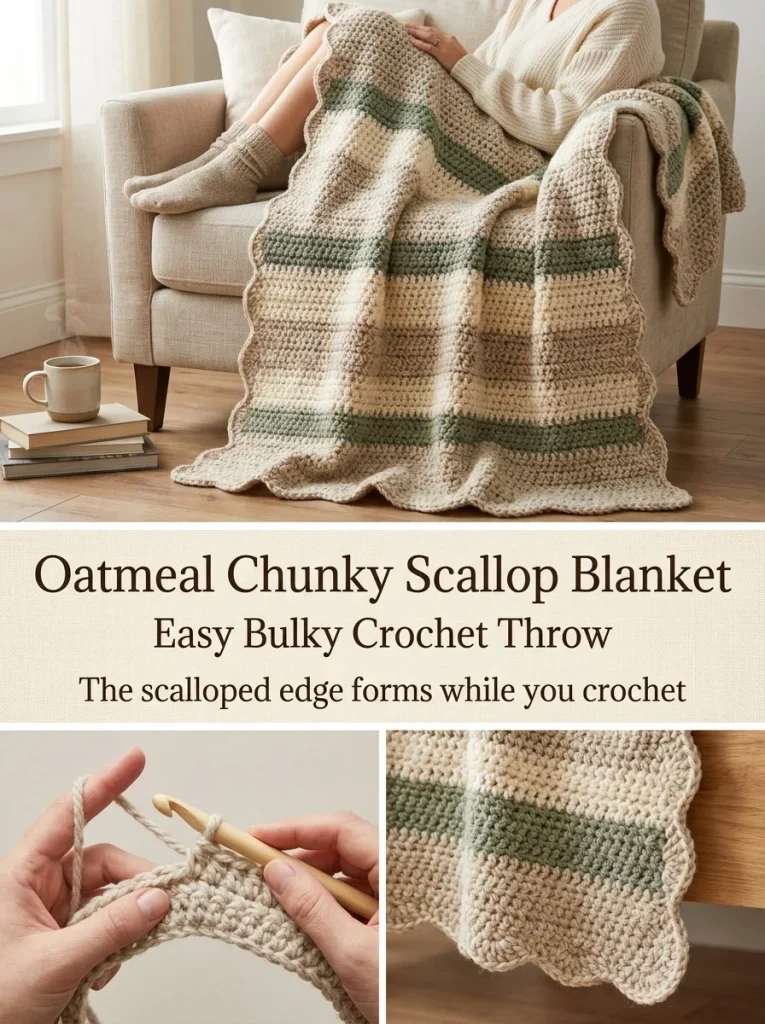
Crocheting a blanket that combines texture, softness, and a delicate visual appeal can be incredibly rewarding. This cozy throw utilizes bulky #5 yarns in a soothing palette of oatmeal, cream, and muted sage, creating an inviting aesthetic that fits naturally into any home décor. The standout feature is its scalloped edges formed organically by the stitch pattern, lending a gentle ripple effect that enhances its tactile and visual charm.
Constructed entirely in rows with a simple yet effective repeating stitch pattern, this blanket is accessible to crocheters who want to achieve a faux scallop border effect without complicated finishing. The use of half double crochets paired with chain spaces to form delicate fan groups makes the texture light and airy despite the chunky yarn chosen. Frequent color changes, especially broad sections in oatmeal complemented by subtle bands of cream and sage, add depth and interest while maintaining a calm, neutral palette.
Ideal for lap throws, this blanket not only keeps you warm but also serves as a stylish accent piece. Its manageable size and straightforward stitch repeat encourage relaxation and creativity, making it well suited for a leisurely project. If you’re interested in similar cozy creations, this blanket shares design sensibilities with other chunky throw patterns featuring playful textures such as the easy two-stitch crochet blanket.
Pattern at a Glance
Skill level: Intermediate
Terminology: US crochet terms
Construction: Worked flat in rows with a repeating stitch pattern
Finished size: Approximately 50–52 inches long; width dependent on starting chain
Yarn weight: Bulky #5 yarn (about 1200–1500 yards) in oatmeal, cream, and muted sage
Hook sizes: 6 mm for main body; 5.5 mm for finishing rows
Main stitch: Half double crochet (hdc) with chain 1 spaces forming scallops
Gauge: N/A (project size guided by stitch repeat and yarn weight)
Motifs: Repeating 44 groups of (hdc, ch1, hdc) fans
Layout: Strip worked widthwise with color bands
Joining: None; single-piece flat construction
Border: Simple single finishing rows at short edges
Seaming: None required
Materials
For this project, you will need:
- Bulky #5 yarn: Approximately 1200–1500 yards total, divided among three colorways—oatmeal (main color), cream, and muted sage—for soft accent stripes. The bulky weight ensures warmth and gives the blanket a plush, substantial feel without being overly heavy.
- Crochet Hook 6 mm (Size J): Used to work the main body of the blanket. This hook size allows the bulldog yarn to show good stitch definition while working up the fabric at a comfortable speed.
- Crochet Hook 5.5 mm: Recommended for the finishing rows to create a controlled edge with slightly looser tension, ensuring the border lies flat without distorting the scalloped edges.
- Tapestry Needle: For weaving in ends after color changes and when finishing the project.
- Optional: Scissors for cutting yarn, stitch markers if desired to mark repeats or color change rows.
Each of these materials contributes to achieving the correct tension and drape for the scallop edges and the cozy throw finish.
Yarn and Color Notes
Bulky weight yarns are ideal for creating warmth and quick project growth, and the choice of fiber can impact the feel and appearance of the throw. A smooth, acrylic or wool blend yarn will provide good stitch definition, highlighting the clean half double crochet fans effectively. Avoid fuzzier yarns like mohair blends that might obscure the scalloped texture.
The color palette here is carefully chosen to evoke calm and understated elegance:
- Oatmeal forms the broad base sections, grounding the project in a neutral tone.
- Cream and muted sage function as accent stripes, gently breaking up the oatmeal and adding fresh, soft color hints without overpowering the overall look.
Feel free to adapt the palette to your own home décor or personal taste. Monochrome or different tonal gradients within a color family could also beautifully emphasize the texture.
Finished Measurements
The blanket is approximately 50 to 52 inches long from the foundation chain edge to the top finished edge. The width corresponds roughly to the foundation chain, which is based on a multiple of 3 stitches minus 1, taken at 131 stitches for 44 repeating fan groups.
This size is a comfortable lap throw dimension, large enough for warmth and visual impact but still easy to handle and store. Adjustments to width or length should follow the established stitch multiples and row repeats carefully.
Gauge
Specific gauge measurements are not provided, as the layout and size directly depend on the stitch repeat and bulky yarn usage. However, maintaining consistent tension is critical to preserve the scalloped edges and overall fabric appearance.
If your gauge is tighter than recommended (smaller stitches), your blanket may come out slightly smaller and denser; looser tension will make a larger, softer fabric. For household throws, precise gauge is less crucial than for garments; focus instead on maintaining consistent stitch size throughout.
Abbreviations
- ch: chain
- hdc: half double crochet
- st(s): stitch(es)
- sp: space
- tog: together (used if decreasing; not applied in this pattern)
All terms align with standard US crochet terminology.
Important Pattern Notes
- The foundation chain is worked as a multiple of 3 minus 1 (3n – 1), where n = 44 to form 44 repeating fan groups.
- The stitch pattern creates fans (hdc, ch1, hdc) that form scallops on the two long edges naturally.
- Color changes should always occur at the beginning or end of a row to maintain clean color transitions.
- The finishing rows use a smaller hook to prevent stretching around the edges.
- Chains forming turning chains do not count as stitches in this pattern.
- Only chain-1 spaces are worked into during the repeating rows, not individual stitches.
Special Stitches and Techniques
Half Double Crochet (hdc): The basic stitch used for the fan groups. Insert your hook into the specified stitch or chain space, yarn over, pull up a loop, yarn over, pull through all three loops on the hook.
Chain-1 space: Used as the placement for fan stitch groups to create open scalloped gaps.
No advanced or post stitches are needed, making this a straightforward stitch repeat suitable for adventurous beginners and intermediate crocheters. Color changing techniques such as fastening off or carrying yarn can be adapted depending on your personal preference for clean stripes.
Understanding the Construction
The blanket is worked flat from the foundation chain upward in rows. The main body consists of repeating "fan" motifs grouped in a sequence. These fans—created by places of (hdc, ch1, hdc) in single stitches or chain spaces—build a fabric that naturally ripples along its long edges, creating soft scallops.
Broad sections of oatmeal yarn dominate, punctuated occasionally by narrower bands in cream and muted sage. Color changes always happen neatly at row edges for visual clarity.
The width is determined by the initial chain (wing span of 44 fan groups), and length is built by repeating the same fan-row pattern until reaching about 50–52 inches.
Finishing involves adding controlled half double crochet or single crochet edging at the short ends only—top edge and foundation chain edge—to echo tension balance without masking the scallop effect on the sides.
Complete Pattern Instructions
Foundation
With the 6 mm hook and oatmeal yarn, chain 131 stitches. This number is calculated as 3 stitches per fan group times 44 groups minus 1 (3 × 44 − 1 = 131).
Row 1
- Starting in the second chain from the hook, work a fan group consisting of (hdc, ch1, hdc) all into that stitch.
- Skip the next two chains.
- In the following chain, again work (hdc, ch1, hdc).
- Repeat this sequence (skip 2 chains, fan in next chain) across the foundation chain until you have created 44 fan groups.
- This establishes the pattern’s scalloped motif foundation with open “valleys” where chains were skipped.
Row 2
- Chain 1 and turn your work.
- Working now only in the chain-1 spaces created by the fans in Row 1, place a fan group (hdc, ch1, hdc) in each of the 44 chain-1 spaces across.
- Do not work into the stitches themselves, only the chain spaces.
Subsequent Rows
Repeat Row 2 for the entire body of the blanket. Each fan group continues to build on the chain-1 spaces of the row below.
As the work builds, the fans radiate from single chain spaces, causing the sides to grow with natural scallops.
Color Changes
Work broad sections in oatmeal as the main color. Integrate occasional thinner bands of cream and muted sage as accent stripes. Always change color after completing a row to keep edges clean.
Length
Continue repeating Row 2 until the piece measures approximately 50 to 52 inches long.
Finishing
Using the 5.5 mm hook for a slightly looser tension on finishing:
- Work a single, controlled row of half double crochet or single crochet stitches evenly across the top edge.
- Rotate the blanket and work the same edging across the foundation chain edge.
- Do not apply any border along the scalloped long sides to maintain the natural rippling effect of the design.
Use a tapestry needle to weave in all ends securely.
Checkpoints
- After foundation chaining and Row 1, you should have 44 fan groups evenly spaced along the row.
- Each successive row keeps the stitch count stable at 44 fan groups.
- The width of the blanket should remain consistent throughout, with soft scallops visible along the long edges.
- After reaching approximately 50-52 inches lengthwise, your blanket will reach the intended finished size.
- Finishing rows should lie flat and reinforce the edges without pulling or warping.
Assembly and Joining
This project is worked in one continuous flat piece; no assembly, seaming, or joining of separate parts is necessary. Color changes seamlessly integrate within the rows, so no special joining techniques are needed for color transitions other than neat yarn management.
Border and Finishing Details
The finishing edging is subtle and practical, meant to stabilize the edges at the top and bottom without flattening the decorative scallops on the sides.
- Use the slightly smaller 5.5 mm hook to maintain control over the edge tension.
- The finishing row is crucial to prevent the top and bottom edges from rolling or stretching.
- Weaving in ends should follow color changes strategically so that ends are hidden within the fans of the corresponding rows.
- Blocking is optional; the natural texture usually holds well with the bulky yarn’s hand. Light blocking to even out scallops is possible but should preserve the gentle curve of the edges.
How to Resize
This pattern’s width is determined by the number of fan groups (44 groups in this version). To resize:
- Width: Adjust the foundation chain by multiples of 3 stitches plus subtract 1 (3n – 1). For example, for 50 fan groups: 3 × 50 − 1 = 149 chains.
- Length: Continue the repeating fan-row for additional rows until the desired length is reached. Each row adds similarly to length.
Keep color changes aligned with row edges as in the original pattern, and maintain the same finishing rows for a balanced look.
Useful Variations
- Make a one-color version using only oatmeal or your favorite bulky yarn color for a minimalist look.
- Use a scrap yarn palette for a playful multicolor variant that highlights the scallop motif.
- Extend lengthwise for a larger throw or shorten for a cozy lap scarf.
- Try adapting the stitch pattern for a coordinating pillow cover or cozy chunky teddy-themed blanket that uses similarly friendly bulky yarns and textures.
Troubleshooting
Why is my fabric too narrow or wide?
Ensure your foundation chain count exactly matches the multiple of 3 minus 1 formula. Stitches skipped in error or extra stitches added will throw off the scallop pattern.
Why don’t the scallops form properly?
The fan groups must be placed precisely into every second chain or chain-1 space as per instructions. Missing a fan or adding extra stitches will flatten or distort scallops.
Why does the edge ripple or curl too much?
This pattern’s sides ripple by design, but if edges beyond that ripple appear uneven, check your tension. Finishing rows on short edges help stabilize lengthwise edges.
How do I keep color changes clean?
Change colors at the edge of rows, preferably at the final yarn over of the last stitch to get a clean transition. Fasten off or carry yarn neatly to avoid bulk.
Frequently Asked Questions
Can I use a different yarn weight?
You can substitute lighter or heavier yarns, but this will change the size and drape. Adjust hook size accordingly and expect variations in scallop definition.
Can beginners make this blanket?
Yes, the stitch pattern is straightforward, relying on half double crochets and chain spaces with repeated rows. Some experience with gauge and color changes is helpful.
How should I carry yarn for color changes?
You can carry unused yarn along the edges or weave in ends between rows. Avoid carrying yarn across the entire row to maintain fabric integrity.
Is the pattern reversible?
The blanket looks good on both sides due to the symmetrical fan repeats, though the right side has a cleaner visual.
How do I block the blanket?
Light blocking with steam or gentle pinning can help even scallops but is optional due to bulky yarn stability.
Can I add a border along the scalloped edges?
Not recommended, as the scallops are a key feature. Adding a heavy border may conceal the delicate edge shaping.
Related Projects
The half double crochet fan stitch motif used here can be adapted for lap throws, scarves, pillow covers, or baby blankets. Its easy-to-repeat structure suits various color and size modifications to create coordinated cozy items.
Final Thoughts
This blanket’s charm lies in its simple construction that yields a naturally scalloped edge, rich texture, and soft color palette. By building on repeated fan stitch groups and clean color changes, crocheters can enjoy a rhythmic, meditative experience with a stunning result. The project comes down to three main steps: foundation chain, repeating fan rows, and subtle finishing edges. This method offers a stylish chunky blanket perfect for gifting or personal comfort, proving that elegance in crochet can be straightforward and deeply satisfying.



