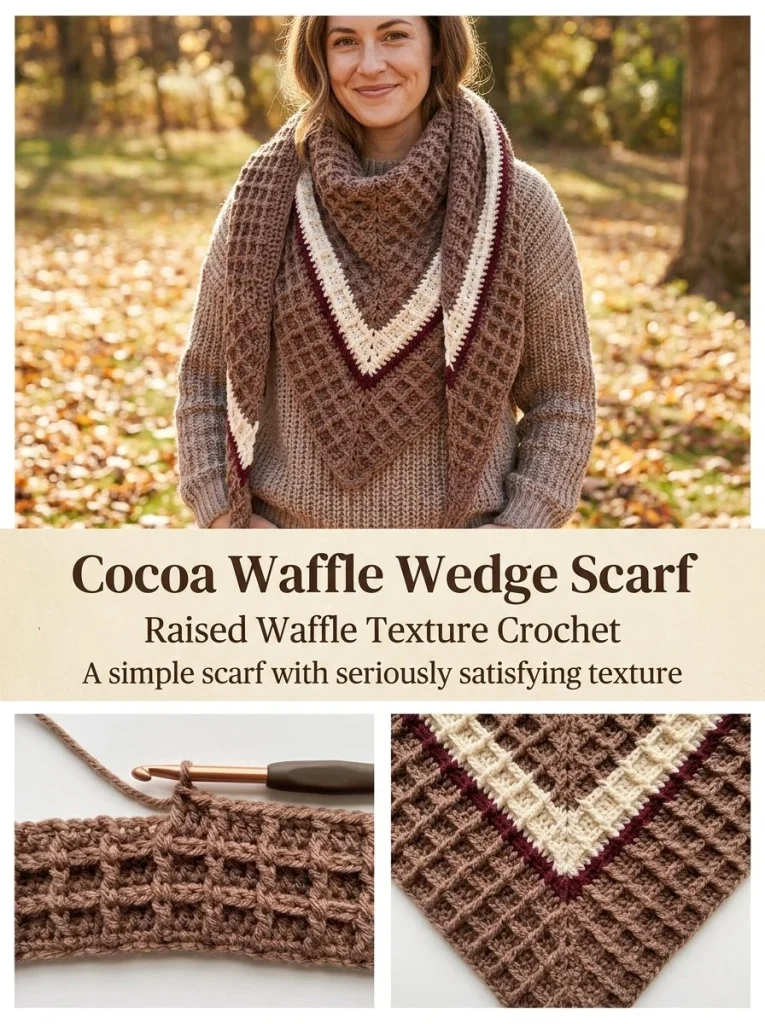
This cozy, textured crochet scarf features a distinctive wedge shape that gently tapers along its length while showcasing a rich waffle stitch pattern accentuated with deep post stitches. Designed to measure approximately 78 inches long and 6 inches wide, this scarf uses a clever shaping technique that balances increases and decreases for an elegant triangular profile. The interplay of colors—cocoa, warm cream, and burgundy—adds subtle accent wedges that enhance the visual appeal without disrupting the stitch pattern.
The main technique combines front-post and back-post double crochet stitches to build dimensional waffle boxes, and the central wedge shaping utilizes double crochet decreases paired with a notable V-stitch at the center spine. This results in a fabric that literally bends into a shallow wedge, creating a sculptural yet comfortable accessory perfect for cooler seasons.
Crafted in worsted weight yarn with a 5.5 mm hook, this project strikes an excellent balance between texture and drape, making it a standout addition to anyone’s crochet wardrobe. For enthusiasts interested in similarly textured projects, consider exploring the intricate Granny Scarf pattern featuring warm cocoa tones, which complements the waffle wedge’s rustic charm with a different stitch construction.
Pattern at a Glance
Skill level: Intermediate – familiarity with front-post/back-post stitches and decreases suggested
Terminology: Standard US crochet terms
Construction: Worked flat in rows, shaping wedge by balanced edge decreases and center increases
Finished size: Approximately 78 inches long by 6 inches wide
Yarn weight: Worsted (#4)
Hook: 5.5 mm (approx. I/9 US)
Main stitch: Combination of single crochet, double crochet, front-post and back-post double crochet, and V-stitch (dc, ch1, dc)
Gauge: Not explicitly specified, but width focused on finishing near 6 inches wide
Motifs: Waffle-like textured boxes formed by post stitches
Layout: Single long rectangle with wedge shaping
Joining: None (single continuous piece)
Border: None beyond pattern’s edge shaping
Seaming: None required
Materials
- Worsted weight #4 yarn: Approximately 500–550 yards total, divided among three colors—cocoa as main color, with warm cream and burgundy for occasional accent wedges. These accent colors are only introduced at the ends of rows to maintain pattern continuity.
- Crochet hook: Size 5.5 mm (US I/9) hook is recommended to create a balanced fabric with good stitch definition suitable for the waffle texture without excessive drape or stiffness.
- Tapestry needle: For weaving in ends after color changes and finishing.
The quantity of yarn ensures enough yardage for the full length, with color changes mostly at row ends to create sharp, clean wedges of accent colors without interrupting the pattern in the row’s center.
Yarn and Color Notes
Choosing the right yarn fiber is important since the waffle stitch texture relies on post stitches that need good stitch definition. Smooth wool or wool blends are ideal as they hold the raised post stitches firmly and highlight the dimensional waffle boxes beautifully.
Colorwise, the project benefits from high contrast between the cocoa base and the accent wedges in warm cream and burgundy. These colors are introduced only at row ends, not mid-row, to maintain a clean visual flow and avoid awkward color joins that can break the fabric’s structural integrity.
Avoid very fuzzy or halo yarns, as they may obscure the intricate post stitch pattern. If you prefer a solid monochrome version or more frequent color changes, consider exploring related textured scarves like the Acorn Brown Keyhole Scarf with subtle tonal shifts, which uses a complementary palette and texture for an elegant finish.
Finished Measurements
The scarf measures approximately 78 inches (198 cm) in length and 6 inches (15 cm) in width after blocking. This length is suitable for wrapping comfortably around the neck with enough tail to tie or drape.
Width is controlled through the wedge-shaped stitch increases and decreases to maintain a slim profile, making it a versatile accessory for layering under jackets or wearing solo.
Because the fabric naturally forms a gentle shallow wedge, it lies flat against the neck providing a flattering drape that doesn’t bunch.
Gauge
While an exact gauge isn’t specified, stitch density and finished width depend directly on your tension and hook size. The pattern’s shaping keeps stitch count roughly constant at 25 stitches across, so the width measures near 6 inches when using the recommended 5.5 mm hook with worsted yarn.
Maintaining consistent tension is crucial for even wedge shaping. If your gauge produces fabric wider or narrower than 6 inches, consider adjusting your hook size slightly: smaller for a denser, narrower fabric; larger for a looser, wider fabric.
Check your width after completing a few repeats of the stitch pattern and wedge shaping rows. This helps ensure your scarf will reach the proper dimensions and maintain the waffle texture effectively.
For projects like scarves and wraps, gauge is somewhat flexible, but for the intended visual effect and fit, aim to approximate the guidelines as closely as possible.
Abbreviations
- ch – chain
- sc – single crochet
- dc – double crochet
- dc2tog – double crochet two stitches together (decrease)
- fpdc – front post double crochet
- bpdc – back post double crochet
- V-st – V stitch (dc, ch1, dc) in the same stitch or space
- RS – right side
- WS – wrong side
Important Pattern Notes
- Turning chains are worked according to stitch height but do not count as stitches in the row count.
- Stitch counts are maintained approximately at 25 stitches per row, controlled by balanced decreases at edges and increases at the center.
- Pattern shaping creates a wedge through simultaneous edge decreases (dc2tog and similar) and a central increase via V-stitch.
- The stitch pattern is worked on flat rows, alternating right side and wrong side rows.
- On the right side rows, double crochet and front post double crochet build the waffle texture; on wrong side rows, post stitches alternate for depth using front and back post double crochet.
- Color changes are introduced only at the ends of rows to form accent wedges; never change colors mid-row to avoid disrupting the post stitch pattern.
- The stitch pattern repeats in 6-row sequences shifting raised posts for even waffle stacking along the length.
Special Stitches and Techniques
- Double Crochet Two Together (dc2tog): Decreases two stitches into one by partially completing double crochets over two stitches, effectively shaping edges to taper the scarf.
- Front Post Double Crochet (fpdc): Working the double crochet around the front of the post of the stitch below, bringing raised texture.
- Back Post Double Crochet (bpdc): Similar to fpdc, but around the back of the stitch, providing negative texture contrast.
- V-Stitch (V-st): Creates a small open “V” shape by working two dc’s separated by a chain one in the same stitch or space, crucial here for the center wedge increase point.
- Wedge Shaping: Balances edge decreases with a center V-stitch increase, keeping stitch count even while forming the triangular wedge shape.
- Managing post stitches carefully and maintaining consistent tension is essential to achieve the defined waffle texture.
Understanding the Construction
This scarf is created as a single long rectangular strip with wedge shaping integrated into the row construction.
- The foundation chain is 26 stitches (ch26), the first row sets up a base with single crochet stitches worked in the 2nd chain from hook and across.
- Each subsequent row maintains the total stitch count around 25 by decreasing one stitch at both edges and increasing one stitch at the center.
- The wedge shaping results from this careful balance of increases and decreases to create a shallow triangular profile rather than a straight rectangle.
- The waffle texture arises from alternating rows of front-post and back-post double crochet stitches that create raised “boxes” resembling a waffle pattern.
- The center V-stitch acts as a spine, encouraging the fabric to bend and fold slightly, which enhances the wedge shape.
- Accent colors are introduced only at the ends of rows to form slightly contrasting triangular wedges without disturbing the textured stitch pattern.
This construction method delivers a scarf that’s as visually interesting as it is functional—its texture provides warmth and subtle dimension, while the wedge shape ensures the scarf rests well around the neck without bulk.
Foundation
Begin with a foundation chain:
- Chain 26 stitches.
This chain establishes the base width of the scarf from which the wedge shaping will build. The chain count is intentionally set to 26, producing 25 stitches to work into on the first row after the initial turning chain.
Row 1
- Starting in the second chain from hook, work single crochet (sc) stitches across the chain. You should have 25 single crochet stitches by the end of the row.
This first row creates a firm yet flexible base for the waffle waffle stitch pattern buildup. Single crochet ensures a sturdy foundation that contrasts nicely with the textured double crochet post stitches in subsequent rows.
Row 2
- Chain 3 to serve as your turning chain and first double crochet.
- Begin the row by working a double crochet two together (dc2tog) over the first two positions, decreasing the edge by one stitch.
- Then, proceed toward the center stitch with a combination of regular double crochet (dc) and front post double crochet (fpdc) stitches. This creates the raised texture that forms the start of the waffle box.
- When you reach the center stitch, work a V-stitch—that is, dc, ch 1, dc all into the center stitch. This acts as a central increase to maintain the stitch count and introduce shaping.
- Mirror the sequence of post stitches, moving from the center back to the opposite edge.
- Finish the row with a dc2tog over the last two stitches, decreasing the opposite edge by one stitch.
This row sets the wedge shaping by balancing decreases at edges with an increase in the center, while simultaneously introducing the waffle texture through strategically placed post stitches.
Wrong Side Rows (Rows 3, 5, etc.)
- On wrong side rows, alternate post stitches to deepen the waffle texture.
- Use front post double crochet (fpdc) and back post double crochet (bpdc) in corresponding positions from the right side to create well-defined waffle boxes.
- Always work the V-stitch (dc, ch1, dc) in the center chain-1 space created in the previous row, preserving the wedge increase.
- Edge decreases are maintained at both sides each row to preserve the wedge shape.
These rows are critical for defining the waffle pockets by shifting raised posts and increasing fabric depth without altering width.
Repeat the 6-Row Sequence
- The established stitch pattern repeat consists of 6 rows.
- Alternate between shifting front and back post positions so that waffle squares stack evenly.
- The centered V-stitch remains constant, ensuring the fabric bends naturally into a shallow wedge shape.
- Continue repeating this 6-row sequence until the scarf measures approximately 78 inches long.
This repeat pattern allows the scarf to grow in length while maintaining an even stitch count and desired wedge form.
Color Changes and Accent Wedges
- Change to warm cream or burgundy yarn only at the ends of rows to create occasional accent wedges.
- Avoid changing color mid-row to prevent disrupting the integrity of the post stitches forming the waffle texture.
- These color changes add visual interest by breaking up the cocoa base without interfering with the stitch pattern.
Using this method, accent colors appear as elongated triangles along the scarf edges, enhancing the subtle wedge aesthetic.
Blocking and Finishing
- After completing all rows, gently block your scarf to bring it to the target dimensions of about 78 x 6 inches.
- Blocking helps relax the stitches and is crucial to keep the scarf’s width close to 6 inches without stretching the waffle texture out.
- Use a tapestry needle to weave in all loose ends securely.
Gentle blocking preserves the depth of the waffle texture and the wedge shape, ensuring your scarf lies flat and comfortable to wear.
Helpful Checkpoints
- After the foundation row, verify 25 single crochet stitches.
- By the end of the second row, confirm the stitch count remains 25, with one stitch decreased at each edge and one increased in the center.
- At every 6-row repeat, measure the scarf length and check the width remains close to 6 inches.
- Confirm the waffle boxes stack evenly with shifted raised posts every 2 rows, creating consistent texture.
- Ensure color changes occur only at row ends for clean contrast wedges.
How to Resize
Adjustments to length and width are possible, though width changes will affect the pattern’s wedge shape:
- To lengthen the scarf, simply increase the number of 6-row repeats beyond the target 78-inch length.
- To make the scarf narrower or wider, alter the starting chain in multiples that maintain the stitch pattern, keeping in mind the wedge shaping depends on a starting chain of 26 (for 25 stitches worked).
- Adding or subtracting chains outside of the multiple of 25 will disrupt the spacing of the central V-stitch and decrease stitches at edges, so resizing width requires an understanding of the stitch arrangement and may require pattern adaptation.
For careful resizing, test small swatches of the stitch pattern to verify even texture and shaping before committing to a larger piece.
Useful Variations
- Make a monochromatic version by using the cocoa color only for the entire scarf, emphasizing texture over color contrast.
- Introduce more frequent accent wedges by adding color changes every several repeats for greater visual rhythm.
- Use hand-dyed or variegated yarn in accent wedges for subtle color blending.
- Experiment with lighter worsted yarn and a smaller hook to create a finer, more delicate scarf while maintaining the waffle texture.
- The wedge shaping concept could be adapted to wider scarves or cowl styles, offering creative avenues for textured accessories.
For inspiration on texture-focused wearable accessories in similar yarn weights, check out the keyhole scarf pattern featuring warm, earthy tones and textured stitchwork.
Troubleshooting
Why Is My Scarf Getting Wider?
If the wedge shaping is not followed precisely—particularly missing decreases at edges or increases at the center—the scarf may become wider than intended. Check that you are working the dc2tog decreases reliably at both edges on every row and that a central V-stitch increase is made correctly.
Why Is the Waffle Texture Uneven or Flattened?
Uneven post stitches or inconsistent tension can flatten the waffle boxes. Ensure you are working front-post and back-post double crochets fully around the stitch posts, not just inserting the hook partially.
Why Are My Color Changes Messy?
Introduce color changes only at the ends of rows to keep joins clean. Changing mid-row disrupts stitch integrity and texture.
Why Does the Scarf Not Form a Wedge?
The shaping depends on balanced increases and decreases. Count stitches regularly to verify you have 25 stitches per row after your shaping steps. Missing any edge decrease or center V-stitch increase will ruin the wedge shaping.
How Do I Keep the Edges Neat?
Using dc2tog decreases at edges creates a tapered effect. Work decreases carefully and maintain consistent stitch height.
Frequently Asked Questions
Can I use a different yarn weight?
You may substitute similar worsted weight yarns, but lighter or heavier yarns will change the scarf’s texture, drape, and size. Matching gauge will be important to maintain intended dimensions.
Can beginners make this scarf?
Intermediate skills are recommended due to use of post stitches and shaping via decreases and increases. Beginners familiar with double crochet and willing to learn front and back post stitches can attempt it with patience.
How should I block this scarf?
Gently wet block to target size, pinning carefully to avoid stretching. Blocking brings out the waffle texture and stabilizes the wedge shape.
Can I make the scarf wider?
Technically yes, by adjusting the foundation chain and stitch pattern multiples, but this requires understanding the wedge shaping logic and possibly adapting edge shaping to maintain balance.
Are color changes necessary?
No, the scarf works beautifully in a single color for a tone-on-tone textured look. Accent wedges add a visual dynamic but are optional.
Is the pattern reversible?
The waffle stitch creates texture that is truly 3D; both sides have texture variations, but the right side with the V-stitch spine is typically considered the “public” side.
Optional Related Uses
The waffle wedge pattern and shaping could be adapted for other accessories, such as:
- Narrow cowls with wedge shaping for comfortable neck fit.
- Textured wrist warmers or arm cuffs using short wedge segments.
- Housewares like textured table runners or placemats by modifying size and omitting wedge shaping.
- Complementary scarves with different texture profiles, inspired by projects like the spike granny scarf.
Exploring alternate projects with the waffle stitch and wedge shaping expands your crochet repertoire.
Final Thoughts
This scarf’s appeal lies in its clever combination of shaping and texture. By balancing edge decreases with central V-stitch increases, it creates a gently tapering wedge that sits elegantly around the neck. The use of front and back post double crochets crafts a tactile waffle pattern that invites touch and warmth.
Working this textured, color-accented scarf deepens your skills in post stitches and shaping, offering satisfying progress row by row. With gentle blocking to set the dimensions, the piece becomes a timeless accessory that blends rustic charm with refined technique. Whether worn solo or layered, its cozy depth and tapered design promise both style and comfort in cooler weather.



