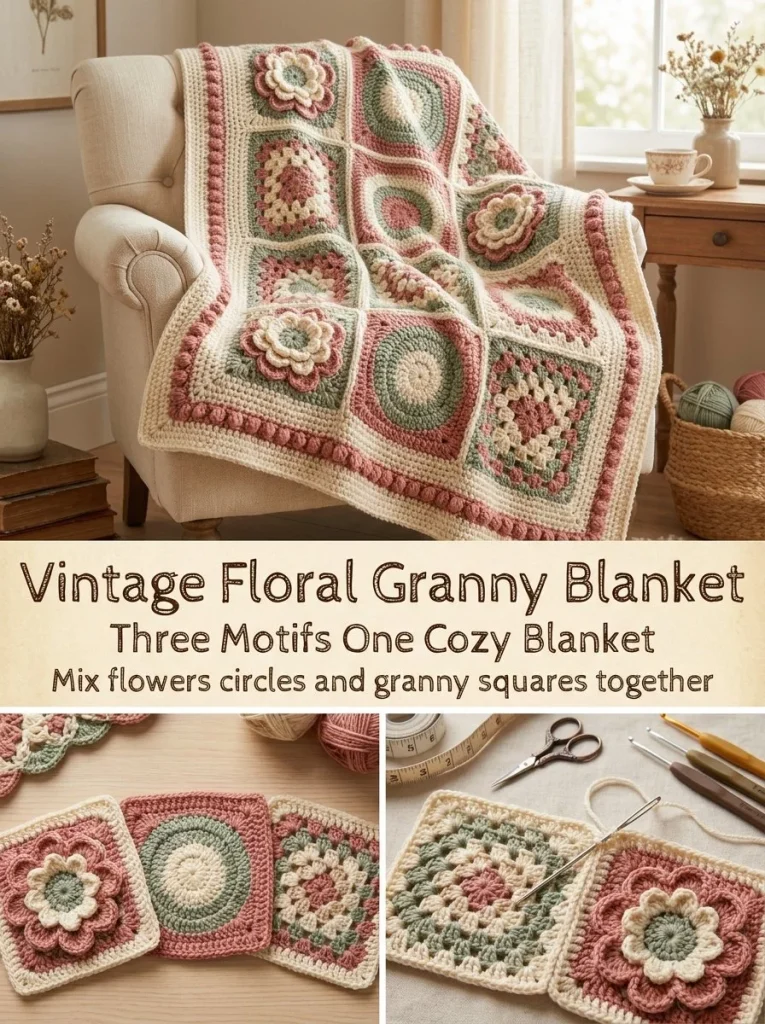
This crochet blanket project combines timeless motifs with a harmonious color palette that evokes vintage floral charm. The design consists of 36 distinct granny squares — a mix of flower-inspired squares, circular-centered squares, and classic granny squares — arranged in a balanced grid that showcases a subtle interplay of warm cream, muted sage, and dusty rose hues. Constructed primarily using traditional crochet techniques, this blanket provides an engaging blend of texture and complexity suitable for crocheters with some experience or enthusiasts eager to challenge their skills.
The blanket’s structure, crafted from individual squares that are joined together, allows for flexibility in layout and creative color placement. Each square is worked in rounds, combining foundational granny stitch elements with decorative floral motifs that add visual interest and dimension. The edges are neatly finished with a delicate border featuring bobble stitches, which lend a tactile flourish and complete the vintage aesthetic. This project is perfect for those interested in blending classic crochet patterns with expressive colorwork, culminating in a cozy, decorative blanket suitable for home or gifting.
For readers interested in exploring similar motifs, the stitch techniques used here resonate with patterns such as the Strawberry Granny Square Blanket, which also implements floral-inspired granny squares with textured petals and complementary color themes.
Pattern at a Glance
- Skill level: Intermediate
- Terminology: US crochet terms
- Construction: 36 individual motifs joined into a 6 x 6 grid, bordered
- Finished size: Approximate size determined by 36 squares × 7 inches each
- Yarn weight: Worsted weight (#4)
- Hook sizes: 5 mm for squares; 4 mm for border
- Main stitches: Double crochet (dc), single crochet (sc), half double crochet (hdc), treble crochet (tr), bobble stitch
- Gauge: Squares approximately 7 inches each
- Motifs: 14 Flower Squares, 8 Circle Squares, 14 Classic Granny Squares
- Layout: 6 squares by 6 squares (total 36)
- Joining: Mattress stitch for rows, then row joining
- Border: Multi-round dc and bobble stitch border
Materials
To complete this crochet blanket, you will need about 2300 yards of worsted weight (#4) yarn in three harmonious colors:
- Warm cream – used predominantly for the final outer rounds of squares and main border rounds
- Muted sage – used within certain squares for added depth and variety
- Dusty rose – adds floral accent and is the highlight color for the bobble round in the border
A 5 mm crochet hook is recommended for the granny squares to create a balanced fabric, while a slightly smaller 4 mm hook will give you a firmer, neater edge in the border rounds. A tapestry needle is essential for weaving in ends and joining the squares using mattress stitch.
Yarn and Color Notes
Selecting yarn with good stitch definition is important to highlight the intricate floral and granny motifs. Worsted weight yarn made from fibers such as acrylic, cotton blends, or wool will provide enough body without sacrificing softness or drape. Avoid yarns that are too fuzzy or fluffy, as they may obscure the detailed petal shapes and stitch patterns.
The chosen color palette of warm cream, muted sage, and dusty rose creates a harmonious, vintage feel that balances subtlety and warmth. Using cream for the outer rounds of the squares unifies the look, while sage and dusty rose offer gentle contrast. You may experiment with similarly muted or pastel color schemes, but aim for shades that provide clear stitch visibility.
Finished Measurements
Each crochet square measures approximately 7 inches square when blocked. With 36 squares arranged in a 6 by 6 grid, the approximate finished blanket size should be around 42 inches x 42 inches, not including the border width.
Keep in mind that slight variation in gauge or blocking tension will affect the final dimensions. The border rounds will add a few inches around the perimeter, contributing to the final size.
Gauge
While the exact gauge is not explicitly specified, the squares are approximately 7 inches each using a 5 mm hook with worsted yarn. It’s important to make and block sample squares to ensure your size matches.
- Measure: Lay your finished square flat after blocking to check the width and height equal 7 inches.
- Why gauge matters: For blankets, gauge is more forgiving than garments but mismatched squares can cause uneven joins and borders that ripple.
- If gauge is too large: Squares may not fit together evenly, resulting in an oversized or irregular blanket. Adjust by switching to a smaller hook or tighter tension.
- If gauge is too small: Blanket may be smaller than intended; consider a larger hook or looser tension.
Abbreviations
- dc: double crochet
- sc: single crochet
- hdc: half double crochet
- tr: treble crochet
- ch: chain
- MR: magic ring
- bobble: bobble stitch (generally clusters worked to create a raised bump)
- sts: stitches
Important Pattern Notes
- Chains used at the beginning of rounds count as stitches only if specified by the stitch pattern.
- All squares are worked in joined rounds from the center outward. Use a magic ring (MR) to start circular centers when indicated.
- Outer rounds on all squares use cream yarn to unify the patchwork appearance.
- Blocking each square to uniform size is essential to ease the joining process and ensure a flat blanket.
- Mattress stitch is the joining method for seams, creating an almost invisible and flexible join.
- The border includes a bobble stitch round for decorative texture interspersed with standard stitches.
- Extra stitches are added at corners during border rounds to prevent curling or rippling edges.
Special Stitches and Techniques
- Magic Ring (MR): Creates a tight center for circular starts.
- Bobble stitch: Clusters of double crochets worked into the same stitch or space to create raised ornaments, important for the dusty-rose bobble round in the border.
- Mattress stitch: A joining technique used to seam crochet motifs neatly, often from the back side for invisibility.
- Squaring the circle: Using a combination of single, half-double, double, and treble crochet stitches to transition a circular motif into a square shape with corners for easier joining.
Understanding the Construction
This blanket construction is based on assembling three types of granny squares:
-
Flower Squares: Feature a petal motif worked in rounds from a magic ring center, incorporating special stitches to form 12 petals. The final rounds square off the motif with corner groups, then continue in traditional granny rounds up to the full 7-inch size, finished in cream.
-
Circle Squares: Start with circular rounds doubling the stitch count, culminating in 36 double crochet stitches in round three. The circle is squared off with carefully placed stitches (sc, hdc, dc, tr) between four corner groups before working traditional granny rounds to size.
-
Classic Granny Squares: Use traditional three-double crochet clusters separated by chain-two corners, worked until approximately 7 inches square.
All squares use the three-color palette variably, but consistent cream outer rounds unify the blanket. The squares are blocked to exact size, then arranged evenly in a 6 x 6 grid mixing motifs to distribute colors and patterns harmoniously.
The squares are joined first into rows with mattress stitch, then the rows are joined to each other. The border is worked last, changing hook size to 4 mm for a more refined finish, and adding visual interest and dimension.
Full Pattern Instructions
Flower Square (Make 14)
-
Round 1: Using warm cream or assigned color, create a magic ring (MR).
Work 12 double crochet (dc) stitches into the ring.
Join with a slip stitch to form a closed circle. -
Round 2:
Around each stitch or space from Round 1, create a petal by working: single crochet (sc), 3 dc, sc into successive spaces or stitches, forming 12 petals total. These petals are slightly raised and give the characteristic floral look. -
Round 3:
Work behind the petals to form a square base. Create four evenly spaced corner groups: 3 dc, ch 2, 3 dc in each corner space, distributing them evenly around the circle. Between corners, work appropriate stitches (usually dc or sc) to help transition the petals into a squared shape. -
Rounds 4 and onwards:
Continue working traditional granny-style rounds, where each side consists of 3-dc groups separated by chain-2 corners, expanding the square evenly until it measures approximately 7 inches. Use warm cream yarn for these outer rounds for cohesion.
Circle Square (Make 8)
- Round 1: Using cream or assigned color, start with MR and work 12 dc.
- Round 2: Work 2 dc in each stitch to double the stitch count to 24 dc.
- Round 3: Work the pattern [dc, 2 dc in next stitch] around to increase to 36 dc total. This creates a smooth circular body.
- Round 4: Square the circle using a combination of single crochet (sc), half double crochet (hdc), double crochet (dc), and treble crochet (tr) stitches placed strategically between four corner groups. Each corner group consists of 3 dc, ch 2, 3 dc, ensuring sharp corners for joining.
- Rounds 5 and onwards: Continue with granny rounds (3-dc clusters separated by chain-2 corners) until the square measures approximately 7 inches.
Classic Granny Square (Make 14)
Work traditional granny squares consisting of 3-dc groups with chain-2 corners from the center outwards. Continue rounds until the square measures 7 inches. Alternate colors (cream, sage, dusty rose) variably but ensure the final few rounds use cream yarn.
Blocking and Assembly
After completing all 36 squares — 14 Flower Squares, 8 Circle Squares, and 14 Classic Granny Squares — block each square to the exact 7-inch dimension to ensure uniformity.
Arrange your squares in a 6 x 6 grid, mixing the three types and colors evenly for balance. Join squares in each row using mattress stitch, an elegant join that creates nearly invisible seams with flexible but secure tension. After completing each row, join the rows similarly to construct the full blanket.
For insight into joining granny squares and arranging mixed motifs, this project shares concepts with patterns like the Blue Granny Stitch Head Scarf Easy Triangle Pattern, which also demonstrates effective ways of combining granny motifs and seamless joining.
Border
Switch to the 4 mm hook for the border rounds to achieve a delicate edge finish.
- Work 3 rounds of double crochet (dc) entirely in warm cream yarn, working extra stitches at corners to maintain a flat edge without puckering or curling.
- Work 1 round in dusty rose yarn featuring bobble stitches: one 5-dc bobble cluster approximately every 10 stitches, separated by plain single crochet or double crochet stitches. This adds a subtle textured accent reminiscent of rosebuds.
- Finish with 2 rounds of double crochet (dc) in cream, again easing extra stitches into corners to keep the border flat and wide enough to frame the blanket beautifully.
Finishing
After the border is complete, weave in all yarn ends carefully with a tapestry needle on the wrong side. Ensure all joins are smooth and secure. Give the finished blanket a final blocking if necessary to shape and relax the border.
Checkpoints
- After completing each motif type, verify the square measures approximately 7 inches across after blocking.
- Before joining, confirm evenness of tension and sizing between squares.
- Each joined row should lie flat and symmetrical without puckering.
- After border rounds, check the blanket edge is flat and smooth, adding extra stitches at corners if curling is noted.
How to Resize
Increasing or decreasing the blanket size depends on adding or subtracting motif squares.
- To enlarge: Add extra squares in rows and columns, maintaining even distribution of flower, circle, and classic motifs to keep visual balance. For example, a 7 x 7 grid adds 7 squares and ups the size by approx 7 inches per side.
- To reduce: Omit squares and re-balance the motif types accordingly.
- Adjust yarn quantities proportionally based on total squares planned.
- Maintain consistent blocking and joining to keep uniform size throughout.
Since the pattern is motif-based rather than row/round count-based, resizing is straightforward by altering the grid layout.
Useful Variations
- Create a monochrome version using one of the yarn colors only to emphasize texture over color contrast.
- Use varied color palettes for each motif type to give a scrap-busting or modern look.
- Make smaller or larger squares (adjusting hook size and rounds) for a pillow or throw size.
- Experiment with different border motifs, such as scallops or shells, instead of bobbles for different edging textures.
- Turn the blanket into a bag or wrap by altering assembly or adding linings and fasteners.
Troubleshooting
Why Are My Squares Not the Same Size?
Uneven tension, inconsistent stitch count, or skipping blocking can cause discrepancies. Ensure you follow the pattern stitch counts precisely, block each square to 7 inches, and use consistent hook sizes.
Why Is My Border Curling or Waving?
Lack of added stitches on corners or uneven tension can cause ripples. Add extra stitches at every corner when working border rounds and try a slightly larger hook if tension is too tight.
Why Do My Motifs Not Join Neatly?
Misaligned corners or differing square sizes cause poor joins. Block all squares uniformly and double-check that corners and edges correspond before mattres stitching.
Why Do Petals in Flower Squares Look Flattened?
Make sure to work petals with the recommended stitch combination [sc, 3 dc, sc] and to work next rounds behind the petals to allow them to maintain volume.
Frequently Asked Questions
Can I use a different yarn weight?
This pattern is designed for worsted weight yarn. Using lighter or bulkier yarns will affect square size and blanket dimensions. To substitute, you must adjust hook size and possibly rounds to maintain the 7-inch square dimension.
Can beginners make this pattern?
Intermediate crochet skills are recommended due to the varying motifs and assembly methods. However, motivated beginners familiar with double crochet and joining techniques can attempt this with careful attention to instructions.
How should I block the squares?
Wet block each square by gently shaping it to 7 inches square, pinning at corners, and allowing it to dry flat. Blocking ensures uniform size and smooth edges for joining.
Can I make this blanket larger?
Yes, simply add more squares in rows and columns, maintaining the balance of flower, circle, and classic motifs.
What is the best way to join these squares?
Mattress stitch joining from the wrong side is recommended for a neat, flexible seam that maintains the pattern continuity.
Is the border necessary?
While the blanket can be finished without a border, the multi-round border with bobbles both frames and stabilizes the edge, enhancing the overall look.
Optional Related Uses
This granny square construction and motif combination can also be adapted to create decorative cushions, lap throws, or even a cozy triangular shawl using similar granny motifs arranged differently. The flower and circle squares add ornamental charm that translates well to other accessory projects.
Final Thoughts
This floral granny blanket is a delightful marriage of classic granny stitch simplicity and floral motif intricacy, united by a soothing color scheme and thoughtful assembly. The project progresses through three main stages: crafting each type of square to size, joining them with precise mattress stitch, and finishing with a textured, bobble-accented border. The result is a beautiful, cozy blanket that balances vintage appeal with contemporary crochet techniques, perfect for adding a handmade touch to any living space.



