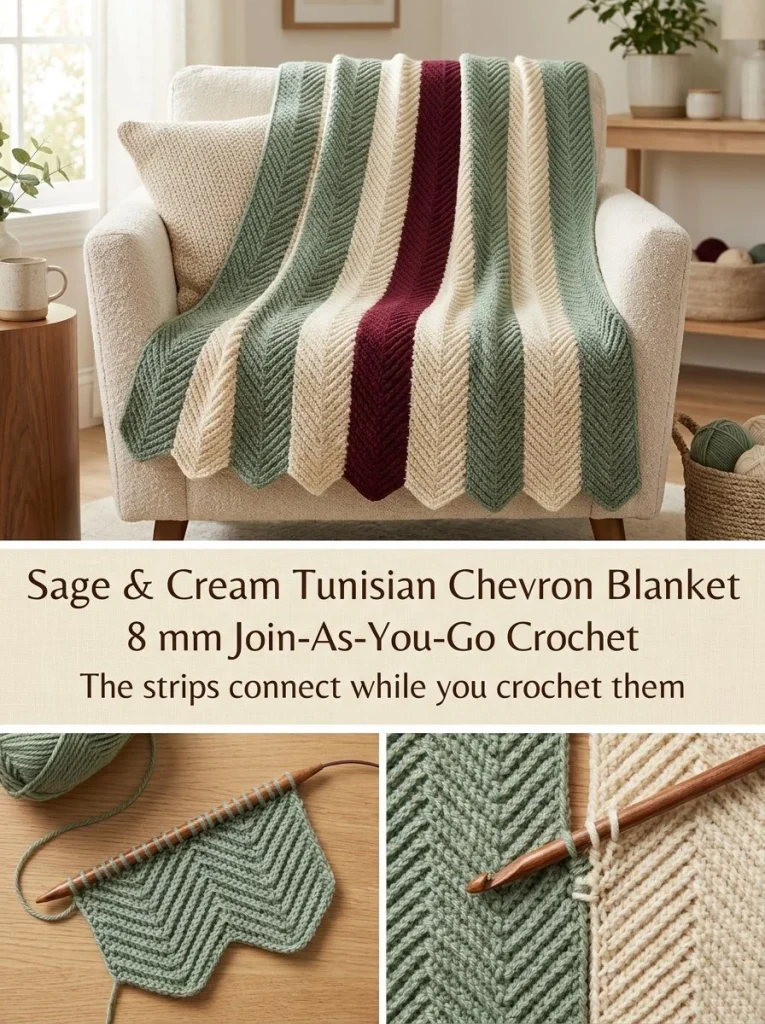
This beautifully textured blanket showcases the rich possibilities of Tunisian crochet, combining clean geometric shapes with a soothing color palette. The chevron stripes alternate in muted sage, warm cream, and deep burgundy shades, creating a harmonious yet striking visual effect. This construction style emphasizes both color and texture, resulting in a cozy but stylish afghan that adds warmth and charm to any living space.
The blanket is created by crafting nine long rectangular strips, each worked individually using a Tunisian crochet technique. These strips are then joined together along their edges during the process, forming a unified chevron pattern across the full width of the blanket. The use of Tunisian crochet offers a dense and sturdy fabric with a unique stitch texture, ideal for blankets that demand durability without sacrificing softness. For similar elegant projects, consider exploring the sage blanket scarf, which also features sophisticated colorwork using Tunisian stitches.
Pattern at a Glance
Skill level: Intermediate – requires familiarity with Tunisian crochet and joining methods
Terminology: US crochet terms with Tunisian crochet abbreviations
Construction: Nine connected long strips, joined during work along one edge
Finished size: Approximately 25 stitches wide by 130 rows tall per strip; overall size depends on strip length (about 58 inches per strip) and total strips connected
Yarn weight: Worsted (#4) yarn, approx. 2050 yards total in three colors
Hook: 8 mm Tunisian crochet hook with cable for comfortable handling of wide strips
Main stitch: Tunisian Simple Stitch (TSS) with Tunisian decrease (TSS2tog) for chevron shaping
Gauge: Not explicitly specified; blocks and size controlled by stitch and row counts
Motifs: None; pattern relies on strip layout and stitch shaping
Layout: Vertical strips in color sequence for chevron effect
Joining: Edge-to-edge joining of strips via loops pulled through neighboring strip row ends
Border: Final finishing row of Tunisian slip stitch across last strip
Seaming: Seamless joining as strips worked and connected simultaneously
Materials
- Worsted weight #4 yarn: A total of approximately 2050 yards divided among muted sage, warm cream, and deep burgundy hues. These color choices create a tasteful yet dynamic palette that works well in a variety of home decors. Choose yarns with good stitch definition and a soft hand for comfortable warmth and textural clarity.
- 8 mm Tunisian hook with cable: Tunisian crochet requires a long or flexible hook to hold multiple live loops. This size balances stitch definition and fabric drape nicely.
- Yarn needle: For weaving in ends after all strips are completed and joined.
These materials ensure that the finished blanket will have a solid yet soft texture with excellent durability and color contrast.
Yarn and Color Notes
Selecting the right yarn is crucial for Tunisian crochet, which creates a denser fabric than traditional crochet. A smooth, high-quality worsted wool or wool-blend yarn will highlight the stitch pattern’s texture without excessive fuzziness. Avoid overly slippery or loosely spun fibers, which can make holding multiple loops on the hook tricky.
The color scheme is deliberately muted and earthy, mixing sage green and cream with an accent of deep burgundy. This restrained palette enhances the chevron geometry, avoiding visual clutter. You may swap colors within this tonal range or try your own combinations. For uniform texture but varied color effects, consider solids rather than variegated yarn to maintain the clean chevron lines.
Finished Measurements
Each strip measures approximately 25 Tunisian stitches wide and about 58 inches long, created by completing 130 rows of Tunisian crochet. Since there are nine strips joined edge-to-edge, the blanket’s total width will be roughly nine times the strip width, plus adjustments for joining tension and finishing. This substantial size makes the blanket suitable for a throw on a sofa, a bedspread accent, or extra warmth on chilly days.
Gauge plays a minor role in final measurements owing to the rectangular strip construction, but maintaining consistent tension is important to ensure all strips align smoothly during assembly.
Gauge
Although a specific gauge number is not provided, keep these guidelines in mind for Tunisian crochet gauge stability:
- Gauge is measured by the number of Tunisian Simple Stitches and rows over a defined swatch, typically 4 inches square.
- Because this blanket is built from separate strips, consistency between strips is more important than matching exact stitch density.
- Check tension frequently to make sure strips are uniform in width and length; this will prevent puckering or gaps upon joining.
- If your fabric feels too tight, your blanket may end up smaller and stiffer; too loose, and the strips might stretch irregularly.
Given the construction, it is recommended to make a small test swatch of Tunisian Simple Stitch at the intended hook size and adjust hook size accordingly before beginning.
Abbreviations
- ch – chain
- TSS – Tunisian Simple Stitch (pick up the vertical bars on the forward pass, work off loops on the return pass)
- TSS2tog – Tunisian Simple Stitch two together (a decrease by working two vertical bars together)
- st(s) – stitch(es)
- yo – yarn over
- fasten off – secure and cut yarn end
All stitch terminology follows US crochet conventions with Tunisian stitch variations.
Important Pattern Notes
- The strips are worked with a fixed stitch width of 25 stitches and length of 130 rows, which results in about 58 inches strip length.
- Each strip’s forward pass involves picking up loops across chains or strips; the return pass involves working off loops.
- Decreasing at strip edges using TSS2tog stitches shapes the chevron pattern by tapering edges inward.
- Edge stitches are worked carefully to maintain even strip widths.
- Joining occurs simultaneously as strips are connected to previously completed strips by pulling loops through row-end loops to create seamless joins.
- Color sequence follows a thoughtful order to achieve balanced contrast: sage, cream, sage, cream, burgundy, cream, sage, cream, sage.
- The final strip receives an edge of Tunisian slip stitches across live loops and ends are woven in to complete the blanket.
Special Stitches and Techniques
This project primarily uses the Tunisian Simple Stitch (TSS), a fundamental stitch in Tunisian crochet that produces a knit-like textured fabric.
- Tunisian Simple Stitch (TSS) Forward Pass: Insert the hook under the vertical bar of the stitch, yarn over, and pull up a loop, holding all loops on the hook.
- Return Pass: Yarn over and pull through two loops repeatedly until one loop remains on the hook.
- TSS2tog (decrease): Work two vertical bars together in one stitch to decrease one stitch, shaping the chevron edges.
- Joining via loop pulling: Pull the final loop through a row end of the neighboring strip to join strips seamlessly during the forward pass.
- Tunisian slip stitch: Used for finishing edge by working across the last strip’s live loops.
Mastering these techniques enables clean chevron shaping and strong edge joins without visible seams.
Understanding the Construction
This blanket consists of nine individual strips worked vertically. Each strip is a rectangle 25 stitches wide and approximately 58 inches long, worked in Tunisian crochet with consistent stitch and row counts.
The first strip is worked from a simple chain, then each subsequent strip is attached along its lower-right corner to the preceding strip. This method involves chaining 24 stitches, picking up loops along the chain for 25 stitches total, then joining the last loop to the adjacent strip’s row end loop before working the chevron pattern.
By working each strip in sequence and joining as you go, you create a flat, connected panel with a distinctive chevron texture formed by decreases at the strip edges. The final assembly is seamless and produces a solid arched pattern.
This modular approach combines precision with creativity, allowing careful control over color placement and fabric texture.
Complete Pattern Instructions
Foundation Strip (First Strip)
- Chain 25 stitches.
- Forward Pass: Starting in the second chain from the hook, pick up one loop in each chain across so there are 25 loops on the hook.
- Return Pass: Chain 1 (counts as turning chain), yarn over, and pull through two loops repeatedly until one loop remains on the hook.
Your hook now holds 25 loops, and the first row is established.
Rows 2–130 (Chevron Stitch Pattern)
- For each row:
- Work TSS2tog (Tunisian Simple Stitch two together) to decrease one stitch at the start of the row.
- Work TSS in the next 9 stitches.
- Yarn over (yo), work TSS in the next stitch, yarn over again, work TSS in the next 9 stitches.
- Work TSS2tog to decrease one stitch at the end of the row.
- Work the edge stitch as normal (typically a TSS).
- Complete the standard Tunisian return pass by pulling yarn over and through two loops repeatedly until one loop is left.
At the end of each row, you maintain a consistent stitch count of 25 loops while shaping the chevron through the decreases at both edges.
Fasten off after completing row 130.
Subsequent Strips (Strips 2 through 9)
- Attach yarn at the lower-right corner of the previously completed strip.
- Chain 24 stitches.
- Pick up loops along the chain for the forward pass so there are 24 loops.
- Pull the final loop through the first row-end loop of the existing neighboring strip, creating a seamless join and bringing the loop count to 25 loops on the hook.
You are now set to work the identical chevron stitch pattern (Rows 2–130):
- After the final TSS2tog, pull one join loop through the corresponding row-end loop of the previously completed strip before the return pass.
- Work the standard Tunisian return pass.
- Continue this sequence to match 130 rows, maintaining width and length consistency.
Color Order of Strips
The strips should be worked in the following sequence to achieve balanced visual interest:
- Sage
- Cream
- Sage
- Cream
- Burgundy
- Cream
- Sage
- Cream
- Sage
This careful alternation provides rhythm and contrast to the overall chevron blanket design.
Final Assembly and Finishing
- After all nine strips are connected and the final strip is live on the hook, work Tunisian slip stitch across the entire last strip to create a polished border edge.
- Weave in all yarn ends securely using a yarn needle for a neat finish.
Checkpoints
- After working each strip, confirm you have 25 loops on the hook before each return pass.
- Confirm the strip length reaches approximately 130 rows (~58 inches).
- Ensure the decreases at the edges line up evenly in a chevron pattern without distortion.
- Check that joining loops are pulled through the previous strip’s row-end loops consistently along every row to avoid gaps.
- Verify color order as you progress to maintain intended pattern alternations.
Assembly and Joining
The joining method is integral to this project’s construction rather than a separate step:
- Strips are attached row-by-row as you crochet subsequent strips by pulling a loop through the corresponding row-end loop of the adjacent strip.
- This creates an invisible seam, ensuring no bulky edges or seams remain.
- Because joining happens seamlessly during the forward pass, the color transitions and strip alignment remain tight and smooth.
- Handle the yarn carefully when joining to maintain consistent tension across strips for an even blanket surface.
Border and Finishing
The final finishing row of Tunisian slip stitches across the last live strip helps maintain the blanket’s edge stability. Use this to:
- Prevent curling or distortion at the edge.
- Give a visually appealing frame to the chevron stripes.
- Ensure the edges feel firm and finished without bulky or loose stitches.
Weaving in yarn ends thoroughly with a yarn needle will prolong the blanket’s durability and keep it looking pristine.
How to Resize
Resizing this blanket involves adjusting the number of strips or strip length, while maintaining the stitch counts per strip:
- To increase width: add additional strips following the same stitch count and joining pattern. Ensure to include the chevron decreases for consistent shaping.
- To decrease width: reduce the number of strips accordingly.
- To increase length: work more rows per strip, maintaining the chevron decrease pattern in each row to keep the shape.
- To decrease length: work fewer rows per strip, adjusting to keep the proportion of decreases for the chevron effect.
Because the pattern relies on fixed stitch widths and row counts per strip for shaping and proper joining, altering these counts changes the blanket’s overall proportions significantly. It is recommended to keep stitch multiples and shaping consistent when resizing.
Useful Variations
- Single-color version: Use only one color for a monochromatic chevron blanket that emphasizes texture.
- Alternate color blocks: Insert additional colors or swap burgundy for another accent hue for seasonal flair or theme-based projects.
- Scrappy yarn version: Utilize leftover worsted yarn scraps in similar tones for a cozy, textured throw.
- Throw pillow cover: Adapt the strip length for smaller projects like pillow covers, joining strips similarly.
- Scarf or shawl: Make fewer strips with shorter length for wearable accessories that echo this textured pattern. For an example of a wearable project using sage hues and Tunisian stitches, see the blush windowpane baby blanket, which shares a similar warm tonal feel.
Troubleshooting
Why Is My Project Getting Wider Than Expected?
If strips start to feel wider than 25 stitches, check tension during the forward pass picking up loops. Avoid looser loops that stretch the width out. Consistent tension prevents distortion.
Why Are The Edges Not Forming a Chevron?
Ensure you are correctly working the TSS2tog decreases at both edges each row. Missing a decrease or working it improperly will affect the chevron shape.
Why Are The Joined Strips Not Lying Flat?
If joining loops pulled through the neighboring strip’s row-end loops are too tight or too loose, the strips won’t lie evenly. Try to keep a consistent, gentle tension while pulling join loops.
Why Is The Blanket Curling at the Edges?
Use the Tunisian slip stitch border as directed across the final strip to stabilize edges and reduce curling.
Why Are My Colors Not Aligned?
Follow the specified color order for strips strictly. Keep track of strips during assembly to maintain pattern flow without unexpected color repeats or irregularities.
Frequently Asked Questions
Can I use a different yarn weight?
This pattern is designed for worsted weight (#4) yarn. Using significantly lighter or heavier yarn may alter the strip size and drape. Adjust hook size accordingly and expect a difference in finished dimensions and fabric feel.
Can I use cotton yarn?
Cotton yarn is workable but tends to have less stretch and drape than the recommended blend. The blanket may feel stiffer, and stitches may close up more. Use a mercerized cotton or blend for softness.
Is this blanket suitable for beginners?
Intermediate familiarity with Tunisian crochet and working decreases is recommended. Beginners willing to learn Tunisian techniques can try this project but should practice the stitches and joins on smaller swatches first.
Do I need a special Tunisian hook?
Yes, an 8 mm Tunisian crochet hook with a cable is suggested for comfortably holding 25 loops and crocheting long strips.
Can I make this blanket larger for a bedspread?
Yes, by increasing the number of strips or lengthening strip rows, you can customize the size. Maintain stitch counts and decreases per strip to keep the chevron design intact.
How should I care for the blanket?
Follow yarn care instructions, which often include gentle hand wash or machine wash on delicate, then lay flat to dry to maintain shape and color vibrancy.
Optional Related Uses
Beyond blankets, the defined chevron strip construction and Tunisian decreases make this stitch pattern adaptable to:
- Decorative pillow covers
- Lapghans and throws in smaller sizes
- Cozy scarves or wraps with stripe patterning
- Table runners by adjusting strip length and count
- Baby blankets with fewer rows and softer yarn blends
This versatile stitch design blends well across home decor and accessory projects.
Final Thoughts
This chevron blanket showcases the unique appeal of Tunisian crochet’s texture combined with smart color planning and modular construction. By working long strips individually and joining them seamlessly row by row, the blanket achieves a sophisticated geometric pattern that is both functional and beautiful. Maintaining consistent stitch counts and tension, carefully following the joining technique, and respecting color order are key steps to success.
The project boils down to masterfully crafting nine strips, each shaped with edge decreases for the chevron, and joining them during work. A final slip-stitch border finishes the piece with polish. This is an excellent project to advance Tunisian crochet skills and produce a stunning piece for everyday comfort.



