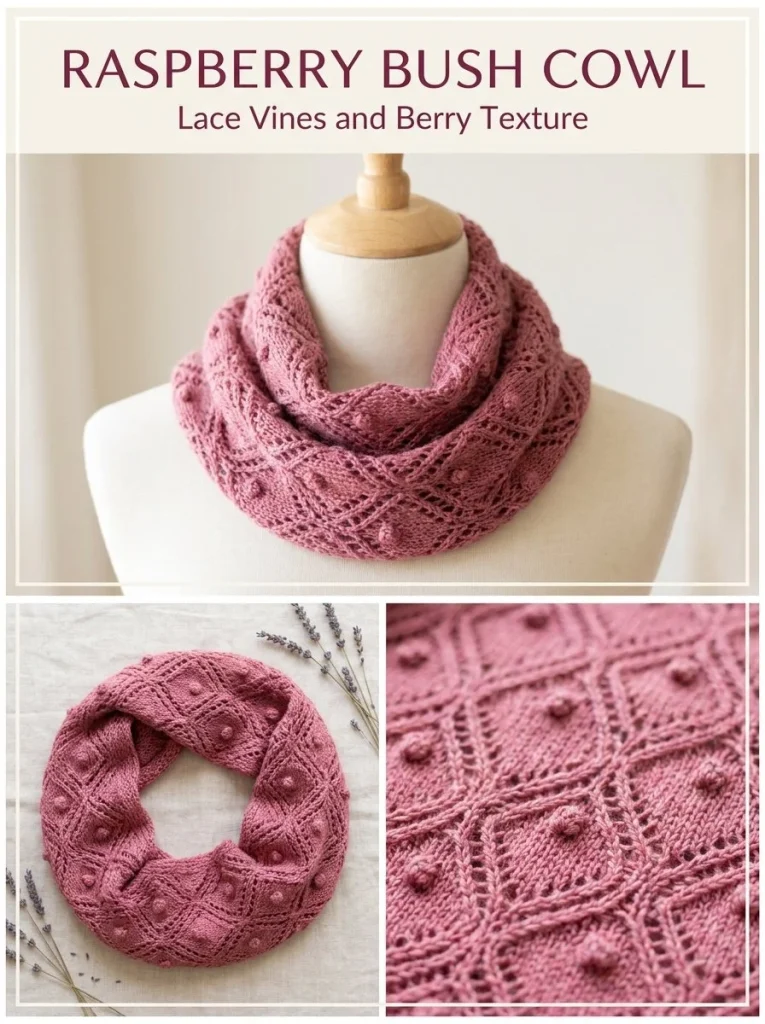
Creating a delicate lace cowl that gracefully combines texture and intricate stitch work requires both careful planning and attention to detail. This cowl is a seamless circular garment crafted using a refined lace motif known as the Leaves & Berries stitch, which produces a sophisticated, nature-inspired design of intertwined leaves and berry-like bobbles. The leafy lace pattern forms a beautifully repeating motif that travels around the cowl’s circumference, offering a harmonious blend of openness and warmth.
The piece is constructed entirely in the round on circular needles, resulting in a smooth, join-free fabric with beautifully aligned motifs that flow continuously around the neck. This approach not only showcases the lacework but also eliminates lateral seams, enhancing comfort and aesthetic appeal. The openwork design lends itself to layering — perfect for transitional weather when you want a scarf-like accessory that adds both style and subtle warmth.
Working this cowl requires skill with a few advanced knitting decreases and increases, as well as consistent use of stitch markers to track pattern repeats. The stitches involve yarn overs (to create the lace holes), slipped single decreases, knit-togethers, and centered double decreases that help sculpt the motifs into their distinctive leafy shapes. Blocked firmly, the lace opens into delicate points resembling natural foliage edges, which frame the neck with elegance and a hint of rustic charm.
For those seeking a similarly stylish accessory with an interesting construction, consider exploring the original lace cowl inspired by this pattern, as it offers further insights into the yarn choices and finishing techniques that bring lace cowl projects to life.
Pattern at a Glance
Skill level: Advanced intermediate to experienced lace knitters
Terminology: Standard knitting terms (US)
Construction: Worked seamlessly in the round using circular needles
Finished size: Approx. 33.75 in / 86 cm circumference; 15.75 in / 40 cm height
Yarn weight: Aran weight (medium)
Needles: US 7 / 4.5 mm circular, 32 in / 80 cm length
Main stitch: Leaves & Berries lace motif featuring lace and bobble texture
Gauge:
- 17 sts x 25 rows = 4 in (stockinette stitch, unblocked)
- 11 sts x 25 rows = 4 in (full Leaves & Berries pattern, after blocking)
Motifs: Six repeats of a 16-stitch pattern running continuously around
Layout: Circular tube worked in rounds, starting with a loose cast-on and ending with a delicate edging
Joining: No seams, circular knitting in the round
Border: Short 2-round edging at both the beginning and the end
Seaming: None required
Materials
To replicate this project faithfully, use the following materials:
- Yarn: An Aran weight yarn with a fiber content blending softness, warmth, and luster is recommended. The original sample uses Louisa Harding Esquel yarn composed of 60% merino wool, 20% llama, and 20% silk, which creates a smooth, luxurious fabric with subtle shine. The color used in the sample is called "Berry." The yarn is approximately 106 yards / 50 grams, with the project requiring about 99.5 grams.
- Needles: US 7 (4.5 mm) circular needles, 32 inches (80 cm) in length, to comfortably hold the circumference stitches in the round.
- Notions:
- Six stitch markers to mark pattern repeats and motif sections
- A tapestry needle for weaving in ends upon finishing
- Blocking pins or wires for shaping the lace after washing
- Additional Tools: A measuring tape for checking gauge and finished measurements during the process.
This selection of materials ensures the lace maintains fluidity while having enough structure to show off the delicate Leaf & Berries pattern. Heavier or scratchier yarns might obscure the fine lace, whereas overly soft or fuzzy yarns could lose stitch definition.
Yarn and Color Notes
Choosing the right yarn can drastically affect the appearance and hand of the finished cowl.
Given the intricate Leaves & Berries lace motif, a yarn with smooth, well-defined stitches is best to highlight the delicate stitch work. Fibers like merino and silk blend offer softness, slight sheen, and resilience, which enhance both drape and lace clarity. The 20% llama in the chosen blend adds warmth without bulk.
Solid or semi-solid hues are preferred for such detailed lacework, as variegated or highly textured yarns can distract from the pattern’s leaves and bobbles. The "Berry" color used in the sample offers enough contrast to the lace holes and texture, enriching the motif without overpowering it.
When selecting your yarn, consider how the fiber content and color intensity will perform after blocking, as the lace opens and reveals more subtle features of the stitch pattern.
Finished Measurements
The completed cowl measures approximately:
- Circumference: 33.75 inches (86 cm), comfortably fitting around the average adult neck with a slight drape
- Height: 15.75 inches (40 cm), sufficient to cover the lower face when pulled up and providing warmth over the neck and chest
These dimensions are ideal for a close-but-comfortable fit that allows the lacy texture to show fully when worn. The collar’s height provides versatile styling options, allowing it to be worn loosely or snugly wrapped.
Dimensions depend on following the pattern gauge closely and applying proper blocking techniques to open the lace motifs effectively.
Gauge
For successful results, gauge is a critical factor for knitters to monitor:
-
In stockinette stitch before blocking, the gauge should measure 17 stitches by 25 rows = 4 inches (10 cm). This standard gauge reflects the yarn and needle combination and offers a baseline for the fabric’s density.
-
When working the full Leaves & Berries lace motif and after blocking, the gauge changes to 11 stitches by 25 rows = 4 inches (10 cm), indicating that the lace pattern expands the fabric width and relaxes the stitch count per inch.
Why gauge matters:
- Achieving this gauge ensures your cowl matches the intended circumference and height, preserving stitch pattern proportions and motif alignment.
- A tighter gauge (more stitches per inch) may result in a smaller, denser cowl that curves or fits too snugly.
- A looser gauge (fewer stitches per inch) might yield a larger, floppier fabric, weakening lace definition and potentially causing edges to curl.
To verify gauge, knit a swatch of the Leaves & Berries stitch, block it as directed, then measure across and down.
Abbreviations
This pattern uses standard knitting abbreviations used in the source and commonly in US terminology:
- yo: Yarn over
- ssk: Slip, slip, knit — a left-leaning decrease
- k2tog: Knit two together — a right-leaning decrease
- cdd: Centered double decrease — typically slip 2 sts knitwise together as one, knit one, pass slipped sts over (exact method per original pattern)
- st(s): Stitch(es)
- rnd: Round
- pm: Place marker
- sl: Slip stitch
- co: Cast on
- bind-off: Finish and secure stitches at the end
- rep: Repeat
Important Pattern Notes
- The cowl is worked entirely in the round, which means you knit continuously without turning rows, resulting in a seamless tube.
- The initial foundation uses a loose long-tail cast-on, which allows for flexibility and avoids a tight cast-on edge that might restrict stretch.
- To keep the intricate motif aligned, six stitch markers divide the circumference into six repeats of 16 stitches each. Periodic marker moves are necessary as you progress to keep the lace motifs "traveling" without shifting.
- The lace pattern is 46 rounds long, but this article does not reproduce the detailed round-by-round chart or written sequence; it refers to the original Knotions pattern for the full motif instructions.
- The pattern includes two short 2-round edgings: one at the beginning before entering the lace pattern and one at the end to finish neatly.
- A loose elastic bind-off is recommended at the finish to maintain the stretchy, open feel at the edge and prevent tightness.
- The lace relies on advanced decreases (ssk, k2tog, centered double decreases) and yarn overs to sculpt the leaf shapes and berries. Accurate stitch execution is essential for clear pattern development.
- Blocking is a critical step after completion to fully open the lacework and shape the cowl into its final form with the pointed leafy edges.
Special Stitches and Techniques
Given the sophistication of the lace pattern, several key techniques are important:
Yarn Overs (yo)
- Create intentional holes in the fabric, which define the lace pattern and leaf motifs.
- They also increase stitch count, which balance decreases throughout each round.
Slip-Slip-Knit (ssk)
- Creates a left-leaning decrease, gently shaping the leaves and maintaining lace flow.
Knit Two Together (k2tog)
- Produces a right-leaning decrease, balancing the ssk and defining motifs.
Centered Double Decrease (cdd)
- A more complex decrease reducing two stitches centered over one, keeps the lace symmetry sharp and defines the veining in leaves.
- Usually involves slipping two stitches knitwise together, knitting one stitch, then passing the slipped stitches over the knit stitch.
Marker Management
- Placing and moving markers as the motifs progress ensures the repeats stay aligned around the circumference without drifting.
- This is essential to maintain the cowl’s circular framework and stitch count consistency.
Elastic Bind-Off
- Essential to finish with elasticity, preventing the edge from binding too tightly, maintaining comfort and aesthetic balance with the delicate lace.
Understanding the Construction
The entire cowl is knitted as a continuous tube in the round, starting with a loose long-tail cast-on that provides a flexible foundation accommodating the neck. Following the initial cast-on, a two-round edging is worked to create a stable, slightly stretchy lower edge that both supports the lace and forms a neat base.
Next, the main fabric consists of six repeats of the 16-stitch Leaves & Berries lace motif evenly spaced around the circumference. These six repeats produce a full 96-stitch round, which flows continuously without breaks or seams.
The Leaves & Berries motif is complex and worked over 46 rounds total, typically repeated multiple times for the height. In this project, the motif is repeated twice in full, establishing a rich, coherent lace column, then followed by a shorter partial repeat to complete the cowl’s vertical dimension.
After the lace sections, a finishing two-round edging mirrors the initial border to neatly close the round count and add structure to the upper edge.
Finally, the cowl is completed with a loose elastic bind-off to preserve stretch at the top opening and allow comfortable wearing.
Once the knitting is finished, the cowl is washed and blocked firmly, which opens the lace to reveal the full charm of the Leaves & Berries design and sets the fabric with graceful pointed edges resembling natural leaves.
The carefully counted stitch repeats, combined with stitch markers and precise lace techniques, create a fabric where the leaf and berry motifs travel smoothly and continuously, enhancing visual interest and protecting the structural integrity of the cowl.
Complete Pattern Instructions
Foundation
Begin by making a loose long-tail cast-on with 96 stitches (6 repeats × 16 stitches per repeat), enough to comfortably wrap a circumference of approximately 33.75 inches (86 cm). This cast-on should be looser than usual to avoid tightness.
Place six stitch markers evenly around your circular needle to divide the stitches into six segments of 16 stitches each.
Opening Edging (Rounds 1–2)
Work two rounds of a simple edging pattern as instructed by the source to stabilize the cast-on edge and prepare for the lace motif. This edging usually consists of knit stitches maintaining stitch count without increasing or decreasing.
Leaves & Berries Motif (Rounds 3–48)
Now begin the main lace motif which repeats over 46 rounds. The motif consists of yarn overs, ssk, k2tog, and centered double decreases arranged to form leaf shapes with berry-like bobbles.
-
Work the full lace motif twice (i.e., complete all 46 rounds × 2 = 92 rounds), maintaining six 16-stitch repeats around the needle and monitoring motif alignment by shifting stitch markers periodically.
-
Following the two full rounds of the motif, work a partial repeat that completes the final necessary rounds to reach the desired cowl height (approx. 15.75 inches / 40 cm). This partial repeat is shorter than the full motif but aligns with pattern flow.
During this section, be vigilant with stitch count:
- Decreases and yarn overs balance to keep stitch numbers constant.
- Move markers as required to maintain alignment—this ensures the leaves and berries “travel” around the cowl without drifting out of position.
Ending Edging (Rounds 49–50)
Work two rounds of the edging again, mirroring the beginning to finish the cowl neatly.
Bind-Off
Use a loose elastic bind-off to finish. This allows the upper edge of the cowl to retain stretch and flexibility, improving fit comfort and preventing edge tightness.
Blocking
After washing, block the cowl firmly:
- Stretch the lace gently across blocking wires or pins to open the Leaves & Berries motif fully.
- This blocking shapes the leafy points along the edges, turning the lace fabric into a beautifully textured, dimensional piece.
The blocking process is crucial because the unblocked fabric is tighter and less defined. Only after blocking does the lace pattern bloom into its final elegant form.
Useful Checkpoints
- After casting on and completing opening edgings, the stitch count should remain at 96 stitches with six markers dividing the rounds evenly.
- After each full 46-round motif repeat, verify that no stitches have been lost or accidentally added and that markers align with leaf columns.
- At completion of the final partial lace repeat, confirm that the piece measures approximately 15.75 inches (40 cm) in height.
- Completing the bind-off, ensure the edge is elastic and the fabric is flexible without tight spots.
- After blocking, the lace should open fully, with well-defined leaf points and bobbles visible across the cowl.
Finishing and Assembly
This project is a seamless tubular cowl, so no assembly or seaming is necessary. The focus turns instead to finishing:
- Weave in all yarn ends neatly with a tapestry needle.
- Wash the cowl gently in warm water with mild detergent or fiber wash.
- Block vigorously to open the lace—stretching widthwise and heightwise to develop the motif shape and scalloped edges.
This finishing elevates the cowl’s drape and texture, ensuring both visual sophistication and comfortable wear.
How to Resize
Sizing can be adjusted by modifying the quantity of stitch repeats around the circumference or by increasing the number of vertical motif repeats.
- Increasing circumference: Work more 16-stitch motif repeats around the original 96 total stitches. For example, to enlarge the neck size, add multiples of 16 stitches per additional motif repeat. Make sure to add corresponding markers and balance stitch counts accordingly.
- Increasing height: Add more full repeats of the 46-round lace motif vertically before the partial repeat and ending edging. This creates a taller cowl that offers more neck and chin coverage.
- Decreasing size: Omit some motif repeats around the circle or work fewer vertical repeats, adjusting to ensure total stitches remain divisible by 16.
When resizing, remember to maintain the stitch multiple of 16 per motif and manage markers for alignment. Adjust yarn amounts accordingly and check gauge to confirm the desired size.
Useful Variations
- One-Color Version: Use a single solid yarn to highlight the intricate lace texture without distraction.
- Two-Color Version: Incorporate contrasting yarns in the edging rounds or alternate motif repeats for subtle color play.
- Seasonal Palette: Choose warmer autumnal colors like rust, gold, or forest green to complement the leafy leaf theme.
- Smaller or Larger Size: Adapt the repeat count to create a child-sized cowl or a voluminous oversized neckwarmer.
- Matching Accessories: Utilize the same Leaves & Berries motif in a coordinating hat or fingerless gloves for a set. See also the Alias Bandana Cowl for alternative lace cowl inspirations.
Troubleshooting
Why Is My Cowl Getting Wider Unexpectedly?
If your stitch count increases unintentionally, check for extra yarn overs not balanced by decreases. Maintain the stitch count by pairing every increase with a corresponding decrease within the round.
Why Do My Motifs Not Align?
Misalignment often occurs if stitch markers are not moved as the motifs progress. Take care to reposition markers periodically as instructed to keep lace columns in sync.
Why Is My Edge Too Tight After Bind-Off?
Ensure you use a loose elastic bind-off technique rather than a standard tight bind-off; this maintains stretch and prevents tightness around the neck.
Why Is My Lace Pattern Hard to See?
This usually means the cowl has not been blocked thoroughly. Proper blocking with pins or wires opens the lace holes, defining the Leaves & Berries pattern distinctly.
Why Is the Fabric Curling at Edges?
Edges curling before blocking are common with stockinette elements in lace. Focus on firm, even blocking to flatten and open the edges.
Why Are My Decreases Uneven?
Practice the decrease stitches (ssk, k2tog, centered double decreases) to keep them symmetric. Use stitch markers to track decrease placement precisely.
Frequently Asked Questions
Can I Use a Different Yarn Weight for This Pattern?
You can substitute yarns if you maintain similar gauge and fiber properties—choose a smooth, medium-weight yarn to preserve stitch definition and drape. Adjust needle size accordingly.
Is This Pattern Suitable for Beginners?
Due to advanced decreases and lace management, this pattern is best suited for intermediate to advanced knitters familiar with lace knitting techniques.
Can I Knit This Cowl Flat and Seam It?
While possible, the original design is seamless in the round to preserve motif alignment and comfort. Seaming may alter the look and feel.
How Should I Block This Lace?
Wet block the cowl using blocking wires or pins, stretching until the measured gauge and lace pattern are open. Allow to dry flat.
Can I Make This Cowl Shorter?
Yes, by reducing the number of vertical motif repeats or the partial repeat length before the final edging.
Do I Need Special Needles for This Project?
A circular needle with a 32-inch cable is necessary to accommodate the 96 stitches in the round comfortably.
Will This Cowl Stay Elastic After Blocking?
When blocked and finished with an elastic bind-off, the cowl maintains excellent stretch and recovers its shape well.
Optional Related Uses
The beautiful Leaves & Berries motif lends itself well to other accessories such as shawls, triangular scarves, or lightweight wraps knitted in the round or flat. Smaller projects using the same lace could include wrist warmers or a delicate headband, offering a matching set.
While primarily a lace knit project, the motif concept inspires similar openwork in crochet or Tunisian crochet for those interested in exploring related techniques.
Final Thoughts
This cowl’s charm lies in the seamless circular construction combined with a flowing lace motif inspired by nature’s leaves and berries. Beginning with a loose cast-on and enhanced with delicate two-round edgings, the six 16-stitch repeats create a balanced and richly textured fabric. The interplay of yarn overs and decreases sculpts the lace shapes, and meticulous marker management ensures consistent motif travel around the circumference. Proper finishing, especially firm blocking, transforms the fabric into an elegant accessory with gently scalloped edges perfectly suited to a stylish, warm neck covering.
Through patience and attention to stitch detail, this pattern rewards knitters with a wearable piece showcasing advanced lace skill and sophisticated design, suitable for gifting or personal indulgence.



