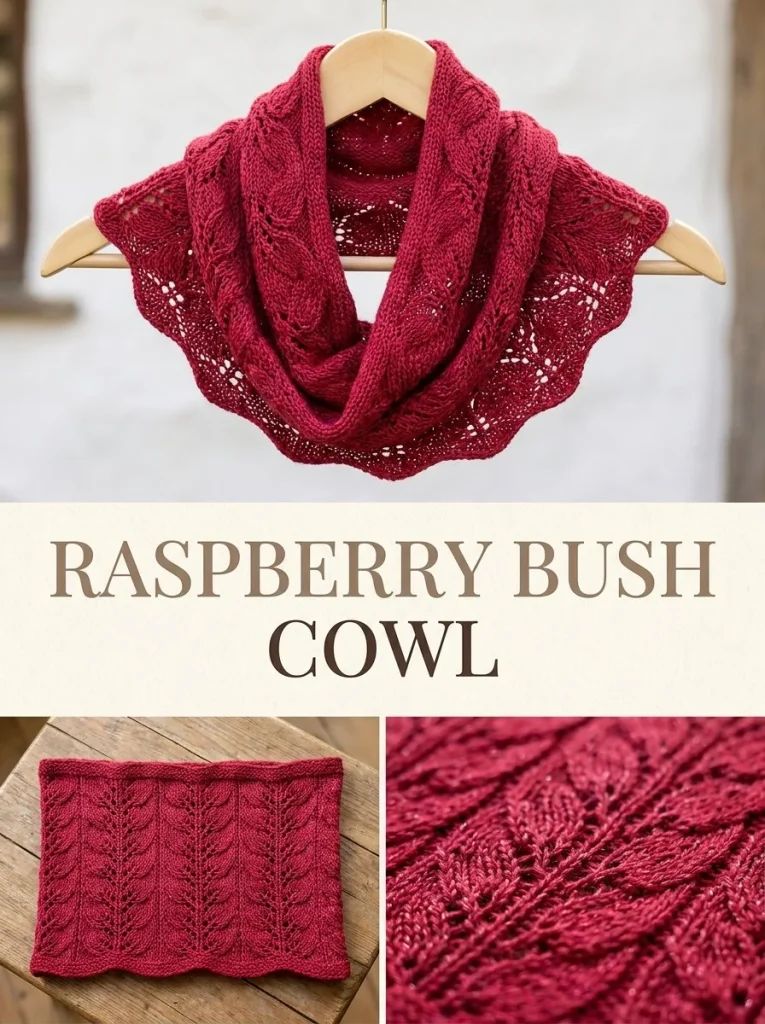
This elegant lace cowl is crafted to showcase the delicate interplay of natural fibers and intricate knitting motifs. Its construction is centered around a beautifully textured Leaves & Berries pattern that unfolds in repeating rounds, creating a fabric with both visual depth and tactile softness. Handmade with a blend of merino, llama, and silk fibers, the fabric promises warmth coupled with a luxurious sheen and comfortable drape.
The cowl’s shape is gently scalloped, following the peaks and valleys of the lace pattern, giving it a refined finish that gracefully frames the neckline. It is knit seamlessly in the round on circular needles, which helps maintain consistent tension and offers a smooth, comfortable edge without side seams. The technique primarily uses stockinette stitch as a foundation before introducing the complex lace motif, making it captivating yet rewarding to knit.
Knitters who appreciate detailed stitch work will find this project satisfying, as it combines the discipline of lace knitting with the practicality of an accessory ideal for cooler weather. Its finished dimensions offer generous coverage without bulk, perfect for layering over coats or sweaters. Unlike simpler cowls, this design challenges you to engage fully with stitch pattern repeats and blocking techniques to reveal the full beauty of the lace.
In addition to the main pattern, those interested in similar projects might enjoy exploring the textural slip-stitch cowl pattern, which offers an alternative creative approach with a focus on colorwork and texture rather than lace.
Pattern at a Glance
Skill level: Intermediate to advanced lace knitting
Terminology: US knitting terms
Construction: Worked in the round on circular needles, seamless
Finished size: Circumference approximately 33.75 inches (86 cm), height approximately 15.75 inches (40 cm)
Yarn weight: Aran
Needles: US 7 / 4.5 mm circular needles, 32 inches (80 cm) length
Main stitch: Leaves & Berries lace motif
Gauge:
- Stockinette stitch, unblocked: 17 stitches and 25 rows = 4 inches (10 cm)
- Leaves & Berries pattern, blocked: 11 stitches and 25 rows = 4 inches (10 cm)
Motifs: 6 repeats of 16-stitch lace motif arranged around
Layout: Work rounds continuously in the round
Border: 2-round edging at beginning and end
Seaming: None (cowl is circular)
Materials
For this project, you will need:
- Yarn: Approximately 3 balls of Louisa Harding Yarns Esquel Aran, a luxurious blend of 60% merino wool, 20% llama, and 20% silk. This mix delivers softness, subtle shine, and excellent stitch definition. The sample used about 99.5 grams in the shade called 008 Berry — a rich, deep pink-red.
- Tools:
- US 7 (4.5 mm), 32-inch circular knitting needle to comfortably accommodate the cowl’s circumference as you work in the round.
- Removable stitch markers to distinguish pattern repeats and track rounds.
- Tapestry needle for weaving in ends and joining bind-offs tidily.
- Blocking pins and wires (optional but highly recommended) to shape the lace edges and open the pattern after knitting.
Using high-quality fibers ensures the lace will bloom beautifully after blocking and that the cowl will be comfortable and warm against the skin.
Yarn and Color Notes
The blend of merino, llama, and silk provides a thoughtful balance between warmth, softness, and durability. Merino offers elasticity and softness, llama adds loft without weight and a subtle halo, while silk imparts a smooth lustrous sheen enhancing stitch clarity. The smooth texture of this yarn is ideal for lace knitting, allowing leaf and berry motifs to stand out sharply.
When choosing colors, consider how the texture will showcase different shades. Solid or semi-solid hues like the sample’s Berry color work best, as heavy variegation can obscure intricate lace patterns.
For knitters interested in using similar yarn weights or exploring projects with a focus on both fiber and intricate detail, the One Skein Chestnut Cowl is a wonderful reference. It combines the interplay of natural yarn fibers with delicate stitch work for a compact project.
Finished Measurements
The completed cowl forms a loose circle with a finished circumference of approximately 33.75 inches (86 cm). This measurement ensures a comfortable fit around the neck, neither too tight nor excessively long, suitable for most adults.
The height (from bottom edge to top edge when worn) is about 15.75 inches (40 cm), providing ample coverage to tuck under coats or wrap around the neck twice for warmth. These dimensions rise from specific stitch and row counts after blocking, so attention to gauge and finishing techniques is essential.
Gauge
The pattern maintains two distinct gauges reflecting two fabric states:
- Stockinette stitch gauge (unblocked): 17 stitches and 25 rows equal 4 inches (10 cm).
- Leaves & Berries pattern gauge (blocked): 11 stitches and 25 rows equal 4 inches (10 cm).
Gauge matters critically for this project because the lace motif opens substantially with blocking, impacting both size and drape. A larger gauge means a looser fabric and potentially bigger finished size; a smaller gauge may result in a tight cowl too snug to wear comfortably.
Blocking aggressiveness also affects gauge and shape: the lace motif must open fully to reveal the iconic scalloped edges and leaf shapes. Therefore, knit a gauge swatch using the yarn and needles planned, then block it similarly to the finished piece before measuring.
Abbreviations
- st(s): stitch(es)
- rnd(s): round(s)
- k: knit
- p: purl
- yo: yarn over
- k2tog: knit two together (decrease)
- SSK: slip, slip, knit (decrease)
(Refer to the original 46-round Leaves & Berries lace motif chart for any specialized stitch patterns or symbols.)
Important Pattern Notes
- The cowl is worked entirely in the round on circular needles, ensuring seamless construction.
- The cast-on is slightly loose with 95 stitches, adjusted to 96 after the initial two rounds of edging.
- The lace motif divides into six repeats of 16 stitches each, aligned evenly around the circumference.
- Stitch markers are highly recommended to mark each 16-stitch repeat boundary in the round.
- Pay attention to repeat counts; you will knit the 46-round Leaves & Berries lace motif twice in succession, then rounds 1 and 2 once more before finishing.
- The final 2-round edging closely mirrors the beginning to mirror scalloped edges.
- The bind-off is elastic and loose to maintain stretch and accommodate blocked shape.
- Blocking is essential to open the lace and define the scalloped edges, which are one of the cowl’s signature features.
Special Stitches and Techniques
This pattern centers around the “Leaves & Berries” lace motif, a detailed stitch pattern comprising basic lace elements such as yarn overs, decreases (k2tog and SSK), and potentially small clusters or textured berry stitches progressed over multiple rounds.
- Lace knitting: Follow the chart or written instructions carefully to maintain symmetry and motif integrity.
- Circular knitting: Use the magic loop or long circular needles to comfortably knit the circumference entirely in rounds.
- Elastic bind-off: A stretchy bind-off method helps keep the final edge from tightening, ensuring comfort and allowing the lace points to relax.
- Blocking lace: Wet blocking with pins or wires opens stitches and sets the scalloped edges; wires help keep edges even and peaks sharp.
Understanding the Construction
The cowl is constructed as a continuous tube worked in the round, starting with a loose cast on of 95 stitches, adapting to 96 stitches after initial edging. The work is divided into six equal sections of 16 stitches each, representing six repeats of the “Leaves & Berries” lace motif.
The project grows by knitting the detailed 46-round lace motif twice in succession, layering the textured leaves and berries for a lush effect. Then a few extra rounds (rounds 1–2 of the motif) are added to smooth the transition toward the final edging.
The cowl is finished with a 2-round edging matching the initial border, maintaining the design’s symmetry and forming the elegant, gently scalloped top and bottom edges.
Foundation
Begin with a loose cast-on of 95 stitches on a circular needle. The loose cast-on provides flexibility and ease when joining to knit in the round without twisting stitches.
Beginning Edging (2 rounds)
Knit the 2-round edging as specified by the source pattern to reach 96 stitches total. This edging serves as a stable base for the main lace motif and contributes to the finished scalloped edge effect.
Establishing Pattern Repeats
Divide the 96 stitches evenly into six repeats of 16 stitches each. Place removable stitch markers between sections to help track pattern repeats and keep correct stitch counts during lace knitting.
Leaves & Berries Motif
Knit the complete 46-round Leaves & Berries lace motif twice in succession. Follow the written chart or motif instructions in detail, maintaining lace pattern integrity and symmetry.
After two full repeats of 46 rounds (total 92 rounds), proceed to knit rounds 1 and 2 once more to finish the main lace motif section.
Ending Edging (2 rounds)
Work the 2-round edging again to mirror the beginning border. This completes the cowl and finishes with a scalloped, decorative edge.
Bind-Off
Use a loose, elastic bind-off method to avoid tightness and maintain the hand-blocked shape. A stretchy bind-off will allow the lace to maintain its openness and the cowl to fit comfortably.
Blocking
Blocking is a crucial final step for this lace cowl:
- Soak or gently wet the finished fabric.
- Pin or use blocking wires to open up the lace, allowing stitches to bloom and leaving the scalloped edges defined and peaked.
- Block aggressively enough for best lace definition but be gentle to avoid stretching too far.
- Allow to dry fully before unpinning.
Checkpoints
- After casting on and completing the edging, confirm you have 96 stitches and six evenly divided marker sections.
- After the first 46-round motif repeat, the fabric should begin to show leaf shapes and berry textures clearly.
- After blocking, the cowl should measure approximately 33.75 inches circumference and 15.75 inches height.
How to Resize
Because the cowl is composed of six repeats of a 16-stitch motif repeat, resizing involves adjusting the number of repeats around the circumference.
- To increase circumference, cast on multiples of 16 stitches plus the edging adjustments (maintain stitch counts as per the edging pattern), adding an extra motif repeat per additional 16 stitches.
- The height can be lengthened by knitting more full repeats of the 46-round motif before finishing with the edging rounds.
- Maintain gauge consistency and account for blocking when resizing.
Useful Variations
- Color variation: Use multicolor or gradient yarns for dynamic leaf and berry effects.
- Fiber substitution: Select yarns with similar weight and drape but experiment with mohair blends or alpaca for different texture.
- Shorter or longer cowl: Adjust the number of lace motif repeates to create a shorter neckwarmer or a longer wrap.
This design also pairs well with garments featuring similar lace motifs or natural colors to complement autumn and winter wardrobes.
Troubleshooting
Why is my lace motif not aligning correctly?
Check that you have the correct number of stitches between markers and that you are repeating the motif exactly six times. Miscounts in stitch number will cause the pattern to shift.
Why does my cowl edge look tight or uneven?
Make sure your cast-on and bind-off are loose enough. Use stretchy bind-off techniques and block thoroughly to ease the edges.
Why is the lace fabric stiff or closed?
Blocking is essential—lace patterns like Leaves & Berries must be aggressively blocked to open the motifs and form scalloped edges.
Why am I losing stitch counts during rounds?
Use stitch markers to separate motifs clearly and recount frequently. Lace knitting requires careful stitch management.
Frequently Asked Questions
Can I use a different yarn weight?
Yes, but gauge will change. Adjust needle size and stitch counts accordingly to maintain circumference and pattern clarity.
Is this pattern suitable for beginners?
The lace motif is intermediate level because of complex stitch patterns, working in the round, and blocking requirements.
How important is blocking?
Very important. The lace pattern’s beauty depends on blocking to open the motif and form scalloped edges.
Can I knit this flat and seam it?
This pattern is designed for seamless round knitting. Seaming is possible but not recommended as it may disrupt lace continuity.
How much yarn will I need?
Approximately 3 balls of aran weight yarn; used sample consumed about 99.5 g.
Can I make this cowl longer?
Yes, add additional full repeats of the 46-round motif before finishing with edging.
Optional Related Uses
The delicate Leaves & Berries lace motif can adapt well to other accessories such as scarves or shawls, where the scalloped edges and texture will impress. Consider adapting the stitch pattern for a lightweight wrap or a matching hat, using similar yarn and stitch counts.
Final Thoughts
This lace cowl gracefully balances elegant stitch details with wearable warmth. Its construction in the round ensures a smooth, seamless fabric and emphasizes the flowing Leaves & Berries motif. Starting with a foundational edging, the project progresses through repeated lace motifs expertly arranged in six-panel symmetry. A matching edging seals the piece, with final blocking unlocking its full potential.
As you work your way through the lace rounds and shape the cowl, you will appreciate the intricate combination of texture, pattern, and fiber qualities, culminating in a truly refined accessory. For knitters wanting to explore similarly detailed neckwear with subtle textural differences, patterns like the Autumn Plaid Slip-Stitch Cowl offer fantastic complementary inspiration.
Enjoy the soothing rhythm of lace knitting and the rewarding results of a garment both beautiful and practical.




There is no chart or written pattern instructions in the PDF.
From the PDF – “(Refer to the original 46-round Leaves & Berries lace motif chart for any specialized stitch patterns or symbols.)”
And:
“Lace knitting: Follow the chart or written instructions carefully to maintain symmetry and motif
integrity.”