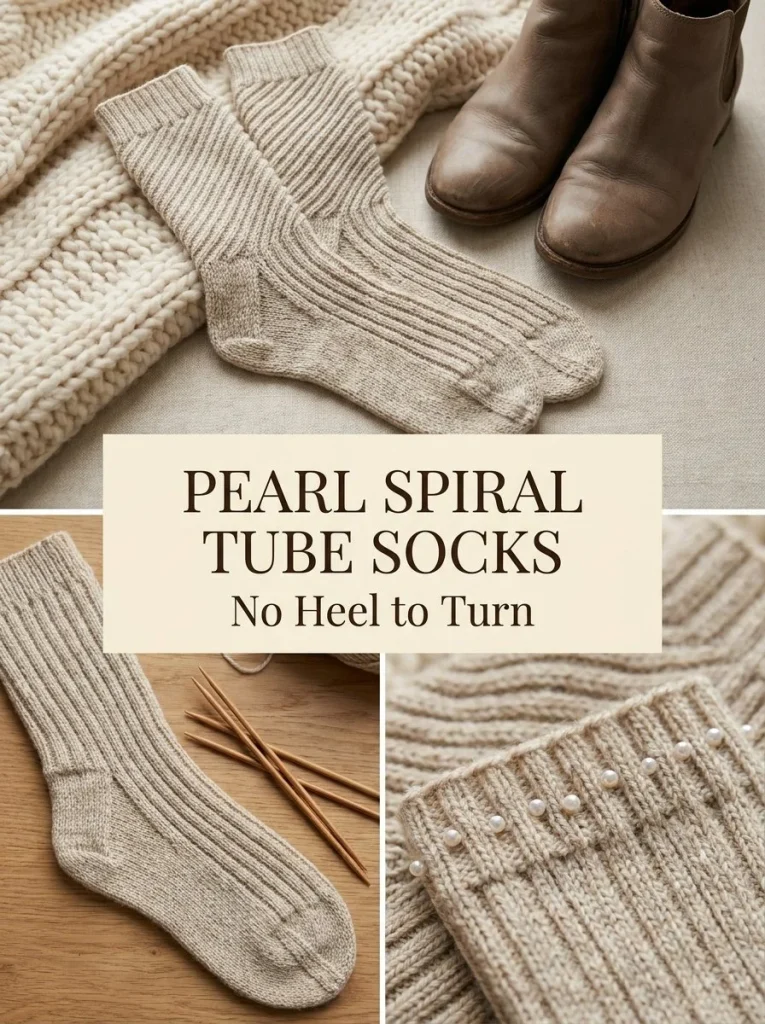
These elegant tube socks are designed as a stretchy, heel-less spiral rib tube that fits comfortably around an adult medium foot, with a circumference of about 8 to 9 inches (20-23 cm). The spiral ribbing creates a subtle textured effect that twirls gracefully around the leg and foot, providing both visual appeal and a nice, snug stretch without restricting movement. Adding to their charm, twelve small faux pearls are sewn delicately near the cuff, giving a refined decorative touch that elevates simple socks into something special and wearable for occasions or everyday luxury.
The construction relies on knitting in the round, beginning with a classic ribbed cuff worked in a straightforward knit-one, purl-one pattern to secure a gentle grip around the ankle. The main leg and foot tube feature a unique six-round spiral rib stitch pattern. This intricate yet approachable stitch repeat interlaces knit and purl clusters in a shifting arrangement, creating the signature spiral effect that wraps around the sock seamlessly. Because this project uses a heel-less tube construction, it does away with separate heel shaping, favoring simplicity and uniform comfort through a continuous tube that can be rotated for the perfect fit.
Using sport-weight wool/nylon sock yarn, the socks offer warmth, breathability, and durability, ideal for everyday wear. The pattern can be worked on double-pointed needles (DPNs) or a long circular needle using the magic loop method, allowing knitters flexibility according to their preferred tool. After completing the knitting, the pearls are carefully sewn in, nestled just below the cast-on edge, enhancing the classic oatmeal color yarn with an understated sparkle that’s both charming and elegant. Overall, this sock pattern offers an excellent balance between decorative detail and practical design.
Pattern at a Glance
Skill level: Intermediate – requires familiarity with knitting in the round, stitch decreases, and grafting techniques
Terminology: Standard knitting terminology (US terms)
Construction: Knit in the round from cuff to toe, heel-less tube construction
Finished size: Adult medium size (foot circumference 8–9 in / 20–23 cm)
Yarn weight: Sport-weight sock yarn (wool/nylon blend)
Needles: US 3 (3.25 mm) double-pointed needles or long circular needle for magic loop
Main stitch: Spiral rib stitch (6-round repeat)
Gauge: Approximately 28 stitches = 4 inches (10 cm) in spiral rib
Motifs: None (continuous spiral rib)
Layout: Tubular sock knitted seamlessly in the round
Joining: None (worked continuously in the round)
Border: Cuff ribbing is a 10-round K1, P1 ribbing
Seaming: Grafting of toe stitches using Kitchener stitch
Materials
- Approximately 280–320 yards (255–293 meters) of sport-weight wool/nylon blend sock yarn in a neutral oatmeal color. The blend of wool and nylon gives warmth, elasticity, and durability to withstand wear.
- US 3 (3.25 mm) double-pointed needles (DPNs) or a long circular needle suitable for magic loop knitting of small circumferences. Both options accommodate circular knitting comfortably for the tube construction.
- A stitch marker to indicate the beginning of the round (BOR marker), which helps track rounds in continuous knitting.
- A tapestry needle for weaving in yarn ends and grafting the toe stitches.
- Twenty-four small washable faux pearls or pearl-look beads measuring approximately 4–5 mm. These will be sewn around the sock cuff as an elegant embellishment.
- Matching sewing thread and a needle strong enough to securely attach the pearls.
Each material serves an important role: the sport-weight sock yarn balances softness and sturdiness, the needles enable circular knitting, and the pearls add a refined decorative touch. For knitters interested in adding subtle luxury, the pearl placement near the cuff is a distinguishing feature worth waiting for.
Yarn and Color Notes
Selecting the right yarn is essential for these socks’ comfort and durability. Sport-weight sock yarns typically include wool blended with nylon for elasticity and strength. Wool’s natural resilience allows the fabric to stretch and recover comfortably around the foot, while nylon improves abrasion resistance, vital for socks that face constant friction.
The oatmeal color chosen here provides a soft, neutral background that highlights the subtle texture of the spiral rib and the gleam of the small pearls. This neutral hue also makes the pearls stand out without overpowering the sock’s natural beauty. Smooth, plied yarns produce clean stitch definition, crucial for revealing the intricate spiral rib stitch pattern. Avoid highly fuzzy or loosely spun yarns that could obscure the texture or reduce stitch clarity.
For color variations, solid colors work best to show off the ribbed spiral effect and let the pearls take center stage. Variegated yarn might distract from the spiral texture, but a carefully chosen gradient or tonal variegation can add an additional dimension of interest if desired.
Using similar fibers and colors to those found in other elegant accessories, such as the pearl hair vine pattern, can yield coordinated wardrobe pieces with timeless appeal.
Finished Measurements
These socks are designed for an adult medium foot, featuring:
- Foot circumference: approximately 8 to 9 inches (20–23 cm), ideal for medium adult feet
- Leg and foot tube length: approximately 14 inches (35.5 cm) from cast-on edge to the start of toe shaping, providing a full coverage leg and foot
- Toe length: about 1.75 inches (4.5 cm) reserved for toe decreases and shaping
These measurements fit a standard adult medium size, but the stretchiness of the spiral rib fabric allows some adjustability. Length can be slightly modified by knitting more or fewer spiral rib repeats prior to toe shaping, within reason, to customize height or foot length. Circumference may be adjusted by modifying the cast-on stitch count, respecting the stitch multiple of the pattern to preserve the stitch pattern integrity.
Because the sock is knit seamlessly in the round and lacks a separate heel, the fit is forgiving and comfortable, especially for wearers seeking no-pressure socks or simple designs. The cuff stretches gently to keep the sock securely in place without tightness.
Gauge
Gauge for this project is specifically 28 stitches = 4 inches (10 cm) in the spiral rib pattern.
Maintaining this exact gauge is important to ensure proper fit, especially since socks need to conform gently but snugly to the foot circumference. An incorrect gauge could result in socks that are either too tight or too loose, affecting comfort and wearability.
- If your gauge shows more stitches per 4 inches, your socks may turn out smaller and tighter—consider using slightly larger needles or loosening your tension.
- If your gauge has fewer stitches per 4 inches, socks could be too loose and baggy—try smaller needles or tighter tension.
Because the spiral rib involves knit and purl stitches in shifting configurations, measuring gauge in plain stockinette will not yield accurate results. Always measure gauge in the actual spiral rib pattern to anticipate the fabric’s stretch and texture.
To check gauge: Knit a swatch in the 6-round spiral rib pattern, blocking it as you plan to block your socks, then measure stitches over 4 inches with a ruler for accuracy. This step ensures the socks fit comfortably when worn.
Abbreviations
The pattern uses standard US knitting abbreviations:
- CO — Cast on
- BOR — Beginning of round (marker)
- K — Knit
- P — Purl
- DPNs — Double-pointed needles
- SSK — Slip, slip, knit (a left-leaning decrease)
- K2tog — Knit two together (a right-leaning decrease)
- Rnd — Round
- St(s) — Stitch(es)
- Purl (P3, P2, P1, etc.) — Purl three, two, one stitches respectively
- Kitchener stitch — A grafting technique for an invisible join, used to finish the toe
Familiarity with these abbreviations is necessary for smooth pattern execution.
Important Pattern Notes
- This pattern is knit entirely in the round, seamless, using either DPNs or the magic loop method on circular needles.
- The sock is worked in a heel-less tube style; there is no separate heel flap or turning. The fabric forms a continuous spiral tube from cuff to toe.
- A stitch marker (BOR) is placed at the join to indicate the beginning of each round.
- The cuff begins with 10 rounds of simple K1, P1 ribbing for elasticity and neat edges.
- The spiral rib motif repeats over 6 rounds, consisting of alternating knit and purl groupings that shift every round to create the spiral effect.
- Toe shaping is achieved by dividing stitches evenly between the top of the foot and sole for symmetrical decreases.
- Decreases alternate between decrease rounds and even rounds to taper the toe neatly.
- The remaining toe stitches are grafted together for a smooth, comfortable finish using the Kitchener stitch or securely drawn closed.
- Pearls are sewn on only after blocking and washing, positioned two rounds below the cast-on edge on the cuff, ensuring they don’t interfere with stretch or comfort. Each pearl is fastened individually with matching thread for durability.
- The socks can be rotated on the foot so the spiral pattern sits comfortably, allowing for personal fit adjustment.
- Hand washing is recommended to preserve the delicate pearl detail and fabric integrity.
Special Techniques and Stitches
Spiral Rib Stitch Repeat
The six-round spiral rib stitch gives these socks their signature textured swirl. It involves shifting knit and purl clusters in a precise sequence over 60 stitches:
- Rnd 1: K3, P3
- Rnd 2: K2, P3, K1
- Rnd 3: K1, P3, K2
- Rnd 4: P3, K3
- Rnd 5: P2, K3, P1
- Rnd 6: P1, K3, P2
This sequence repeats continuously, creating alternating ridges that spiral along the sock’s length, combining both visual and tactile texture.
Slip, Slip, Knit (SSK)
A left-leaning decrease used during toe shaping. Slip two stitches knit-wise, one at a time, then knit these slipped stitches together through the back loops.
Knit 2 Together (K2tog)
A right-leaning decrease where two stitches are knitted together through the front loops.
Kitchener Stitch
An invisible grafting technique used to close the toe smoothly, joining live stitches from the two sides of the toe for a seamless finish, enhancing comfort inside the sock.
Magic Loop Method
An alternative circular knitting technique allowing flexible needle use for small diameters, preferred by knitters who wish to avoid multiple DPNs.
Understanding the Construction
These socks begin at the cuff, which is a straightforward ribbing band to provide elasticity and ensure the sock stays up comfortably. The 10 rounds of K1, P1 ribbing create a firm yet flexible edge.
Next, the leg and foot are knit seamlessly in the round, following the six-round spiral rib pattern. The spiral rib forms a tube without interruption, creating the unique visual spiral effect by moving knit and purl sections every round.
Once the tube length reaches approximately 14 inches from the cast-on edge (or the intended leg and foot length minus the toe section), the knitting transitions to the toe shaping phase. Unlike traditional socks with separate heels, these are heel-less tube socks, making the leg and foot a single, continuous tube.
For the toe, the stitches are separated evenly into two holders or needles (magic loop or DPNs), designating one half for the top of the foot and the other for the sole. Decreasing occurs symmetrically across both halves to taper the toe neatly.
After all decreases are finished and the toe reaches 8 stitches total, the remaining live stitches are grafted together to form a smooth toe without a seam.
Finally, the decorative pearls are sewn evenly around the cuff about two rounds below the cast-on edge, adding a subtle sparkle to complement the oatmeal tone of the yarn.
This construction makes the sock experience straightforward yet elegant. It omits complicated heel shaping, favoring simplicity, style, and comfort.
Complete Pattern Instructions
Foundation
- Cast on 60 stitches using your preferred method compatible with knitting in the round (e.g., long-tail cast on).
- Join to knit in the round being careful not to twist the stitches. Place a stitch marker to denote the beginning of the round (BOR).
Cuff
- Work K1, P1 ribbing for 10 rounds. This creates a stretchy, elastic cuff that comfortably hugs the ankle.
Spiral Rib Pattern
Begin the spiral rib stitch repeat over all 60 stitches:
- Round 1: K3, P3 repeat to end of round
- Round 2: K2, P3, K1 repeat to end
- Round 3: K1, P3, K2 repeat to end
- Round 4: P3, K3 repeat to end
- Round 5: P2, K3, P1 repeat to end
- Round 6: P1, K3, P2 repeat to end
Repeat these six rounds continuously until the tube measures about 14 inches (35.5 cm) from the cast-on edge, or until the length desired for the leg and foot combined, minus approximately 1.75 inches (4.5 cm) reserved for the toe.
Toe Setup
Arrange stitches to prepare for toe shaping:
- Divide the 60 stitches evenly into two sets of 30 each. One set represents the top of the foot and the other the sole.
- Use four double-pointed needles or magic loop on a long circular needle to work both halves simultaneously.
Toe Decrease Round
Work decreases on each half as follows to taper the toe evenly:
- On each half, K1, SSK, knit to the last 3 stitches, K2tog, K1.
This shape gently narrows the toe from both ends.
Knit One Round Even
After the decrease round, knit one round without decreases. This alternating pattern shapes the toe neatly.
Repeat Toe Shaping
- Continue repeating these two rounds (decrease round followed by even round) until a total of 20 stitches remain on both halves combined.
- Then switch to working the decrease round every round (no even rounds between decreases) until only 8 stitches remain.
Grafting the Toe
- With the final 8 stitches (4 stitches per side), graft together using the Kitchener stitch technique or carefully draw the stitches closed using the tapestry needle, forming a seamless, comfortable finish that sits well inside the shoe or slipper.
Pearl Detail
- After knitting and thorough washing or blocking, sew 12 small pearls evenly spaced around the cuff, approximately 2 rounds below the cast-on edge.
- Use strong, matching sewing thread to securely attach each pearl individually, ensuring durability through wear and washing.
Finishing
- Weave in all yarn ends neatly inside the sock.
- Knit the second sock identically to the first for a matching pair.
- Due to the heel-less spiral tube design, wearers can rotate the sock slightly on the foot until the spiral pattern sits for maximum comfort and aesthetic appeal.
- Because the pearls are delicate decorations, hand washing is recommended to preserve their appearance and attachment.
Knitters looking for inspiration for similar sock projects might enjoy exploring the cream pearl edge crochet house socks cozy adult sock pattern with its elegant pearl detailing, albeit in a crochet context.
Checkpoints
- After casting on and joining, your sock should have a smooth round join with no twists and 60 stitches total.
- The cuff ribbing should have pronounced, elastic K1, P1 ribs that hug the ankle.
- Spiral rib rounds will exhibit visible twisting texture, with knit and purl columns spiraling around.
- At 14 inches in length, the tube should be flexible, stretchy, and match your leg-foot length minus the toe portion.
- The toe setup should clearly split your 60 stitches evenly into top and sole.
- Decreases should reduce stitches evenly without holes or laddering.
- Final grafted toe should look smooth, with no tightness or gaps.
- Pearls sewn evenly and securely, adding tasteful sparkle without bulk.
Follow these checkpoints to stay on track and adjust if necessary.
How to Resize
This pattern is sized for an adult medium foot circumference (~8–9 inches / 20–23 cm). To resize:
- Increasing circumference: Because the stitch count is divisible by 6 for the spiral rib, add or subtract multiples of 6 stitches to maintain pattern symmetry. To make a larger sock, cast on multiples of 6 greater than 60 (e.g., 66 or 72 stitches).
- Adjusting length: Add or remove repeats of the 6-round spiral rib section before beginning toe shaping to customize leg and foot length. Each full cycle adds or subtracts approximately 1 inch or so, depending on yarn and gauge.
- Toe shaping: Divide stitches evenly between top and sole halves and adjust decreases proportionally for larger or smaller stitch counts.
- Gauge: Always knit a swatch to confirm gauge for your yarn and needle choice to ensure sizing accuracy.
Because the sock is a heel-less tube, circumference controls tightness. Leg length is controlled by the length measurement before toe shaping begins.
Useful Variations
- Solid color with contrasted pearls: Try darker or tonal yarns to make pearls pop.
- Longer cuffs: Extend K1, P1 ribbing for a taller cuff, especially for colder seasons.
- Shorter ankle socks: Reduce spiral rib rounds for low-rise tube socks.
- Add simple stripes: Introduce subtle one- or two-row stripes within the spiral rib for pattern interest without complex colorwork.
- Different bead embellishments: Use colored or translucent beads instead of pearls for seasonal looks or personal style.
While not a crochet project, crafters interested in elegant adornments on textured stitches might also appreciate hair accessories like the blossom pearl hair vine, which shares the delicate pearl motif aesthetic.
Troubleshooting
Why Are My Socks Too Tight or Too Loose?
Check your gauge carefully. The spiral rib fabric stretches somewhat, but a mis-gauged tension can cause sizing issues. Adjust needle size accordingly before starting.
Why Is the Spiral Rib Pattern Not Aligning?
Ensure the stitch count is a multiple of 6 and that the correct pattern repeat is followed precisely every 6 rounds. A miscount can cause the texture to shift incorrectly.
Why Are My Decreases Creating Holes?
Use SSK and K2tog properly to create neat decreases. Beware of accidentally slipping stitches or knitting them incorrectly.
How Do I Avoid Twisting When Joining in the Round?
Lay your cast-on stitches flat and ensure they are not twisted before joining with the stitch marker.
Are the Pearls Secure?
Sew each pearl individually with strong thread and a secure knot. Avoid sewing pearls too close to stretchier fabric zones to reduce stress.
How to Graft the Toe Comfortably?
Practice Kitchener stitch using scrap yarn or sample swatches to perfect a seamless invisible join. This will increase sock comfort.
Can I Use a Different Yarn Weight?
The pattern is designed for sport-weight yarn. If using thicker or thinner yarn, adjust needle size and stitch count proportionally, and knit gauge swatches to ensure fit.
Frequently Asked Questions
Can I knit these socks on straight needles?
No, straight needles cannot accommodate circular knitting for tubes. Use DPNs or circular needles with the magic loop method as recommended.
Do these socks have a heel?
No, these are heel-less tube socks, designed for simple continuous knitting with no heel flap. The fit is adjustable by rotating on the foot.
Can I omit the pearls?
Yes, pearls are decorative. The socks can be worn plain or embellished with any similar beads.
How should I care for these socks?
Hand wash gently due to pearl embellishments and wool yarn. Lay flat to dry.
Are these socks suitable for beginners?
Intermediate knitters comfortable with circular knitting, decreases, and grafting will find this pattern rewarding.
How do I block these socks?
After knitting and before adding pearls, gently wash and shape the socks flat until dry to even out stitches and set the shape.
Final Thoughts
This pattern masterfully combines simplicity and elegance by emphasizing the timeless spiral rib stitch and the subtle beauty of pearls. Its heel-less tube design offers comfort and ease of construction while the spiraling texture provides visual interest and stretch. From carefully selecting yarn and needles to detailed toe shaping and thoughtful pearl embellishment, every step ensures you produce a pair of socks that are as wearable as they are refined.
These socks suit those who appreciate minimalist design with a delicate flourish—a testament to the harmony of texture, color, and small decorative details in handmade accessories. The finished result is a cozy, stretchy, and visually captivating tube sock perfect for personal wear or thoughtful gifting.



